
The Ultimate Guide to Medicare for Seniors
Why It Matters to Understand Medicare Plans Before You Enroll
Understanding Medicare plans is one of the most important steps you can take as you approach retirement — and one of the most confusing.
Medicare is the federal health insurance program for people 65 and older, as well as certain younger individuals with qualifying disabilities. But it isn’t a single plan. It’s a system of parts, options, and decisions that can affect both your health coverage and your finances for years to come.
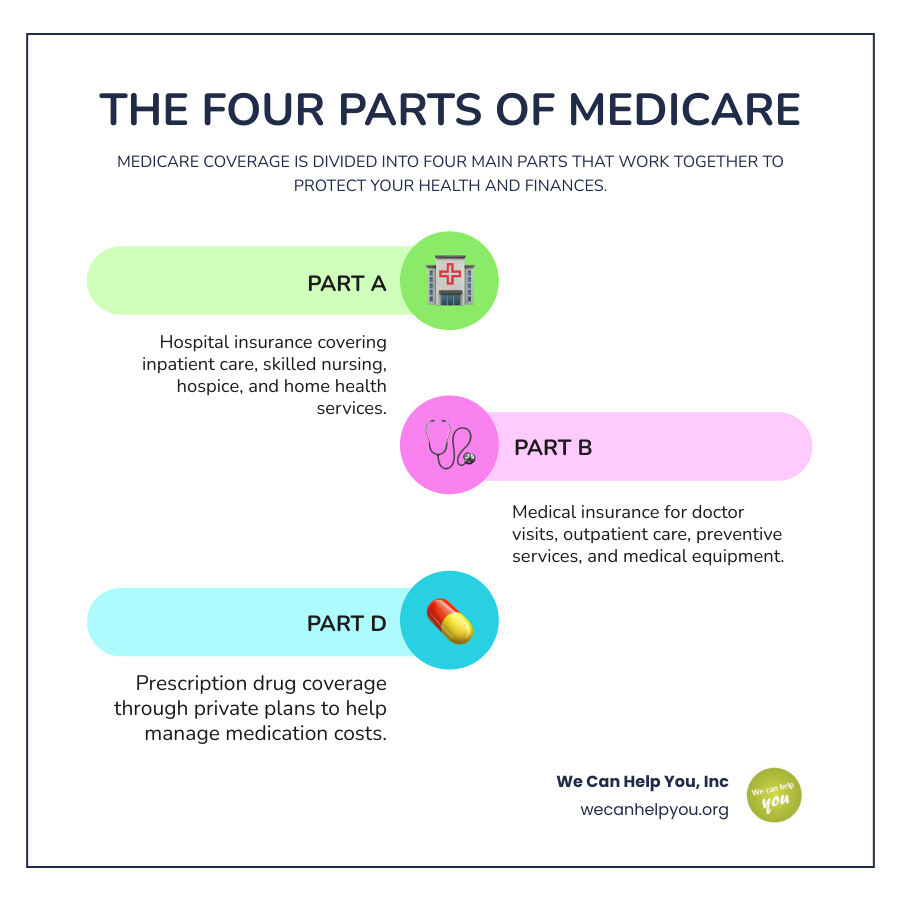
Here’s a quick overview of the four parts of Medicare:
| Medicare Part | Common Name | What It Covers |
|---|---|---|
| Part A | Hospital Insurance | Inpatient hospital care, skilled nursing, hospice, home health |
| Part B | Medical Insurance | Doctor visits, outpatient care, preventive services, medical equipment |
| Part C | Medicare Advantage | Bundles Part A + B (and usually Part D) through a private insurer |
| Part D | Drug Coverage | Prescription medications through private insurance plans |
Beyond the four parts, you’ll also choose how you receive your coverage — either through Original Medicare (government-managed) or Medicare Advantage (private plans). You may also want to add a Medigap policy to help cover what Original Medicare doesn’t pay.
The stakes are real. Choosing the wrong plan — or missing an enrollment deadline — can mean higher lifetime premiums, unexpected out-of-pocket costs, or gaps in coverage.
This guide breaks it all down clearly, so you can make confident decisions.
Easy Understand Medicare plans word list:
The Four Parts of Medicare Explained (A, B, C, and D)
To truly Understand Medicare plans, we first have to look at the building blocks. Medicare isn’t a “one size fits all” policy; it’s more like a menu where you can choose the items that best fit your health needs. These items are categorized into four distinct “Parts.”
Parts of Medicare are generally divided into hospital insurance, medical insurance, and prescription drug coverage. While the federal government manages the core components, private insurance companies play a massive role in delivering the “extra” options like Part C and Part D.
Key Benefits of Part A and Part B
Together, Part A and Part B are known as “Original Medicare.” This is the traditional fee-for-service program where the government pays providers directly for your care.
- Part A (Hospital Insurance): Think of this as your “room and board” coverage. It helps pay for inpatient care in hospitals, skilled nursing facility care (though usually only for a short time after a hospital stay), hospice care, and some limited home health care services. Most people don’t pay a monthly premium for Part A because they or their spouse paid Medicare taxes while working.
- Part B (Medical Insurance): This is for almost everything else. It covers doctor visits, outpatient services, lab tests, X-rays, and durable medical equipment like wheelchairs or walkers. Crucially, it also covers many preventive services, like flu shots and screenings, to keep you healthy.
For a deeper dive into these core services, our Medicare Guide offers a comprehensive look at what you can expect from the federal program.

How to Understand Medicare plans for Prescription Drugs
One of the most frequent questions we hear at We Can Help You, Inc. is about medicine. Original Medicare (Parts A and B) generally does not cover most prescription drugs you take at home. To get that coverage, you need Medicare Part D.
Part D plans are run by private insurance companies approved by Medicare. Each plan has a “formulary,” which is just a fancy word for a list of covered drugs. These drugs are placed into “tiers”—lower tiers usually cost less (like generics), while higher tiers cost more (like brand-name or specialty drugs).
If you want to master the details, check out The Complete Guide to Medicare Prescription Plans.
Big News for 2026: Thanks to recent legislation, there is a major financial win for seniors. Starting in 2025, and continuing into 2026, there is a hard cap on what you pay out-of-pocket for prescriptions. In 2026, your out-of-pocket costs for covered drugs are capped at $2,100. Once you hit that limit, you pay $0 for your covered drugs for the rest of the year. This is a massive relief for those managing chronic conditions!
How to Understand Medicare plans: Original Medicare vs. Medicare Advantage
Once you understand the parts, you have to decide on the “delivery method.” You have two main paths:
- Original Medicare: You get Part A and Part B from the federal government. You can see any doctor or hospital in the U.S. that accepts Medicare. To get drug coverage, you add a standalone Part D plan. To cover the “gaps” (like the 20% coinsurance you usually owe), you can buy a Medigap policy.
- Medicare Advantage (Part C): This is an “all-in-one” alternative. Private companies bundle Part A, Part B, and usually Part D into one plan. These plans often have lower premiums but require you to use a specific network of doctors and may require referrals to see specialists.
You can Compare Original Medicare & Medicare Advantage | Medicare to see which fits your lifestyle. If you travel frequently within the U.S., Original Medicare’s flexibility might be best. If you prefer a predictable monthly budget and “extra” perks, Medicare Advantage might be the winner.
For a side-by-side breakdown, we’ve created a resource on Medicare Advantage vs Medigap to help you weigh the pros and cons.
| Feature | Original Medicare | Medicare Advantage (Part C) |
|---|---|---|
| Doctor Choice | Any provider that accepts Medicare (nationwide) | Usually restricted to a network (HMO or PPO) |
| Costs | 20% coinsurance (no yearly limit) | Copays/Coinsurance (with yearly out-of-pocket limit) |
| Prescription Drugs | Need to buy a separate Part D plan | Usually included in the plan |
| Extra Benefits | Generally none (no dental/vision) | Often includes dental, vision, hearing, and fitness |
| Referrals | No referrals needed | Often required for specialists (in HMOs) |
Supplemental Coverage with Medigap
If you choose Original Medicare, you’ll quickly realize it doesn’t pay for everything. You are typically responsible for a $1,632 deductible (in 2024) for hospital stays and 20% of the cost for doctor visits.
Medigap (Medicare Supplement Insurance) is extra insurance you buy from a private company to pay those “gaps.” These plans are standardized by letters. For example, Plan G and Plan N are very popular in 2026. While the premium might be higher than a Medicare Advantage plan, you’ll have almost no out-of-pocket costs when you go to the doctor.
Learn more about this choice in our article Understanding the Differences Between Medigap and Medicare Advantage.
Extra Benefits in Medicare Advantage
Why do so many people choose Part C? The “extras.” Because Medicare Advantage plans are run by private companies competing for your business, they often include benefits that Original Medicare simply doesn’t cover. This includes:
- Vision Care: Exams, frames, and contacts.
- Dental Services: Cleanings, X-rays, and sometimes even dentures or crowns.
- Hearing Aids: Coverage for exams and the devices themselves.
- Fitness Programs: Many plans include “SilverSneakers” or similar gym memberships.
If these perks sound appealing, read Everything You Need to Know About Medicare Advantage Plans to see if a bundled plan is right for you.
Medicare Costs, Premiums, and 2026 Financial Updates
Budgeting for healthcare is a major part of retirement planning. Even though Medicare is a government program, it isn’t free.

- Part B Premium: For most people in 2024/2025, the standard monthly premium has hovered around $174.70. This is usually deducted directly from your Social Security check.
- Part A Deductible: If you are admitted to the hospital, you’ll pay a deductible of $1,632 (based on 2024 figures) per benefit period.
- IRMAA: If you are a higher-income earner, you might have to pay an extra amount called the Income Related Monthly Adjustment Amount (IRMAA) for your Part B and Part D premiums.
For a full breakdown of what you might owe, see The Ultimate Guide to Medicare Premiums.
Understanding the 2026 Prescription Drug Cap
We cannot stress enough how important the 2026 changes are for your wallet. Under the Inflation Reduction Act, the “donut hole” or coverage gap in Part D has been eliminated.
In 2026, the maximum out-of-pocket limit for covered drugs is $2,100. This means once you spend $2,100 on your medications (including the deductible), you have reached the “catastrophic coverage” phase, and your plan pays 100% for the rest of the year. This provides incredible peace of mind for seniors who rely on expensive maintenance medications.
Out-of-Pocket Maximums in Part C
Unlike Original Medicare, which has no limit on how much you could spend in a year, all Medicare Advantage plans have a mandatory yearly out-of-pocket maximum.
Once you reach this limit on covered Part A and Part B services, the plan pays 100% for the remainder of the year. This acts as a financial safety net, protecting you from bankruptcy in the event of a serious illness. However, it’s important to weigh this against the network restrictions, which we discuss in Medicare Advantage: Your Guide to Benefits and Drawbacks.
When and How to Enroll in Your Chosen Plan
Timing is everything. If you don’t sign up when you’re supposed to, you could face penalties that stay with you for the rest of your life.
How does Medicare work? | Medicare provides the official timeline, but here is the “cheat sheet”:
- Initial Enrollment Period (IEP): This is your first chance to sign up. It’s a 7-month window that includes the three months before you turn 65, the month you turn 65, and the three months after.
- General Enrollment Period (GEP): If you missed your IEP, you can sign up between January 1 and March 31 each year, with coverage starting the following month.
- Special Enrollment Period (SEP): If you are still working and have insurance through an employer (or a spouse’s employer), you can often delay Part B without penalty. When that coverage ends, you get an SEP to sign up.
Avoiding Late Enrollment Penalties
We hate seeing seniors lose money to avoidable fees. There are two main penalties to watch out for:
- Part B Penalty: For every 12-month period you were eligible for Part B but didn’t have it (and didn’t have “creditable” employer coverage), your premium goes up by 10%. This penalty lasts forever.
- Part D Penalty: If you go 63 days or more without creditable drug coverage, you’ll pay a penalty added to your Part D premium.
To make sure you don’t fall into these traps, read our Medicare Planning Complete Guide.
Coordinating Medicare with Other Insurance
Medicare doesn’t always work alone. If you have other coverage, there are “coordination of benefits” rules that determine who pays first.
- Employer Coverage: If the company has 20 or more employees, the employer plan usually pays first.
- Retiree Coverage: Usually, Medicare pays first and the retiree plan pays second.
- Medicaid: For those with limited income, Medicaid can pay for Medicare premiums and out-of-pocket costs. These individuals are “dual eligible.”
- VA Benefits: VA and Medicare are separate. The VA doesn’t pay for care at non-VA facilities, so many veterans choose to enroll in Medicare Part B to have more options.
Frequently Asked Questions about Medicare Plans
What is the difference between Medicare and Medicaid?
Medicare is an insurance program primarily based on age (65+) or disability, regardless of income. Medicaid is an assistance program based on financial need. You can have both!
Can I switch from Medicare Advantage back to Original Medicare?
Yes, but there’s a catch. You can switch during the Medicare Advantage Open Enrollment Period (Jan 1 – March 31) or the Annual Enrollment Period (Oct 15 – Dec 7). However, you might not be able to buy a Medigap policy easily if you have pre-existing conditions, depending on your state’s laws and how long you’ve been in Medicare Advantage.
Does Medicare cover dental and vision care?
Original Medicare (Parts A and B) does not cover routine dental or vision care. However, many Medicare Advantage plans include these as extra benefits. If you stay with Original Medicare, you can buy separate private dental and vision insurance.
Conclusion
Understanding Medicare plans is the key to a secure and healthy retirement. Whether you choose the flexibility of Original Medicare with a Medigap supplement or the “all-in-one” convenience of Medicare Advantage, the best plan is the one that fits your specific health needs and budget.
At We Can Help You, Inc., we are dedicated to making this process simple. We operate across the country, from the busy streets of Chicago, IL, and Charlotte, NC, to the quiet communities of Concord, NH, and Santa Fe, NM. Our mission is to educate you so you can maximize your retirement income and minimize your healthcare stress.
Ready to take the next step?
- Download our free Medicare Planning Guide.
- Request a free Social Security maximization report to see how to increase your retirement income.
- Find Medicare insurance agents near me to get personalized help in your local area.
Don’t leave your health to chance. Let us help you navigate the 2026 Medicare landscape with confidence!