
Why Texas Retirees Are Choosing Medicare Advantage
Medicare Advantage Texas plans have become the coverage choice for more than half of the state’s 4.7 million Medicare beneficiaries. If you’re approaching 65 or already enrolled in Medicare, understanding how these plans work—and whether they’re right for you—could save you thousands of dollars and give you access to benefits Original Medicare doesn’t cover.
Quick Answer: What is Medicare Advantage in Texas?
Medicare Advantage (Part C) is a private insurance alternative to Original Medicare that:
- Combines hospital (Part A) and medical (Part B) coverage into one plan
- Includes prescription drug coverage (Part D) in most plans
- Adds extra benefits like dental, vision, hearing, and fitness programs
- Caps your annual out-of-pocket costs (Original Medicare has no limit)
- Requires you to use specific provider networks in most cases
- Costs $0 monthly premium for many plans (though you still pay Medicare Part B premiums)
More than 2.5 million Texans have chosen Medicare Advantage over Original Medicare as of 2024. These plans are available in all 254 Texas counties, offered by private insurers like UnitedHealthcare, Humana, and Aetna. While they must cover everything Original Medicare does, they work differently—with provider networks, prior authorization requirements, and plan rules that vary by county and insurer.
The choice between Original Medicare and Medicare Advantage isn’t simple. Original Medicare gives you freedom to see any doctor who accepts Medicare, while Medicare Advantage plans typically limit you to specific networks but offer lower out-of-pocket costs and extra benefits. For Texas retirees on fixed incomes, these differences can have a major impact on both your healthcare experience and your budget.
This guide walks you through how Medicare Advantage works in Texas, what plan types are available, how to compare options in your county, and what enrollment rules you need to know.
Understanding Medicare Advantage Texas
When we talk about Medicare Advantage, we are referring to Medicare Part C. These plans aren’t a separate “part” of the government program in the way Part A and Part B are; instead, they are a different way to receive your Medicare benefits. In Texas, private insurance companies contract with Medicare to provide your hospital and medical coverage.
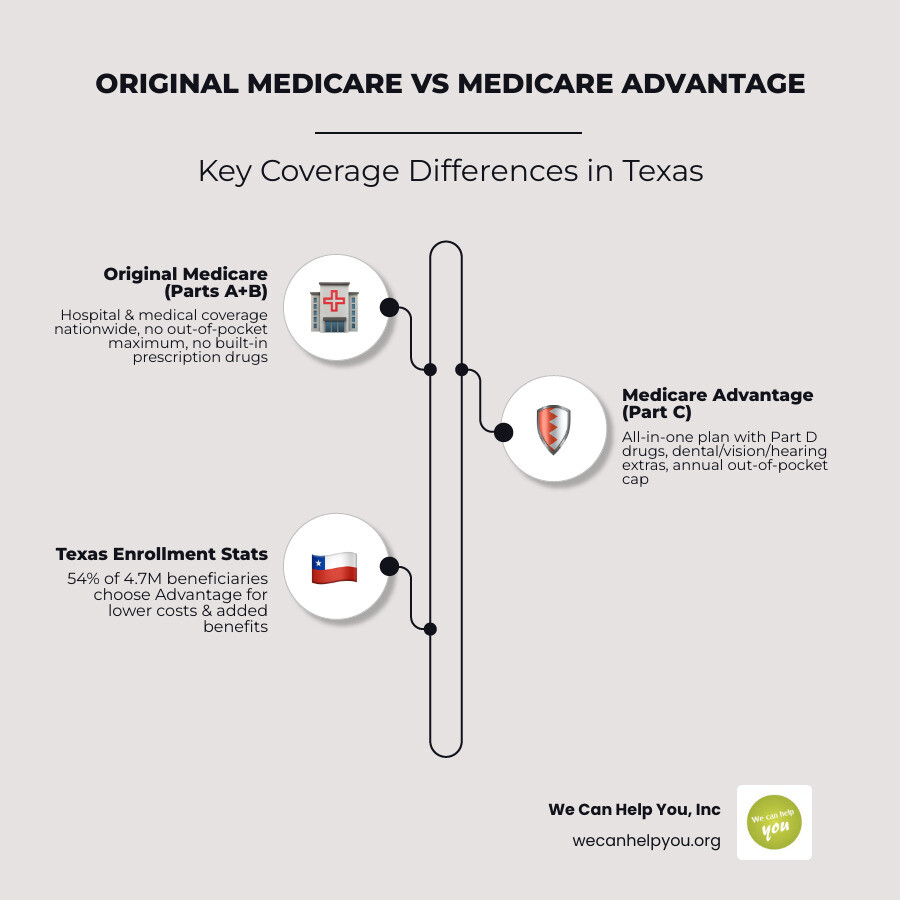
As of September 2024, over 4.7 million people in Texas are enrolled in Medicare, and a whopping 54% of them have opted for a Medicare Advantage Texas plan. This means more than half of your neighbors have decided that the “all-in-one” approach suits their lifestyle better than the traditional government-run route.
One of the most important things we tell our readers is that while these plans are private, they must follow rules set by Medicare. They are required to cover everything that Original Medicare covers. However, they often go much further. To get a deeper look at the trade-offs, you might want to check out our Medicare Advantage: Your Guide to Benefits and Drawbacks.

How Part C Differs from Original Medicare
The biggest difference lies in who manages your care. With Original Medicare, the federal government is your insurer. You can go to any doctor or hospital in the United States that accepts Medicare (which is most of them).
With Medicare Advantage Texas plans, a private company like Aetna or UnitedHealthcare manages your care. This introduces a few key changes:
- Out-of-Pocket Limits: Original Medicare has no “ceiling.” If you have a catastrophic health event, your 20% coinsurance could theoretically go on forever. Medicare Advantage plans have a mandatory annual out-of-pocket maximum. Once you hit that limit, the plan pays 100% for covered services for the rest of the year.
- Provider Networks: Most Advantage plans use networks (HMOs or PPOs). You may need to see doctors within a specific group to get the lowest rates.
- Part B Givebacks: Some plans in Texas offer Medicare Part B Giveback Offers, where the plan pays a portion of your monthly Part B premium for you.
Integrated Prescription Drug Coverage (Part D)
In Texas, more than 2 million residents have their prescription drug coverage integrated directly into their Medicare Advantage plan. These are known as MA-PD plans. This is incredibly convenient because you only have one insurance card for your doctor visits, hospital stays, and trips to the pharmacy.
It’s important to review the “formulary”—which is just a fancy word for the list of drugs the plan covers. Thanks to recent Inflation Reduction Act changes, out-of-pocket costs for insulin are capped at $35 per month, and starting in 2025, there is a $2,000 cap on total out-of-pocket drug costs. This is a huge win for Texans managing chronic conditions.
Types of Medicare Advantage Plans in Texas
Not all Medicare Advantage Texas plans are created equal. Depending on where you live—whether it’s Houston, Dallas, or a smaller town like Amarillo—you’ll see several different structures. You can explore the different types in our Category Medicare Advantage Part C Plan section, but here is the breakdown:
| Feature | HMO (Health Maintenance Org) | PPO (Preferred Provider Org) |
|---|---|---|
| Primary Care Physician (PCP) | Usually Required | Not Required |
| Referrals Needed? | Yes, usually | No |
| Out-of-Network Coverage? | Emergencies only | Yes, but at a higher cost |
| Monthly Premium | Often $0 | May have a small premium |
HMO and PPO Medicare Advantage Texas Options
If you choose an HMO (Health Maintenance Organization), you’ll generally need to pick a Primary Care Physician who acts as your “quarterback.” If you need to see a specialist, you’ll likely need a referral. These plans are often the most affordable, with many $0 premium options available across Texas.
PPOs (Preferred Provider Organizations) offer more flexibility. You don’t need a referral to see a specialist, and you can see doctors outside the network, though you’ll pay more for the privilege. For many Texans who travel or want access to specific specialists in cities like Austin or San Antonio, the UnitedHealthcare National Network info can be a great resource to see how PPO networks span across state lines.
Special Considerations for Dual-Eligible Texans
For those who qualify for both Medicare and Medicaid, Texas offers Dual-Eligible Special Needs Plans (D-SNPs). These plans coordinate benefits between the two programs, often resulting in $0 costs for most medical services and prescriptions. We recommend looking at the Texas Medicare financial assistance guide to see if you qualify for extra help with premiums or long-term care.
Top-Rated Plans and Extra Benefits
One of the most attractive parts of Medicare Advantage Texas is the “extra” stuff. Original Medicare doesn’t cover routine dental, vision, or hearing care. Most Texas Advantage plans do.
We often get asked, How Can Medicare Advantage Part C Plans Be 0 Premium? It’s not magic—the federal government pays the private insurance company a set fee to take over your care. If the company manages care efficiently, they can offer you these $0 premiums and extra perks.
Evaluating Medicare Advantage Texas Star Ratings
The Centers for Medicare & Medicaid Services (CMS) uses a 5-star rating system to help you judge plan quality. Ratings are based on member experience, customer service, and how well the plan manages chronic conditions.
In 2025, there are 29 Medicare Advantage plans listed for Texas, many of which boast 4.5 or even 5-star ratings. For example, Baylor Scott & White Health Plan offers several HMO-POS plans with 4.5 stars in counties like Bell, Williamson, and Dallas. You can Explore your Medicare coverage options on the official Medicare site to see the specific ratings for plans in your ZIP code.
Fitness and Wellness Programs
Staying active is key to a happy retirement. Many Texas plans include the SilverSneakers program, which provides no-cost gym memberships at thousands of locations. Whether you prefer a traditional gym in El Paso or a yoga class in Corpus Christi, you can use the SilverSneakers class search to find a spot near you. Some plans even offer a 24-hour nurse line for those “is this normal?” health questions that pop up at 2:00 AM.
Enrollment and Eligibility for Texans
To join a Medicare Advantage Texas plan, you must:
- Be enrolled in Medicare Part A and Part B.
- Live in the plan’s service area (usually defined by your county).
You are eligible at age 65, or earlier if you have a qualifying disability, End-Stage Renal Disease (ESRD), or ALS. If you’re feeling overwhelmed, you can find Medicare Insurance Agents Near Me TX to help steer the local landscape.
Key Enrollment Periods in Texas
Timing is everything in Medicare. If you miss a window, you might have to wait another year or pay a penalty.
- Initial Enrollment Period (IEP): The 7-month window around your 65th birthday.
- Annual Enrollment Period (AEP): October 15 to December 7. This is when you can join, switch, or drop a Medicare Advantage plan for the following year.
- Medicare Advantage Open Enrollment Period (OEP): January 1 to March 31. If you’re already in an Advantage plan, you can switch to a different one or go back to Original Medicare during this time.
- Special Enrollment Periods (SEP): These are triggered by life events, like moving to a new house in a different Texas county or losing employer coverage.
State-Specific Protections and Retiree Plans
Texas has some unique features. For instance, the HealthSelect Medicare Advantage PPO is a specific plan for retirees of Texas state agencies and higher education institutions. It’s insured by UnitedHealthcare and offers $0 deductibles and the freedom to see any provider who accepts Medicare. You can use the HealthSelect MAPPO provider search to see if your doctor is on the list.
Additionally, while federal law doesn’t guarantee Medigap (Medicare Supplement) access for those under 65, Texas Department of Insurance resources note that Texas law requires Medigap insurers to offer at least Plan A to disabled beneficiaries under age 65.
Frequently Asked Questions about Texas Medicare Advantage
What happens if I move out of my plan’s service area?
If you move to a new county or state, you will likely need to switch plans because Medicare Advantage plans are based on local networks. This move qualifies you for a Special Enrollment Period, giving you a window to choose a new plan in your new area without penalty.
Can I have both a Medicare Advantage plan and a Medigap policy?
No. In fact, it is illegal for someone to sell you a Medigap policy if they know you have a Medicare Advantage plan. Medigap is designed to supplement Original Medicare. If you have Medicare Advantage, your “gaps” are already covered by the plan’s out-of-pocket maximum.
How do I find plans available in my specific Texas ZIP code?
The easiest way is to use the Medicare.gov Plan Finder or visit a provider site like UHC.com/medicare and enter your ZIP code. Because plans vary by county, a plan available in Dallas might not be available in Tarrant County.
Conclusion
Navigating Medicare Advantage Texas doesn’t have to be a solo journey. With over half of the state’s seniors choosing these plans, the benefits of $0 premiums, capped out-of-pocket costs, and extra dental and vision coverage are clear. However, the “best” plan is always the one that includes your specific doctors and your specific medications.
At We Can Help You, Inc., we are dedicated to educating you on how to maximize your retirement. We offer a free Medicare Planning Guide and a free Social Security maximization report to help you increase your retirement income and ensure you aren’t leaving money on the table. Whether you are in Houston, San Antonio, or right here in Austin, our goal is to provide the clarity you need to retire with confidence.
Ready to take the next step? Find Medicare Insurance Agents Near Me TX to get personalized help today.