
What You Need to Know About a Medicare Prescription Plan
A medicare prescription plan — officially called Medicare Part D — is optional drug coverage that helps pay for brand-name and generic medications. It’s offered by private insurance companies approved by Medicare, and it’s available to anyone enrolled in Medicare Part A and/or Part B.
Here’s a quick overview of what you need to know:
| Topic | Key Facts |
|---|---|
| What it is | Optional prescription drug coverage (Part D) through approved private insurers |
| Who qualifies | Anyone with Medicare Part A and/or Part B |
| How to get it | Join a standalone drug plan (PDP) or a Medicare Advantage plan with drug coverage (MA-PD) |
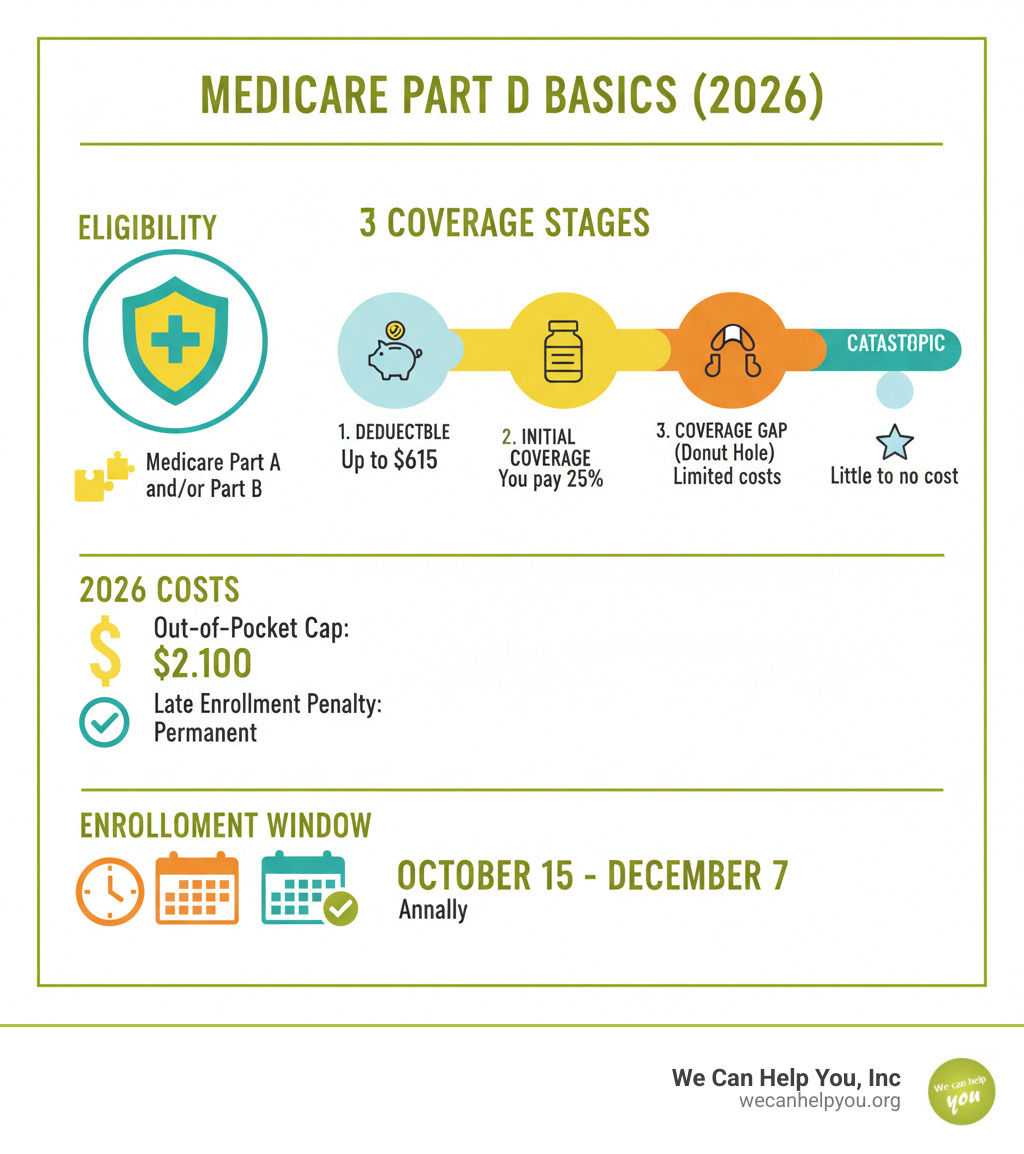
| Annual costs (2026) | Deductible up to $615; out-of-pocket cap of $2,100 |
| Open Enrollment | October 15 – December 7 each year |
| Late penalty risk | Yes — skipping coverage can mean a permanent monthly penalty |
If you’re approaching Medicare eligibility or already enrolled, understanding Part D is one of the most important financial decisions you’ll make. The costs, rules, and deadlines are easy to get wrong — and mistakes can follow you for years.
The good news: once you understand how the pieces fit together, the right plan is very findable.
This guide walks you through everything — from how coverage works and what it costs, to how to avoid penalties and find the best plan for your specific medications.
What is a Medicare Prescription Plan (Part D)?
When Medicare was first created in 1965, it didn’t include much in the way of outpatient drug coverage. For decades, seniors were on their own at the pharmacy counter. That changed in 2006 with the birth of Part D.
A medicare prescription plan is a form of private insurance. While the federal government sets the rules, you actually buy the plan from companies like UnitedHealthcare, Humana, or Aetna. These plans help cover the costs of brand-name and generic drugs, which can otherwise be astronomical.

Every plan has a formulary, which is just a fancy word for its list of covered drugs. These drugs are organized into tiers. Generally, Tier 1 and 2 include low-cost generics, while Tiers 4 and 5 are reserved for “specialty” drugs that might cost thousands of dollars. Before you sign up, we always recommend checking that your specific medications are on the plan’s formulary and seeing which tier they fall into.
Eligibility for a Medicare Prescription Plan
To get a medicare prescription plan, the rules are fairly straightforward:
- You must be entitled to Medicare Part A and/or enrolled in Medicare Part B.
- You must live in the service area of the plan you want to join. Whether you’re in a big city like Chicago, IL, or a smaller town like Beatrice, NE, your plan options are based on your home ZIP code.
- You must be a U.S. citizen or lawfully present in the United States.
It’s important to note that you don’t get drug coverage automatically. You have to actively choose to join a plan. If you don’t, you might face a late enrollment penalty later (more on that in a bit).
What Drugs are Covered and Excluded?
Medicare requires all Part D plans to cover a broad range of drugs. In fact, they must cover all drugs in six “protected classes”:
- Anticonvulsants
- Antidepressants
- Antineoplastics (cancer drugs)
- Antipsychotics
- Antiretrovirals (HIV/AIDS drugs)
- Immunosuppressants
Beyond these, plans must cover at least two drugs in every other therapeutic category. There are also some great perks thanks to recent laws. For instance, there is a $35 maximum cost for a one-month supply of covered insulin prescriptions. Additionally, most adult vaccines (like the shingles shot) are now $0 out-of-pocket for Part D members.
However, some things are almost always excluded by law. You generally won’t find coverage for:
- Weight loss or weight gain drugs
- Fertility medications
- Drugs used for cosmetic purposes or hair growth
- Over-the-counter (OTC) medications (like Advil or vitamins)
- Drugs for erectile dysfunction
For a deeper dive into the basics, you can check out What’s Medicare Drug Coverage (Part D)?.
Understanding the Costs and Coverage Stages of Your Medicare Prescription Plan
When it comes to your medicare prescription plan, the price tag isn’t just the monthly premium. You also have to think about deductibles, copays (a flat dollar amount), and coinsurance (a percentage of the cost).
If you have a high income, you might also have to pay an IRMAA (Income Related Monthly Adjustment Amount). This is an extra fee added to your premium if your modified adjusted gross income from two years ago was above a certain threshold. For 2025 and 2026, these adjustments are a significant part of the cost conversation. You can read more about how recent laws have shifted these numbers in our guide on the Inflation Reduction Act Impact on Medicare Part D for 2025.
The Three Stages of Coverage
Medicare Part D used to be famous for the “donut hole” (the coverage gap), but recent legislation has simplified things significantly. For 2025 and 2026, you will move through three distinct stages:
- Annual Deductible Stage: You pay 100% of your drug costs until you reach the deductible set by your plan. In 2026, the maximum allowed deductible is $615. Some plans have a $0 deductible, meaning they start paying right away.
- Initial Coverage Stage: Once the deductible is met, you and the plan share the costs. You’ll usually pay a copay or coinsurance. This stage lasts until your total out-of-pocket spending reaches the annual cap.
- Catastrophic Coverage Stage: Once you hit the out-of-pocket spending limit, you enter this stage. In 2025 and 2026, your cost-share in this stage is $0 for all covered drugs for the rest of the year.
Comparison of Coverage Stages
| Feature | 2025 | 2026 |
|---|---|---|
| Max Annual Deductible | $590 | $615 |
| Out-of-Pocket Cap | $2,000 | $2,100 |
| Catastrophic Stage Cost | $0 | $0 |
The 2025 and 2026 Out-of-Pocket Spending Caps
The biggest win for seniors in recent years is the hard cap on out-of-pocket spending. In 2025, the limit is $2,000. In 2026, it increases slightly to $2,100.
Once you spend that amount on covered drugs (known as your True Out-of-Pocket or TrOOP costs), you are done paying for the year. This provides incredible peace of mind for people taking expensive specialty medications. To understand how this cap is tracked, take a look at our article on Understanding the Medicare Prescription Payment Plan.
The Medicare Prescription Payment Plan
Starting in 2025, there is a new way to pay your pharmacy bills. Instead of paying a large amount all at once at the pharmacy counter (say, $500 for a single refill), you can “opt-in” to the Medicare Prescription Payment Plan.
This program allows you to spread your out-of-pocket costs over the course of the year through monthly billing from your insurance provider. It doesn’t reduce the total amount you owe, but it makes your monthly budget much more predictable. All Part D plans are required to offer this. For a step-by-step on how to sign up, see our Medicare Prescription Payment Plan Guide 2026.
Enrollment Periods and the Late Enrollment Penalty
Timing is everything with Medicare. If you miss your window, it can cost you—literally.
There are three main times you can sign up for a medicare prescription plan:
- Initial Enrollment Period (IEP): This is the 7-month window around your 65th birthday (3 months before, the month of, and 3 months after).
- Annual Open Enrollment Period (AEP): Every year from October 15 to December 7, you can join, switch, or drop a plan. Your new coverage starts January 1.
- Special Enrollment Periods (SEP): If you have a major life change—like moving from Newark, NJ, to Phoenix, AZ, or losing employer coverage—you usually get a 63-day window to find a new plan.
You can find more technical details on these windows at Medicare Prescription Drug Eligibility and Enrollment.
Avoiding the Part D Late Enrollment Penalty
If you go 63 days or more without “creditable” drug coverage (coverage as good as Medicare’s) after your Initial Enrollment Period ends, you’ll likely face a late enrollment penalty.
The penalty is calculated as 1% of the “national base beneficiary premium” for every full month you were eligible but didn’t have coverage. For 2026, that base premium is $38.99.
Example: If you wait 24 months to join a plan, your penalty would be 24% of $38.99, which is about $9.40. This amount is added to your monthly premium permanently. To avoid this, we always suggest joining a low-cost plan even if you don’t currently take any medications. It’s like an insurance policy against future penalties.
How to Choose the Right Medicare Prescription Plan for Your Needs
With dozens of plans available in states like Florida, Texas, and North Carolina, how do you pick just one? We recommend a few key steps.
First, use the Medicare Plan Finder tool. You can enter your specific medications and your preferred pharmacy to see which plan offers the lowest total annual cost (premium + drug costs). Don’t just look at the premium; a “cheap” $5 monthly plan might end up costing you more if it puts your most important medication in a high-cost tier.
Second, check the Star Ratings. Medicare rates plans from 1 to 5 stars based on quality and customer service. A 5-star plan is considered excellent.
Third, look at the pharmacy network. Many plans have “preferred” pharmacies where your copays are lower. If you prefer getting your meds delivered, check if the plan offers mail-order savings—often you can get a 90-day supply for the price of a 60-day supply. You can start your search here: Explore your Medicare coverage options.
Coordinating with Other Coverage
If you have other types of insurance, you need to know how they play with Part D:
- Employer/Union Plans: Check if the coverage is “creditable.” Your employer is required to send you a notice every year telling you if it is.
- VA Benefits: VA drug coverage is excellent and considered creditable. Many veterans choose not to enroll in Part D, though some join a plan so they can use local non-VA pharmacies.
- TRICARE: This is also creditable coverage. Usually, you don’t need Part D if you have TRICARE.
- Medigap: Modern Medigap (Medicare Supplement) plans do not include drug coverage. You’ll need a standalone PDP to go alongside your Medigap policy.
For more on how these costs interact, visit How much does Medicare drug coverage cost?.
Extra Help and Financial Assistance
If you have limited income and resources, you might qualify for Extra Help (also known as the Low-Income Subsidy or LIS). This program helps pay for your Part D premiums, deductibles, and copays.
In 2024 and 2025, the income and asset limits have expanded, meaning more people qualify than ever before. If you qualify, you won’t face a late enrollment penalty, and you can switch plans once per quarter during the first nine months of the year.
If you’re struggling to pay for medications right now, look into the LI NET program, which provides temporary immediate coverage while your Extra Help application is being processed. Learn more about these savings here: Unlock savings: How to get Extra Help with your Medicare prescriptions.
Frequently Asked Questions about Medicare Prescription Plans
Can I change my plan if my drugs are no longer covered?
Generally, you can only change plans during the Annual Open Enrollment (Oct 15 – Dec 7). However, if your plan makes a “maintenance change” to its formulary (like removing a drug), they must usually notify you 30 days in advance. If you find yourself without coverage for a vital medication, you can work with your doctor to request a formulary exception or file an appeal.
What is the maximum deductible for 2026?
The maximum deductible for any medicare prescription plan in 2026 is $615. That many plans waive the deductible for Tier 1 and Tier 2 drugs, so you might only have to pay it if you use brand-name or specialty medications.
Does Medigap include prescription drug coverage?
No. Since 2006, Medigap plans sold to new members are not allowed to include drug coverage. If you have Original Medicare and a Medigap policy, you must buy a standalone Part D plan (PDP) to have drug coverage.
Conclusion
Navigating Medicare can feel like trying to solve a puzzle where the pieces keep changing shape. But at We Can Help You, Inc., we believe that education is the ultimate tool for a secure retirement. Whether you are in New York, California, or right here in East Greenwich, RI, our mission is to simplify these complex choices so you can focus on enjoying your life.
We offer a free Medicare Planning Guide and a free Social Security maximization report to help you increase your retirement income and reduce your healthcare stress. Don’t leave your prescription costs to chance—take control of your coverage today.
For more resources and deep dives into specific plan details, visit our page for More info about Medicare Part D services. We are here to help you every step of the way!