
What Are Medicare Premiums in 2026? (Quick Answer)
Medicare premiums are the monthly costs you pay to keep your Medicare coverage active — and in 2026, those costs went up noticeably across the board.
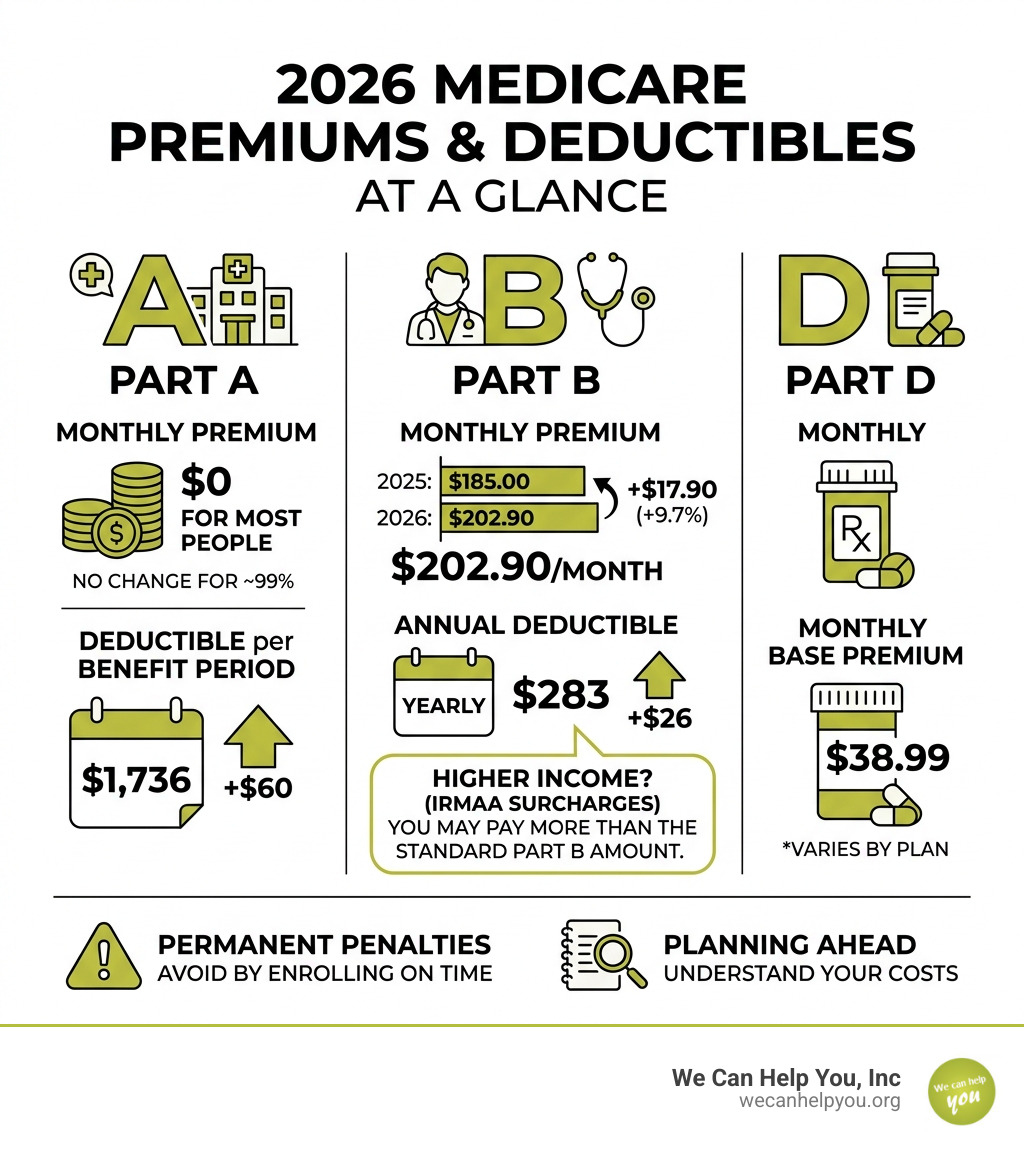
Here’s a fast look at the key numbers:
| Coverage | 2026 Cost | Change from 2025 |
|---|---|---|
| Part A premium | $0 for most people | No change for ~99% |
| Part A deductible | $1,736 per benefit period | +$60 |
| Part B premium | $202.90/month | +$17.90 (+9.7%) |
| Part B deductible | $283/year | +$26 |
| Part D base premium | $38.99/month | Varies by plan |
If your income is above $109,000 (individual) or $218,000 (joint), you’ll pay more than the standard Part B amount due to IRMAA surcharges — up to $689.90/month at the highest income tier.
If you’re approaching Medicare eligibility or already enrolled, understanding what you’ll pay each month matters a lot. The difference between enrolling on time and missing your window can mean a permanent premium penalty. And for higher-income retirees, the income-based surcharges can add hundreds of dollars to monthly costs.
This guide breaks down every Medicare premium and deductible for 2026 in plain language — so you can plan with confidence and avoid costly surprises.
Understanding 2026 Medicare Premiums and Deductibles

As we navigate through April 2026, many of us are feeling the pinch of the updated Medicare costs. The 2026 Medicare Parts A & B Premiums and Deductibles | CMS fact sheet recently confirmed that the standard monthly medicare premiums for Part B have risen to $202.90. This represents a 9.7% increase from the $185.00 we saw in 2025.
It isn’t just the premiums that have climbed. The Part B annual deductible—the amount you pay out-of-pocket before your insurance kicks in—is now $283.00, up $26 from last year. Meanwhile, Part A, which covers hospital stays, saw its inpatient deductible rise to $1,736 per benefit period.
To help you visualize these shifts, here is a quick comparison:
| Cost Category | 2025 Amount | 2026 Amount | Increase |
|---|---|---|---|
| Part B Standard Premium | $185.00 | $202.90 | $17.90 |
| Part B Annual Deductible | $257.00 | $283.00 | $26.00 |
| Part A Inpatient Deductible | $1,676.00 | $1,736.00 | $60.00 |
We know these numbers can look a bit daunting. However, understanding the “why” behind them—such as projected price changes and utilization trends—can help us prepare our retirement budgets more effectively. For a deeper dive into these changes, check out our Medicare Premiums 2026 Complete Guide.
Medicare Part A: Premium-Free vs. Paid Coverage
Most of us are accustomed to the idea of “premium-free” Part A. If you or your spouse worked and paid Medicare taxes for at least 10 years (40 quarters), your Part A premium is $0. According to official data, about 99% of beneficiaries fall into this category.
But what if you didn’t hit those 40 quarters? You can still get coverage, but you’ll have to pay a monthly fee:
- 30-39 quarters of work: You’ll pay a reduced premium of $311 per month in 2026 (up from $285 in 2025).
- Fewer than 30 quarters: You’ll pay the full premium of $565 per month (up from $518 in 2025).
If you find yourself in the “paid coverage” group, sign up when you are first eligible to avoid late enrollment penalties, which we will discuss later.
Hospital and Skilled Nursing Facility Coinsurance
Even if your Part A premium is $0, “free” doesn’t mean no costs. If you are hospitalized, you’ll encounter coinsurance amounts that kick in after a certain number of days. In 2026, these costs are:
- Days 1–60: $0 coinsurance after you’ve met your $1,736 deductible.
- Days 61–90: $434 per day.
- Days 91 and beyond (Lifetime Reserve Days): $868 per day (you get 60 of these over your lifetime).
For those requiring a Skilled Nursing Facility (SNF), the first 20 days are covered at $0 coinsurance. However, for days 21–100, you will pay $217 per day in 2026. If you’re wondering how these costs might affect your long-term planning, you might ask, Will My Medicare Premiums Rise In 2026? The answer is yes, and staying informed is your best defense.
How Income Affects Your Medicare Premiums (IRMAA)
While the standard Part B premium is $202.90, about 8% of beneficiaries pay more. This extra charge is known as the Income-Related Monthly Adjustment Amount (IRMAA).
The Social Security Administration (SSA) determines if you owe IRMAA by looking at your Modified Adjusted Gross Income (MAGI) from your tax return two years prior. This means for your 2026 medicare premiums, the government is looking at your 2024 tax year data.
If your income has dropped significantly since 2024 due to a life-changing event, don’t worry—you aren’t necessarily stuck with a high bill. We often help people explore Is It Possible To Reduce My Medicare Part B Premium by filing an appeal.
2026 Income Thresholds for Part B and Part D
The IRMAA brackets are based on your filing status. If you file as an individual and your MAGI was $109,000 or less, you pay the standard rate. If you file jointly and your income was $218,000 or less, you also pay the standard rate.
Once you cross those thresholds, the costs scale up quickly:
- Tier 1 ($109k–$137k individual / $218k–$274k joint): Total Part B premium is $284.10.
- Highest Tier (≥$500k individual / ≥$750k joint): Total Part B premium is $689.90.
Part D (prescription drug coverage) also has IRMAA surcharges. These range from an extra $14.50 to $91.00 per month on top of your plan’s base premium. For more tips on managing these costs, see Dont Miss Out The Secret To Lowering Your Medicare Part B Premium.
Life-Changing Events and IRMAA Appeals
The SSA recognizes that life happens. If your income decreased in 2025 or 2026 because of a specific “life-changing event,” you can use Form SSA-44 to request a new determination. Qualifying events include:
- Retirement or work reduction
- Marriage or divorce
- Death of a spouse
- Loss of income-producing property (due to disaster)
- Loss or reduction of pension income
We recommend being proactive. If you know your income is lower than it was two years ago, don’t wait for the bill to arrive. You can find more details on Paying For Medicare Premiums and how to navigate these administrative hurdles.
Costs for Medicare Advantage, Part D, and Medigap
While Original Medicare (Parts A and B) has set rates, other parts of Medicare are offered through private insurance companies. This means costs can vary wildly depending on where you live—whether you’re in Charlotte, NC, Las Vegas, NV, or Chicago, IL.
- Medicare Advantage (Part C): Many of these plans have $0 premiums, but you must continue to pay your Part B premium. These plans are popular because they include out-of-pocket limits, something Original Medicare lacks.
- Part D (Prescription Drugs): The national base premium for 2026 is $38.99. This number is used to calculate late enrollment penalties and IRMAA, but your actual plan premium will depend on the specific drug list (formulary) you choose.
- Medigap (Medicare Supplement): These plans help pay for the “gaps” in Original Medicare (like that $1,736 Part A deductible). Premiums vary based on the plan letter (like Plan G or N) and your age and location.
As you look ahead, it’s wise to Prepare For Tomorrow What To Expect For 2027 Medicare Costs to ensure your savings last through your golden years.
Avoiding Late Enrollment Penalties and Finding Financial Help
One of the biggest mistakes we see is missing enrollment deadlines. Medicare is a “pay now or pay (more) later” system.
- Part B Penalty: If you don’t sign up for Part B when you’re first eligible (and don’t have “creditable” coverage from an employer), your premium will increase by 10% for each full 12-month period you waited. This is a permanent surcharge that stays with you for life.
- Part D Penalty: This is calculated as 1% of the national base premium ($38.99) for every month you went without creditable drug coverage.
If you are currently working in a city like Omaha, NE or Phoenix, AZ, make sure your employer coverage is considered “creditable” by Medicare standards before you decide to skip Part B or Part D.
Assistance Programs for Low-Income Beneficiaries
We want everyone to know that help is available if medicare premiums are a financial hardship.
- Medicare Savings Programs (MSP): State-run programs that can help pay Part A and Part B premiums, deductibles, and coinsurance.
- Extra Help: A federal program that helps with the costs of Medicare prescription drug plans.
- Medicaid: For those with very limited income, being “dual-eligible” for both Medicare and Medicaid can eliminate almost all out-of-pocket healthcare costs.
Resources like the Medicare Savings Program – CT.gov or Help with Paying Medicare Costs Only in Arizona provide excellent starting points for seeing if you qualify for state-specific aid.
Frequently Asked Questions about Medicare Premiums
Who qualifies for premium-free Part A in 2026?
Most people qualify for premium-free Part A because they (or their spouse) paid Medicare taxes for at least 40 quarters (10 years) of Medicare-covered employment. If you are a resident in any of our service areas, from Albany, NY to Albuquerque, NM, the rules are the same. You can learn more about these requirements at our Tag/Medicare Part B Premium page.
How is the Part B late enrollment penalty calculated?
The penalty is 10% of the standard premium for every full 12-month period you were eligible but didn’t enroll. For 2026, with a premium of $202.90, a one-year penalty would add roughly $20.29 to your monthly bill forever. This is why we emphasize the importance of the initial enrollment period. For more details on avoiding these traps, visit Tag/Part B Premium.
Which tax year is used for 2026 IRMAA?
The SSA uses your 2024 Modified Adjusted Gross Income (MAGI) to determine your 2026 premiums. They use a two-year lookback because 2024 is the most recent year for which the IRS has complete, verified data. You can find more about the specific 2026 brackets at Tag/2026 Medicare Part B Premiums.
Conclusion
Navigating medicare premiums doesn’t have to be a solo journey. Between the rising standard costs of Part B and the complexities of IRMAA surcharges, having a solid plan is the best way to ensure financial security in retirement.
At We Can Help You, Inc., we are dedicated to educating you on every facet of Medicare and Social Security. Whether you are in Manchester, NH, Raleigh, NC, or Columbus, NE, our mission is to provide you with the tools to maximize your retirement income.
Don’t leave your healthcare costs to chance. Get your free Medicare Planning Guide today and let us help you build a strategy that fits your life and your budget.