
Is the Medicare Give Back Benefit Real — and Can You Get It?
The medicare give back benefit is a real, federally-allowed program where certain Medicare Advantage plans pay part — or even all — of your monthly Medicare Part B premium back to you.
Here’s the quick version:
- What it is: A monthly reduction on your Part B premium, offered by select Medicare Advantage (Part C) plans
- Who qualifies: Anyone enrolled in Medicare Parts A and B who pays their own Part B premium and lives in a plan’s service area
- How much: Anywhere from a few dollars to the full $202.90/month (2026 standard premium)
- How you get it: Your Social Security check goes up, or your direct Medicare bill goes down
- Income limits: None — this is not means-tested
Every year during Medicare Open Enrollment, TV commercials promise to “put money back in your pocket.” For many people nearing retirement, it sounds too good to be true. But it isn’t.
The catch? Not everyone can get it. Availability depends almost entirely on where you live and which plans operate in your zip code — not your income, savings, or health status.
In 2025, about 1 in 3 Medicare Advantage plans offered some form of this benefit. For 2026, that number has shifted to roughly 1 in 4 plans nationwide — but the amounts and availability vary enormously from one county to the next.
This guide will walk you through everything you need to know: what the benefit is, whether you qualify, how to find it, and — critically — whether chasing the biggest giveback is actually the smartest move for your retirement healthcare.
What is the Medicare Give Back Benefit?

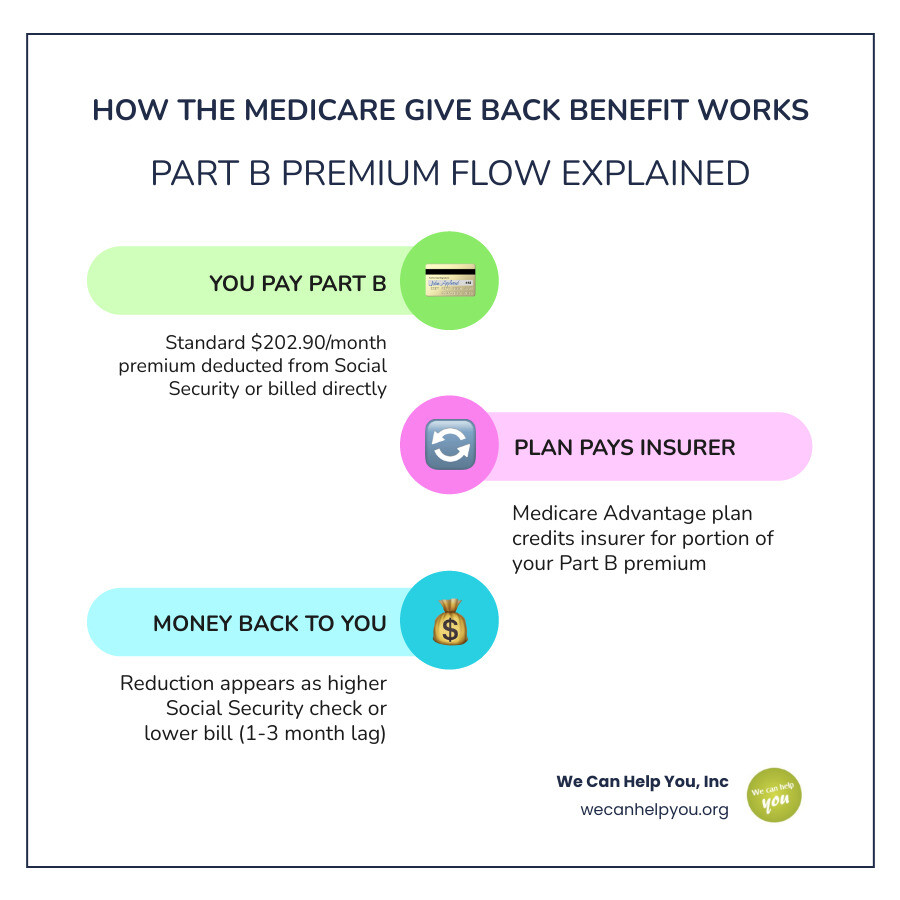
The medicare give back benefit, technically known as the Part B Premium Reduction, is a feature offered by some Medicare Advantage (Part C) plans. Under this program, the private insurance company providing your Medicare coverage agrees to pay a portion of your Part B monthly premium on your behalf.
While Original Medicare is managed by the federal government, Medicare Advantage plans are run by private insurers. These companies receive a set amount of money from the Centers for Medicare & Medicaid Services (CMS) to manage your care. If a plan can provide that care for less than the government’s benchmark, they can use the “rebate” money to offer extra perks—like vision, dental, or the coveted Part B giveback.
It is important to understand that this is not a cash payment or a gift card sent in the mail. Instead, it is a credit applied to your Medicare account. For more foundational details, you can explore our Medicare Part B Giveback: Complete Guide.
According to research on Understanding the Medicare Part B Giveback Benefit, these plans have become a competitive tool for insurers looking to attract new members, especially in “hot spot” states like Florida, North Carolina, and Illinois.
How the Medicare Give Back Benefit Works
The mechanics of the giveback involve a complex “bid” process. Every year, Medicare Advantage plans submit bids to the government stating what it will cost them to provide Part A and Part B services. When a plan bids below the CMS benchmark, they receive a rebate.
We often explain to our students that insurers use these rebates in three ways:
- To offer lower copays or deductibles.
- To provide extra benefits (like a $150 eyewear allowance or $0 gym memberships).
- To pay for your Part B premium.
If you choose a plan with a giveback, the insurer notifies the Social Security Administration (SSA). The SSA then adjusts your monthly deduction. If you are interested in the financial mechanics, check out Don’t Miss Out: The Secret to Lowering Your Medicare Part B Premium or browse our Medicare Part B Giveback archive.
Who Qualifies for the Medicare Give Back Benefit?
Qualification is simpler than many people realize, but there are strict “must-haves” to participate. To be eligible, you must:
- Be enrolled in both Medicare Part A and Part B.
- Pay your own Part B premium. If you are “dual-eligible” (meaning Medicaid pays your premium) or if you are enrolled in a Medicare Savings Program (MSP), you cannot receive the giveback because you aren’t the one paying the premium in the first place.
- Reside in the plan’s service area. This is the biggest hurdle. A plan might offer a $100 giveback in Chicago, IL, but that same company might offer $0 in nearby Naperville or Aurora.
- Be a U.S. citizen or a lawfully present resident for at least five years.
If you’re wondering, “Do I fit the bill?” our guide Do You Qualify for the Medicare Giveback? Let’s Find Out! provides a deeper dive into these requirements.
Eligibility and Geographic Availability in 2026
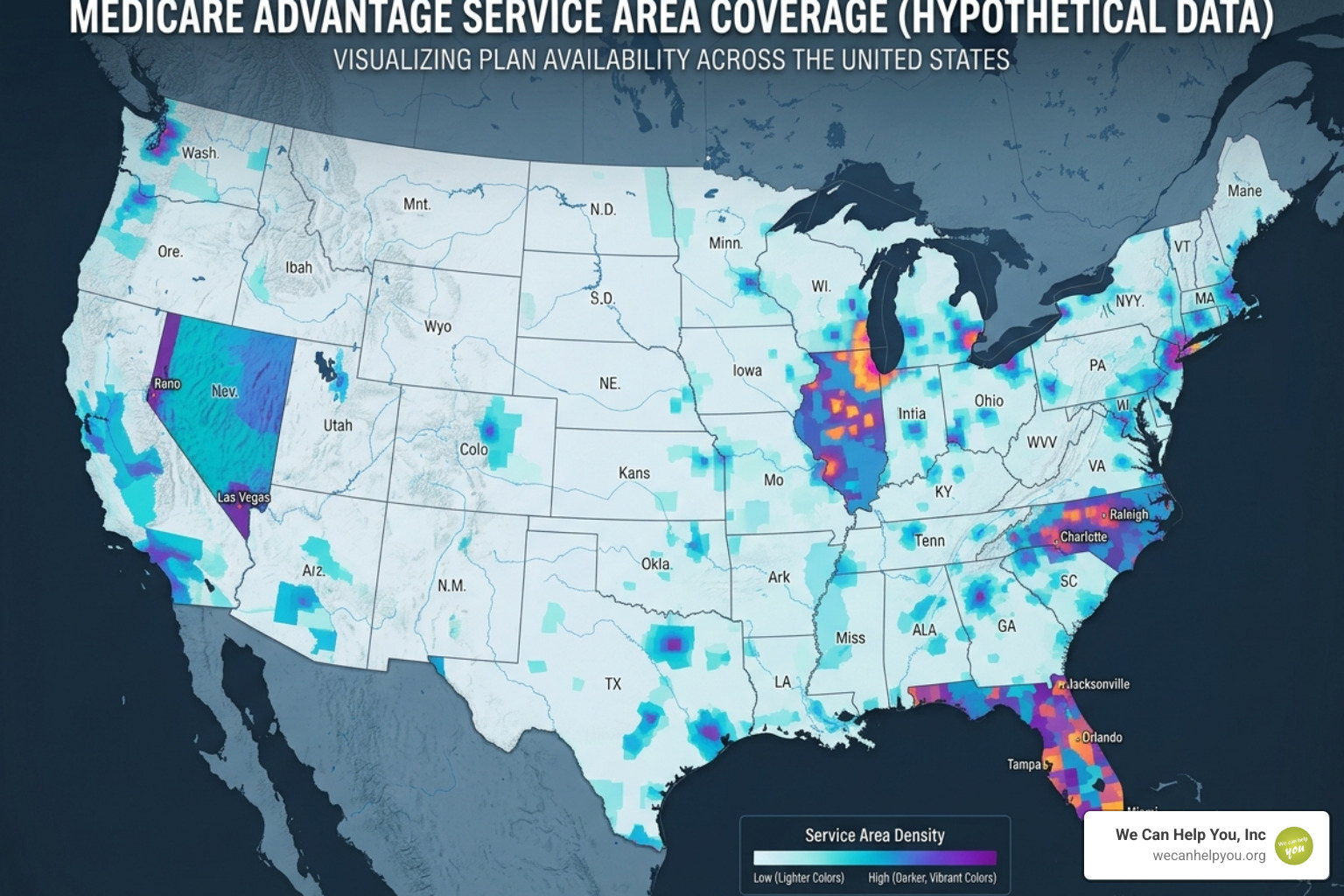
One of the most common misconceptions we hear at We Can Help You, Inc. is that the medicare give back benefit is a national program available to everyone. In reality, it is highly localized.
In 2026, about a quarter of all Medicare Advantage plans (1,369 out of approximately 5,600) offer a premium reduction. This is a slight decrease from 2025, where 32% of plans participated. Why the change? Insurers adjust their “bids” every year based on healthcare costs and government funding.
Availability is concentrated in highly competitive markets. If you live in a major metro area like Charlotte, NC, Las Vegas, NV, or Miami, FL, you are far more likely to find multiple giveback options than if you live in a rural part of Nebraska or Maine. For a breakdown by region, you might consult resources like Medicare Giveback Program by Zip Code | MyClearMatch.
If you’re frustrated because you can’t find a plan in your area, read our article Is it Possible to Reduce My Medicare Part B Premium? for alternative cost-saving strategies.
Finding a Medicare Give Back Benefit Plan
To find these plans, you don’t have to wait for a TV commercial. The most reliable tool is the official Medicare.gov Plan Finder. When you enter your zip code and view Medicare Advantage plans, look for the “Plan Details” section. Under “Premiums,” look for a line labeled “Part B premium reduction.”
When comparing, don’t just look at the dollar amount. A plan with a $50 giveback might have a much better doctor network than one offering $100. Our resource on Understanding Medicare Part B Giveback Offers helps you navigate these nuances. Residents in the Sunshine State should also check out Florida Medicare Giveback 2026: A Complete Guide for state-specific insights.
Financial Impact: 2026 Premiums and Savings
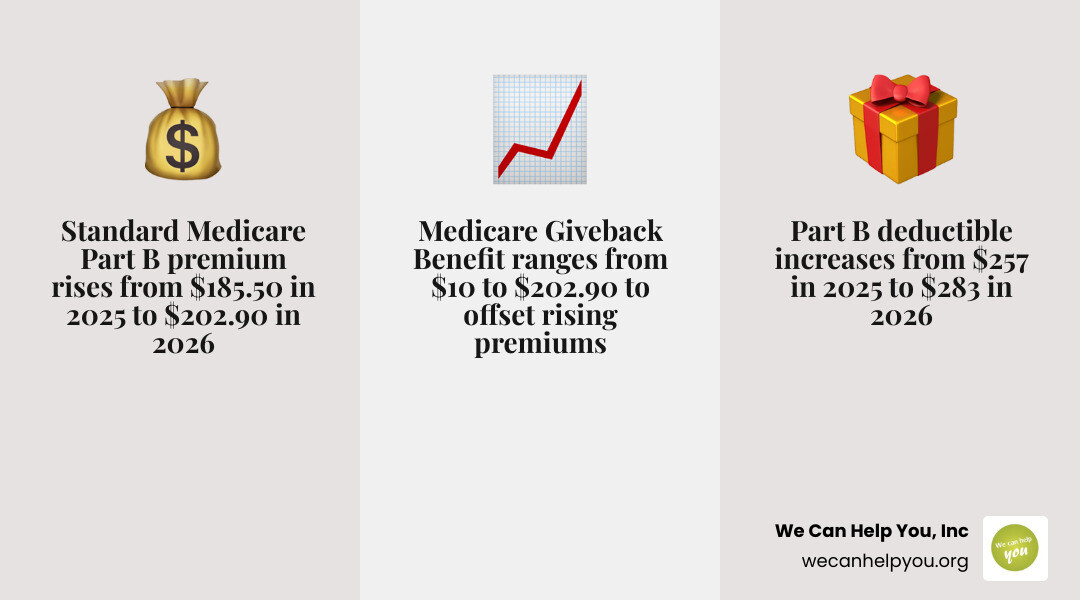
| Feature | 2025 (Standard) | 2026 (Standard) |
|---|---|---|
| Standard Part B Premium | $185.50 | $202.90 |
| Part B Deductible | $257 | $283 |
| Common Giveback Range | $10 – $185.50 | $10 – $202.90 |
| % of Plans with Giveback | 32% | ~24% |
For most beneficiaries in 2026, the standard Part B premium is $202.90. If you find a plan with a $100 monthly giveback, your net premium effectively drops to $102.90. Over a full year, that is $1,200 back in your retirement budget!
However, full givebacks (where the plan pays the entire $202.90) are rare. In 2026, the breakdown of giveback amounts looks like this:
- 36% of plans offer $100 or more.
- 23% of plans offer between $50.01 and $100.
- 13% of plans offer $10.01 to $50.
- 28% of plans offer $10 or less.
To stay updated on these shifting numbers, bookmark our Medicare Premiums 2026: Complete Guide and Will My Medicare Premiums Rise in 2026?.
Receiving Your Part B Premium Reduction
A frequent question we get is, “When will I see the money?” It isn’t instant.
- The Lag: It typically takes the Social Security Administration 60 to 90 days to process the change after you enroll in a new plan.
- Retroactive Payments: Don’t worry—you won’t lose that money. If your plan starts in January but the SSA doesn’t process it until March, you will receive a “lump sum” credit for January and February in your March check.
- The Method: If you pay Medicare directly (via an invoice), your bill will simply show a lower amount. If your premium is deducted from Social Security, your check will increase.
For more on the logistics of payments, see Paying for Medicare Premiums or our tag for Part B Premium.
Evaluating the Pros and Cons of Giveback Plans
While the medicare give back benefit is a fantastic way to save on fixed costs, it isn’t always a “win.” There are trade-offs to consider.
The Pros:
- Lower Monthly Costs: Directly increases your spendable income in retirement.
- No Income Limits: Unlike Medicaid or MSPs, high-income earners can qualify if they live in the right zip code.
- Extra Perks: Most giveback plans still include vision, dental, and hearing benefits.
The Cons:
- Network Restrictions: Many giveback plans are HMOs, which may require you to stay within a strict network of doctors or get referrals for specialists.
- Higher Out-of-Pocket Costs: To fund the giveback, some plans may have higher copays for hospital stays or specialist visits.
- Drug Coverage Gaps: Ensure your specific medications are on the plan’s formulary. A $50/month giveback is worthless if the plan charges you $100 more for your prescriptions.
As noted in What to know about the Medicare Give Back Benefit, you must look at the “Total Cost of Care,” not just the premium. We recommend checking the Medicare Part B Premium tag on our site to see how these costs balance out over time.
Frequently Asked Questions about the Medicare Giveback
Can I get the giveback with Medigap or Original Medicare?
No. The giveback benefit is exclusive to Medicare Advantage (Part C) plans. If you have a Medigap (Medicare Supplement) policy, you are responsible for the full Part B premium. While Medigap offers more freedom to choose doctors, it does not offer premium reductions. For a comparison of costs, see Part B Premiums in 2025: The Monthly Breakdown.
Is the giveback benefit income-based or means-tested?
No. This is a common misconception! Unlike “Extra Help” or Medicare Savings Programs, the giveback is available to anyone regardless of income or assets, provided they pay their own premium and live in a qualifying area. This makes it a unique tool for middle-to-high-income retirees looking to optimize their cash flow. You can find more clarification on this in the Medicare Part B Giveback Benefit explained – Humana resource.
What happens to my benefit if I move to a new zip code?
Because the medicare give back benefit is tied to your local service area, moving can change everything. If you move from a “high-competition” area like Chicago to a rural town, your current plan might not even be available. This triggers a Special Enrollment Period (SEP), allowing you to pick a new plan. However, the new plan in your new zip code may offer a different giveback amount—or none at all. For a look at how benefits vary by county, see the 2026 Devoted GIVEBACK Illinois in IL Plan Benefits Details.
Conclusion
Navigating Medicare can feel like learning a second language, but the medicare give back benefit is one of the few “perks” that offers immediate, tangible financial relief. Whether you’re in New York, Arizona, or North Carolina, understanding your local options is the first step toward a more secure retirement.
At We Can Help You, Inc., our mission is to empower you with the education you need to make these decisions with confidence. Don’t leave your retirement income to chance.
Ready to take the next step?
- Download our free Medicare Planning Guide to simplify your enrollment.
- Request your free Social Security maximization report to see how a Part B reduction could boost your monthly check.
For more information and to browse our full library of resources, visit our Medicare education services page today. We are here to help you make sense of the numbers so you can get back to enjoying your retirement.