
What the 2027 Medicare Part B Premium Means for Your Retirement Budget
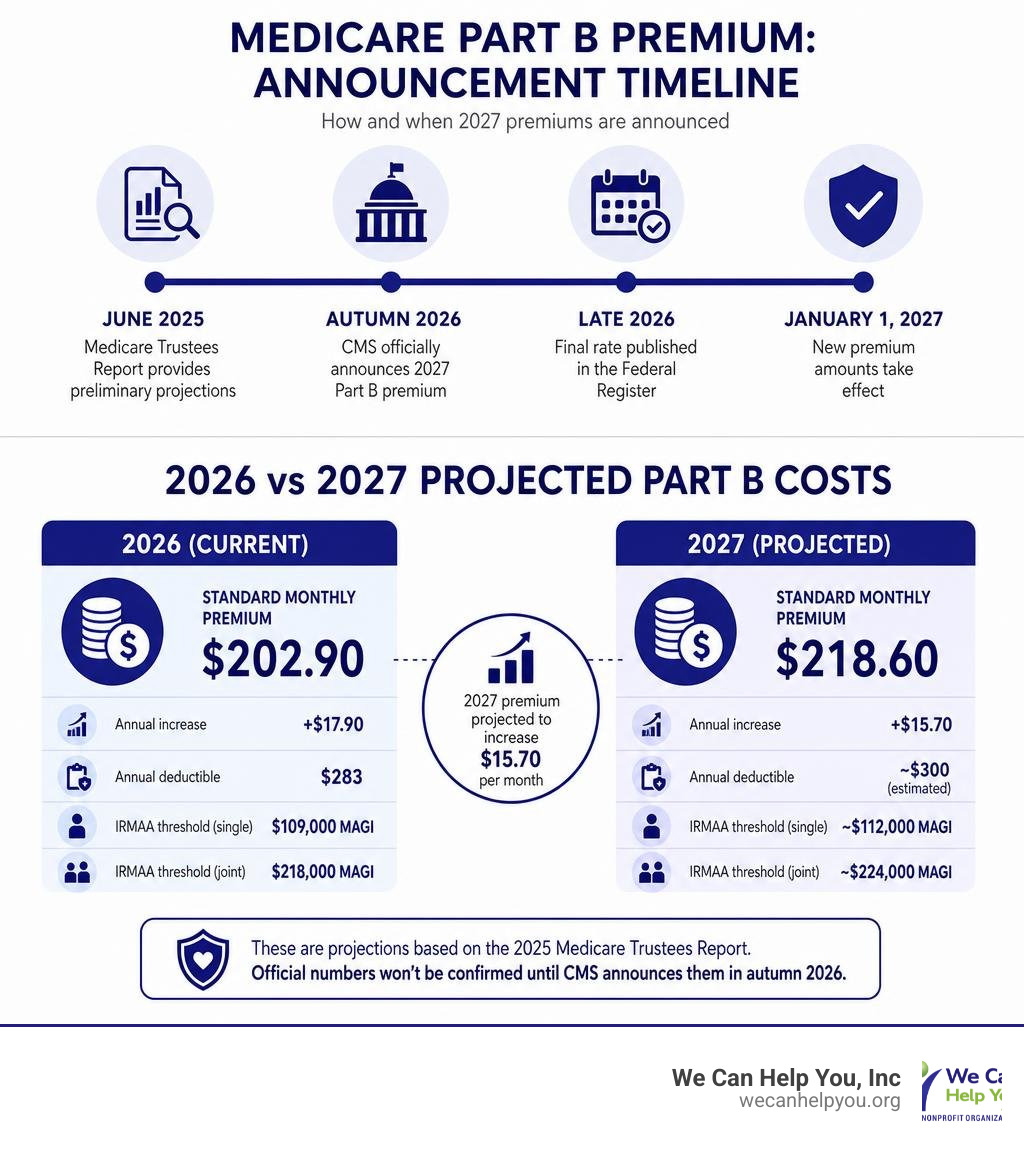
The 2027 Medicare Part B premium is projected to reach $218.60 per month — a $15.70 increase from the 2026 rate of $202.90.
Here’s a quick summary of what to expect:
| Detail | 2026 (Current) | 2027 (Projected) |
|---|---|---|
| Standard monthly premium | $202.90 | $218.60 |
| Annual increase | +$17.90 | +$15.70 |
| Annual deductible | $283 | ~$300 (estimated) |
| IRMAA threshold (single) | $109,000 MAGI | ~$112,000 MAGI |
| IRMAA threshold (joint) | $218,000 MAGI | ~$224,000 MAGI |
These are projections based on the 2025 Medicare Trustees Report. Official numbers won’t be confirmed until CMS announces them in autumn 2026.
For retirees on fixed incomes, even a modest increase matters. The average Social Security cost-of-living adjustment (COLA) in 2026 added roughly $56 per month. The projected 2027 premium increase would consume nearly 28% of that raise before it ever reaches your bank account.
And for higher-income beneficiaries, the impact can be far greater — IRMAA surcharges can push monthly Part B costs well above the standard premium, depending on income reported two years earlier.
This article breaks down everything you need to know: what’s driving the increase, who is protected, how IRMAA works, and what steps you can take right now to reduce your 2027 costs.
Projections for the 2027 Medicare Part B Premium

As we look ahead from our current vantage point in June 2026, planning for healthcare expenses remains a top priority for retirees across the nation. Whether you are living in the sunny valleys of Arizona, navigating retirement in Ohio, or enjoying the coastal views of Rhode Island, staying ahead of Medicare adjustments is essential for protecting your nest egg.
According to intermediate-cost projections from the Medicare Trustees, the standard 2027 Medicare Part B premium is expected to climb to $218.60 per month. This represents a steady $15.70 increase from the 2026 standard premium of $202.90. While a monthly increase of under sixteen dollars might seem small on paper, it builds upon a multi-year trend of rising healthcare costs that outpaces general inflation. To put this in perspective, the standard Part B premium sat at $148.50 back in 2021. If the 2027 projections hold true, beneficiaries will have seen their monthly Part B premiums rise by more than 47% in just six years.
These estimates are discussed in detail by analysts tracking the intersection of federal benefits and retiree spending power. For a deeper look at how these numbers are shaking out, you can review the reporting from Medicare’s Part B premium is projected to hit $218.60 in 2027 — clawing back nearly a third of next year’s Social Security raise before checks arrive – The Financial Wire as well as our detailed forecasting guide, Prepare for Tomorrow: What to Expect for 2027 Medicare Costs.
How the 2027 Medicare Part B Premium is Calculated
The process of determining what you pay for outpatient care under Medicare Part B is not arbitrary. By law, the standard Part B premium is designed to cover approximately 25% of the projected program costs for the upcoming year, while the federal government covers the remaining 75% from general revenues.
These program costs are paid out of the Supplementary Medical Insurance (SMI) Trust Fund. Several key factors influence whether the trust fund’s expenditures will rise, subsequently pushing up your monthly premiums:
- Healthcare Utilization: As the baby boomer generation continues to age into Medicare, the sheer volume of beneficiaries utilizing medical services increases. More doctor visits, outpatient surgeries, and diagnostic tests mean higher overall program outlays.
- New Medical Technologies and Therapies: Advanced treatments, specialized outpatient drugs, and cutting-edge medical equipment improve health outcomes but carry high price tags.
- Inflation and Administrative Adjustments: General economic inflation affects the reimbursement rates paid to doctors and clinics. Additionally, regulatory decisions by the Centers for Medicare & Medicaid Services (CMS) — such as policy updates regarding clinical services — directly alter the program’s financial balance.
Because these factors are fluid, the final premium can sometimes surprise analysts. For instance, in late 2025, CMS actions on clinical skin substitutes helped shave about $11 per month off what the trustees had originally projected for the 2026 premium. You can read more about how these moving parts influence your wallet in Medicare Part B Premiums May Rise Again in 2027 – Here’s What Retirees Need to Know Now | FinanceBuzz .
Projected Deductibles and Coinsurance for 2027
Your monthly premium is only one side of the Medicare Part B coin; you must also budget for out-of-pocket costs when you actually access medical care.
- The Part B Annual Deductible: Before Medicare pays a dime for your outpatient care, you must meet an annual deductible. In 2026, the Part B deductible was set at $283, which was a $26 increase from the 2025 deductible of $257. For 2027, early estimates suggest the deductible will likely cross the $300 threshold, continuing its upward trajectory.
- Coinsurance: Once your deductible is met, you are typically responsible for a 20% coinsurance payment for most Medicare-approved outpatient services, including doctor visits, physical therapy, and durable medical equipment. There is no out-of-pocket maximum under Original Medicare, which is why managing these costs is so critical.
To see how these deductibles have shifted historically and what it means for your broader coverage, explore the 2026 Medicare Parts A & B Premiums and Deductibles | CMS sheet, and consult our Medicare Premiums 2026 Complete Guide.
The Premium-COLA Collision and Hold-Harmless Protections

One of the most challenging aspects of retirement planning is managing expenses when your primary source of income is fixed or adjusted only once a year. For many seniors in states like Pennsylvania, Virginia, and North Carolina, the annual Social Security cost-of-living adjustment (COLA) is supposed to provide breathing room. However, when Medicare premiums rise faster than inflation, that breathing room quickly vanishes.
We refer to this tension as the “Premium-COLA Collision.” Because Part B premiums are automatically deducted from monthly Social Security checks for the vast majority of retirees, any increase in Medicare costs directly reduces the net amount of your monthly deposit. To understand this dynamic better, check out our resource, Will My Medicare Premiums Rise in 2026?.
How the 2027 Medicare Part B Premium Intersects with Social Security COLA
In 2026, Social Security beneficiaries received a 2.8% COLA, which translated to an average monthly benefit increase of about $56 for retired workers. While that sounded like a helpful bump, the 2026 Part B premium increase of $17.90 immediately claimed a significant chunk of it.
Looking forward to 2027, the collision is expected to persist:
- The Squeeze: If the standard premium rises by the projected $15.70 (from $202.90 to $218.60), that single premium increase will consume roughly 28% of the average retiree’s 2026 COLA raise.
- The Cumulative Effect: Over time, this dynamic erodes the purchasing power of seniors. While your overall Social Security benefit might technically be higher, your net check — after Medicare deductions — does not keep pace with the real-world costs of groceries, utilities, and housing.
Who is Protected by the Hold-Harmless Provision?
Fortunately, federal law includes a safety net designed to prevent a retiree’s net Social Security check from actually decreasing from one year to the next due to rising Medicare premiums. This is known as the hold-harmless provision (codified under Section 1839(f) of the Social Security Act).
Here is how the hold-harmless rule works:
- The Protection: If the increase in your standard Part B premium is larger than the dollar amount of your Social Security COLA, your Part B premium increase is scaled back so that your net monthly Social Security benefit remains the same as the previous year.
- Who Qualifies: To be protected, you must have your Part B premiums deducted directly from your Social Security benefit check, and you must be entitled to Social Security benefits for both December of the prior year and January of the current year.
However, the hold-harmless rule is not a universal shield. You will not be protected by this provision if you fall into any of the following categories:
- New Enrollees: If you are enrolling in Medicare Part B for the first time in 2027, you must pay the full standard premium regardless of your Social Security status.
- Direct Payers: If you do not yet draw Social Security benefits and instead pay your Medicare premiums directly via credit card, bank draft, or Medicare Easy Pay, you must pay the full increase.
- High-Income Earners: Anyone subject to the Income-Related Monthly Adjustment Amount (IRMAA) surcharges is entirely excluded from hold-harmless protections.
- Low-Income Beneficiaries Assisted by Medicaid: If you qualify for a Medicare Savings Program where your state (such as New York, California, or Michigan) pays your Part B premium, the state will absorb the increase, meaning you won’t pay it, but you aren’t personally “held harmless” in the traditional sense. For eligibility details, you can refer to resources like the Medicare Savings Program-Eligibility – CT.gov guide.
Projected 2027 IRMAA Brackets and Surcharges
For roughly 8% of Medicare beneficiaries, the standard premium is only the starting point. If your income exceeds certain thresholds, you are required to pay an additional surcharge known as the Income-Related Monthly Adjustment Amount (IRMAA).
Below is a detailed look at the projected 2027 IRMAA brackets for both Medicare Part B and Part D, assuming a standard inflation adjustment of approximately 2.25% applied to the brackets:
| 2025 MAGI (Determines 2027 IRMAA) – Single Filer | 2025 MAGI (Determines 2027 IRMAA) – Joint Filer | Part B Monthly Surcharge | Total Projected Part B Premium | Part D Monthly Surcharge |
|---|---|---|---|---|
| $112,000 or less | $224,000 or less | $0.00 (Standard) | $218.60 | $0.00 (Standard Plan Cost) |
| $112,001 to $141,000 | $224,001 to $282,000 | +$87.40 | $306.00 | +$15.40 |
| $141,001 to $176,000 | $282,001 to $352,000 | +$218.60 | $437.20 | +$39.70 |
| $176,001 to $211,000 | $352,001 to $422,000 | +$349.80 | $568.40 | +$64.00 |
| $211,001 to $499,999 | $422,001 to $749,999 | +$480.90 | $699.50 | +$88.10 |
| $500,000 or more | $750,000 or more | +$524.60 | $743.20 | +$96.50 |
Note: The actual brackets and premiums will be finalized by CMS in late 2026. Part D surcharges are added to your specific plan’s base premium.
Understanding the Two-Year Lookback Rule
One of the most common surprises for retirees in states like New Jersey, Florida, and Georgia is receiving an IRMAA bill when they feel their income has significantly dropped. This confusion stems from the two-year lookback rule.
Medicare does not look at your current income to determine your 2027 premiums. Instead, the Social Security Administration (SSA) uses your federal tax return from two years prior — meaning your 2025 tax return (filed in early 2026) dictates your 2027 Medicare Part B premium and Part D surcharges.
The metric used is your Modified Adjusted Gross Income (MAGI). For Medicare purposes, MAGI is calculated as your Adjusted Gross Income (AGI) plus any tax-exempt interest income (such as municipal bond interest) and certain foreign earned income. Even a single dollar over an IRMAA threshold acts as a “cliff,” bumping you into the next tier and costing you hundreds or thousands of dollars extra over the course of the year.
Part B and Part D IRMAA Thresholds
As shown in the table above, the surcharges scale up sharply. At the highest bracket, a single filer with a 2025 MAGI of $500,000 or more will pay a staggering $743.20 per month for Part B alone, plus an additional $96.50 per month on top of their standard Part D prescription plan premium. Because these surcharges apply per person, married couples who both fall into high brackets can easily face combined Medicare premiums exceeding $1,600 a month.
Strategies to Lower Your Medicare Costs and Appeal Surcharges
Because of the two-year lookback rule, the financial decisions you make today will directly shape your healthcare costs down the road. If you are living in Massachusetts, North Carolina, or Texas, implementing proactive tax strategies is one of the most effective ways to manage your MAGI and keep your Medicare premiums as low as possible.
Proactive Tax Planning and Income Timing
We always recommend working with a qualified financial professional to look at the big picture, but here are some of the most powerful strategies to consider:
- Strategic Roth Conversions: Moving money from a traditional IRA or 401(k) to a Roth IRA triggers income tax in the year of the conversion, but it allows that money to grow and be withdrawn tax-free in the future. If you execute these conversions during “gap years” (after retirement but before Required Minimum Distributions (RMDs) kick in), you can clear out taxable balances before they trigger massive IRMAA surcharges later.
- Qualified Charitable Distributions (QCDs): If you are age 70.5 or older, you can direct up to $105,000 per year directly from your traditional IRA to a qualified charity. This distribution satisfies your RMD requirement but is completely excluded from your adjusted gross income, keeping your MAGI safely below IRMAA cliffs.
- Tax-Gain Harvesting and Asset Location: Be highly strategic about when you realize capital gains. Selling a vacation home or liquidating a large stock position can trigger a massive, one-time spike in your MAGI. Timing these sales, utilizing installment agreements, or offsetting gains with tax-loss harvesting can help protect your 2027 premium bracket.
How to Appeal an IRMAA Determination
What happens if your 2025 income was high, but you have since retired, lost a job, or experienced another major life change? You do not have to sit back and accept a massive premium surcharge. You can file an appeal using Form SSA-44 (Medicare Income-Related Monthly Adjustment Amount – Life-Changing Event).
To successfully appeal, your income reduction must be caused by one of the following qualifying life-changing events:
- Death of a spouse
- Marriage, divorce, or annulment
- Work stoppage (retirement) or work reduction
- Loss of income-producing property (due to a natural disaster or similar event)
- Loss or reduction of pension income
- Employer settlement payment (due to employer bankruptcy or reorganization)
When you submit Form SSA-44 to the Social Security Administration, you must provide proof of the event (such as a letter from your former employer or a death certificate) along with an estimate of your lower, current-year income. If approved, the SSA will adjust your premiums to reflect your current financial reality rather than your outdated 2025 tax return.
Frequently Asked Questions About Medicare Premiums
What is the projected standard Medicare Part B premium for 2027?
The standard 2027 Medicare Part B premium is projected to be $218.60 per month, which is a $15.70 increase from the 2026 rate of $202.90. This figure is an estimate from the Medicare Trustees and will be finalized by CMS in the fall of 2026.
Does the hold-harmless provision protect everyone from premium increases?
No. The hold-harmless provision only protects beneficiaries whose standard premium increase exceeds their Social Security COLA dollar raise. It does not protect new enrollees, individuals who do not have their premiums deducted from Social Security checks, or high-income earners who pay IRMAA surcharges.
How can I lower my MAGI to avoid IRMAA surcharges?
You can lower your MAGI by utilizing Qualified Charitable Distributions (QCDs) for charity, timing your capital gains and property sales carefully, executing Roth IRA conversions in lower-income years, and managing the taxable withdrawals you take from traditional retirement accounts.
Conclusion
Understanding how the 2027 Medicare Part B premium is calculated, how it interacts with your Social Security benefits, and how IRMAA brackets are structured is critical to avoiding expensive surprises in your retirement.
At We Can Help You, Inc., our mission is to provide clear, accessible, and warm retirement education to help you maximize your income and protect your hard-earned savings. Whether you are located in Illinois, Indiana, Colorado, or any of our other service locations across the country, we are here to support you.
To help you take control of your financial future, we offer a free Medicare Planning Guide and a free Social Security maximization report designed to help you increase your retirement income and cut unnecessary costs. Don’t let rising healthcare costs catch you off guard — plan ahead, stay informed, and make the most of your benefits.
For more information on how to maximize your Medicare benefits and access essential care without breaking the bank, read our comprehensive guide on Understanding Medicare’s Preventative Services.