
Medicare Costs Are Rising in 2026 — Here Is What You Need to Know Right Now
How much Medicare 2026 costs is one of the most pressing questions for anyone approaching or already in retirement. The short answer: every major cost has gone up, and the increases are large enough to affect your monthly budget in real ways.
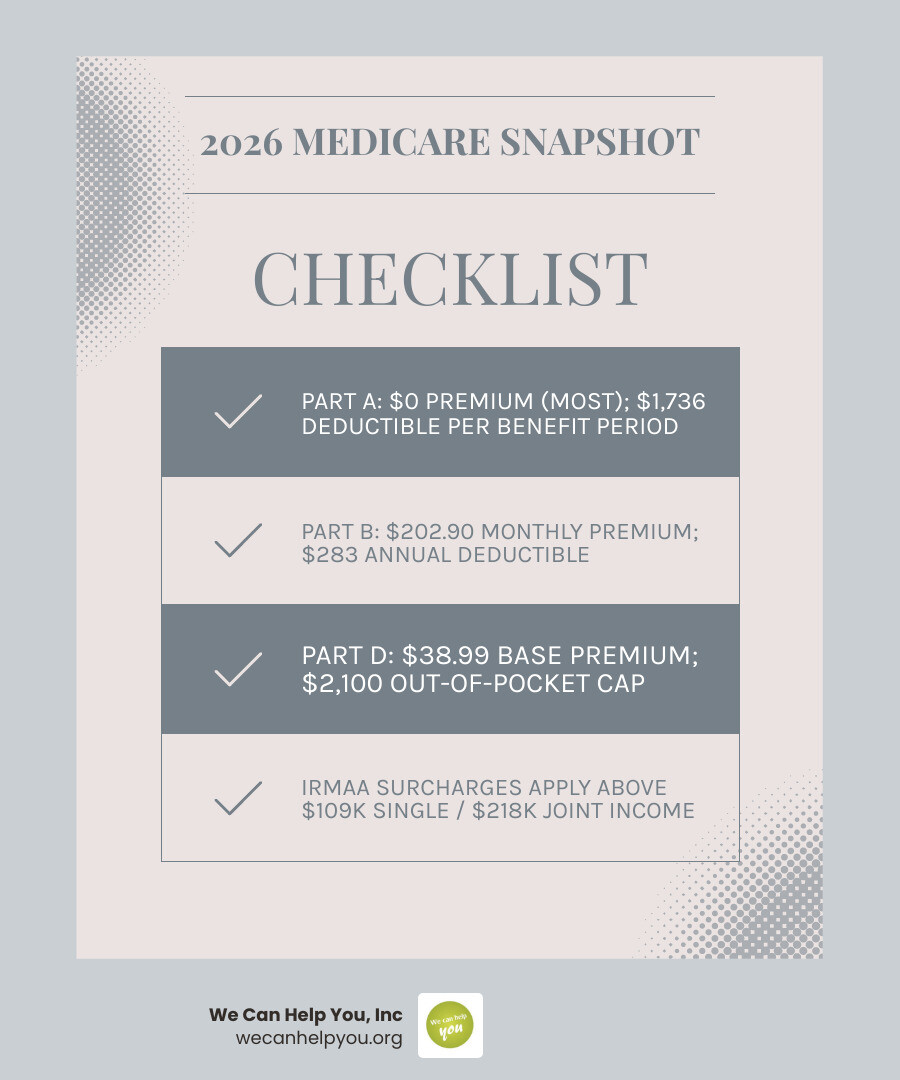
Here is a quick snapshot so you have the numbers immediately:
| Medicare Part | Key 2026 Cost | Change from 2025 |
|---|---|---|
| Part A premium | $0 for most people (up to $565/mo if not premium-free) | Up $47 at full rate |
| Part A hospital deductible | $1,736 per benefit period | Up $60 |
| Part B standard premium | $202.90/month | Up $17.90 (~10%) |
| Part B annual deductible | $283 | Up $26 |
| Part D base premium | $38.99/month | Varies by plan |
| Part D out-of-pocket cap | $2,100 | New for 2026 |
A few things stand out about these numbers:
- The Part B premium increase alone will consume more than 25% of Social Security’s 2.8% cost-of-living adjustment (COLA) for 2026.
- Part B premiums now represent 9.4% of average Social Security benefits — an all-time high.
- If your income is above $109,000 (single) or $218,000 (joint), you will pay even more through IRMAA surcharges on top of these base amounts.
For most retirees, Medicare is not just a healthcare decision — it is a financial planning challenge. Understanding exactly what each part costs, and why, is the first step to avoiding surprises on your monthly statement.
The sections below break down every cost in plain language, including Part A, Part B, Part D, Medicare Advantage, IRMAA surcharges, and the coverage gaps that Original Medicare still does not fill.
How much Medicare 2026 definitions:
How much Medicare 2026: the key numbers to know first
If you want the short version, here it is:
- Most people pay $0 for Part A
- The Part A hospital deductible is $1,736 per benefit period
- The standard Part B premium is $202.90 per month
- The Part B deductible is $283 for the year
- The Part D national base beneficiary premium is $38.99
- The projected Part D maximum deductible is $615
- The 2026 Part D out-of-pocket cap is $2,100
Those are the headline numbers, but they do not tell the full story. Medicare costs depend on the part of Medicare you use, your income, your prescriptions, whether you choose Original Medicare or Medicare Advantage, and whether you enrolled on time.

What is the Medicare Part B deductible for 2026?
The Medicare Part B deductible for 2026 is $283.
This is an annual deductible, not a monthly one. In plain English, that means you generally pay the first $283 of covered Part B services yourself before Original Medicare starts sharing costs.
Part B usually covers things like:
- Doctor visits
- Outpatient care
- Lab work
- Preventive services
- Durable medical equipment
- Physical therapy
- Mental health outpatient services
After you meet the deductible, Original Medicare typically pays 80% of approved Part B services, and you pay the remaining 20%. That 20% can add up quickly if you have frequent outpatient care, expensive imaging, chemotherapy, infusion drugs, or durable medical equipment.
So when people ask us How much Medicare 2026 costs, the Part B deductible is only one piece. The bigger issue is that after the deductible, there is usually still coinsurance.
What is the standard Part B premium in 2026?
The standard Medicare Part B premium in 2026 is $202.90 per month.
That is up from $185.00 in 2025, an increase of $17.90 per month, or roughly 10%. You can verify the official numbers in the 2026 Medicare Parts A & B Premiums and Deductibles | CMS .
This matters because Part B is usually deducted directly from Social Security. So many retirees feel this increase immediately in their monthly check.
Two key takeaways:
- The increase is large enough to eat up more than one-quarter of the 2026 Social Security COLA
- Part B premiums now take 9.4% of the average retired worker benefit
In other words, your COLA may arrive with one hand and Medicare may wave from the other hand while taking a chunk of it back.
Quick 2026 Medicare cost table
| Medicare Cost Item | 2026 Amount |
|---|---|
| Part A premium for most people | $0 |
| Part A premium with 30-39 work quarters | $311/month |
| Part A premium with fewer than 30 work quarters | $565/month |
| Part A hospital deductible | $1,736 per benefit period |
| Part A coinsurance, days 61-90 | $434/day |
| Part A lifetime reserve days | $868/day |
| Skilled nursing facility coinsurance, days 21-100 | $217/day |
| Part B standard premium | $202.90/month |
| Part B deductible | $283/year |
| Part D national base premium | $38.99/month |
| Part D maximum deductible | $615 |
| Part D out-of-pocket cap | $2,100 |
2026 Medicare Part A costs: premiums, deductible, and hospital coinsurance
Part A is hospital insurance. It covers inpatient hospital stays, limited skilled nursing facility care, hospice, and some home health services.
For many people, Part A feels free because they do not pay a monthly premium. But “premium-free” does not mean “cost-free.” Hospital cost-sharing under Part A can still be significant.

How much is Part A if you do not qualify for premium-free coverage?
Most people do not pay a Part A premium because they or a spouse worked and paid Medicare taxes long enough. In fact, about 99% of beneficiaries pay $0 for Part A.
If you do not qualify for premium-free Part A in 2026, the buy-in premium depends on your work history:
- $311 per month if you or your spouse paid Medicare taxes for 30-39 quarters
- $565 per month if you or your spouse paid Medicare taxes for fewer than 30 quarters
A quarter is basically a work credit period tied to Medicare-covered employment. In general, 40 quarters gets you premium-free Part A.
What are the 2026 Part A deductible and coinsurance amounts?
For 2026, Medicare Part A cost-sharing is:
- $1,736 deductible for each benefit period
- $434 per day for hospital days 61-90 in a benefit period
- $868 per day for each lifetime reserve day after day 90
- $217 per day for skilled nursing facility care on days 21-100
These numbers matter because a hospital stay can trigger more than one type of cost:
- First, you may owe the Part A deductible
- If the stay is long enough, daily coinsurance can begin
- If you need skilled nursing after discharge, separate daily coinsurance may apply there too
Why the Part A deductible can be charged more than once in a year
This is one of the least understood Medicare rules.
The Part A deductible is charged per benefit period, not once per calendar year. A benefit period starts when you are admitted as an inpatient and ends when you have been out of the hospital or skilled nursing facility for 60 days in a row.
That means you could pay the $1,736 deductible more than once in the same year if you have separate hospitalizations.
Example:
- You go into the hospital in February and owe the deductible
- You recover and stay out of inpatient care for more than 60 days
- You are admitted again in October
- A new benefit period begins, and you may owe another deductible
This is one reason Original Medicare can leave retirees exposed even when they think they are “covered.”
How much Medicare 2026 costs for Part B and IRMAA high-income surcharges
Part B is where many people see the biggest monthly budget impact, especially if they are subject to IRMAA.
IRMAA stands for Income-Related Monthly Adjustment Amount. It is an extra charge added to Part B and Part D premiums for higher-income beneficiaries. Social Security usually looks at your 2024 modified adjusted gross income (MAGI) to determine your 2026 IRMAA.
Roughly 8% of Medicare beneficiaries pay these income-based surcharges.
How much Medicare 2026 Part B premiums rise by income
For 2026, standard and income-adjusted Part B premiums are:
- $202.90 for individuals with MAGI of $109,000 or less, or joint filers with MAGI of $218,000 or less
- $284.10
- $405.80
- $527.50
- $649.20
- $689.90 at the highest tier
The highest Part B premium applies to:
- Individuals with MAGI of $500,000 or more
- Married couples filing jointly with MAGI of $750,000 or more
Important detail: if a married couple is subject to IRMAA, each spouse generally pays the surcharge individually if both have Medicare Part B.
How IRMAA also increases Part D costs
IRMAA does not stop with Part B. It can also increase your Part D costs.
In 2026, the monthly Part D IRMAA surcharges are:
- $14.50
- $36.60
- $58.70
- $80.80
- $91.00
These amounts are paid on top of your drug plan premium. So if your Part D plan premium is $40 and your IRMAA surcharge is $58.70, your total monthly Part D cost is effectively $98.70.
If you want a deeper explanation, see our guides on How IRMAA Surcharges in 2026 Impact High Earners and Decoding 2026 IRMAA Brackets: What the Projections Mean for You.
Can you appeal IRMAA in 2026?
Yes, sometimes.
If your income has dropped because of a qualifying life-changing event, you may ask Social Security to reconsider your IRMAA using Form SSA-44.
Common qualifying events include:
- Retirement or work stoppage
- Marriage
- Divorce or annulment
- Death of a spouse
- Loss of income-producing property
- Loss or reduction of pension income
If your 2024 income was unusually high but your 2026 reality is much lower, it is worth reviewing whether an appeal makes sense.
Part D and Medicare Advantage in 2026: what you may pay beyond Original Medicare
Original Medicare is only part of the picture. Drug coverage and Medicare Advantage costs can change your budget a lot.
What are the projected 2026 Part D premiums, deductible, and out-of-pocket limit?
Part D costs vary by plan, but the key national figures for 2026 are:
- National base beneficiary premium: $38.99
- Maximum deductible: $615
- Out-of-pocket cap: $2,100
The national base premium is especially important because Medicare uses it to calculate late enrollment penalties and IRMAA amounts. The official Medicare summary is available in 2026 Medicare Costs .
The new $2,100 out-of-pocket cap is one of the biggest consumer protections in Part D. Once your covered drug spending reaches that threshold, your costs for covered prescriptions should be much more limited than under the old catastrophic structure.
Still, actual Part D costs vary based on:
- Your specific plan premium
- Your prescription list
- Your plan formulary
- Pharmacy network rules
- Whether your drugs are preferred, non-preferred, brand, or specialty
For more on the drug cap, see Capping the Chaos with the 2026 Medicare Part D Maximums.
One more important point: if you delay Part D without having creditable drug coverage, you may owe a permanent late enrollment penalty. That penalty is generally calculated as 1% of $38.99 for each month you went without creditable coverage.
How much Medicare 2026 Medicare Advantage plans may cost
Medicare Advantage, also called Part C, is offered by private insurers approved by Medicare. Costs vary by county, so what is available in Arizona may differ from what is available in Connecticut, California, Florida, Texas, or any other area we serve.
In 2026, Medicare Advantage plans may include:
- $0 monthly premium plans
- Plans with an added monthly premium
- Copays for primary care, specialists, urgent care, and hospital stays
- Drug coverage bundled in
- Annual maximum out-of-pocket limits for Part A and Part B services
- Extra benefits like dental, vision, hearing, fitness, or transportation
A key reminder: even with a $0-premium Medicare Advantage plan, you usually still pay the Part B premium of $202.90, unless a plan offers a giveback feature.
When comparing Advantage plans, look at more than premium:
- Provider network
- Referral rules
- Drug coverage
- Copays and coinsurance
- Prior authorization rules
- Maximum out-of-pocket limit
The cheapest-looking plan is not always the cheapest when you actually use it.
Key coverage gaps in Original Medicare to plan for in 2026
Original Medicare covers a lot, but it does not cover everything. This is where many retirement budgets get surprised.
Major gaps include:
- 20% Part B coinsurance for many outpatient services
- No annual out-of-pocket maximum in Original Medicare
- Most dental care
- Routine vision care and eyeglasses
- Most hearing exams and hearing aids
- Most long-term care
- Most care received outside the U.S.
This is why many people add:
- A Medicare Supplement policy
- A stand-alone Part D plan
- Or a Medicare Advantage plan that packages services differently
Without supplemental protection, one serious illness can turn “I thought Medicare covered that” into a very expensive sentence.
How rising 2026 Medicare costs affect Social Security and how to avoid penalties
Medicare and Social Security are deeply connected because Part B premiums are often deducted from Social Security benefits.

How the 2026 Part B increase affects your Social Security check
The standard Part B premium is rising by $17.90 per month in 2026. At the same time, Social Security’s COLA is 2.8%.
That combination means:
- More than 25% of the COLA is consumed by the Part B increase alone
- Part B premiums equal 9.4% of average Social Security benefits
- After out-of-pocket medical spending, the median beneficiary keeps only about 71% of Social Security income for non-medical expenses
That last number is sobering. It means healthcare costs are taking a bigger bite out of retirement income than many people expect.
How to avoid Medicare late enrollment penalties in 2026
Late enrollment penalties are one of the few Medicare costs that can follow you for years, sometimes for life. The good news: many are avoidable.
Here are the basics:
- Enroll in Medicare during your Initial Enrollment Period (IEP) when first eligible
- If you delay because you have employer coverage, make sure it is creditable and qualifies you for a Special Enrollment Period (SEP)
- Do not assume COBRA counts the same as active employer coverage for Medicare timing
- Keep proof of employer and drug coverage
- Review your options annually during Medicare’s enrollment windows
- If you need Part A and do not get it automatically, buy it when first eligible to avoid possible penalties
- Do not go without Part D or other creditable drug coverage unless you understand the penalty risk
The penalties themselves:
- Part B penalty: typically 10% for each full 12-month period you could have had Part B but did not sign up, and it may last as long as you have Part B
- Part D penalty: generally 1% of the national base beneficiary premium for each month without creditable drug coverage, usually permanent
What to do if Medicare feels unaffordable
If Medicare costs feel heavy, you are not alone. There are programs that may help.
Look into:
- Medicare Savings Programs, which may help pay Part B premiums and sometimes other cost-sharing
- Extra Help for Part D prescription costs
- State counseling through SHIP
- Annual plan review to make sure your coverage still fits your doctors and prescriptions
We also encourage beneficiaries to review our Medicare Premiums 2026 Complete Guide and Will My Medicare Premiums Rise in 2026?.
As a nonprofit, we at We Can Help You, Inc. focus on education. We offer a free Medicare Planning Guide and a free Social Security maximization report to help people make smarter retirement decisions.
Frequently Asked Questions about How much Medicare 2026
Is the 2026 Medicare Part B deductible paid every month?
No. The Part B deductible is $283 for the year, not per month. You generally pay it once each calendar year before Part B starts sharing the cost of covered services.
Do most people pay a Part A premium in 2026?
No. About 99% of Medicare beneficiaries pay no Part A premium because they or a spouse worked at least 40 quarters in Medicare-covered employment.
Does Original Medicare have a yearly out-of-pocket maximum?
No. Original Medicare does not have a yearly out-of-pocket maximum for Part A and Part B combined. That is one reason many people consider supplemental coverage.
Conclusion
If you were searching for How much Medicare 2026 costs, the biggest answers are now clear:
- Part B deductible: $283
- Standard Part B premium: $202.90
- Part A hospital deductible: $1,736
- Part D national base premium: $38.99
- Part D out-of-pocket cap: $2,100
Just as important, the real cost of Medicare is not only the premium. It is the combination of deductibles, coinsurance, income surcharges, drug costs, and coverage gaps.
At We Can Help You, Inc., we believe retirement decisions get easier when the numbers are explained in plain English. If you want help thinking through next steps, start with an annual Medicare review and learn more here: Will My Medicare Premiums Rise in 2026?
A little planning now can help you avoid expensive surprises later. Medicare may be complicated, but your next step does not have to be.