Why Understanding Medicare’s Income-Based Premium Surcharges Matters in 2026
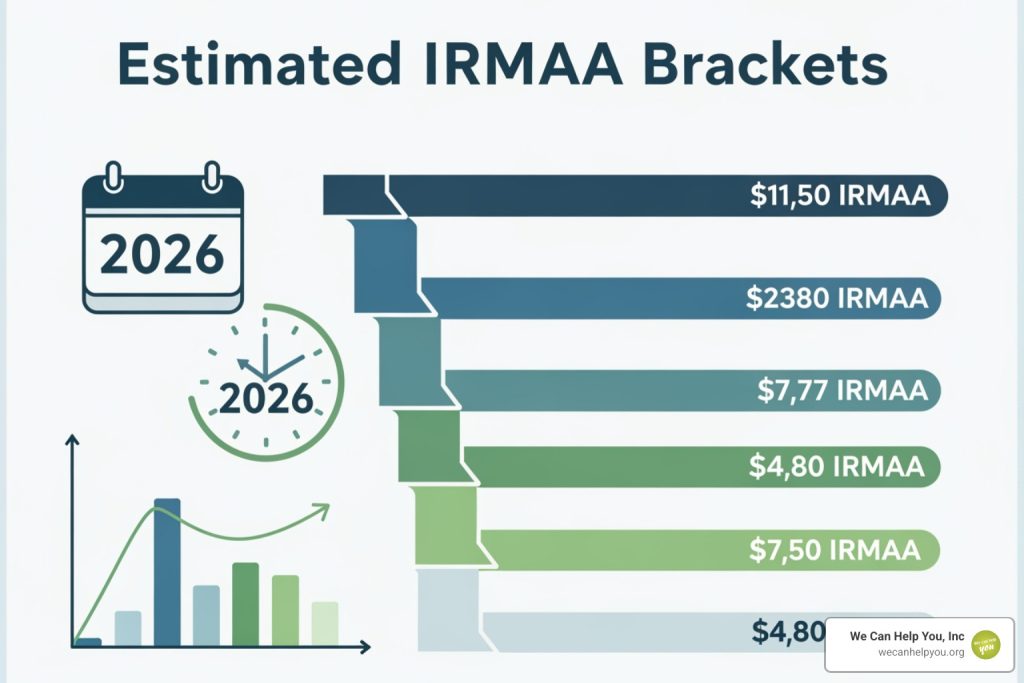
Estimated 2026 IRMAA brackets determine how much extra you’ll pay for Medicare Part B and Part D if your income exceeds certain thresholds. Based on official CMS announcements, here are the confirmed 2026 brackets:
2026 Part B IRMAA Brackets (Individual Filers)
| Income Range | Monthly Part B Premium | IRMAA Surcharge |
|---|---|---|
| ≤ $109,000 | $202.90 | $0 |
| $109,001 – $137,000 | $284.10 | $81.20 |
| $137,001 – $171,000 | $405.80 | $202.90 |
| $171,001 – $205,000 | $527.50 | $324.60 |
| $205,001 – $500,000 | $649.20 | $446.30 |
| ≥ $500,000 | $689.90 | $487.00 |
For married couples filing jointly, double these thresholds (e.g., $218,000, $274,000, etc.).
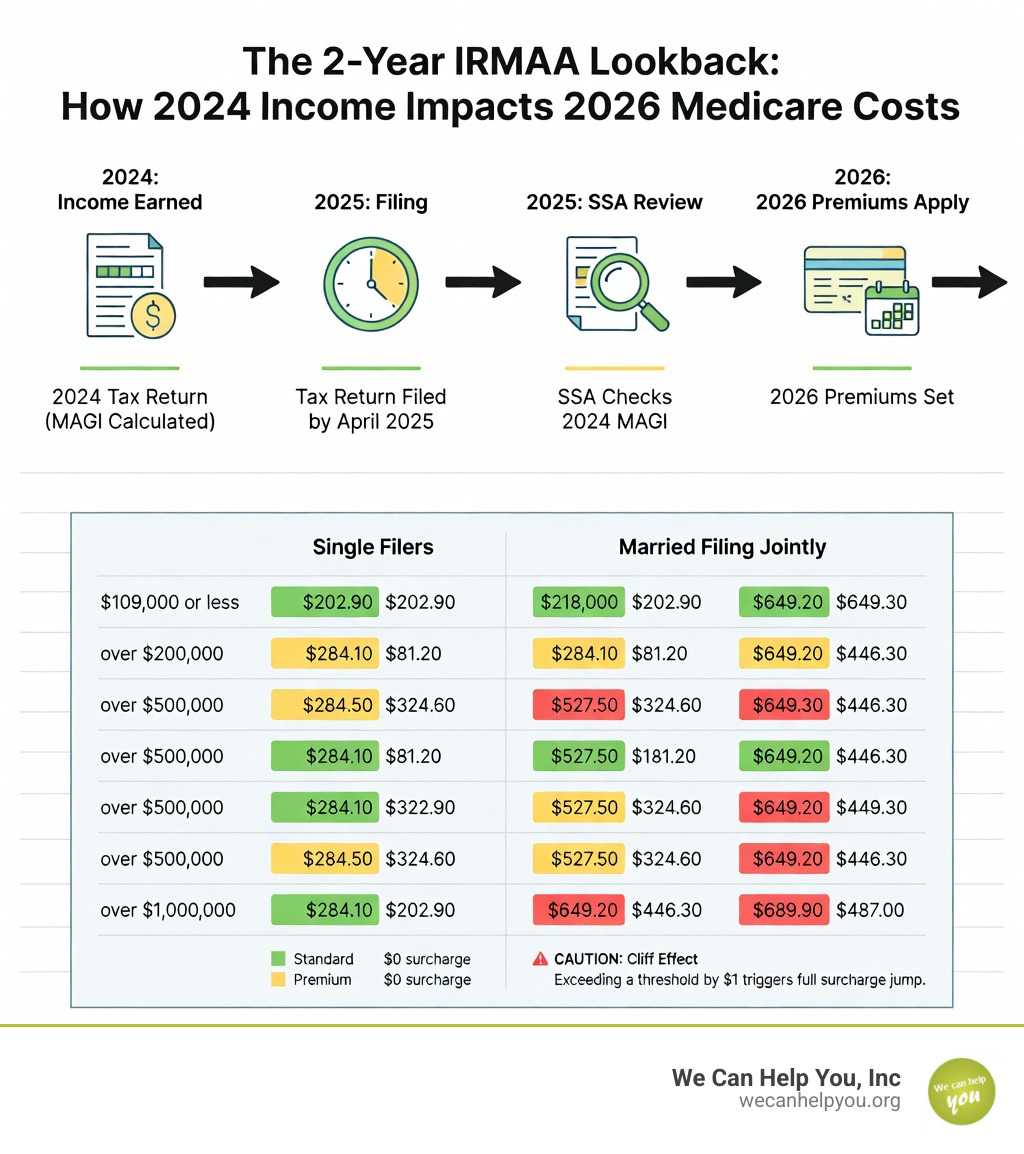
IRMAA stands for Income-Related Monthly Adjustment Amount. It’s a surcharge that higher-income Medicare beneficiaries pay on top of their standard Medicare premiums. The catch? Your 2026 surcharges are based on your 2024 tax return filed in 2025.
This two-year lookback creates both challenges and opportunities. A sudden income spike from selling property or taking a large retirement account distribution can trigger surcharges years later. But it also means you can plan ahead.
The standard Part B premium jumped to $202.90 per month in 2026, up $17.90 from 2025. For those subject to IRMAA, total monthly premiums range from $284.10 to $689.90. Part D surcharges add another $14.50 to $91.00 on top of your prescription drug plan premium.
Roughly 8% of Medicare beneficiaries pay IRMAA. If your modified adjusted gross income (MAGI) exceeds $109,000 as an individual or $218,000 filing jointly, you’ll face these surcharges.
The cliff effect makes this especially painful. Earning just one dollar over a threshold triggers the full surcharge for that bracket—potentially over $1,000 extra per year per person.
But there’s good news. You can appeal IRMAA determinations if you’ve experienced qualifying life-changing events like retirement or divorce. And with proper planning, you can manage your income to minimize or avoid these surcharges entirely.
Understanding IRMAA and the 2-Year Lookback Rule
To steer the estimated 2026 irmaa brackets, we first need to understand the “time machine” the government uses to check your finances. The Social Security Administration (SSA) doesn’t look at what you are earning today; they look at your Modified Adjusted Gross Income (MAGI) from two years ago.
According to the Medicare Trustees Report, only about 7% to 8% of beneficiaries are affected by these surcharges, but those who are pay a significantly higher share of the program’s costs. While the average beneficiary’s premium covers about 25% of the cost of Part B, those in the highest IRMAA brackets cover up to 85%.
For your 2026 premiums, the SSA pulls data from your 2024 tax returns (the ones you filed in early 2025). This can be frustrating for new retirees. You might have earned a high salary in 2024 while working, but by 2026, you are living on a fixed pension. Understanding how these IRMAA charges work is the first step in ensuring you don’t pay more than your fair share.
How MAGI is Calculated for Medicare
Medicare’s definition of income isn’t just the “taxable income” number at the bottom of your tax return. They use Modified Adjusted Gross Income (MAGI). For IRMAA purposes, MAGI is your Adjusted Gross Income (AGI) from Form 1040, Line 11, plus any tax-exempt interest income (Line 2a).
This means that even “tax-free” income, like interest from municipal bonds, is added back into the calculation. Other items included in this calculation are:
- Wages and self-employment income
- Taxable Social Security benefits
- Pension and IRA distributions
- Capital gains from the sale of stocks or real estate
If you live in a high-cost area like New York, NY or Chicago, IL, it is easy for these combined income sources to push you toward those higher tiers.
The Impact of the 24-Month Delay
The two-year lag is a double-edged sword. On one hand, it gives us time to see the “cliff” coming. On the other hand, it can lead to “phantom” surcharges. If you had a one-time income spike in 2024—perhaps you sold a vacation home in Florida or did a large Roth conversion—that income will haunt your Medicare bill in 2026.
We often see beneficiaries surprised by this. They forget about that one-time gain from two years ago and are shocked when their Social Security check is smaller than expected due to a high-income surcharge.
Official and Estimated 2026 IRMAA Brackets for Part B and Part D
The Centers for Medicare & Medicaid Services (CMS) recently released the 2026 Medicare Parts A & B Premiums and Deductibles data. For 2026, we saw the income thresholds for the brackets increase by approximately 3% due to inflation, while the surcharge amounts themselves increased by about 9%.

Planning for 2026 Medicare costs requires looking at both Part B (medical insurance) and Part D (prescription drug coverage).
Part B Premiums and Estimated 2026 IRMAA Brackets
For most people, the standard monthly premium for Medicare Part B is $202.90. However, if your income exceeds $109,000 (individual) or $218,000 (joint), you move into the medicare-part-b-irmaa tiers.
The tiers are structured as multipliers. For example, the second tier (1.4x) applies to individuals earning between $109,001 and $137,000. These individuals pay the standard $202.90 plus an $81.20 surcharge, totaling $284.10 per month. The highest tier (3.4x) applies to those earning $500,000 or more, resulting in a staggering total monthly premium of $689.90 per person.
Part D Surcharges within the Estimated 2026 IRMAA Brackets
If you have a Medicare Part D plan, the IRMAA surcharge is added to whatever premium you pay your private insurance company. The income brackets for medicare-part-d-irmaa are exactly the same as the Part B brackets.
In 2026, the Part D surcharges range from $14.50 to $91.00. Unlike the Part B premium, which is often deducted from your Social Security check, the Part D IRMAA is sometimes billed directly to you by Medicare, even if you pay your plan premium to a company like Humana or Aetna.
Special Brackets for Filing Separately and Immunosuppressive Coverage
There are two “special” categories that often catch people off guard:
- Married Filing Separately: If you lived with your spouse at any time during the year but file separate tax returns, the brackets are much harsher. IRMAA kicks in at just $109,000, but the surcharge jumps immediately to $446.30 for Part B once you cross that threshold.
- Immunosuppressive Drug Coverage: For individuals who only have Part B coverage for immunosuppressive drugs (typically after a kidney transplant), the base premium is $121.60. However, they are still subject to IRMAA, with total premiums ranging from $202.70 to $608.10 depending on income.
How to Appeal an IRMAA Determination
If you receive a notice saying you owe IRMAA but your income has recently dropped, don’t panic. You have the right to appeal. We help individuals steer appealing-medicare-irmaa-charges every day, and the process is more straightforward than you might think.
You generally have a 60-day window from the time you receive your IRMAA notice to file an appeal. The most common way to do this is by using the SSA-44 Form.
Qualifying Life-Changing Events (LCE)
You cannot appeal simply because you think the surcharge is “unfair.” You must have experienced a specific Life-Changing Event that caused your income to decrease. These include:
- Work Stoppage or Reduction: Retirement is the most common reason.
- Divorce or Annulment: A change in filing status.
- Death of a Spouse: Loss of the spouse’s income or change in filing status.
- Loss of Pension Income: Due to a plan failure or termination.
- Employer Settlement Payment: A one-time payment that won’t recur.
If you retired in 2025, your 2024 income doesn’t reflect your current reality. By filing the SSA-44, you can ask the SSA to use your estimated 2026 income instead of your actual 2024 income.
The Reconsideration Process
The appeal process is officially called a “Request for Reconsideration.” You can start by calling the SSA at 1-800-772-1213 or visiting a local office in cities like Raleigh, NC, or Albuquerque, NM.
If your appeal is based on a life-changing event, you’ll need to provide evidence, such as a letter from your former employer or a divorce decree. If your appeal is based on the IRS having the wrong data (perhaps you filed an amended return), you should use form SSA-561. For more details, see our guide on how to file an appeal.
Strategies to Minimize or Avoid IRMAA Surcharges
Proactive planning is the best way to deal with the 2026-medicare-irmaa surcharges. Since the government looks back two years, the moves you make today will impact your premiums in 2028.
Proactive Income Planning
The goal of IRMAA planning is to keep your MAGI below the “cliff” thresholds. Here are a few strategies we recommend:
- Roth Conversions: Converting traditional IRA funds to a Roth IRA is a great long-term move. However, the conversion itself counts as income. It is often best to do these conversions before age 63 (two years before Medicare starts) or spread them out over several years to avoid jumping into a higher bracket.
- Qualified Charitable Distributions (QCDs): If you are over 70.5, you can send money directly from your IRA to a charity. This counts toward your Required Minimum Distribution (RMD) but is not included in your MAGI.
- 401(k) Contributions: If you are still working at 65, maximizing pre-tax contributions can lower your AGI and potentially keep you out of IRMAA territory.
These strategies were largely influenced by the Medicare Prescription Drug, Improvement, and Modernization Act of 2003, which first introduced the concept of income-adjusted premiums.
Managing Investment Income
Investment decisions can have a massive impact on your MAGI.
- Tax-Loss Harvesting: Selling losing investments to offset capital gains can lower your total income.
- Dividend Timing: Be careful with large year-end “capital gain distributions” from mutual funds in taxable accounts.
- Municipal Bonds: While the interest is federally tax-free, it is added back for IRMAA. Sometimes, a taxable bond with a similar yield might actually be better if the muni-bond interest pushes you over an IRMAA cliff.
Frequently Asked Questions about 2026 IRMAA
Does IRMAA apply to Medicare Advantage plans?
Yes. This is a common point of confusion. Even if you have a private Medicare Advantage plan (Part C), you are still required to pay the Part B premium. If you are a high-income earner, you will pay the standard Part B premium plus the IRMAA surcharge. Additionally, if your Advantage plan includes prescription drug coverage (MAPD), the Part D IRMAA surcharge will also apply.
How do I pay my IRMAA surcharges?
If you are already receiving Social Security benefits, the SSA will automatically deduct the Part B premium and IRMAA surcharge from your monthly check.
If you are not yet collecting Social Security, you will receive a bill (the “Medicare Premium Bill”) every three months. You can pay this online through your secure Medicare account, use Medicare Easy Pay for automatic deductions from your bank account, or mail a check.
What happens if I exceed a bracket by only one dollar?
Medicare IRMAA is a “cliff” system, not a graduated system like income tax. If the threshold for a bracket is $109,000 and your MAGI is $109,001, you will pay the full surcharge for that entire tier. In 2026, that one extra dollar of income would cost an individual an extra $974.40 per year in Part B premiums alone. This is why precise income planning is so critical.
Conclusion
The estimated 2026 irmaa brackets represent a significant expense for high-income retirees, but they don’t have to be a surprise. By understanding the two-year lookback rule and the specific MAGI calculation, you can take control of your retirement budget.
At We Can Help You, Inc., we are dedicated to educating individuals across the country—from New Jersey to California—on the complexities of Medicare and Social Security. Our goal is to help you achieve financial security by maximizing your benefits and minimizing unnecessary costs.
Don’t leave your retirement income to chance. Get your free Medicare Planning Guide today and learn how to steer the road ahead with confidence. Whether you’re in East Greenwich, RI or Las Vegas, NV, we are here to ensure you have the tools you need to prosper.