
Why Knowing When to Enroll in Medicare Can Save You Thousands
Understanding medicare when enroll is one of the most important decisions you’ll make as you approach retirement — and getting it wrong can cost you permanently.
Quick Answer: When Should You Enroll in Medicare?
| Situation | When to Enroll |
|---|---|
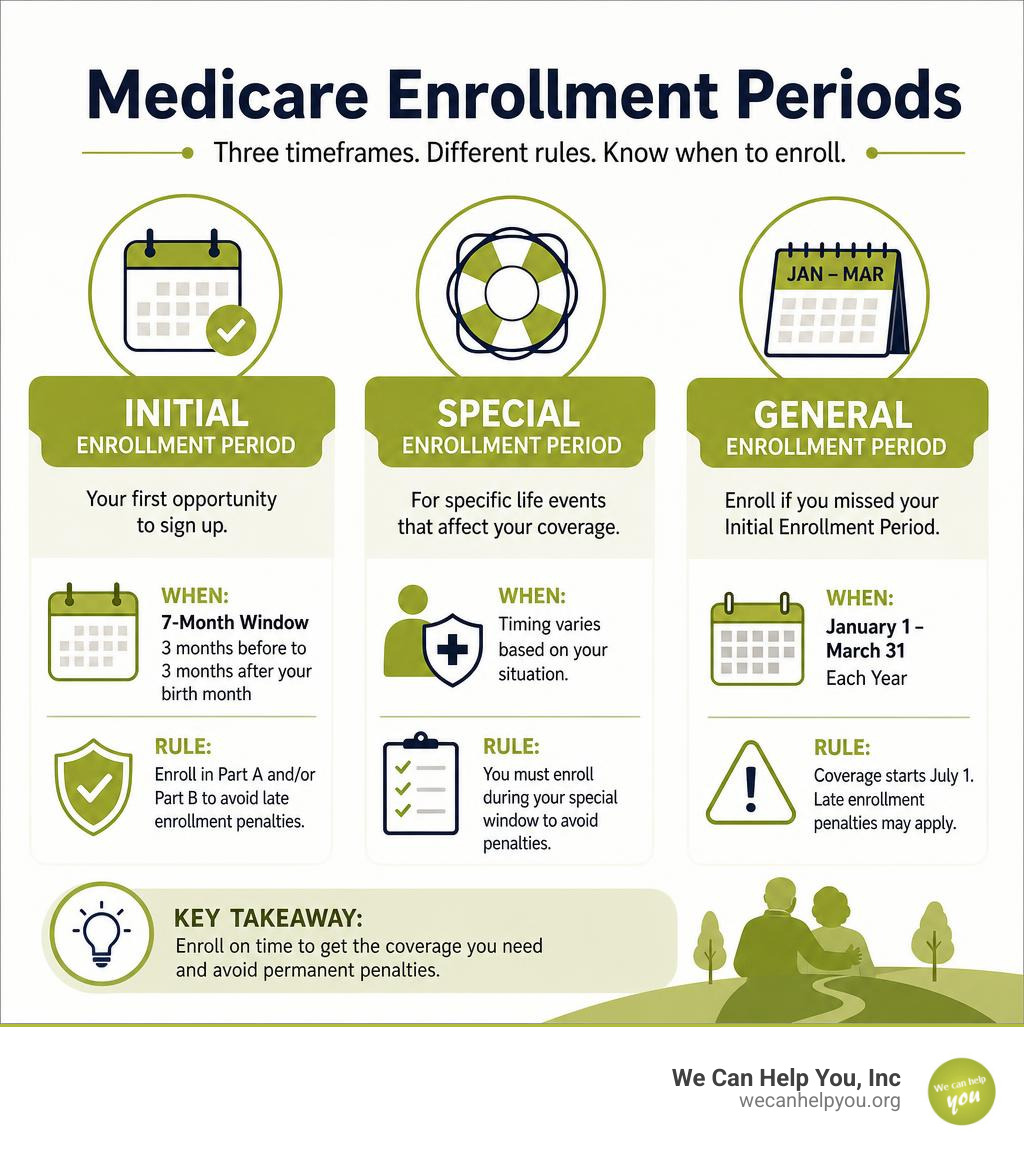
| Turning 65 (general) | During your 7-month Initial Enrollment Period (3 months before to 3 months after your birth month) |
| Already getting Social Security | You’re enrolled automatically at 65 |
| Working with employer coverage (20+ employees) | You can delay — enroll within 8 months of losing that coverage |
| Working with small employer (<20 employees) | Sign up during your Initial Enrollment Period |
| Missed your Initial Enrollment Period | General Enrollment Period: January 1 – March 31 each year (penalties may apply) |
| Special circumstances (job loss, Medicaid loss, etc.) | Special Enrollment Period — timing varies by situation |
Most people become eligible for Medicare at age 65. But when you actually sign up depends heavily on your specific situation — whether you’re still working, what kind of health coverage you have, and how many employees your employer has.
Miss the right window, and you could face permanent premium penalties that follow you for life. Time it right, and you get seamless coverage with no gaps and no extra costs.
This guide breaks down every enrollment scenario — clearly and completely — so you can make the right call with confidence.
Medicare When Enroll: The Initial Enrollment Period Explained

When you are first mapping out your transition to retirement, the most crucial date on your calendar is your 65th birthday. For the vast majority of Americans, this milestone marks your first opportunity to sign up for Medicare. This window is officially known as the Initial Enrollment Period (IEP).
Failing to mark this period on your calendar can lead to immediate coverage gaps and future financial headaches. To make sure you don’t miss this critical window, you can read more about how the system works on the official page: When can I sign up for Medicare? | Medicare.
Understanding the exact rules of your Medicare Initial Election Period is the first step to securing your healthcare future without any unnecessary stress.
Understanding the 7-Month Timeline
The Initial Enrollment Period is not a single day, nor is it a single month. It is a highly specific 7-month window that revolves directly around your 65th birthday.
This 7-month timeline is structured as follows:
- The 3 months before the month you turn 65.
- The month of your 65th birthday.
- The 3 months after the month you turn 65.
For example, if your 65th birthday is in June, your IEP begins on March 1 and wraps up on September 30.
Whether you have to manually enroll during this time depends entirely on your Social Security status. If you are already receiving Social Security benefits (or Railroad Retirement Board benefits) at least four months before you turn 65, you don’t need to worry about manual enrollment. The government will automatically enroll you in both Medicare Part A (Hospital Insurance) and Medicare Part B (Medical Insurance). Your Medicare card will simply arrive in your mailbox about three months before your birthday.
However, if you are not yet drawing Social Security benefits—perhaps because you are waiting until age 67 or 70 to maximize your monthly income—you must take active steps to enroll yourself. The government will not automatically sign you up, and assuming they will is one of the most common mistakes seniors make.
When Does Your Coverage Actually Begin?
Signing up during your IEP is only half the battle; you also need to know when your healthcare benefits actually kick in. Under the current rules, your coverage start date is determined strictly by the exact month you submit your application.
Here is how the timing breaks down:
- If you enroll during the 3 months before your birthday month: Your coverage will start on the first day of your birthday month.
- If you enroll during your birthday month: Your coverage will start on the first day of the following month.
- If you enroll during the 3 months after your birthday month: Your coverage will start on the first day of the month after you sign up.
To plan your healthcare transition smoothly and avoid going weeks without any insurance, check out the official timeline guidelines at When does Medicare coverage start? | Medicare. For a deeper dive into how this fits into your broader retirement roadmap, you can also explore our guide on When Do You Need to Enroll in Medicare?.
Working Past 65 and Employer Group Health Coverage

In May 2026, working past age 65 is more common than ever. If you plan to keep working and maintain your employer’s health insurance, you might not need to enroll in Medicare the moment you turn 65. However, delaying your enrollment requires a clear understanding of federal rules to avoid lifetime penalties.
Before making any quick decisions, it is wise to read our comprehensive analysis: Working Past 65: Do You Need Medicare Part B If You Have Employer Insurance?.
Working Past 65: Medicare When Enroll Decisions
If you have health coverage through your job (or your spouse’s job), your enrollment timeline depends entirely on employer size. The federal government draws a strict line at 20 employees to determine who pays first:
- Large Employers (20 or more employees): If your company has 20 or more employees, your group health plan is considered “primary” coverage. This means your employer’s plan pays your medical bills first, and Medicare acts as “secondary” coverage. Because your employer plan is primary, you can safely delay enrolling in Medicare Part B without facing any late enrollment penalties.
- Small Employers (Fewer than 20 employees): If your employer has fewer than 20 employees, Medicare automatically becomes the primary payer at age 65, and your group health insurance becomes secondary. If you fail to enroll in Part B during your IEP, your small employer insurance can refuse to pay your medical claims, leaving you personally responsible for virtually all of your healthcare bills.
To make sure you don’t fall into this trap, check out our guide on Do I Need to Enroll in Medicare at 65?.
Health Savings Accounts (HSAs) and Medicare Coordination
If you are enrolled in a High-Deductible Health Plan (HDHP) and actively contribute to a Health Savings Account (HSA), you must tread very carefully when approaching Medicare age.
By law, you cannot make tax-free contributions to an HSA once you enroll in any part of Medicare (including Part A). If you or your employer continue to contribute to your HSA after your Medicare coverage begins, you could face tax penalties and IRS complications.
Furthermore, if you delay enrolling in Medicare until after age 65 and then sign up, your Part A coverage will be retroactive for up to six months (but no further back than the month you turned 65). To avoid tax penalties, you must stop all HSA contributions at least six months before you apply for Medicare.
The Pitfalls of COBRA and Retiree Health Coverage
Many retirees mistakenly assume that COBRA or retiree health plans count as active employer coverage. This is a highly dangerous assumption that can lead to permanent financial penalties.
Under federal law, COBRA and retiree health coverage do not count as coverage based on current employment.
If you transition from active employment to COBRA or a retiree plan at age 65 or older, you do not qualify for a Special Enrollment Period when that coverage ends. You must sign up for Medicare during your Initial Enrollment Period (or immediately when your active employment ends). If you rely on COBRA and delay Medicare, you will likely face a permanent Part B premium penalty and a major gap in your medical coverage.
For the official rules on navigating this complex transition, refer to Medicare and COBRA | Medicare.
Special Enrollment Periods, Penalties, and Coverage Gaps
If you miss your Initial Enrollment Period because you were covered under a qualifying group health plan, you don’t have to worry. The government provides a safety valve known as a Special Enrollment Period (SEP). This window allows you to sign up for Medicare without penalties or coverage gaps.
To see how these windows keep you protected, read our overview of Medicare Enrollment Periods Made Easy.
Who Qualifies for a Special Enrollment Period?
The most common way to qualify for an SEP is by losing your job-based health insurance. If you or your spouse stop working, or if your group health coverage ends, you trigger an 8-month Special Enrollment Period to sign up for Part A and Part B.
This 8-month window begins the month after your employment or your group health coverage ends (whichever comes first). To ensure you have seamless coverage with zero gap, it is highly recommended to sign up for Medicare Part B during the month before your employer coverage officially ends.
When applying during an SEP, you must provide proof that you had continuous, qualifying group coverage since turning 65. This requires submitting two official forms to the Social Security Administration:
- Form CMS-40B (your application for Part B).
- Form CMS-L564 (completed by your employer to verify your group health coverage).
To access these forms and review the official application process, visit the Medicare Benefits portal.
Exceptional Circumstances and New SEPs
In recent years, the Centers for Medicare & Medicaid Services introduced new, highly flexible Special Enrollment Periods for individuals facing exceptional life circumstances. These rules protect you from penalties if you miss your enrollment windows due to situations beyond your control.
You may qualify for an exceptional circumstances SEP if you experience:
- Medicaid Termination: If you lose your Medicaid eligibility, you qualify for an SEP to transition smoothly onto Medicare.
- Natural Disasters: If you were unable to enroll because of a federally declared emergency or natural disaster.
- Employer Misrepresentation: If your employer or health plan administrator gave you incorrect information that caused you to delay Medicare enrollment.
- Incarceration Release: If you are newly released from correctional custody.
These modern protections ensure that honest mistakes and life emergencies do not result in lifelong financial penalties. For more details on how to join a plan under these special rules, check out the official resource: Joining a plan | Medicare.
How Other Coverages Affect Your Timing
If you are covered by military, veterans, or public health exchange insurance, your Medicare enrollment timeline must be handled with care. The table below outlines how these common coverages coordinate with Medicare Part B.
| Coverage Type | Does it allow you to delay Part B penalty-free? | How it coordinates with Medicare |
|---|---|---|
| TRICARE (for Life) | No | You must enroll in Part A and Part B at age 65 to keep your TRICARE coverage active. |
| VA Health Benefits | No | VA benefits are not considered group health coverage based on active employment. Delaying Part B will result in a permanent penalty. |
| CHAMPVA | No | You must enroll in both Part A and Part B to maintain your CHAMPVA eligibility. |
| Marketplace (ACA) Plans | No | Marketplace tax credits and subsidies stop once you become eligible for Medicare. You must transition to Medicare during your IEP. |
How to Avoid Penalties: Medicare When Enroll Rules
If you miss your enrollment windows and do not qualify for an SEP, you will face late enrollment penalties that can significantly increase your healthcare costs for the rest of your life.
- The Part B Late Enrollment Penalty: For every full 12-month period you were eligible for Part B but did not enroll, your monthly Part B premium increases by 10%. This penalty is permanent and stays with you for as long as you have Medicare.
- The Part A Late Enrollment Penalty: If you do not qualify for premium-free Part A (usually because you haven’t worked and paid Medicare taxes for at least 10 years), your Part A premium will increase by 10%. Unlike the Part B penalty, this surcharge is temporary: you must pay it for twice the number of years you delayed enrollment.
To make sure you protect your retirement savings from these costly, permanent surcharges, read our detailed guide: How to Sign Up for Medicare Without Getting Penalized.
Frequently Asked Questions About Medicare Enrollment Timing
Navigating Medicare rules can raise plenty of questions. If you find yourself outside your standard window, you can explore your recovery options in our detailed guide: Missed Medicare at 65? What to Do Next. Below, we answer some of the most common questions seniors ask about enrollment timing.
Can I delay Medicare Part B if I have VA benefits?
No. While VA health care provides excellent coverage at veterans’ hospitals and clinics, it is not considered group health insurance based on active employment.
If you rely solely on VA benefits and choose to delay enrolling in Medicare Part B at age 65, you will face a permanent 10% premium penalty for each year you delayed when you eventually sign up. Furthermore, having both VA benefits and Medicare gives you the flexibility to see private doctors outside the VA network, ensuring you always have access to the care you need.
What happens if my 65th birthday is on the first of the month?
If your 65th birthday falls on the first day of any given month, the federal government treats you as if you turned 65 in the preceding month.
For example, if your birthday is October 1, your entire 7-month Initial Enrollment Period shifts forward by one full month. Your IEP will begin on June 1 and end on December 31, and your Medicare coverage will officially begin on September 1.
How do I sign up for Medicare if I missed my Initial Enrollment Period?
If you missed your IEP and do not qualify for a Special Enrollment Period, you must wait for the General Enrollment Period (GEP).
The GEP runs every year from January 1 through March 31. When you enroll during this window, your Medicare coverage will begin on the first day of the month following your enrollment. That you may be subject to lifetime late enrollment penalties for delaying your coverage.
To learn more about the annual signup windows, read our guide on Important Medicare Election Periods.
Conclusion
Getting your Medicare enrollment timing right is one of the smartest financial moves you can make for your retirement. By understanding your personal timeline and coordinating your transition carefully, you can protect your health and keep your hard-earned savings where they belong: in your pocket.
At We Can Help You, Inc., we are a dedicated non-profit organization on a mission to simplify retirement for seniors. We specialize in helping you navigate the complex intersection of Medicare and Social Security so you can make highly informed, stress-free decisions.
To help you take your next steps with absolute confidence, we are proud to offer:
- Our Free Medicare Planning Guide to walk you through every step of your healthcare enrollment.
- Our Free Social Security Maximization Report, designed to help you optimize your claiming strategy and increase your lifetime retirement income.
We operate across a wide range of states, including Arizona, California, Colorado, Connecticut, Florida, Georgia, Illinois, Indiana, Maine, Massachusetts, Michigan, Nebraska, Nevada, New Hampshire, New Jersey, New Mexico, New York, North Carolina, Ohio, Pennsylvania, Rhode Island, South Carolina, Tennessee, Texas, Vermont, and Virginia.
Don’t leave your retirement security to chance. For more information on securing your penalty-free coverage, check out our guide on More info about penalty-free enrollment and contact us today to claim your free planning resources!