Understanding the Medicare Part B Giveback Benefit
The Medicare Part B giveback is a premium reduction benefit offered by certain Medicare Advantage plans that can lower or eliminate your monthly Part B premium. Instead of paying the full premium out of pocket, the insurance company pays part or all of it for you.
Quick facts about the Medicare Part B giveback:
- What it is: A rebate from Medicare Advantage plans that reduces your Part B premium
- How much: Ranges from $0.10 to the full premium ($185/month in 2025, $202.90/month in 2026)
- How you get it: Automatically added to your Social Security check or credited to your premium bill
- Who qualifies: Anyone enrolled in a qualifying Medicare Advantage plan in their service area
- Availability: 32% of Medicare Advantage plans offered this benefit in 2025, up from 19% in 2024
When you see ads promising to “put money back in your Social Security check,” they’re talking about the Part B giveback. The benefit works because Medicare pays private insurers a set amount per enrollee. When these plans spend less than that amount on benefits, they can return the difference to members as a premium reduction.
The giveback appears as a higher Social Security check if your premium is normally deducted there. If you pay Medicare directly, you’ll see a lower bill instead. Either way, you keep more money each month.
But here’s what matters most: A larger giveback doesn’t always mean a better plan. Some plans offset the premium reduction with higher copays, smaller provider networks, or fewer extra benefits. The key is looking at total value, not just the headline number.
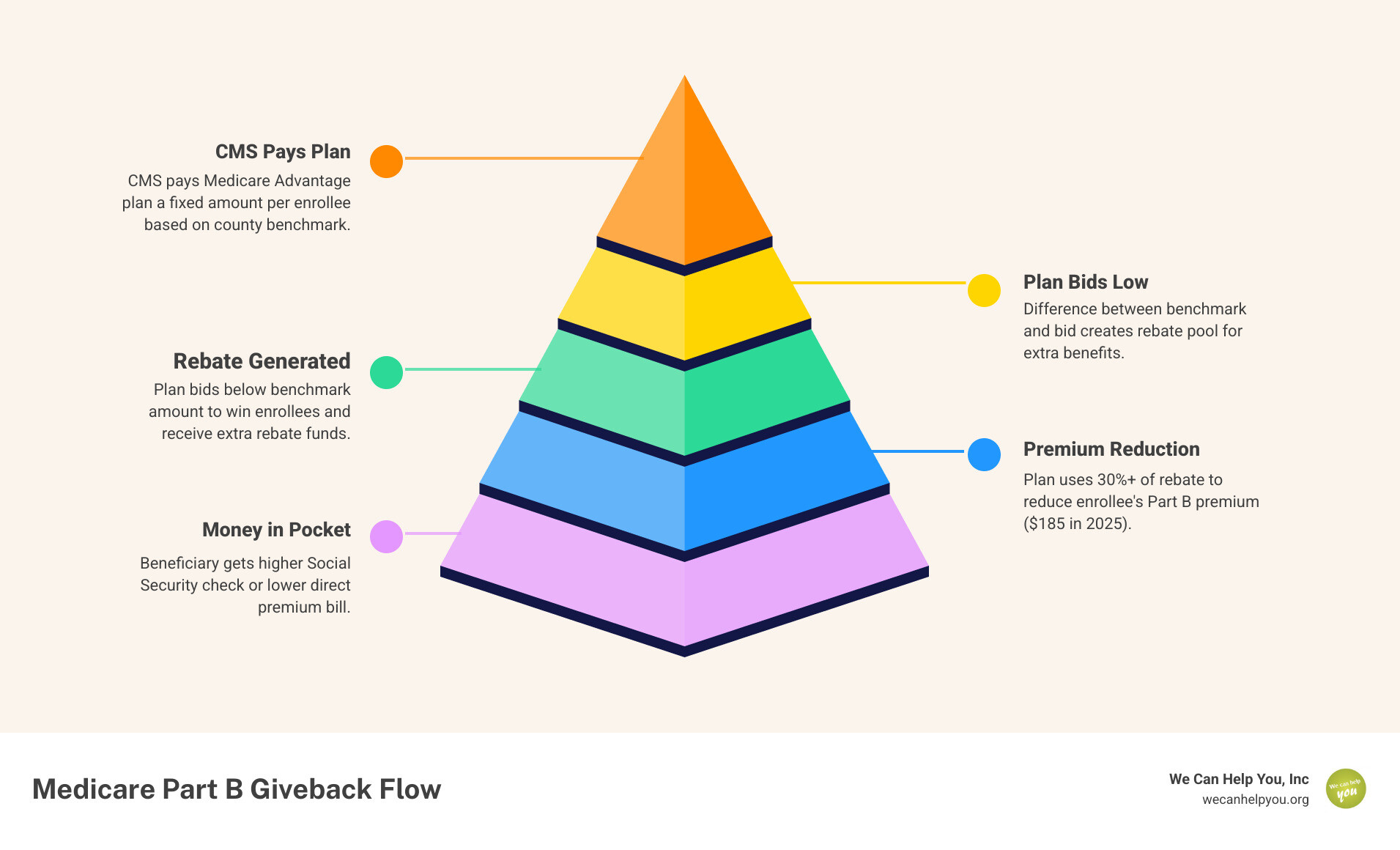
Infographic showing: CMS pays Medicare Advantage plan → Plan bids below benchmark → Rebate funds premium reduction → Reduced Social Security deduction OR lower direct bill → More money in your pocket
What is the Medicare Part B Giveback and How Does It Work?
The medicare part b giveback (technically known as a Medicare Part B premium reduction) is a financial incentive offered by some private insurance companies through their Medicare Advantage (Part C) plans. For most of us, the standard Part B premium is a fixed monthly expense—$185 in 2025—that is taken right out of our Social Security checks. The giveback acts like a “rebate” on that cost.
How does a private company pay for your government premium? It all comes down to the “bid” process. Every year, Medicare Advantage plans submit a bid to the Centers for Medicare & Medicaid Services (CMS) representing the cost of providing care to a member. If a plan manages its costs efficiently and bids below the CMS benchmark, it receives a rebate. The insurance company can use this rebate to offer extra benefits, like dental or vision, or they can use it to pay a portion of your Part B premium.
| Feature | Standard Part B (2025) | With Part B Giveback Plan |
|---|---|---|
| Monthly Premium | $185.00 | $85.00 – $175.00 (Typical) |
| Giveback Amount | $0.00 | $10.00 – $100.00+ |
| Net Social Security Impact | Full deduction | Higher monthly deposit |
We often tell our clients that this is one of the few ways to actually increase your net Social Security income without a cost-of-living adjustment (COLA). For a deeper dive into these mechanics, check out our guide on understanding medicare part b giveback offers.
Eligibility for the medicare part b giveback
To be eligible for this benefit, you must meet a few specific criteria. First, you must be enrolled in both Medicare Part A and Part B. Since the giveback is only available through Medicare Advantage, you must also live within the service area of a plan that offers this specific benefit. In 2025, while 32% of plans offer it, they are not distributed evenly across the country.
There are two major exclusions to keep in mind:
- Medicaid and Medicare Savings Programs: If you are “dual-eligible” and the state already pays your Part B premium through Medicare Savings Programs, you cannot receive a giveback. You can’t get a rebate on a premium you aren’t actually paying!
- Premium Payment: You must be responsible for paying your own Part B premium to qualify for the reduction.
How you receive the medicare part b giveback
You don’t need to file a claim or wait for a check in the mail to get your money. The process for receiving the medicare part b giveback is handled automatically behind the scenes between your insurance plan and the Social Security Administration (SSA).
- If you receive Social Security: The SSA will simply reduce the amount they deduct for Part B. If your premium is $185 and your giveback is $50, they will only take $135. This makes your monthly check look $50 larger.
- If you are direct-billed: If you don’t collect Social Security yet and pay Medicare directly, you will see a Medicare Part B premium reduction as a credit on your quarterly or monthly statement.
Savings and Availability in 2025 and 2026
The landscape for the medicare part b giveback is changing rapidly. According to the Medicare Advantage 2025 Spotlight, nearly one-third of all plans now offer some form of premium reduction. This is a significant jump from 2024, when only 19% of plans included the benefit.
In 2025, the standard premium is $185, and for 2026, it is projected to rise to $202.90. The amount you can save varies wildly:
- 30% of plans offer a small giveback of $10 or less.
- 25% of plans offer between $50.01 and $100.
- 28% of plans offer $100 or more.
While some marketing materials hint at “full” premium coverage, those plans are extremely rare and usually only found in high-competition areas like Florida or parts of California. If you’re looking for local options, you can find medicare insurance agents near me to help navigate the specific plans available in your city.
Regional variations and ZIP codes
The “giveback” is a local game. Because Medicare Advantage plans are based on ZIP codes, a plan available in Chicago, IL may offer a $100 giveback, while a plan in Omaha, NE might only offer $25—or nothing at all. This is due to local healthcare costs and the level of competition between insurers in your specific county.
To find out exactly what is available to you, we recommend using the Medicare Plan Finder tool. When you look at the plan details, look specifically for the line labeled “Part B premium reduction.” If it says $0.00, that plan does not have a giveback.
Pros, Cons, and Marketing Pitfalls to Avoid
At We Can Help You, Inc., we want you to be a savvy shopper. While a medicare part b giveback sounds like “free money,” it is often a trade-off. Insurance companies have a limited pool of money (the rebate) to spend on you. If they spend it on your Part B premium, they might have less to spend on other things.
The Pros:
- Increased Cash Flow: More money in your Social Security check every month.
- Lower Fixed Costs: Great for healthy individuals on a fixed budget.
The Cons:
- Higher Out-of-Pocket Costs: Plans with high givebacks often have higher copays for doctor visits or hospital stays.
- Smaller Networks: You might find that your favorite specialist isn’t in-network for the giveback plan.
- Fewer “Extras”: The plan might offer a giveback but skip out on dental, vision, or gym memberships.
We also urge you to be wary of CMS marketing regulations regarding misleading ads. Some commercials blast “GET $185 BACK!” across the screen, but that specific plan might only be available in one county in the entire country. This “bait-and-switch” tactic is something CMS is actively trying to curb. You can learn more about identifying these tactics by visiting our page for medicare insurance agents near me.
Should you switch for a giveback?
Switching plans just for the giveback is like buying a car just because it comes with a free tank of gas. It’s a nice perk, but the car still has to get you where you’re going. Before you switch, ask yourself:
- Are my drugs covered? Check the formulary.
- Are my doctors in-network? Don’t lose your cardiologist for $50 a month.
- What is the Max Out-of-Pocket (MOOP)? If you get sick, a plan with a $50 giveback but an $8,000 MOOP could cost you much more in the long run.
- What is the Star Rating? A low-rated plan might have poor customer service or slow claims processing.
Frequently Asked Questions about Medicare Part B Giveback
How long does it take to start receiving the giveback?
Don’t expect your very next Social Security check to be larger. There is usually a processing delay of 1 to 3 months after your coverage begins. The SSA and your insurance plan have to sync their data. However, the benefit is retroactive. If it takes three months to process, you will typically receive a “lump-sum” adjustment in your check to cover the missed months. For more on how CMS handles these payments, see the official document on Refunds of Premiums and Copayments.
Can I get the giveback with a Medigap plan?
No. The medicare part b giveback is strictly a feature of Medicare Advantage (Part C). Medigap (Medicare Supplement) plans work differently; they pay after Original Medicare pays its share. They do not receive rebates from the government and therefore cannot offer premium reductions. If you prefer the freedom of Medigap, you’ll have to pay the full Part B premium. You can compare the two paths in this guide to Understanding Medicare Advantage Plans.
Is the giveback benefit income-based?
Unlike Medicaid or the Extra Help program, the giveback is not income-based. Whether you make $20,000 a year or $200,000 a year, if you enroll in a plan that offers a giveback, you get it. However, if you are a high-earner subject to IRMAA (Income-Related Monthly Adjustment Amount), the giveback will simply reduce your total bill. It won’t eliminate the IRMAA surcharge itself, but it will lower the “standard” portion of your premium.
Conclusion
The medicare part b giveback is a fantastic tool for many retirees to keep more of their hard-earned Social Security income. With 32% of plans now offering this benefit, there is a good chance a plan exists in your area—whether you are in Florida, New Jersey, or New Mexico—that can put money back in your pocket.
However, we always remind our community at We Can Help You, Inc. that healthcare is about more than just the monthly premium. You must evaluate the total value of a plan, including its network, drug coverage, and out-of-pocket maximums. Our goal is to help you maximize your retirement income while ensuring you have the best possible care.
If you’re ready to see how a giveback might fit into your retirement strategy, we invite you to explore our resources on understanding medicare part b giveback offers and download our free Medicare Planning Guide today. We are here to help you navigate these complex choices with confidence!