
Understanding Your Medicare Hospice Benefits in 2026
Medicare hospice benefits 2026 provide crucial end-of-life care for terminally ill beneficiaries through Medicare Part A. If you or a loved one needs hospice care, here’s what you need to know right now:
Quick Overview of Medicare Hospice Benefits 2026:
- Eligibility: Medicare Part A coverage + terminal illness diagnosis (6 months or less) + physician certification + acceptance of palliative (comfort) care
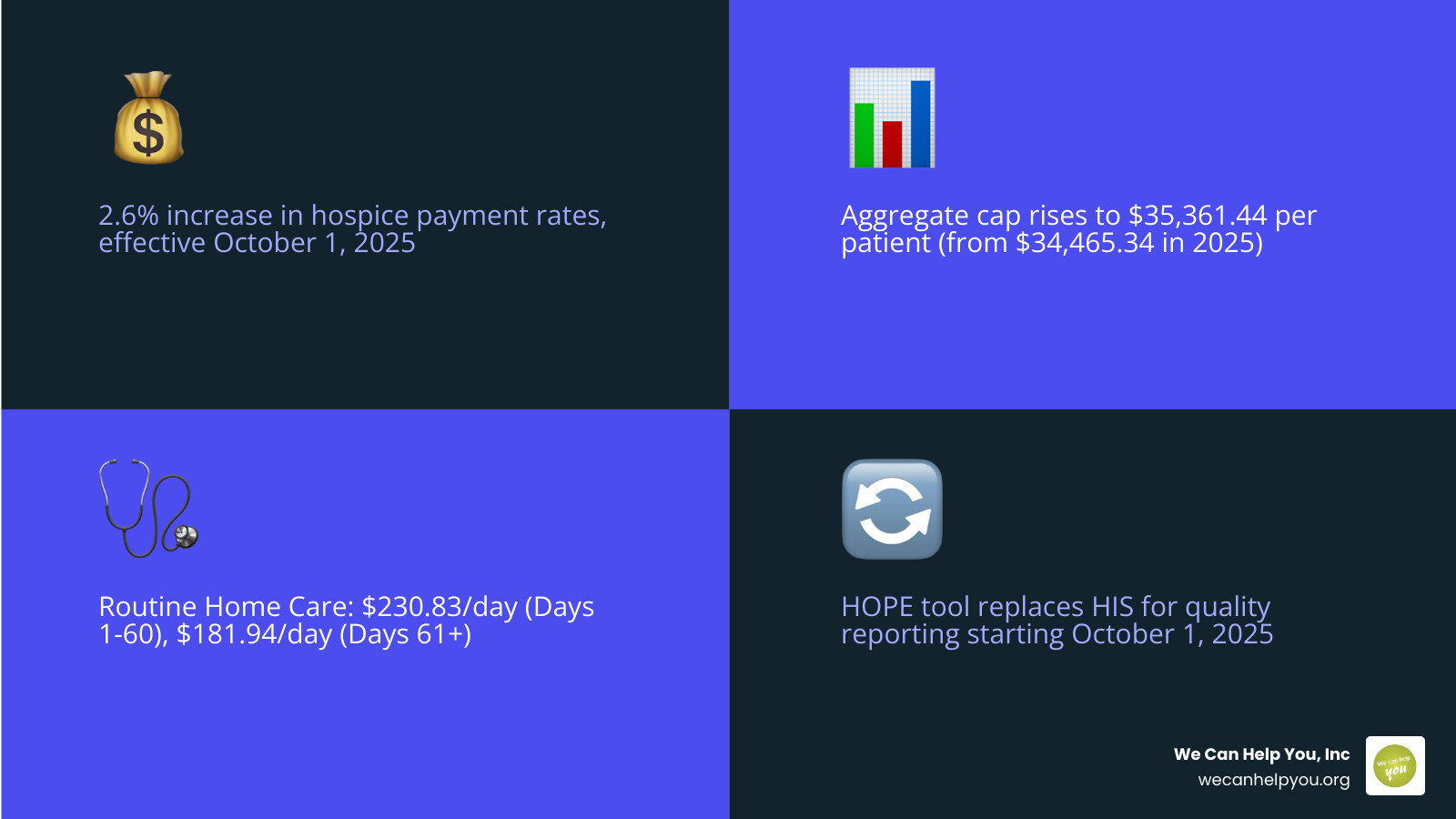
- Payment Update: 2.6% increase in hospice payment rates, effective October 1, 2025
- Aggregate Cap: $35,361.44 per patient (up from $34,465.34 in 2025)
- Your Costs: $0-$5 copay for pain/symptom drugs; 5% of Medicare-approved amount for respite care
- Major Change: Transition from HIS to HOPE quality reporting tool begins October 1, 2025
- Covered Services: Nursing care, medical equipment, medications for symptom management, counseling, respite care
- Not Covered: Curative treatments, room and board (except short-term inpatient/respite), unapproved providers
When facing a terminal illness, understanding your Medicare hospice benefits becomes critical. These benefits focus on palliative care—keeping you comfortable and managing symptoms—rather than curing the illness.
The Centers for Medicare & Medicaid Services (CMS) released the FY 2026 Hospice Final Rule with significant updates affecting both providers and beneficiaries. These changes bring an estimated $750 million increase in Medicare hospice payments nationwide, along with new quality reporting requirements and operational adjustments.
Whether you’re considering hospice for yourself or a family member, this guide walks you through everything that’s changing in 2026. We’ll explain eligibility requirements, what’s covered (and what’s not), new payment rates, and important deadlines you need to know.
Understanding Medicare Hospice Benefits 2026: Eligibility and Coverage

To access medicare hospice benefits 2026, you must meet specific requirements established by 42 CFR part 418. First and foremost, you must be entitled to Medicare Part A (Hospital Insurance). This is the foundation of the benefit.
The core of eligibility rests on a medical prognosis. A hospice doctor and your attending physician (if you have one) must certify that you are terminally ill, meaning you have a life expectancy of six months or less if the illness runs its normal course. This is a sensitive time, and we want you to know that this certification is about opening doors to specialized support, not giving up hope.
Once certified, you must sign an election statement choosing hospice care. By doing this, you acknowledge that you are choosing palliative care for comfort and symptom management over curative treatments intended to fix the illness. You can find more details on how these choices work in our guide on navigating-medicare-and-hospice-care-understanding-costs-and-coverage.
Covered Services and Out-of-Pocket Costs
Medicare’s hospice benefit is remarkably comprehensive, designed to cover almost everything related to the terminal illness. According to 42 CFR 418.3, the focus is on a holistic approach. Covered services include:
- Nursing Care: Regular visits from RNs and LPNs to manage care.
- Medical Equipment: Items like hospital beds, wheelchairs, and oxygen.
- Medical Supplies: Bandages, catheters, and other necessary items.
- Drugs for Symptom Management: Medications specifically for pain relief or comfort.
- Hospice Aide and Homaker Services: Help with personal care and light household tasks.
- Therapies: Physical, occupational, and speech-language therapy if needed for symptom control.
- Counseling: Dietary, spiritual, and grief counseling for the patient and family.
Regarding costs, the financial burden on the family is minimal. You typically pay $0 for hospice care. However, there are two small exceptions:
- Prescription Drugs: You may pay a copayment of up to $5 for each prescription drug for pain and symptom management.
- Respite Care: You may pay 5% of the Medicare-approved amount for inpatient respite care.
Services Not Covered by Original Medicare
While the benefit is broad, it doesn’t cover everything. It is important to understand these exclusions to avoid surprise bills. We’ve detailed these in our recent hospice-huddle-unpacking-cmss-2026-guidelines-and-payment-changes. Non-covered services include:
- Curative Treatment: Any treatment intended to cure your terminal illness is not covered once you elect hospice.
- Unapproved Providers: Care must be arranged by your chosen hospice team. If you seek care from a different provider without arrangement, you may be responsible for the full cost.
- Room and Board: Medicare does not cover room and board if you live in a nursing home or a hospice residential facility, unless the hospice team arranges for short-term inpatient or respite care.
- Ambulance Transport: Transportation is only covered if arranged by the hospice team.
Key Changes in the CMS Hospice Final Rule for FY 2026
The CMS Hospice Final Rule for Fiscal Year (FY) 2026, which begins October 1, 2025, introduces several vital updates. The most headline-grabbing change is the 2.6% overall payment update. This increase is expected to add approximately $750 million in Medicare hospice payments nationwide during the 2026 fiscal year.
CMS also updated the “aggregate cap.” This is the maximum amount Medicare will pay a hospice provider per patient, per year. For FY 2026, the cap is set at $35,361.44, an increase from the $34,465.34 cap in 2025. This adjustment is required under 42 CFR 418.22(b)(4) and ensures that payment limits keep pace with inflation.
Updated Payment Rates for Medicare Hospice Benefits 2026
Payments to hospice agencies are made based on four “levels of care.” Here is how the rates break down for the 2026 fiscal year:
| Level of Care | FY 2026 Daily Rate |
|---|---|
| Routine Home Care (Days 1–60) | $230.83 |
| Routine Home Care (Days 61+) | $181.94 |
| Continuous Home Care (Full Day) | $1,674.29 ($69.76 per hour) |
| Inpatient Respite Care | $532.48 |
| General Inpatient Care | $1,199.86 |
These rates reflect the 2.6% increase and are designed to help providers manage the rising costs of labor and medical supplies while continuing to offer high-quality care.
Wage Index Adjustments and Geographic Impacts
Because the cost of living and labor varies across the country—from the busy streets of Newark, NJ, to the quiet corners of Alliance, NE—Medicare uses a “wage index” to adjust payments. For FY 2026, CMS is using the most recent Hospice Wage Index Information based on updated geographic delineations from the Office of Management and Budget (OMB).
To prevent sudden, drastic drops in funding for hospices in areas where the local economy has shifted, CMS maintains a 5% cap policy. This means that a hospice’s wage index cannot decrease by more than 5% compared to the previous year, providing a safety net for providers in reclassified regions.
The Transition to the HOPE Tool and Quality Reporting
One of the most significant operational shifts in medicare hospice benefits 2026 is the mandatory transition from the Hospice Item Set (HIS) to the Hospice Outcomes & Patient Evaluation (HOPE) tool. Starting October 1, 2025, all Medicare-certified hospices must begin using HOPE.
Unlike the old HIS, which only collected data at admission and discharge, the HOPE tool is designed to capture data at multiple points during the hospice stay. This allows for a more “real-time” look at patient needs and the quality of care being provided. All data must be submitted through the iQIES platform. For more technical details on this shift, providers can visit the official HOPE Technical Information page or browse our tag/hospice-care for clinical updates.
Compliance Thresholds and Payment Penalties
CMS takes quality reporting seriously. To avoid financial penalties, hospices must meet a 90% submission threshold. This means that 90% of all required HOPE records must be submitted within 30 days of the patient “event” (like admission or a scheduled assessment).
If a hospice fails to meet these requirements in FY 2026, they face a 4-percentage point reduction in their annual payment update. Instead of receiving the 2.6% increase, a non-compliant hospice would actually see a -1.4% reduction in their rates. This underscores the importance of staff training, which you can explore further through the Hospice Quality Reporting Training library.
Operational Updates: Physician Roles and Telehealth Extensions
The FY 2026 rules also bring clarity to administrative roles. CMS has finalized a change specifying that any physician member of the hospice interdisciplinary group (IDG) can now recommend a patient for hospice admission. Previously, this role was more strictly defined. However, the final certification of terminal illness still requires the signature of the hospice medical director or a designated physician.
Additionally, CMS has streamlined the “face-to-face” attestation process. Physicians can now use signed clinical notes to satisfy the attestation requirement, rather than having to fill out entirely separate forms, as long as the notes clearly document the encounter. These technical corrections are part of a broader effort to align regulations with Pub. L. 119-4.
Navigating Medicare Advantage and Medicare Hospice Benefits 2026
If you are one of the 31.4 million people enrolled in a Medicare Advantage (MA) plan, you might wonder how hospice works for you. Currently, hospice remains “carved out” of Medicare Advantage. This means that even if you have a private MA plan, your hospice services are paid for by Original Medicare Part A.
There has been much debate about a “carve-in,” where MA plans would manage hospice. A pilot program known as the VBID (Value-Based Insurance Design) demo tested this, but the hospice component ended in 2024 due to low participation. While bills like the Medicare Advantage Reform Act (H.R. 3467) have been introduced to change this, for 2026, the status quo remains: Original Medicare is your hospice provider.
Frequently Asked Questions about 2026 Hospice Care
What is the biggest change in the FY 2026 rule?
The biggest change is the mandatory transition to the HOPE tool for quality reporting, effective October 1, 2025. This replaces the old HIS system and requires hospices to collect data more frequently throughout a patient’s care. We discuss the operational impact of this in our hospice-huddle-unpacking-cmss-2026-guidelines-and-payment-changes guide.
Can any physician certify a patient for hospice in 2026?
No. While any physician in the Interdisciplinary Group (IDG) can recommend admission, the official certification of terminal illness must still be completed by the hospice medical director (or their designee) and the patient’s attending physician (if they have one).
How long is telehealth allowed for hospice recertification?
Telehealth for the “face-to-face” encounter required for hospice recertification has been extended through January 30, 2026. This allows physicians and nurse practitioners to use technology to meet with patients who may have difficulty traveling. You can stay updated on these extensions via the CMS Hospice Regulations and Notices page.
Conclusion
Navigating the end-of-life journey is one of the most challenging experiences a family can face. At We Can Help You, Inc., our mission is to ensure you don’t have to do it alone. As a non-profit dedicated to retirement and Medicare education, we are here to help you unlock the full value of your benefits.
Whether you are in Manchester, NH, Charlotte, NC, or any of our other service locations from Arizona to New York, we want to empower you with knowledge. Understanding medicare hospice benefits 2026 is the first step in ensuring a dignified, comfortable, and well-supported experience for your loved ones.
To help you plan for the future, we invite you to download our free Medicare Planning Guide or request a free Social Security maximization report. These resources are designed to help you increase your retirement income and navigate the complexities of Medicare with confidence. For a deeper dive into how costs are handled, be sure to read our guide on navigating-medicare-and-hospice-care-understanding-costs-and-coverage. We are here to help—every step of the way.