
The Medicare Hospice Coverage Gap Most Families Don’t See Coming
When a loved one enters the final stages of a terminal illness, the focus should be on comfort, dignity, and family connection. However, many families are blindsided by the financial realities of facility-based care. Does Medicare pay for hospice room and board? Here’s the short answer:
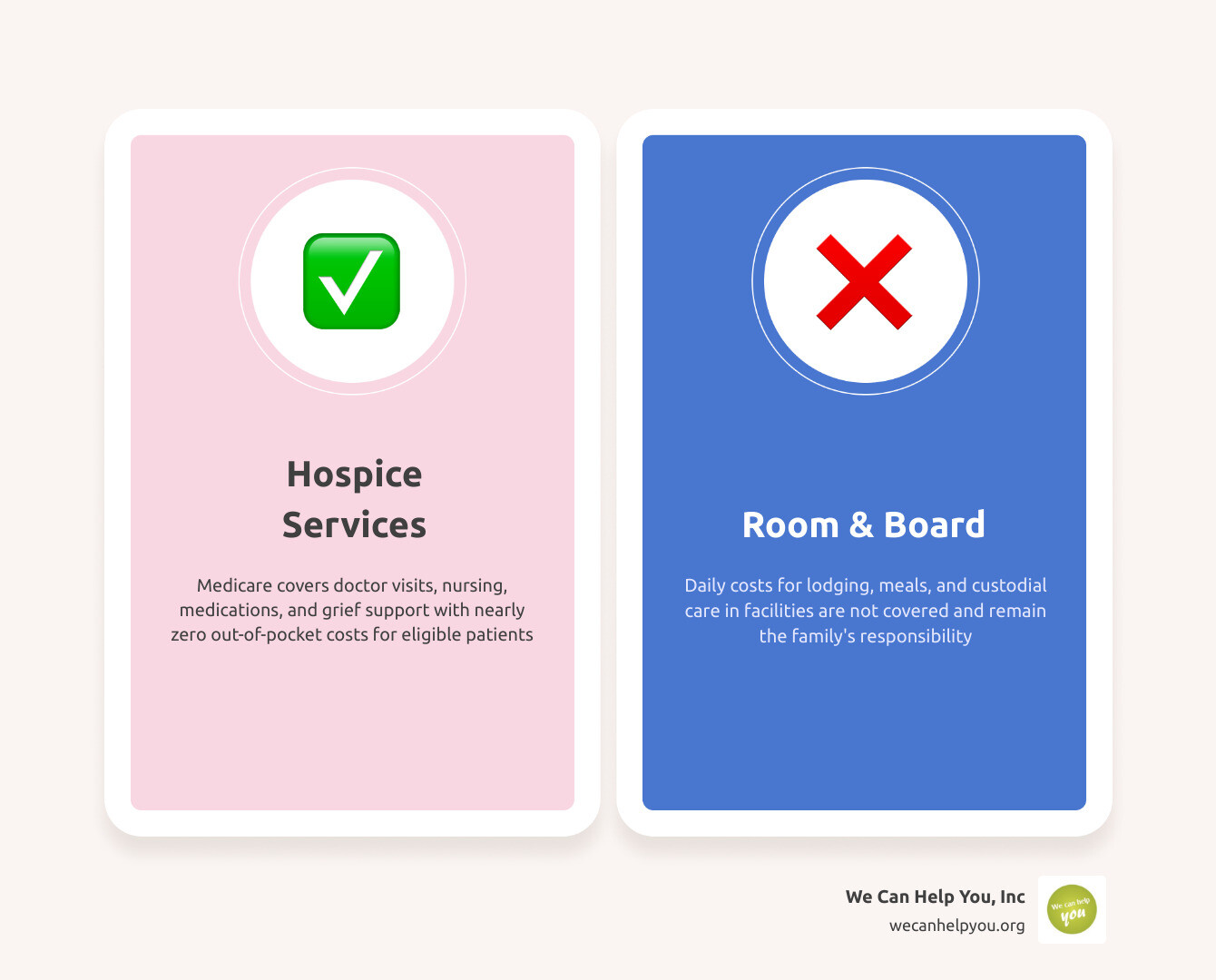
No — Medicare does not cover room and board costs for hospice patients, with two important exceptions.
| Situation | Does Medicare Cover Room & Board? |
|---|---|
| Hospice care received at home | No |
| Hospice care in a nursing home | No |
| Hospice care in a residential hospice facility | No |
| Short-term inpatient care arranged by hospice team | Yes |
| Inpatient respite care arranged by hospice team | Yes (with 5% copay) |
Nearly 99% of hospice patients have no out-of-pocket costs for hospice services — but room and board is a different story. Medicare Part A covers an extensive range of comfort-focused care for people with a terminal illness and a life expectancy of six months or less. This benefit is designed to provide palliative care, which focuses on symptom management rather than curative treatment. What it does not cover is the daily cost of sleeping, eating, and living in a facility while receiving that care.
To qualify for the Medicare hospice benefit, a patient must be certified as terminally ill by both their attending physician and the hospice medical director. Once the benefit is elected, the patient waives the right to Medicare coverage for curative treatments related to their terminal diagnosis. While this covers the medical team, medications for pain, and medical equipment, the “roof over the head” remains the responsibility of the patient or their family.
For families already navigating one of life’s hardest moments, this gap can come as a real shock. Understanding exactly where Medicare’s coverage starts and stops — and what options exist to fill the gap — can save you from a costly surprise at the worst possible time.
Does medicare pay for hospice room and board word list:
Does Medicare Pay for Hospice Room and Board?
When we talk about hospice care, we are usually talking about a philosophy of care rather than a specific building. Most hospice care in the United States—about 98% of all hospice days—is provided as “routine home care.” This means the hospice team comes to wherever you call home, whether that is a private residence, an apartment, or a senior living community.
However, if “home” is a nursing home or an assisted living facility, a common misunderstanding arises. While Medicare pays the hospice agency a daily rate to provide medical equipment, nursing visits, and medications, it does not pay the facility for your rent or meals. This is often referred to as custodial care. Medicare’s logic is that even if you weren’t in hospice, you would still have to pay for your own housing and food. Therefore, these are considered “living expenses” rather than “medical expenses.”

If you are receiving hospice care in a dedicated residential hospice facility, the same rule applies. You are responsible for the “room and board” portion of the bill. These facilities provide a peaceful, home-like environment, but they are not hospitals. Because they are not providing acute medical intervention, Medicare views the stay as residential. For more details on what is included in the broader scope of care, you can view The Complete Guide to Medicare Hospice Coverage.
It is important to remember that Medicare’s primary goal with the hospice benefit is to provide comfort (palliative care) rather than a cure. Because room and board are considered living expenses rather than medical treatments, they fall outside the standard benefit package for routine care. This distinction is a major reason why families search for answers on hospice costs and coverage.
Exceptions: When Medicare Covers Facility Stays
While the general rule is “no,” there are two specific scenarios where the answer to “does medicare pay for hospice room and board” becomes a “yes.” These exceptions are designed to handle medical crises or provide much-needed rest for family caregivers. Understanding these levels of care is essential for families who may need to transition from home care to a facility setting as the illness progresses.
1. General Inpatient Care (GIP)
Sometimes, pain or symptoms become so severe that they cannot be managed in a home setting. This might include uncontrollable respiratory distress, severe agitation, or complex wound care that requires frequent monitoring. In these cases, the hospice team may arrange for the patient to be admitted to a Medicare-approved hospital or hospice inpatient unit. Because this stay is medically necessary for symptom management, Medicare covers the entire cost, including the room and board, for the duration of the crisis. Once the symptoms are stabilized, the patient is typically transitioned back to routine home care.
2. Inpatient Respite Care
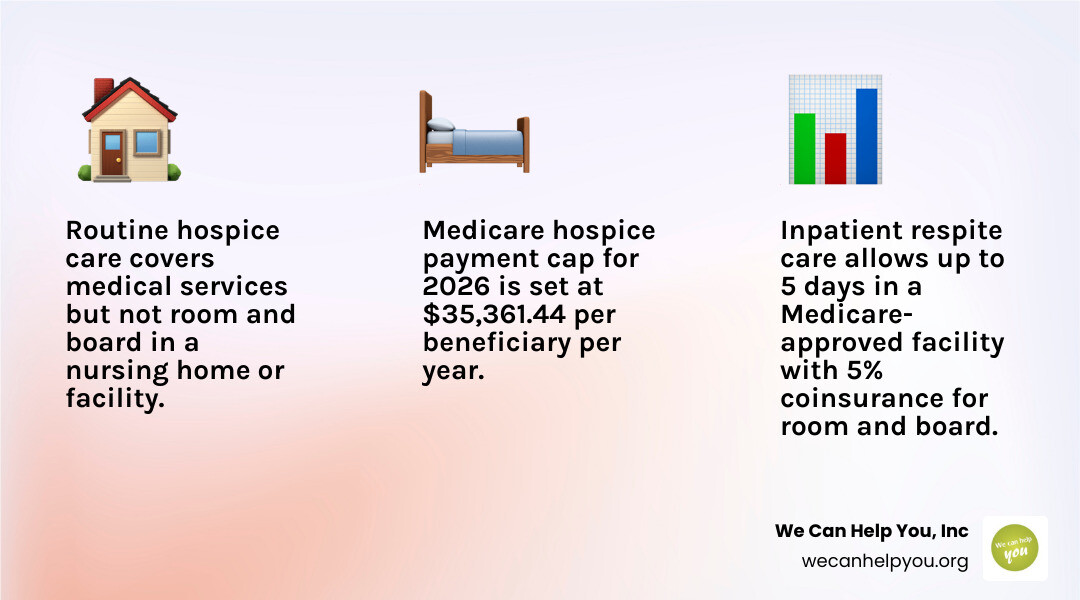
We know that caregiving is an exhausting labor of love, often involving 24/7 attention. Medicare provides a “respite” benefit to give the primary caregiver a break. A patient can stay in a Medicare-approved facility (like a nursing home or hospital) for up to five consecutive days. During this time, Medicare pays for the room and board, though the beneficiary is responsible for a 5% coinsurance payment. This benefit can be used occasionally to allow caregivers to attend a family event, recover from their own illness, or simply rest.

Navigating these levels of care is vital for long-term planning. For a deeper dive into these specific benefits, see our guide on Hospice Help: Unlocking Your Medicare Benefits in 2026. You can also find official regulatory details on the Hospice | CMS website. It is important to coordinate closely with your hospice social worker to ensure that any facility stay meets the strict Medicare criteria for coverage.
Out-of-Pocket Costs and 2026 Payment Caps
As we move through May 2026, it’s important to stay updated on the latest financial figures. Medicare updates its payment rates annually, and these changes affect how much providers receive and, occasionally, what you might pay. These updates are part of the CMS (Centers for Medicare & Medicaid Services) effort to keep pace with inflation and the rising costs of healthcare delivery.
For the 2026 fiscal year, Medicare hospice payment rates increased by approximately 2.6%. This adjustment also raised the “annual cap”—the maximum amount Medicare will pay a hospice provider per patient per year—to $35,361.44. This cap is an aggregate limit for the hospice agency, but it reflects the overall value Medicare places on the comprehensive care provided during the end-of-life journey.
Here is a breakdown of the costs you should expect in 2026:
| Expense Category | Beneficiary Responsibility |
|---|---|
| Covered Hospice Services | $0 |
| Prescription Drugs (Pain/Symptom Management) | Up to $5 per prescription |
| Inpatient Respite Care | 5% of the Medicare-approved amount |
| Room and Board (Routine Care) | 100% of the facility’s rate |
While the $5 drug copay and the 5% respite coinsurance are relatively small, the room and board costs can reach thousands of dollars per month depending on the facility and the state. In 2020 alone, Medicare spent $22.4 billion on hospice services for 1.72 million beneficiaries, highlighting the massive scale of this program. Understanding these numbers helps you plan for the future and avoid financial strain. For the latest updates on these regulations, check out Hospice Huddle: Unpacking CMS’s 2026 Guidelines and Payment Changes.
Frequently Asked Questions about Hospice Room and Board
We often hear from families in states like New York, Ohio, and Florida who are trying to piece this puzzle together. The rules can feel overwhelming, especially when you are focused on the health of a loved one. Here are the most common questions we address.
Does Medicare pay for hospice room and board in a nursing home?
No. If you live in a skilled nursing facility or a long-term care home, Medicare Part A will pay for your hospice medical care (nurses, social workers, supplies), but it will not pay for your room and board. This means the patient or family must continue to pay the facility’s monthly rent.
However, many people in this situation qualify for Medicaid. In many states, if you are eligible for both Medicare and Medicaid (dual-eligible), Medicaid may step in to cover the room and board costs at the nursing home while Medicare handles the hospice services. This is a critical safety net for low-income seniors. We recommend Navigating Medicare and Hospice Care: Understanding Costs and Coverage for more on this intersection.
Does Medicare pay for hospice room and board during respite care?
Yes, but only for short-term stays (up to 5 days) arranged by your hospice team. This is specifically for caregiver relief. You will likely owe a 5% copayment for these days. It is a wonderful benefit for families who need a moment to recharge or handle an emergency. It is important to note that the 5-day limit is per “instance,” and you should talk to your hospice provider about how often this benefit can be utilized. For more on how these daily contributions work, see Daily Hospice Care: Understanding Medicare’s Contribution.
Can I keep my Medicare Advantage plan while receiving hospice?
Yes. If you are enrolled in a Medicare Advantage plan (Part C), you can keep it. However, once you “elect” the hospice benefit, Original Medicare (Part A) usually takes over the payment for all services related to your terminal illness. This is known as a “carve-out” rule. Your Medicare Advantage plan may still cover services unrelated to your terminal condition, such as a broken arm or a pre-existing condition like vision or dental care. This is a complex rule that is explained further in Hospice Social Work: What Medicare Wants You to Know.
Conclusion
The question “does medicare pay for hospice room and board” highlights one of the most significant limitations of the Medicare hospice benefit. While the medical and emotional support is virtually free for 99% of patients, the physical space where that care happens remains a private expense unless a medical crisis or respite need arises. This gap underscores the importance of early retirement planning and understanding the full scope of your benefits.
At We Can Help You, Inc., we believe that no one should have to choose between quality care and financial stability during their final months. As a non-profit dedicated to retirement education, we provide resources to help you maximize your benefits and protect your savings. Whether you are looking for a free Medicare Planning Guide or a Social Security maximization report to increase your retirement income, we are here to support your journey. Our goal is to empower you with the knowledge needed to navigate the complexities of Medicare and Social Security with confidence.
If you are currently planning for end-of-life care, we encourage you to speak with your hospice provider about their contracted facilities and any potential financial assistance programs they may offer. Many non-profit hospices have foundations that can help offset costs for those in need. For more guidance on managing these transitions, visit our resource on Navigating Medicare and Hospice Care: Understanding Costs and Coverage.