
Why Understanding How Social Security Benefits Are Calculated Can Change Your Retirement
Knowing how social security benefits are calculated could be the difference between a comfortable retirement and leaving thousands of dollars on the table.
Here is the quick answer:
How Social Security Benefits Are Calculated (3 Steps)
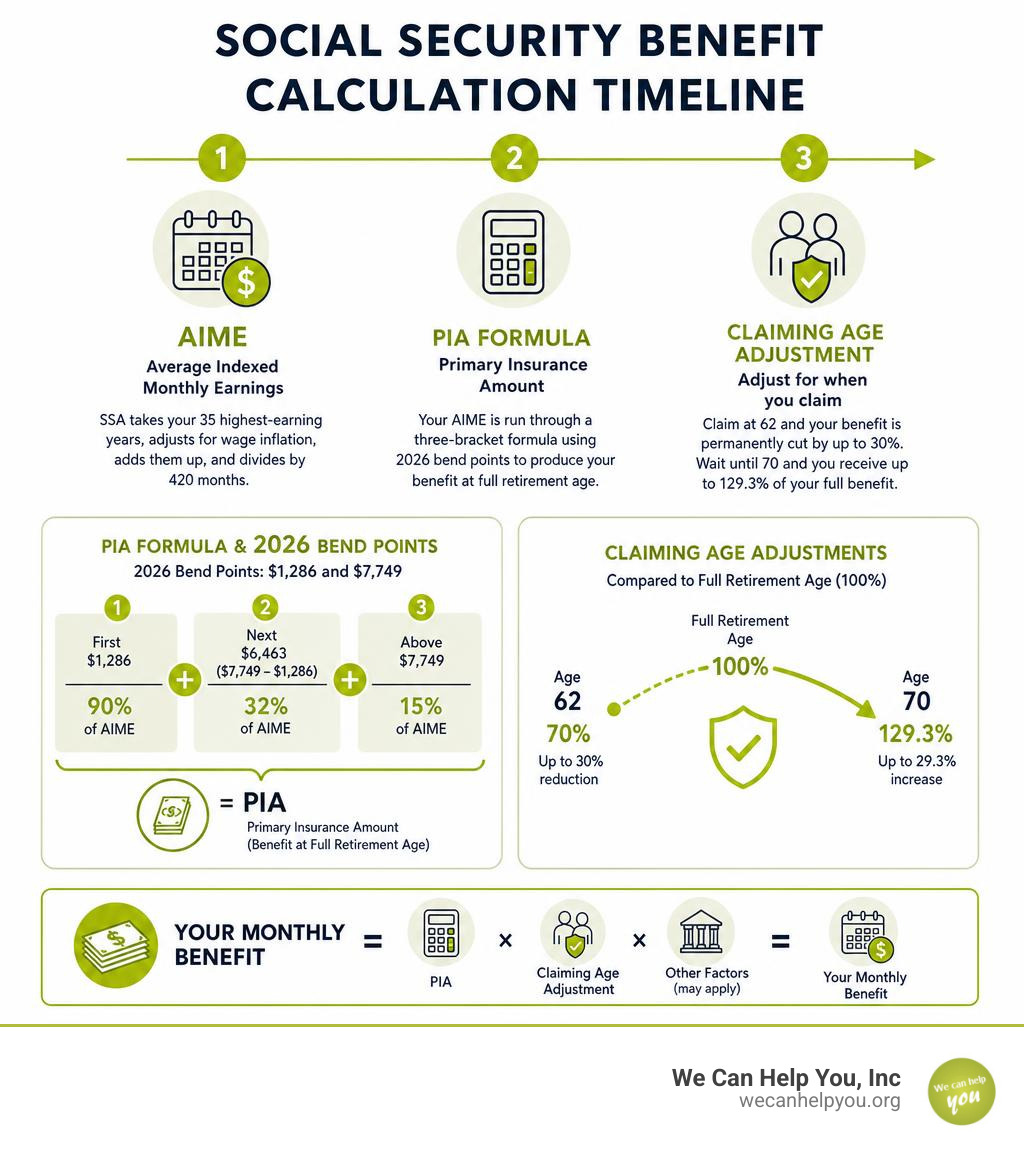
- Calculate your AIME — The Social Security Administration (SSA) takes your 35 highest-earning years, adjusts them for wage inflation, adds them up, and divides by 420 months.
- Apply the PIA formula — Your AIME is run through a three-bracket formula using 2026 bend points ($1,286 and $7,749) to produce your Primary Insurance Amount — the benefit you’d receive at full retirement age.
- Adjust for claiming age — Claim at 62 and your benefit is permanently cut by up to 30%. Wait until 70 and you receive up to 129.3% of your full benefit.
That’s the core formula. But the details — bend points, earnings tests, spousal rules, taxes — matter enormously.
More than 80% of Americans aged 65 and older receive Social Security each month. For roughly 1 in 5, it’s their only source of income. Yet most people don’t fully understand how their benefit amount is determined until it’s too late to change it.
This guide breaks down every piece of the formula using the latest 2026 numbers, so you can make smarter decisions before you file.
How Is Your Social Security Benefits Calculated Amount Determined?
To understand how your monthly check is determined, we have to look behind the curtain at the Social Security Administration’s (SSA) two-step mathematical process. Your benefit is not a random percentage of your final salary, nor is it based on the amount of money you have “saved” in a personal account.
Instead, the SSA relies on a formula that translates your lifetime earnings into a single, standardized monthly benefit. This process relies on two critical acronyms: AIME (Average Indexed Monthly Earnings) and PIA (Primary Insurance Amount).

First, the SSA calculates your AIME by looking at up to 35 of your highest-earning years. However, because a dollar earned in 1985 had much more purchasing power than a dollar earned in 2026, the SSA uses “indexing factors” to adjust your historical earnings. This ensures that your past wages are evaluated in today’s economic terms.
Once your lifetime earnings are indexed, the SSA applies a progressive formula to determine your PIA. Your PIA is the exact monthly benefit you are entitled to receive if you claim at your Full Retirement Age (FRA).
For a highly detailed explanation of this foundational mathematical process, you can explore the official Social Security Retirement Benefit Calculation documentation or read our guide on Average Indexed Monthly Earnings (AIME).
How Your Social Security Benefits Calculated Base (AIME) Is Formed
Your AIME is the foundation of your entire retirement benefit. To calculate it, the SSA follows a strict step-by-step methodology:
- Verify Your Earnings Record: The SSA tracks your covered earnings year by year, up to the annual maximum taxable wage base.
- Apply Indexing Factors: Earnings from past years are multiplied by an indexing factor. This factor is calculated by taking the national average wage index for the year you turn 60 and dividing it by the average wage index for each prior year. For any year you worked at age 60 or older, the indexing factor is exactly 1.0.
- Select the Top 35 Years: The SSA selects the 35 years with the highest indexed earnings.
- Sum and Divide: The indexed earnings from these 35 top years are added together. The total is then divided by 420 (the number of months in 35 years). Finally, the result is rounded down to the next lower dollar.
But what if you didn’t work for a full 35 years? This is a common pitfall. If you only have 30 years of documented earnings, the SSA does not adjust the divisor. They will still divide your total earnings by 420, meaning five “zero-earnings” years will be factored into your calculation. This significantly drags down your AIME and, consequently, your monthly check.
To learn how to avoid this and step through the math yourself, see our guide on Your AIME, Your Future: A Step-by-Step Guide to Calculating Your Average Indexed Monthly Earnings.
Applying the PIA Formula to Your AIME
Once your AIME is established, the SSA converts this monthly average into your Primary Insurance Amount (PIA) using a piecewise formula. This formula is designed to be progressive, meaning it replaces a larger percentage of lifetime earnings for lower-wage earners than for higher-wage earners.
The formula divides your AIME into three distinct portions using dollar thresholds known as bend points. These bend points change every year based on national wage trends. For anyone first becoming eligible for benefits in 2026, the bend points are locked in at $1,286 and $7,749.
Once the bend points segment your AIME, the SSA applies three fixed percentages: 90%, 32%, and 15%. The sum of these three calculated portions represents your basic benefit at Full Retirement Age.
If you want to understand how this formula treats different income levels without getting bogged down in the algebra, read AIME for Social Security Explained Without the Math Headache.
The 2026 Bend Points and Key Social Security Numbers
Every year, the SSA adjusts its limits, thresholds, and formulas to keep pace with inflation and wage growth. Staying on top of these yearly updates is essential for accurate retirement planning. Below is a summary of the key limits and maximums for 2026.
| Category | 2026 Value |
|---|---|
| First Bend Point | $1,286 |
| Second Bend Point | $7,749 |
| Cost-of-Living Adjustment (COLA) | 2.8% |
| Maximum Taxable Wage Base | $184,500 |
| Max Monthly Benefit (Age 62) | $2,969 |
| Max Monthly Benefit (FRA – Age 67) | $4,152 |
| Max Monthly Benefit (Age 70) | $5,181 |
For historical context and a look at how these numbers are established annually, you can refer directly to the official Social Security Benefit Amounts page.
Understanding the 2026 Bend Points
To see exactly how social security benefits are calculated using the 2026 bend points, let’s break down the progressive brackets. If you become eligible for retirement benefits in 2026, your PIA is calculated as follows:
- Bracket 1: 90% of your AIME up to the first bend point of $1,286.
- Bracket 2: 32% of your AIME for amounts between $1,286 and $7,749.
- Bracket 3: 15% of your AIME for any amount that exceeds the second bend point of $7,749.
Let’s look at a quick example. Imagine a worker retiring in 2026 with an AIME of $6,000.
- First, we take 90% of the first $1,286, which equals $1,157.40.
- Next, we find the amount of AIME in the second bracket: $6,000 minus $1,286 equals $4,714. We take 32% of $4,714, which equals $1,508.48.
- Because this worker’s AIME is below the second bend point of $7,749, nothing falls into the third bracket.
Adding these portions together ($1,157.40 + $1,508.48) gives us a PIA of $2,665.88 (rounded down to the nearest dime, or $2,665.80). This is the exact monthly amount this worker would receive at their Full Retirement Age.
2026 COLA, Taxable Wage Base, and Maximum Benefits
The year 2026 brings several important baseline changes to the Social Security system:
- Cost-of-Living Adjustment (COLA): Beneficiaries receive a 2.8% COLA in 2026, helping to preserve the purchasing power of their monthly checks against inflation.
- Taxable Wage Base: The maximum amount of annual earnings subject to the 6.2% Social Security payroll tax rises to $184,500 in 2026. Any earnings above this cap are not taxed, and they do not count toward your future benefit calculations.
- Maximum Monthly Benefits: Because of the wage cap, there is a hard ceiling on how much a retiree can receive. In 2026, the maximum monthly benefits are:
- $2,969 for those who claim early at age 62.
- $4,152 for those who claim at their Full Retirement Age (67).
- $5,181 for those who delay claiming until age 70.
How Claiming Age Affects Your Monthly Benefit
Your PIA is only half of the story. The final amount you see on your monthly check depends heavily on when you choose to claim your benefits. While you can file for retirement benefits as early as age 62, doing so comes with a cost. Conversely, waiting past your Full Retirement Age rewards you with permanent increases.

This age-based adjustment is permanent. Once you file, your base benefit is locked in (aside from annual COLA increases), making the decision of when to claim one of the most critical financial choices you will ever make. To dive deeper into how delaying your claim can boost your monthly income, read our guide on how to Unlock More Money: A Guide to Delayed Social Security Credits.
Claiming at Age 62 vs. Full Retirement Age (FRA)
For anyone born in 1960 or later, the Full Retirement Age is exactly 67. If you choose to claim your benefits before this milestone, the SSA applies an early-filing penalty.
If you claim at exactly age 62, your monthly benefit is slashed by 30 percent compared to your PIA. This reduction is calculated using a specific formula:
- Your benefit is reduced by 5/9 of 1% for each of the first 36 months before your FRA.
- It is further reduced by 5/12 of 1% for each month beyond 36 months.
This reduction is a permanent penalty. If your PIA is $2,000 at age 67, claiming at age 62 reduces your monthly check to just $1,400. To see how these age reductions play out if you choose to claim mid-way through early retirement, check out our breakdown on Calculating How Much Social Security You Will Receive at 65.
Delaying Benefits to Age 70 for Maximum Payout
If you have the financial flexibility to wait, delaying your benefits past your Full Retirement Age is one of the most guaranteed ways to secure a higher return.
For every year you delay claiming beyond your FRA (up to age 70), your benefit increases by 8% per year through delayed retirement credits. This equates to an increase of 2/3 of 1% for each month you wait.
For someone with an FRA of 67, delaying until age 70 results in a permanent 24% increase over their PIA. When combined with compounding COLAs, waiting until 70 can yield a benefit that is 129.3% of your original FRA amount. No delayed retirement credits are earned after you reach age 69, so there is never a reason to delay claiming past your 70th birthday.
Working While Receiving Benefits: The Earnings Test
Many retirees choose to continue working part-time or even full-time while collecting their Social Security benefits. If you do this before reaching your Full Retirement Age, you must navigate the Social Security Earnings Test.
If your earnings exceed certain annually adjusted thresholds, the SSA will temporarily withhold a portion of your benefits. To see how your specific work situation might affect your payouts, you can run your numbers through the official Benefit Calculators | SSA.
How the Earnings Test Affects Your Social Security Benefits Calculated Total
The earnings test rules differ depending on how close you are to your Full Retirement Age:
- When You Are Under FRA for the Entire Year: In 2026, if you are under your FRA, the earnings limit is $22,320 (note: this is adjusted annually). If you earn more than this limit, the SSA will withhold $1 in benefits for every $2 you earn above the threshold.
- In the Year You Reach FRA: During the months leading up to your FRA birthday, a higher limit of $59,520 applies. The SSA will withhold $1 in benefits for every $3 you earn above this threshold, counting only the earnings you make before the month you hit FRA.
- Once You Reach FRA: The earnings test disappears entirely. Starting the month you reach your FRA, you can earn an unlimited amount of money with zero benefit withholding.
It is vital to understand that withheld benefits are not lost forever. Once you reach your Full Retirement Age, the SSA recalculates your monthly benefit upward to account for the months your benefits were withheld. This means your monthly check will permanently increase, allowing you to gradually recoup the withheld funds over time.
Spousal, Survivor, and Dependent Benefits
Social Security is designed to protect families, not just individual workers. If you are married, divorced, widowed, or raising dependent children, you may be eligible for benefits based on your spouse’s or parent’s earnings record.
These family benefits can provide a crucial financial safety net. To see if you qualify for these additional programs, read our article: Are You Missing Out on Social Security Spousal Benefits?.
How Are Spousal and Survivor Social Security Benefits Calculated?
Family benefits are calculated as a direct percentage of the primary worker’s PIA:
- Spousal Benefits: If you claim at your FRA, your spousal benefit can be up to 50% of your spouse’s PIA. If your own retirement benefit is higher than 50% of your spouse’s, you will receive your own higher benefit instead. Claiming spousal benefits early (before your FRA) will permanently reduce the monthly amount.
- Survivor Benefits: If your spouse passes away, you may be entitled to receive 100% of their monthly benefit as a survivor benefit, provided you have reached your FRA. If you claim survivor benefits early (available as early as age 60, or age 50 if disabled), the benefit is reduced.
- Divorced Spouses: If you were married for at least 10 years, are currently unmarried, and are at least age 62, you can claim spousal or survivor benefits based on your ex-spouse’s record. This claim will not impact your ex-spouse’s benefit or any benefits their current spouse receives.
To see the exact mathematical relationships between these claiming options, check out our guide on The Math Behind Your Spousal Social Security Benefits.
Taxation of Social Security and Combined Income
A common surprise for new retirees is discovering that their Social Security benefits may be subject to federal income taxes. Whether you owe taxes on your benefits depends on your combined income (often called provisional income).
Surprisingly, the income thresholds for taxing Social Security benefits have never been adjusted for inflation since they were first introduced in 1983 and expanded in 1993. As a result, more retirees than ever before find themselves owing federal income taxes on their benefits.
Calculating Your Combined Income
To determine if your benefits are taxable, you must first calculate your combined income using this simple formula:
$$\text{Combined Income} = \text{Adjusted Gross Income (AGI)} + \text{Nontaxable Interest} + 50\% \text{ of your Social Security benefits}$$
Once you have your combined income total, apply the federal tax brackets based on your tax filing status:
If You File as Single:
- Under \$25,000: You owe 0% tax on your benefits.
- Between \$25,000 and \$34,000: Up to 50% of your benefits may be taxed.
- Over \$34,000: Up to 85% of your benefits may be taxed.
If You File Jointly (Married):
- Under \$32,000: You owe 0% tax on your benefits.
- Between \$32,000 and \$44,000: Up to 50% of your benefits may be taxed.
- Over \$44,000: Up to 85% of your benefits may be taxed.
Please note that this does not mean you pay an 85% tax rate on your benefits. Rather, it means that up to 85% of your benefit amount is added to your taxable income and taxed at your ordinary marginal income tax rate.
Strategies to Maximize Your Lifetime Benefits
Maximizing your lifetime Social Security payout requires careful planning and a clear strategy. Because every individual’s financial situation, health status, and life expectancy are unique, there is no single “correct” age to claim. However, these proven strategies can help you maximize your lifetime benefits:
- Work a Full 35 Years: Ensure you have at least 35 years of covered earnings so you do not have any “zero” years dragging down your AIME.
- Maximize Your Peak Earning Years: If you are nearing retirement, replacing a low-earning year from your youth with a high-earning year today will instantly boost your AIME.
- Delay Claiming If Possible: If you are in good health and have other assets to live on, delaying your claim up to age 70 guarantees an 8% annual increase that is hard to match in any traditional investment market.
- Coordinate Spousal Claims: Couples should coordinate their filing dates. Often, it makes sense for the lower-earning spouse to claim early while the higher-earning spouse delays until age 70 to maximize both the current joint income and the future survivor benefit.
To learn more about how to evaluate these strategies for your household, read our guide: Don’t Guess, Calculate: A Guide to Your Future Social Security Payments.
Using Official SSA Calculators to Plan
To build an accurate retirement plan, you should utilize the official tools provided by the Social Security Administration. These tools allow you to model different scenarios without requiring you to share sensitive personal information with third-party websites:
- The Quick Calculator: This tool provides a fast, rough estimate of your retirement, disability, and survivor benefits based on your current earnings. You can access it directly at the Social Security Quick Calculator.
- The Online Calculator: This tool allows you to manually input your historical earnings record from your official statement to produce a highly accurate benefit estimate.
- The Detailed Calculator: A robust, downloadable program designed for complex calculations, particularly for individuals affected by specialized rules like the Windfall Elimination Provision (WEP) or the Government Pension Offset (GPO).
Frequently Asked Questions About How Benefits Are Calculated
What happens if I have fewer than 35 years of work history?
If you do not have 35 years of covered work history, the SSA will still use a 35-year base (420 months) to calculate your AIME. For every year you lack documented earnings, a zero is averaged into your formula. This significantly lowers your AIME and reduces your monthly benefit. Working even part-time to replace those zero-wage years can have a major positive impact on your final benefit amount.
How does the 2026 COLA affect my monthly benefit?
The 2.8% COLA for 2026 is an automatic inflation adjustment designed to help your benefits keep up with the rising cost of goods and services. If you are already receiving benefits, your monthly check will automatically increase by 2.8% starting in January 2026. If you have not yet claimed benefits, your future PIA is adjusted behind the scenes to ensure your starting benefit maintains its purchasing power.
Can I estimate my benefits without creating an online account?
Yes. If you do not want to set up an online “my Social Security” account, you can still estimate your benefits using the official Quick Calculator. By entering your birth date, current year earnings, and planned retirement age, the calculator will generate a reliable estimate of your future monthly payments.
Conclusion
Understanding how social security benefits are calculated is a critical step toward securing your financial future. The decisions you make today—whether to work a few more years, how to coordinate with your spouse, or exactly when to file—will impact your monthly income for the rest of your life.
At We Can Help You, Inc., our mission as a non-profit is to educate and empower you to navigate these complex retirement systems with confidence. We specialize in helping retirees optimize their benefits and coordinate their Social Security with Medicare.
To take the guesswork out of your retirement planning, we invite you to request our free Medicare Planning Guide and a personalized Social Security maximization report. Let us help you find the smartest path forward. Explore our resources today at Social Security to get started.