
Understanding Social Security Spousal Benefits: Your Path to Financial Security
Social Security spousal benefits allow you to receive monthly payments based on your spouse’s work record—even if you’ve never worked or earned very little. This often-overlooked benefit can provide up to 50% of your spouse’s full retirement amount, potentially adding thousands of dollars to your household income each year.
Quick Answer: Social Security Spousal Benefits at a Glance
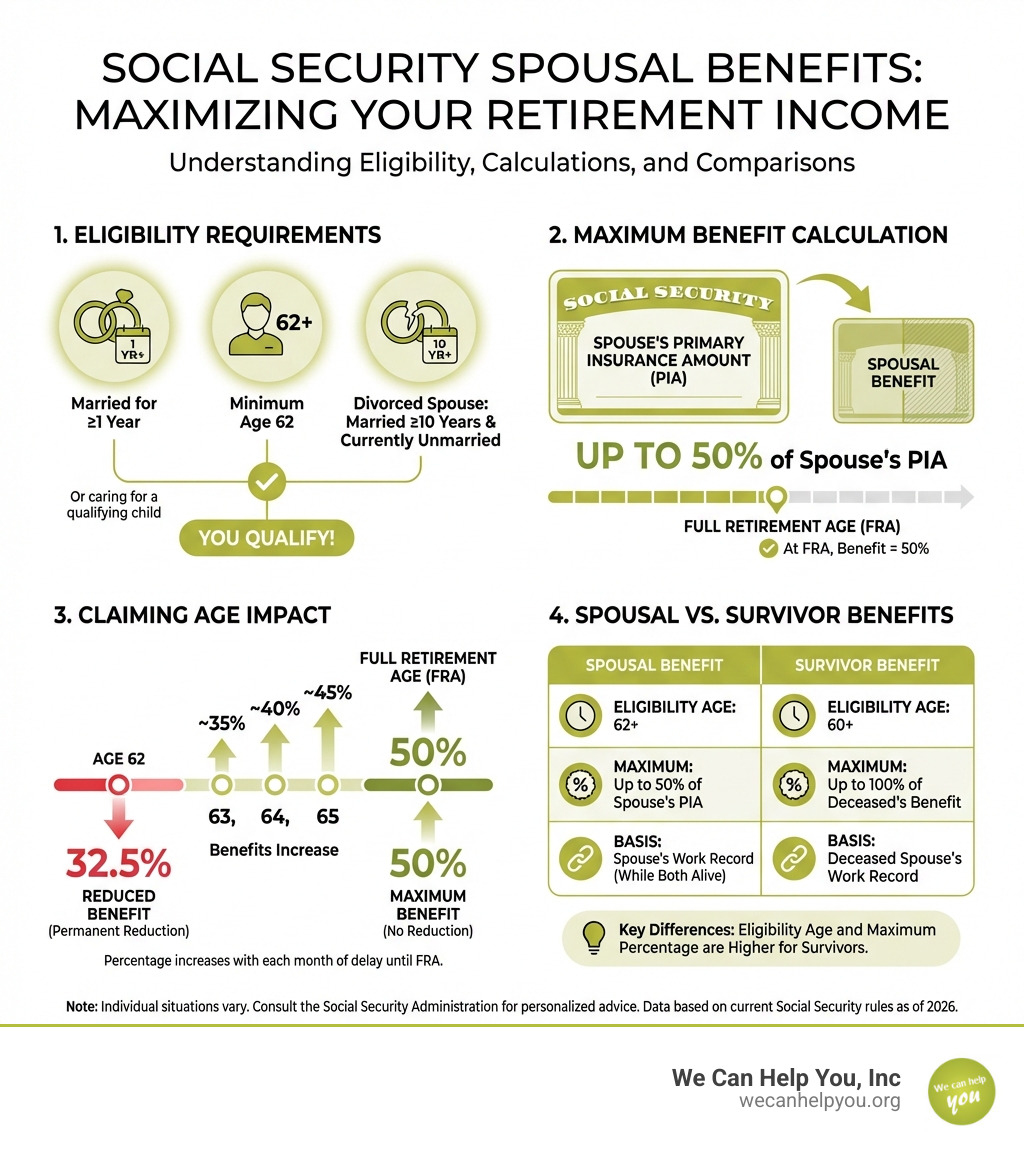
- Eligibility: You must be at least 62 years old and married for at least one year (or caring for a qualifying child)
- Maximum Benefit: Up to 50% of your spouse’s full retirement age benefit
- Divorced Spouses: Can claim if married for 10+ years and currently unmarried
- Your Own Benefit: If you qualify for both, you’ll receive the higher amount
- Claiming Early: Reduces your benefit permanently (as low as 32.5% at age 62)
- Survivor Benefits: Can increase to 100% of deceased spouse’s benefit
Many people approaching retirement feel overwhelmed by Social Security’s complex rules. You might worry about making the wrong decision or leaving money on the table. The truth is, spousal benefits represent a significant source of retirement income that many couples overlook or misunderstand.
Whether you stayed home to raise children, worked part-time, or simply earned less than your spouse, spousal benefits ensure you’re not left behind in retirement. These benefits don’t reduce your spouse’s payment—they’re designed to help families maximize their combined Social Security income.
Understanding how spousal benefits work is crucial for making informed decisions about when to claim and how much you’ll receive. The timing of your application can mean the difference between receiving $1,050 per month or $1,400 per month—a difference of more than $4,000 per year.
Who Can Claim Spousal Benefits? The Eligibility Checklist
Navigating Social Security can feel a bit like solving a puzzle, but when it comes to Social Security spousal benefits, we’re here to help you fit the pieces together. The first step is understanding if you’re eligible. Let’s walk through the key requirements.
Understanding Your Social Security Spousal Benefits Eligibility
So, who exactly is eligible for Social Security spousal benefits? Generally, you can qualify for benefits on your spouse’s record if they are already receiving retirement or disability benefits. Here are the core criteria:
- Your Spouse’s Status: Your spouse must currently be receiving Social Security retirement or disability benefits. You generally cannot claim spousal benefits until they have filed for their own.
- Marriage Duration: You must have been married to your spouse for at least one continuous year immediately before applying for benefits. There are exceptions, such as if you are the natural parent of your spouse’s child.
- Age Requirement: You must be at least 62 years old to claim spousal benefits. However, there’s a significant exception that can allow you to claim earlier.
- Caring for a Qualifying Child: If you are caring for a child who is younger than 16 or who is disabled, and that child is entitled to benefits on your spouse’s record, you can claim spousal benefits at any age without the age 62 requirement. This is a fantastic provision for families!
- Your Own Benefits: For most people, your own Social Security retirement benefit must be less than half of your spouse’s full retirement age benefit. If your own benefit is higher, the Social Security Administration (SSA) will pay you your own benefit. If your own benefit is lower, they will pay you your own benefit plus an additional amount from your spouse’s record to bring you up to the spousal benefit amount.
Social Security laws have evolved to be inclusive. For same-sex couples, the Social Security Administration (SSA) now recognizes valid marriages, meaning if you meet the other criteria, you are eligible for spousal benefits just like any other married couple. This applies if your marriage is recognized in your state of domicile, such as in Connecticut, Illinois, Massachusetts, New Jersey, New York, Pennsylvania, or Virginia, among the states we serve. Even if you were married in one state but reside in another that historically did not recognize same-sex marriage, the SSA generally uses the wage earner’s “place of domicile” as the relevant state law. However, if your state does not recognize your marriage, you might need to consult a local practitioner about your state’s relationship recognition and intestacy laws, as these could potentially provide a basis for a claim.
Special Rules for Divorced Spouses
What if your marriage didn’t last forever, but you still need retirement support? Don’t worry, Social Security spousal benefits can extend to divorced spouses as well! This is a common situation, and the rules are quite specific:
- Marriage Duration: Your marriage must have lasted for at least 10 continuous years.
- Marital Status: You must currently be unmarried. If you remarried, you generally cannot collect on a former spouse’s record unless your later marriage ended (by death, divorce, or annulment).
- Age Requirement: You must be at least 62 years old.
- Ex-Spouse’s Eligibility: Your ex-spouse must be entitled to Social Security retirement or disability benefits. They don’t necessarily have to be receiving them yet, but they must be eligible.
- Independence: The best part? Your ex-spouse does not need to know you are applying for benefits, and your claim will not affect their benefit amount or their current spouse’s benefit. You can claim independently!
For example, if you were married for 15 years, divorced for 5 years, and are now 63 and unmarried, you could potentially claim benefits on your ex-spouse’s record, provided they are at least 62 and eligible for their own benefits. This can be a significant financial lifeline.
For more detailed information and resources on various Social Security benefits, we encourage you to explore our page on Social Security Benefits.
How Your Social Security Spousal Benefits Are Calculated
Understanding how your Social Security spousal benefits are calculated is key to knowing what you can expect in retirement. It’s not just a flat amount; several factors come into play, primarily revolving around your spouse’s earnings record and your age when you decide to claim.
The 50% Maximum Rule Explained
Let’s explain the calculation. Your spousal benefit is based on your spouse’s Primary Insurance Amount (PIA). The PIA is the benefit your spouse would receive if they filed at their Full Retirement Age (FRA). Your maximum spousal benefit is 50% of your spouse’s PIA.
This 50% is based on your spouse’s benefit at their Full Retirement Age, not necessarily the amount they are actually receiving if they claimed early or delayed. For instance, if your spouse earned delayed retirement credits by waiting past their FRA, those credits increase their benefit, but they do not increase your spousal benefit. Your spousal benefit remains capped at 50% of their PIA at FRA.
For example, if your spouse’s PIA at their FRA is $2,800 per month, your maximum spousal benefit would be $1,400 per month (50% of $2,800). This is the amount you would receive if you claim at your own Full Retirement Age.
To get a clearer picture of what your spousal benefit might look like, we highly recommend using the SSA’s official online tool. You can estimate your benefit by visiting Use the SSA’s online calculator. This tool can help you visualize the impact of different claiming ages.
How Your Claiming Age Affects Your Payment
Just like your own retirement benefits, claiming your Social Security spousal benefits before your Full Retirement Age (FRA) will result in a permanent reduction in your monthly payment. Conversely, waiting until your FRA means you receive your full 50% entitlement.
Your Full Retirement Age depends on your birth year:
- Born before 1943: FRA is 65
- Born between 1943 and 1954: FRA is 66
- Born between 1955 and 1959: FRA gradually increases from 66 and 2 months to 66 and 10 months
- Born in 1960 or later: FRA is 67
If you claim spousal benefits as early as age 62, your benefit could be permanently reduced to as little as 32.5% of your spouse’s PIA. This is a significant reduction, and it’s why timing is so important. There is no incentive to delay claiming spousal benefits past your own Full Retirement Age, as the benefit amount does not increase further.
Let’s look at some approximate reduction percentages based on claiming age, assuming an FRA of 67:
- Age 62: Approximately 32.5% of your spouse’s PIA
- Age 63: Approximately 35.8% of your spouse’s PIA
- Age 64: Approximately 39.2% of your spouse’s PIA
- Age 65: Approximately 42.5% of your spouse’s PIA
- Age 66: Approximately 45.8% of your spouse’s PIA
- Age 67 (FRA): 50% of your spouse’s PIA
As you can see, the difference between claiming at 62 and waiting until your FRA of 67 can be substantial. For example, if your spouse’s PIA is $2,800, your benefit could be $910 at age 62 versus $1,400 at age 67. That’s an extra $490 per month just by waiting! This highlights the importance of strategic planning, which we’ll discuss further in a later section.
Navigating Special Circumstances: Survivors and Pensions
The world of Social Security includes more than just retirement and spousal benefits. It also offers crucial support for survivors and can be impacted by other government pensions. Let’s explore these special circumstances.
Spousal vs. Survivor Benefits: What’s the Difference?
While both Social Security spousal benefits and survivor benefits are based on another person’s work record, they serve different purposes and have distinct rules. It’s a common point of confusion, so let’s clarify with a quick comparison.
| Feature | Spousal Benefits | Survivor Benefits training Born in 1960 or later, your full retirement age is 67. If you choose to claim at age 62, your spousal benefit would be reduced to 32.5% of your spouse’s full retirement age amount.
- If you wait until you reach full retirement age, you’ll receive your full spouse’s benefit amount, which is 50% of your spouse’s benefit at their full retirement age.
The Impact of Government Pensions (GPO & WEP)
For some individuals, especially those who worked for a government agency or employer that did not pay into Social Security, their Social Security spousal benefits can be affected by two provisions: the Government Pension Offset (GPO) and the Windfall Elimination Provision (WEP). These rules were designed to prevent what Congress considered “windfalls” for individuals who receive a pension from non-covered employment and also qualify for Social Security.
- Government Pension Offset (GPO): This provision can reduce or even eliminate your Social Security spousal benefits (or survivor benefits) if you also receive a pension from a federal, state, or local government based on work where you did not pay Social Security taxes. The GPO reduces your Social Security spousal or survivor benefit by two-thirds of your government pension. For example, if your government pension is $1,200 per month, two-thirds of that is $800. If your potential spousal benefit is $1,000, it would be reduced by $800, leaving you with only $200 per month in spousal benefits.
- Windfall Elimination Provision (WEP): The WEP primarily affects your own Social Security retirement or disability benefit, not typically spousal benefits directly, if you also receive a pension from non-covered employment. It reduces the formula used to calculate your own Social Security benefit, leading to a lower payment.
The good news is there’s a significant legislative change on the horizon! The Social Security Fairness Act of 2023 aims to repeal both the GPO and WEP. This act, if fully implemented for benefits payable after December 2023, would mean that your Social Security benefits, including spousal and survivor benefits, would no longer be diminished by these provisions if you also receive a government pension. This is a huge win for many public sector workers and their families in states like New York, New Jersey, Illinois, Massachusetts, and Ohio, where many government employees do not pay into Social Security.
We understand these rules can be particularly complex. For those affected by GPO and WEP, staying informed about the Social Security Fairness Act is crucial. You can find more information about these changes and their potential impact on our dedicated page: Social Security Repeals Windfall Elimination Provision and Government Pension Offset.
Strategies to Maximize Your Retirement Income
Now that we’ve covered the basics of eligibility and calculation, let’s talk strategy! Maximizing your Social Security spousal benefits isn’t about finding loopholes; it’s about making informed decisions about when and how you claim. The goal is to ensure you and your spouse receive the highest possible combined lifetime income.
Maximizing Your Social Security Spousal Benefits with Deemed Filing
The “deemed filing” rule is a crucial concept when you’re eligible for both your own Social Security retirement benefit and Social Security spousal benefits. Before certain rule changes, some individuals could employ a strategy called “restricted application” where they could claim only spousal benefits at their Full Retirement Age while allowing their own benefit to grow with delayed retirement credits. This strategy is now largely unavailable for most people born after January 1, 1954.
Under current rules, if you file for either your own retirement benefit or spousal benefits, you are generally “deemed” to have filed for both. What does this mean for you? The SSA will automatically pay you the higher of the two benefit amounts.
Here’s how it works:
- SSA calculates your own retirement benefit.
- SSA calculates your potential spousal benefit.
- You receive your own benefit first. If your spousal benefit is higher, the SSA will add an amount from your spouse’s record to your own benefit to bring your total payment up to the higher spousal amount. You will never receive less than your own benefit, nor will you receive less than your maximum eligible spousal benefit if that is higher.
For example, let’s say your own Full Retirement Age benefit is $800, and your maximum spousal benefit (50% of your spouse’s PIA at their FRA) is $1,200. If you claim at your FRA, you would receive your $800 benefit, plus an additional $400 from your spouse’s record, for a total of $1,200. You’re getting the best of both worlds, but you don’t get to choose to only take one while the other grows for you.
Understanding this rule is vital because it means you can’t simply claim spousal benefits while letting your own retirement benefit continue to accrue delayed retirement credits if you were born after the cutoff date. However, it simplifies the process by ensuring you automatically receive the highest amount you’re entitled to based on your claiming age.
To truly understand your future payments and make smart decisions, don’t leave it to chance. We’ve put together a guide to help you estimate your benefits: Don’t Guess: Calculate a Guide to Your Future Social Security Payments.
Coordinating Claims as a Couple
For couples, coordinating your Social Security claims can be one of the most impactful financial decisions you make for your retirement. This is where strategic thinking really pays off, especially for maximizing Social Security spousal benefits.
Strategy for Different Earning Histories:
If one spouse has significantly higher lifetime earnings than the other, a common strategy is for the higher-earning spouse to delay claiming their own benefits until age 70. This maximizes their individual benefit, which can grow by approximately 8% per year past their FRA up to age 70 (for those born in 1943 or later). While the higher earner delays, the lower-earning spouse can claim their spousal benefits as early as age 62 (with a reduction) or at their own FRA (for the full 50%). This allows the couple to have some income coming in while the higher earner’s benefit continues to grow, ultimately leading to a much larger combined lifetime income.
Consider Mike and Ann from our research example. Mike, the higher earner, could delay claiming until age 70, resulting in a significantly higher monthly benefit. Ann, a homemaker with limited benefits, could claim spousal benefits based on Mike’s record. If Ann waits until her FRA (say, 67), she could receive the full 50% of Mike’s PIA. This strategy could lead to a combined monthly income of $4,927 compared to $3,850 if they claimed earlier, a difference of $1,077 per month!
Strategy for Similar Earning Histories:
If both spouses have relatively similar earnings records, the optimal strategy often involves both partners delaying their individual claims until age 70. Since both benefits are substantial, maximizing both individual benefits will result in the highest combined monthly income. This also provides higher survivor benefits for the surviving spouse should one partner pass away.
Why Delaying Can Be Beneficial:
- Higher Monthly Payments: Each year you delay claiming past your FRA (up to age 70), your benefit increases.
- Increased Survivor Benefits: The higher earner’s delayed benefit also translates to a higher potential survivor benefit for their spouse.
- Inflation Protection: Social Security benefits are adjusted for inflation (Cost-of-Living Adjustments, or COLAs), so a larger initial benefit means larger increases over time.
However, delaying isn’t always the right choice for everyone. Factors like current health, immediate financial needs, and other retirement income sources should be considered. There’s no one-size-fits-all answer, which is why personalized planning is so important.
For a deeper dive into these strategies and to understand how they might apply to your unique situation, we offer valuable resources. You can learn more by watching our Social Security on Demand Webinar.
Frequently Asked Questions about Spousal Benefits
We know you might still have some lingering questions about Social Security spousal benefits. It’s a complex topic, and we want to make sure you have all the information you need. Here are answers to some of the most common questions we hear.
Can I receive spousal benefits if I’ve never worked?
Absolutely, yes! One of the primary purposes of Social Security spousal benefits is to provide financial security for individuals who have little to no work history, or whose own work history would result in a very low Social Security benefit.
Your eligibility for spousal benefits is based entirely on your spouse’s work record, not your own. As long as you meet the age and marriage duration requirements (at least 62 years old, married for at least one continuous year, or caring for a qualifying child), you can receive benefits. For example, if you were a stay-at-home parent or caregiver your entire life, you could still be eligible for up to 50% of your spouse’s Full Retirement Age benefit. This is a vital safety net for many families.
What happens to my spousal benefit if my ex-spouse dies?
This is a critical question with a very important answer. If you are receiving Social Security spousal benefits as a divorced spouse, and your ex-spouse dies, your benefit will convert from a spousal benefit to a survivor benefit.
Survivor benefits are generally more generous than spousal benefits. While spousal benefits are capped at 50% of your ex-spouse’s PIA, survivor benefits can be up to 100% of your deceased ex-spouse’s benefit. The exact amount will depend on your age when you claim the survivor benefit (as early as age 60, or 50 if disabled).
To qualify for divorced survivor benefits, you must generally have been married for at least 10 years and be currently unmarried. If you remarry after age 60 (or age 50 if disabled), it typically will not affect your eligibility for survivor benefits from a former spouse. This can be a substantial increase in income for many individuals. It’s important to contact the SSA promptly if this situation arises to ensure a smooth transition of benefits.
Does my spouse’s benefit amount decrease if I claim a spousal benefit?
No, happily, it does not! Claiming Social Security spousal benefits based on your spouse’s work record will not reduce the amount of their own retirement or disability benefit. Your spousal benefit is an additional payment from the Social Security trust fund, calculated separately but based on their earnings record.
Think of it this way: your spouse’s benefit is like a pie, and your spousal benefit is a separate slice that doesn’t come out of their pie. It’s an entitlement you have based on your relationship and their contributions to the system.
However, there is one nuance to be aware of: the “family maximum” benefit. Social Security limits the total amount of benefits that can be paid to a family on one worker’s record. This maximum is typically between 150% and 180% of the worker’s full retirement benefit. If the combined benefits for the worker, spouse, and any eligible children exceed this family maximum, each person’s benefit (except the worker’s) may be proportionally reduced until the total reaches the family maximum. This is relatively rare but worth being aware of, especially for families with multiple dependents.
Conclusion
We’ve covered a lot of ground today, from who’s eligible for Social Security spousal benefits to how they’re calculated and the strategies you can use to maximize them. We’ve learned that spousal benefits are a vital tool for retirement security, especially for those with lower earnings histories or who have spent time caring for family.
Key takeaways to remember:
- Eligibility is broad, including current and divorced spouses, with exceptions for age if caring for a qualifying child.
- Your maximum spousal benefit is 50% of your spouse’s Full Retirement Age (FRA) benefit, not their delayed benefit.
- Claiming early means a permanent reduction, so timing is crucial.
- Survivor benefits offer higher potential payments (up to 100%) and different eligibility rules.
- The Social Security Fairness Act of 2023 aims to eliminate the GPO and WEP, which could significantly impact those with government pensions.
- The “deemed filing” rule means you’ll typically receive the higher of your own or spousal benefit, but strategic coordination as a couple can still lead to maximum combined income.
Understanding these intricacies and planning strategically can truly make a difference in your financial well-being during retirement. It’s not just about getting a benefit; it’s about getting the most benefit you’re entitled to.
At We Can Help You, Inc., we believe in empowering you with the knowledge to make the best decisions for your future. We provide educational resources and tools to help you steer the complexities of Social Security and Medicare. Don’t leave your retirement income to chance.
Take the next step to secure your retirement and ensure you’re not missing out on any benefits you’ve earned.