
Why Retirement Planning in New York Is More Complex Than You Think
Retirement planning in New York comes with a unique set of challenges that most general guides simply don’t cover — from navigating public pension systems to managing one of the highest costs of living in the country.
Here’s a quick snapshot of what effective New York retirement planning looks like:
| Planning Area | Key Action |
|---|---|
| Public pension (NYSLRS/NYCERS) | Understand your tier, service credit, and final average earnings |
| Supplemental savings | Use the NYS Deferred Compensation Plan (457b), IRA, or Roth IRA |
| Social Security | Estimate your benefit and coordinate timing with your pension |
| Healthcare | Plan for Medicare enrollment and NYSHIP retiree coverage |
| Tax strategy | Know how New York taxes retirement income and plan withdrawals wisely |
| Private-sector workers | Explore the New York Secure Choice Savings Program |
New York State public employees have access to strong defined benefit pensions through systems like NYSLRS and NYCERS. But even with a pension, many retirees find themselves falling short. A common example: a Tier 4 member retiring at age 62 with 25 years of service may receive a pension equal to 50% of their final salary, plus roughly 20% from Social Security — leaving a real income gap compared to the 80% replacement rate most financial experts recommend.
And that’s before factoring in inflation, healthcare costs, or New York’s state income tax.
The good news? With the right plan in place — started early and reviewed often — you can close that gap and retire with real confidence.
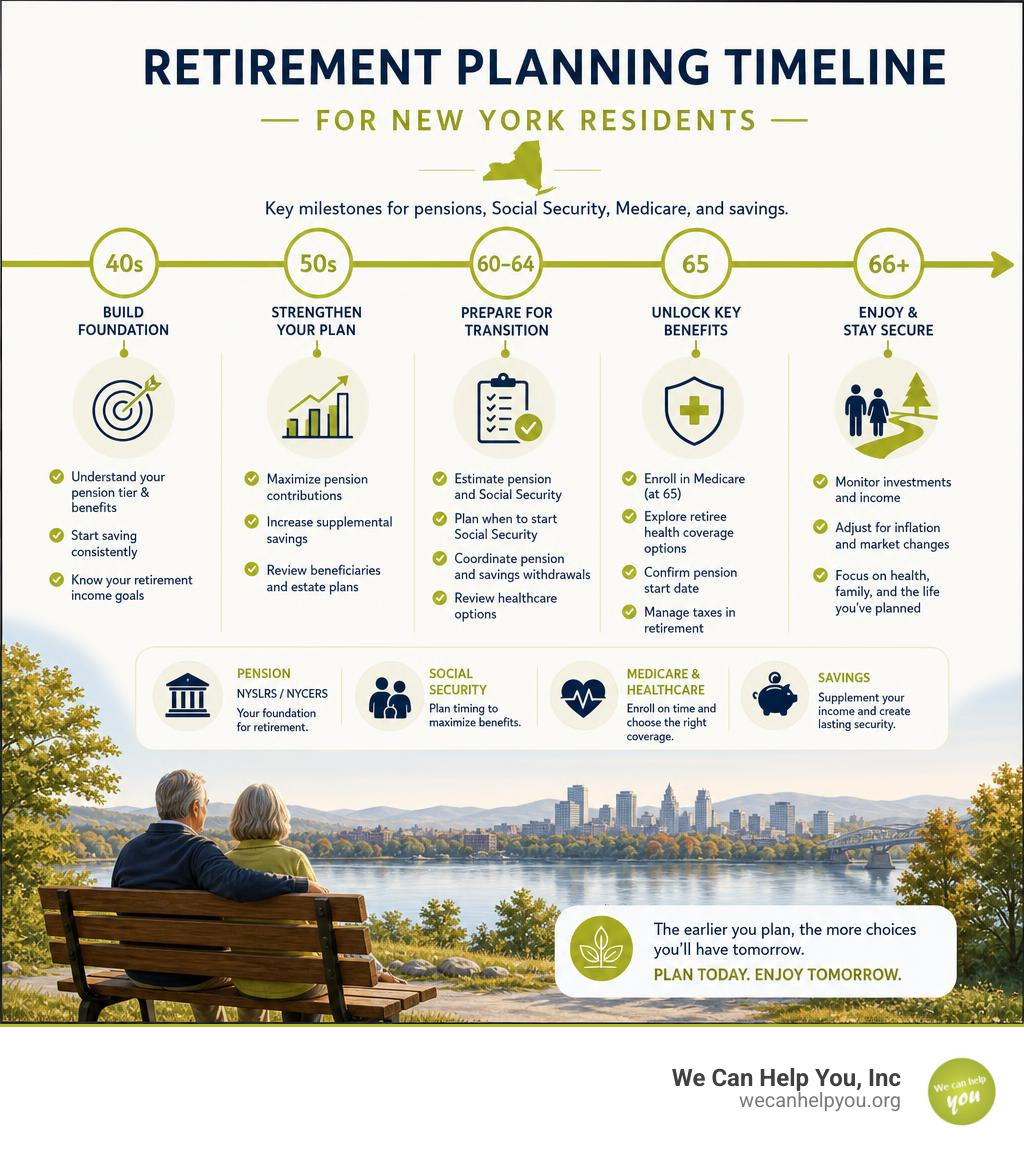
Retirement planning New York terms explained:
Understanding NYSLRS and NYCERS Pension Systems
For hundreds of thousands of public servants across the Empire State—from teachers in Syracuse to transit workers in Yonkers—the foundation of retirement planning New York is a defined benefit pension plan. Unlike defined contribution plans (like a 401k) where your retirement income depends on market performance, a defined benefit pension provides a guaranteed, monthly payment for life.
In New York, these pensions are primarily managed by two massive systems:
- NYSLRS (New York State and Local Retirement System): This system administers benefits for state and local government employees outside of New York City. It is split into two systems: the Employees’ Retirement System (ERS) and the Police and Fire Retirement System (PFRS).
- NYCERS (New York City Employees’ Retirement System): For more than 100 years, NYCERS has served municipal employees across New York City’s five boroughs.
How much will you actually receive when you retire? Both systems calculate your lifetime monthly benefit using a formula based on four critical factors:
- Your Tier: Your tier is determined by the exact date you joined the retirement system. Tiers range from Tier 1 to Tier 6. Because benefits have become less generous over time, knowing your tier is essential. For example, Tier 4 members can retire with full benefits at age 62 with 30 years of service, while Tier 6 members generally must wait until age 63 to retire without an age reduction.
- Service Credit: This is the total number of years and months you have worked in public service. You can sometimes purchase “prior service credit” for military service or previous public employment to boost this number.
- Final Average Earnings (FAE): This is the average of your highest consecutive years of salary (usually three consecutive years for older tiers, or five consecutive years for Tier 6), subject to certain statutory limitations.
- Age: Retiring before your plan’s “full retirement age” can permanently reduce your monthly benefit.
To help you navigate these calculations, the State Comptroller’s office offers robust planning resources. NYSLRS members can log into Retirement Online to estimate their pension benefits using current salary data, test different retirement dates, and update beneficiary details.
If you are beginning to map out your post-career timeline, you can learn more about managing these variables directly from the Planning | Office of the New York State Comptroller resources.
The Core Pillars of Retirement Planning New York
When we talk about retirement planning New York, it is easy to get bogged down in numbers. However, successful planning requires transitioning your mindset from asset accumulation (saving as much money as possible) to income generation (ensuring that money flows predictably throughout your golden years).
To achieve this, we focus on several core pillars:
- Income Generation over Asset Accumulation: Having a massive nest egg is great, but it is the steady stream of monthly income that provides true freedom and stability. Your plan must turn paper assets into reliable cash flow.
- Debt Reduction: One of the most effective financial tips for retirement is to enter it debt-free. Paying off high-interest credit cards and clearing outstanding Retirement System loans is critical. If you retire with an outstanding pension loan, your lifetime benefit is permanently reduced, and the outstanding balance may be treated as taxable income by the IRS.
- Inflation Protection: Inflation is a silent retirement killer. Even at a modest 5% annual inflation rate, your purchasing power will cut in half in just 15 years. Because most public pensions in New York only offer limited cost-of-living adjustments (COLA), you must build inflation-protected assets into your personal savings.
- Lifestyle Changes: Retirement is not just a financial transition; it is a major lifestyle shift. Are you planning to stay in Albany, downsize to a condo in Saratoga Springs, or split your time between Buffalo and a warmer climate? Your physical location and daily activities will ultimately dictate your budget.
How to Start Your Retirement Planning New York Journey
We recommend approaching your retirement plan not as a one-time checklist, but as an ongoing, circular process. To make this manageable, follow these five steps:
- Self-Assessment: Ask yourself what you want your retirement to look like. What makes you feel excited? What makes you anxious?
- Goal Setting: Write down specific, realistic, and positive goals with clear target dates. Writing down your goals makes you significantly more likely to achieve them.
- Information Gathering: Collect your pension statements, Social Security estimates, and savings account balances.
- Action Steps: Establish a realistic savings goal for every payday. Use payroll deductions to “pay yourself first” into retirement accounts.
- Annual Review: Life changes, and so will your plan. Review your financial roadmap at least once a year to adjust for inflation, family changes, or career shifts.
For a comprehensive, step-by-step workbook designed specifically for public workers, you can consult the official Chapters 1-11 2024 guide, which covers everything from budgeting worksheets to psychological readiness.
Best Practices for a Diversified Income Plan
Relying solely on a pension and Social Security is a risky strategy. To protect yourself from market volatility and economic downturns, you need a diversified “income bucket” strategy.
A robust retirement income plan combines:
- Guaranteed Income: Your pension, Social Security, and potentially fixed annuities to cover your basic, non-negotiable living expenses (housing, food, taxes).
- Growth Assets: A portion of your portfolio kept in diversified mutual funds or index funds to outpace inflation.
- Liquid Assets: Cash, money market accounts, or short-term CDs to cover emergencies and prevent you from having to sell stocks during a market downturn.
When drawing down your personal savings, a classic guideline is the 4 percent rule. This rule suggests that withdrawing 4% of your portfolio in your first year of retirement, and adjusting that dollar amount for inflation each year after, gives you a very high probability of your money lasting 30 years.
To see how your investments, pension, and lifestyle goals fit together, read our guide on Your Retirement Roadmap to Financial Freedom to build a resilient withdrawal strategy.
Supplemental Income Strategies: Beyond the Pension
Even with a strong public pension, most New Yorkers need to supplement their income to maintain their pre-retirement lifestyle. Fortunately, there are several powerful vehicles available to help you build that extra cushion.
For state and local government employees, the NYS Deferred Compensation Plan (457b) is an exceptional tool. Unlike a traditional 401k, a 457(b) plan does not impose a 10% early withdrawal penalty if you leave your employer before age 59½ (though standard income taxes still apply). This makes it highly flexible if you plan to retire early.
Other supplemental options include:
- Annuities: These contracts with insurance companies allow you to exchange a lump sum of cash for a guaranteed stream of lifetime income. They can act as a personal “pension” to cover gaps in your fixed income, though it is vital to research fees and verify that any guarantees are backed by a highly rated, stable financial institution.
- Life Insurance Cash Value: If you own a permanent life insurance policy, it builds cash value over time. You can potentially access this cash value tax-free through policy loans or withdrawals to supplement your retirement income, though doing so will reduce the policy’s death benefit.
Tax Considerations for Retirement Planning New York Residents
New York is often labeled a high-tax state, but the reality for retirees is surprisingly nuanced. Understanding how the state taxes different retirement income streams can save you thousands of dollars:
- Public Pensions: If you receive a federal, New York State, or local government pension, your pension income is 100% exempt from New York State and local income taxes.
- Private Pensions and IRAs: If you are age 59½ or older, New York State allows you to exclude up to $20,000 of your private pension or traditional IRA/401k withdrawal income from your state taxes each year.
- Social Security: New York State does not tax Social Security benefits.
- State Income Tax Rates: For income that is not exempt, New York’s top state income tax rate can reach up to 10.9% for high earners, which makes tax-efficient withdrawal strategies essential.
When deciding whether to save in a traditional tax-deferred account (where you get a tax break now but pay taxes on withdrawals later) or a Roth account (where you save after-tax dollars now but get tax-free withdrawals in retirement), it helps to run the numbers.
To calculate your exact tax burden and income needs based on your local ZIP code, you can use the New York, NY Retirement Calculator 2025 – Social Security Exempt to model your state tax liabilities and portfolio longevity.
The New York Secure Choice Savings Program
What if you are a private-sector worker in Rochester or Syracuse whose employer doesn’t offer a retirement plan?
To close the retirement savings gap for millions of New Yorkers, the state launched the New York Secure Choice Savings Program. This state-administered program requires private-sector employers who do not offer a retirement plan to automatically enroll their employees in a portable Roth IRA.
Key features of the program include:
- Automatic Payroll Deductions: Contributions are automatically deducted from your paycheck, making saving effortless.
- Portability: The account belongs to you. If you change jobs from a bakery in Utica to an office in Binghamton, your account stays with you.
- Voluntary Participation: While enrollment is automatic for eligible workers, participation is completely voluntary. You can opt out or change your contribution rate at any time.
- No Cost to Employers: The program is free for employers to facilitate, and they carry no fiduciary liability or contribution requirements.
Coordinating Social Security and State Pensions

Social Security is a critical component of retirement planning New York, typically replacing about 35% to 40% of an average worker’s career earnings. However, coordinating Social Security with a state public pension requires careful timing.
Unlike some states where public employees do not pay into Social Security, most NYSLRS and NYCERS members participate in both systems. This means you will collect both a pension and a Social Security check.
When coordinating these two income sources, consider these strategic timing factors:
- The Cost of Delaying: You can claim Social Security as early as age 62, but doing so permanently reduces your monthly check by up to 30% compared to claiming at your Full Retirement Age (FRA). Furthermore, delaying your claim past your FRA up to age 80 (or age 70, where benefits stop growing) increases your monthly benefit by 8% for every year you wait.
- Bridging the Gap: If you retire from your state job at age 62 with a pension, you might choose to live off your pension and personal savings (like a 457b or IRA) for a few years, allowing your Social Security benefit to grow until you claim it at age 67 or 70.
- Spousal Coordination: If you are married, coordinating claims with your spouse can dramatically increase your household’s lifetime cumulative benefits.
For a deeper dive into debt payoff strategies, pension projections, and the mechanics of choosing a trusted financial planner to coordinate these income streams, you can download the booklet Straight Talk About Financial Planning For Your Retirement | Office of the New York State Comptroller .
Navigating Healthcare, NYSHIP, and Medicare in the Empire State
No retirement plan is complete without a strategy to cover healthcare and long-term care costs. A single major medical event can wipe out decades of retirement savings if you are unprepared.
If you are a retired New York State or local government employee, you may be eligible to continue your health coverage through the NYSHIP (New York State Health Insurance Program). However, once you turn 65, the rules of the road change:
- Medicare Becomes Primary: At age 65, Medicare becomes your primary health coverage. This means Medicare pays your medical claims first, and NYSHIP acts as a secondary payer to cover deductibles, copays, and services Medicare doesn’t fully cover.
- Mandatory Enrollment: To maintain your NYSHIP retiree coverage, you must enroll in both Medicare Part A (hospital insurance) and Medicare Part B (medical insurance) as soon as you become eligible.
- Medicare Part B Premium Reimbursement: In many cases, the state or your former public employer will reimburse you for the standard cost of your monthly Medicare Part B premium—a major financial perk for New York public retirees!
For private-sector workers or public retirees looking to optimize their coverage, navigating the Medicare transition is notoriously confusing. You will need to decide between:
- Original Medicare + Medigap: This combination offers the freedom to see any doctor in the country who accepts Medicare, paired with a supplemental policy to cover out-of-pocket costs. Read more about selecting a supplemental policy in our guide, Find Your Perfect Medigap Policy in the Empire State.
- Medicare Advantage (Part C): These private, all-in-one plans often feature low premiums and extra benefits like dental and vision, but they require you to use local network doctors. To learn more about how these plans operate locally, check out Everything You Need to Know About NY Medicare Advantage.
To make the best choice for your unique health needs and budget, review our comprehensive framework for Picking a Winner Among New York Medicare Plans.
Frequently Asked Questions about New York Retirement
To help you quickly compare the primary public retirement systems in the state, we have compiled this comparative overview:
| Feature | NYSLRS (State & Local) | NYCERS (New York City) |
|---|---|---|
| Primary Audience | NYS state, county, and municipal workers (outside NYC) | New York City municipal and agency employees |
| System Age | Founded in 1921 (Over 100 years of operation) | Founded in 1920 (Over 100 years of operation) |
| Key Tools | Retirement Online portal for estimates | MyNYCERS portal for account management |
| Benefit Type | Defined Benefit Pension (Lifetime Monthly Payments) | Defined Benefit Pension (Lifetime Monthly Payments) |
| Death Benefits | Yes, payable to designated beneficiaries | Yes, payable to designated beneficiaries |
How is my NYSLRS pension benefit calculated?
Your pension is calculated using a formula: Service Credit × Tier Multiplier × Final Average Earnings (FAE).
For example, if you are a Tier 4 member with 20 to 30 years of service, your multiplier is 2% per year. If you retire with 25 years of service and an FAE of $80,000, your annual pension would be:
$$25 \text{ years} \times 2\% \times \$80,000 = \$40,000 \text{ per year } (\$3,333 \text{ per month})$$
If you retire before your plan’s full retirement age, an age reduction penalty will permanently lower this amount.
What is the New York Secure Choice Savings Program?
It is a state-sponsored retirement savings program designed for private-sector workers whose employers do not offer a retirement plan. Eligible employees are automatically enrolled in a portable Roth IRA with automatic payroll deductions, though they can opt out at any time.
How do I coordinate Medicare with NYSHIP coverage?
When you turn 65, Medicare automatically becomes your primary health insurance, and NYSHIP becomes your secondary insurer. You must enroll in Medicare Parts A and B to keep your NYSHIP retiree benefits. NYSHIP will then coordinate with Medicare to pay your remaining eligible medical expenses.
Conclusion
Retirement planning New York does not have to be an overwhelming or stressful process. Whether you are counting on a public pension from NYSLRS, preparing to enroll in Medicare, or building a private nest egg from scratch, taking proactive steps today is the key to securing your financial freedom tomorrow.
At We Can Help You, Inc., we are a dedicated non-profit organization focused on educating retirees and pre-retirees across New York—from Niagara Falls to Long Island. We want to make sure you never leave money on the table or make costly, irreversible mistakes during your retirement transition.
To help you take immediate action, we offer:
- A free Medicare Planning Guide to help you seamlessly coordinate NYSHIP and Medicare.
- A free Social Security maximization report designed to help you and your spouse claim your benefits at the perfect time to maximize your lifetime household income.
Ready to take control of your future? Connect with local experts in your area and claim your free guides today by visiting our Medicare Insurance Agents Near Me/NY page. Let’s build your roadmap to a secure, happy, and confident retirement together!