
Does Medicare Advantage Cover Cancer Treatment? What You Need to Know First
Does medicare advantage cover cancer treatment — and the short answer is yes, but with important limits that can affect your care.
Here’s a quick overview before we dive deeper:
| Coverage Area | Medicare Advantage Covers? | Key Limitation |
|---|---|---|
| Inpatient chemotherapy | Yes | Must use in-network hospital |
| Outpatient chemotherapy (IV) | Yes | Prior authorization may be required |
| Oral chemotherapy drugs | Yes (via Part D) | Must be on plan formulary |
| Radiation therapy | Yes | Network restrictions apply |
| Cancer surgery | Yes | Prior authorization often required |
| Top cancer centers (NCI) | Sometimes | 2 in 5 plans exclude them |
| Second opinions | Yes | Must use in-network provider |
| Anti-nausea medications | Yes | Coverage rules vary |
Medicare Advantage plans are required by law to cover everything Original Medicare covers. But how they cover it — and who you can see — can be very different.
In 2026, about 2.1 million Americans are expected to be diagnosed with cancer. For those already on Medicare, the plan you choose can have a serious impact on your treatment options, your costs, and even your outcomes.
More than 50% of Medicare beneficiaries are now enrolled in Medicare Advantage plans. Many chose them for the lower premiums and extra perks. But a cancer diagnosis changes the math quickly.
This guide breaks down exactly what Medicare Advantage covers for cancer treatment, how costs compare to Original Medicare, and what the research says about patient outcomes — so you can make a confident, informed decision.
Key does medicare advantage cover cancer treatment vocabulary:
How Does Medicare Advantage Cover Cancer Treatment?

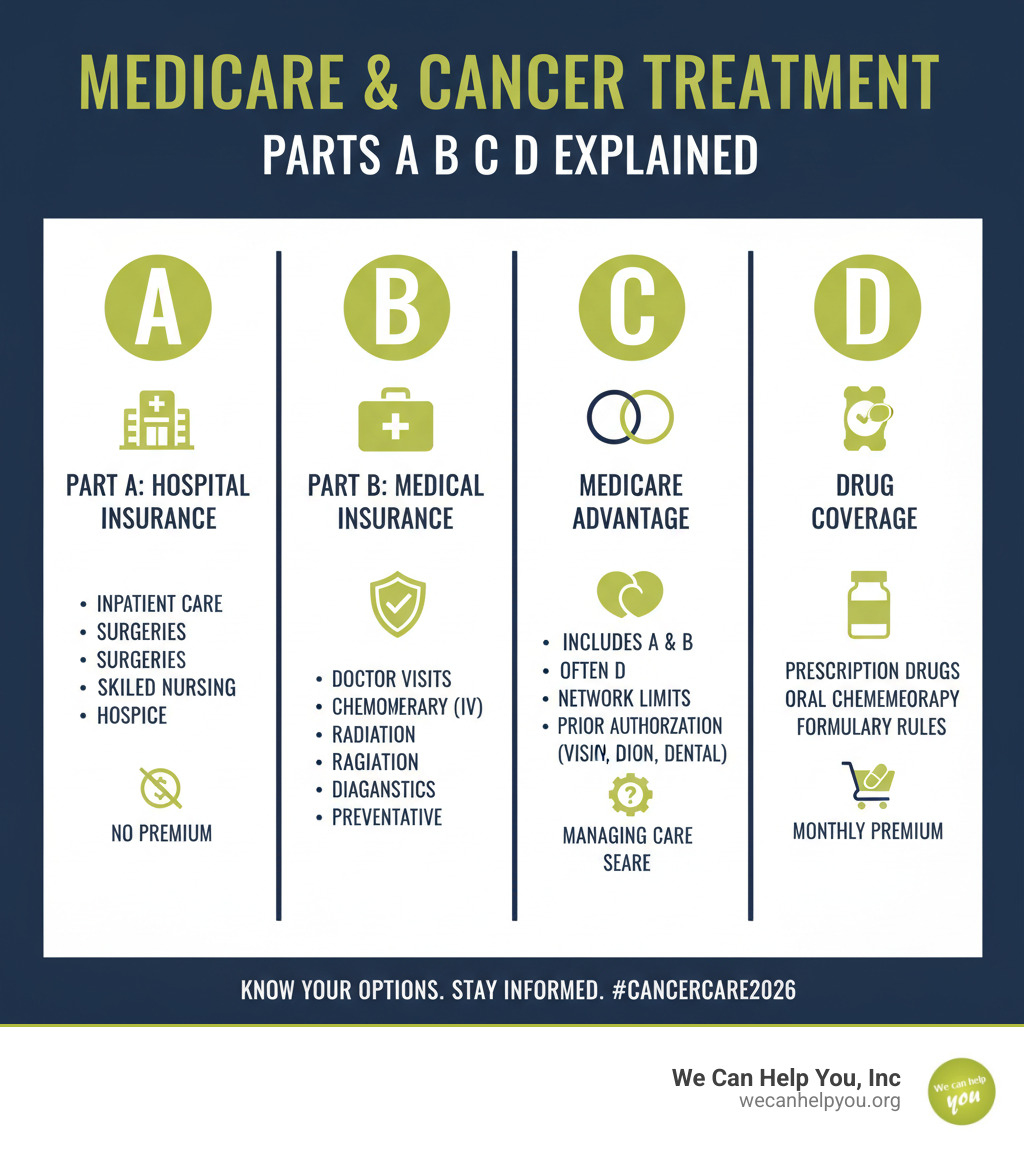
When we talk about whether does medicare advantage cover cancer treatment, we have to look at how these plans mirror the federal government’s “Original Medicare” program. By law, any Medicare Advantage (MA) plan must provide at least the same level of coverage as Medicare Parts A and B.
In practical terms, this means if you are diagnosed with cancer, your plan must cover:
- Inpatient Care (Part A equivalence): This includes hospital stays for surgeries, inpatient chemotherapy, or specialized nursing care.
- Outpatient Services (Part B equivalence): This covers the bulk of cancer care, such as doctor visits, radiation therapy, IV chemotherapy administered in a clinic, and diagnostic imaging like CT scans or MRIs.
However, the “equivalence” only applies to what is covered, not how you access it. While Original Medicare allows you to see any doctor in the country who accepts Medicare, an MA plan usually restricts you to a specific network of providers. If your favorite oncologist or the local hospital isn’t “in-network,” you might face significantly higher costs or a total denial of coverage.
For a deeper dive into these requirements, you can view the official Medicare coverage of cancer services or our guide on Everything You Need To Know About Medicare Advantage Plans.
Does Medicare Advantage cover cancer treatment drugs?
One of the most complex parts of cancer care is the medication. Does medicare advantage cover cancer treatment drugs like oral chemotherapy? Yes, but the rules are split between two different “buckets” of coverage.
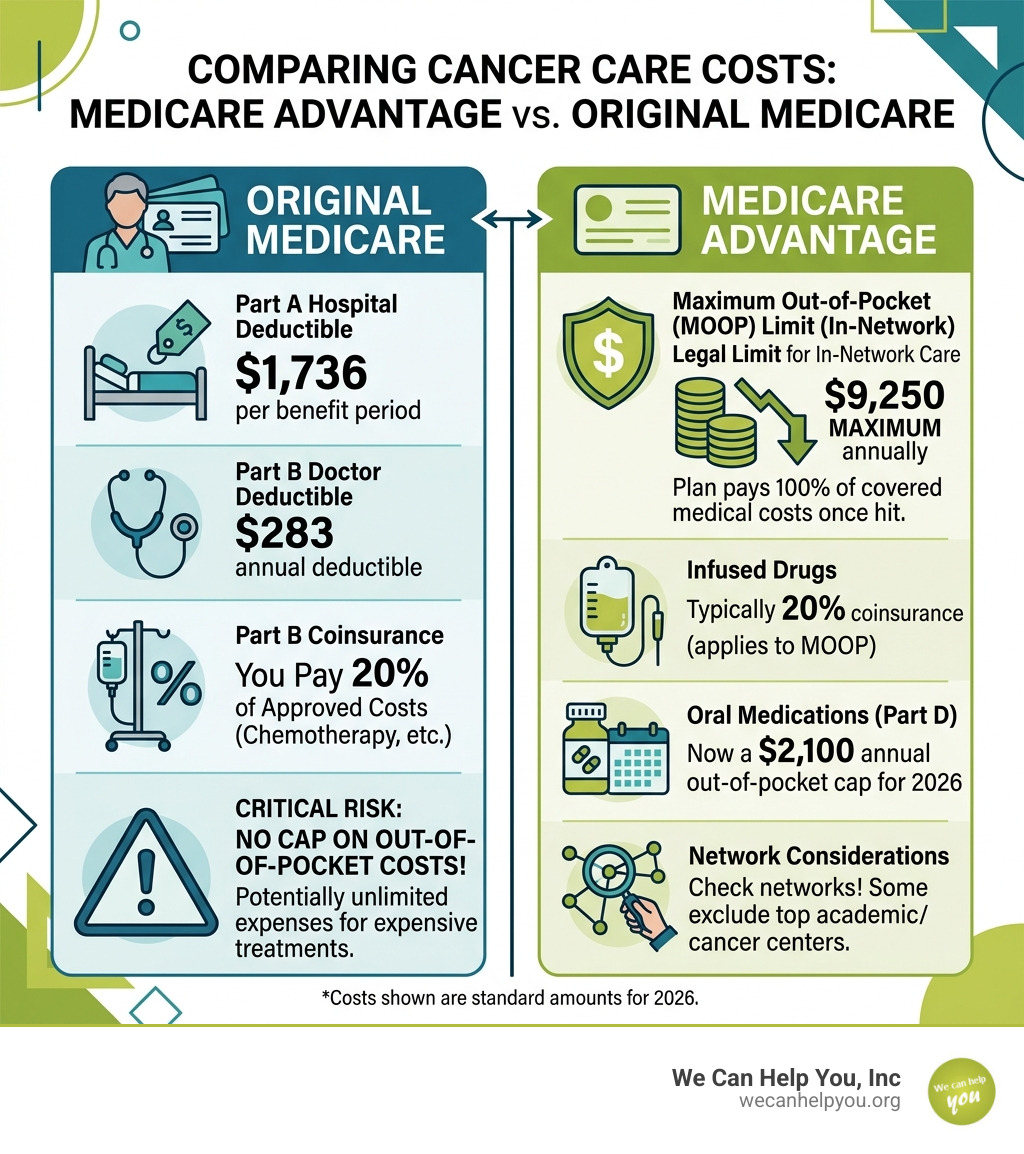
- Infused Drugs: If you receive chemotherapy or immunotherapy via an IV or injection at a doctor’s office, this is covered under the “Part B” portion of your Advantage plan. You typically pay a 20% coinsurance for these expensive drugs.
- Oral Medications: If you take a pill at home, such as Xeloda or Tarceva, it is covered under the “Part D” (prescription drug) portion of your plan.
There is good news for 2026! Thanks to recent legislative changes, there is now a $2,100 annual out-of-pocket cap on Part D prescription drugs. This is a massive win for cancer patients who previously faced thousands of dollars in “donut hole” costs for oral chemo. Additionally, Medicare has begun negotiating prices on some of the most expensive cancer drugs, expected to save beneficiaries billions of dollars collectively.
We also see coverage for “supportive” drugs. For instance, anti-nausea medications are generally covered under Part B if they are administered within 48 hours of a chemotherapy session. If you need them for a longer period at home, they fall under Part D. You can learn more about these specific drug rules in our article on What Does Medicare Actually Cover In 2025.
Does Medicare Advantage cover cancer treatment at top-tier hospitals?
This is where we urge caution. While your plan must cover cancer treatment, it doesn’t have to cover it anywhere.
Research shows that one in five Medicare Advantage plans do not include a single academic medical center in their network. Even more startling, in areas where world-class National Cancer Institute (NCI)-Designated Cancer Centers exist, two out of five MA plans exclude them.
If you are 76 and facing a Stage 4 diagnosis, access to these top-tier specialists and clinical trials can be life-changing. If your plan’s network is narrow, you may find yourself stuck with local generalists rather than specialists who deal exclusively with your specific type of cancer. This is one of the primary “perks vs. care” trade-offs we discuss in Medicare Advantage Your Guide To Benefits And Drawbacks.
Comparing Costs: Medicare Advantage vs. Original Medicare
Understanding the financial side of a cancer diagnosis is essential for retirement security. In 2026, the costs for Original Medicare are standardized:
- Part A Deductible: $1,736 per benefit period.
- Part B Deductible: $283 annually.
- Part B Coinsurance: 20% of the Medicare-approved amount for most services.
The “danger zone” with Original Medicare is that there is no limit on that 20% coinsurance. If your chemotherapy costs $100,000, you could owe $20,000.
Medicare Advantage plans, by contrast, have a Maximum Out-of-Pocket (MOOP) limit. For 2026, the legal limit for in-network care is $9,250, though many plans set theirs lower. Once you hit this limit, the plan pays 100% of your covered medical costs for the rest of the year.
To get a better grasp of these numbers, see our guide on Decoding Medicare A Simple Explanation Of Your Costs.
Medigap as an Alternative for Cancer Patients
Many of our clients ask: “If Original Medicare has no cap, isn’t Medicare Advantage always better?” Not necessarily. This is where Medigap (Medicare Supplement) comes in.
If you choose Original Medicare and add a Medigap plan (like Plan G), the supplement pays almost all of your out-of-pocket costs. With Plan G, after you pay your $283 Part B deductible, your cancer treatments, surgeries, and doctor visits are covered at 100%. This provides ultimate financial predictability—you know exactly what your medical bills will be, regardless of how intense the treatment gets.
We highly recommend reading Understanding The Differences Between Medigap And Medicare Advantage to see which financial structure fits your budget.
Prior Authorization and Patient Outcomes

One of the biggest hurdles in Medicare Advantage is prior authorization. This is a process where your doctor must ask the insurance company for permission before performing a scan, starting a specific chemotherapy, or scheduling a surgery.
The statistics are sobering:
- In recent years, MA insurers required 53 million prior authorization requests.
- They denied roughly 4.1 million of them.
- This is 84 times the number of hurdles found in Original Medicare, which rarely requires prior authorization for standard cancer care.
These delays aren’t just annoying; they can be dangerous. A study by the City of Hope found that Medicare Advantage patients were significantly more likely to die in the month following surgery for stomach, pancreatic, or liver cancer compared to those on Original Medicare. Experts suggest this may be due to delays in care or restricted access to the most experienced surgical teams.
When considering does medicare advantage cover cancer treatment, you must weigh the “free” gym membership against the risk of an insurance adjuster questioning your doctor’s treatment plan. We explore these nuances further in Medicare Advantage vs Medigap.
Switching Plans and Long-Term Considerations
If you have a Medicare Advantage plan and receive a cancer diagnosis, you might want to switch to Original Medicare and a Medigap plan to get better access to specialists.
Here is the catch: In most states, once you are past your initial enrollment period, Medigap companies can use medical underwriting. This means they can look at your health history and deny you coverage because you have cancer.
If you are currently healthy, choosing a plan is a long-term commitment. If you choose an Advantage plan now because it’s cheap, you may find yourself “locked in” later when you actually need the freedom of Original Medicare.
There are certain “Guaranteed Issue” windows and the Annual Enrollment Period (Oct 15 – Dec 7), but these don’t always allow you to get a Medigap plan without a health check. For those in the Lone Star State, check out Texas Medicare Advantage Benefits Options And How It Works for local specifics on switching.
Frequently Asked Questions about Cancer Coverage
What happens if my Medicare Advantage plan denies a cancer treatment?
You have the right to appeal. The process involves several levels, starting with a redetermination by your plan and potentially moving to an Independent Review Entity. If your doctor states that the treatment is “medically necessary,” it strengthens your case. You can find the full steps in the Medicare coverage of cancer treatment services booklet.
Does Medicare Advantage cover second opinions for cancer?
Yes. If your doctor recommends surgery or a major treatment path, your plan must cover a second opinion. However, unlike Original Medicare, you usually must choose another doctor within your plan’s network. If you want an opinion from a specialist at a top cancer center that isn’t in your network, you may have to pay for it yourself. Some plans are “0 premium,” but these restrictions are often the trade-off. Learn more at How Can Medicare Advantage Part C Plans Be 0 Premium.
Are clinical trials covered under Medicare Advantage?
Yes, but the billing is unique. Usually, Original Medicare (the federal government) steps in to pay for the “routine” costs of the clinical trial, while your Medicare Advantage plan may cover certain ancillary costs. This coordination ensures you aren’t denied cutting-edge care just because you are in a private plan. For more on hospital-related costs, see Medicare Hospital Costs.
Conclusion
So, does medicare advantage cover cancer treatment? It does, but it comes with a set of rules that require you to be your own best advocate. While the out-of-pocket maximums offer some protection against bankruptcy, the network restrictions and prior authorization hurdles can create stress during an already difficult time.
At We Can Help You, Inc., we believe that informed patients make better decisions. Whether you are in Florida, Texas, Ohio, or any of our other service locations, our mission is to help you navigate these complex choices so you can focus on what matters most: your health and your family.
Before you make a final decision, we invite you to use our free resources to Compare Medicare Advantage vs Medigap. We offer a free Medicare Planning Guide and a Social Security maximization report to help ensure your retirement is as secure and healthy as possible. Your future self will thank you for doing the research today.