
Why Medicare Feels So Confusing — and How to Cut Through It Fast
Getting medicare choices explained in plain English is harder than it should be — and if you’ve recently turned 65 (or are about to), you’ve probably already felt that.
The government sends you a stack of mail. Friends give you conflicting advice. Insurance companies flood your inbox. And somehow you’re supposed to make a decision that affects your health and your wallet for years to come.
Here’s the short version, so you can orient yourself right now:
The 2 main Medicare paths at a glance:
| Option | What it is | Best for |
|---|---|---|
| Original Medicare (Parts A & B) | Government-run; add Part D for drugs and Medigap for cost protection | People who want any doctor, anywhere |
| Medicare Advantage (Part C) | Private plan bundling A, B, and usually D | People who want one plan, extra benefits, and an out-of-pocket cap |
That’s really it at the core. Everything else — Medigap, Part D, HMOs, PPOs, enrollment windows — builds on top of those two paths.
As of 2024, about 65 million Americans are enrolled in Medicare, split almost evenly between the two options. Neither path is universally better. The right choice depends on your doctors, your prescriptions, your budget, and how you live.
This guide from We Can Help You, Inc. will walk you through every piece — simply, without the paperwork headache.
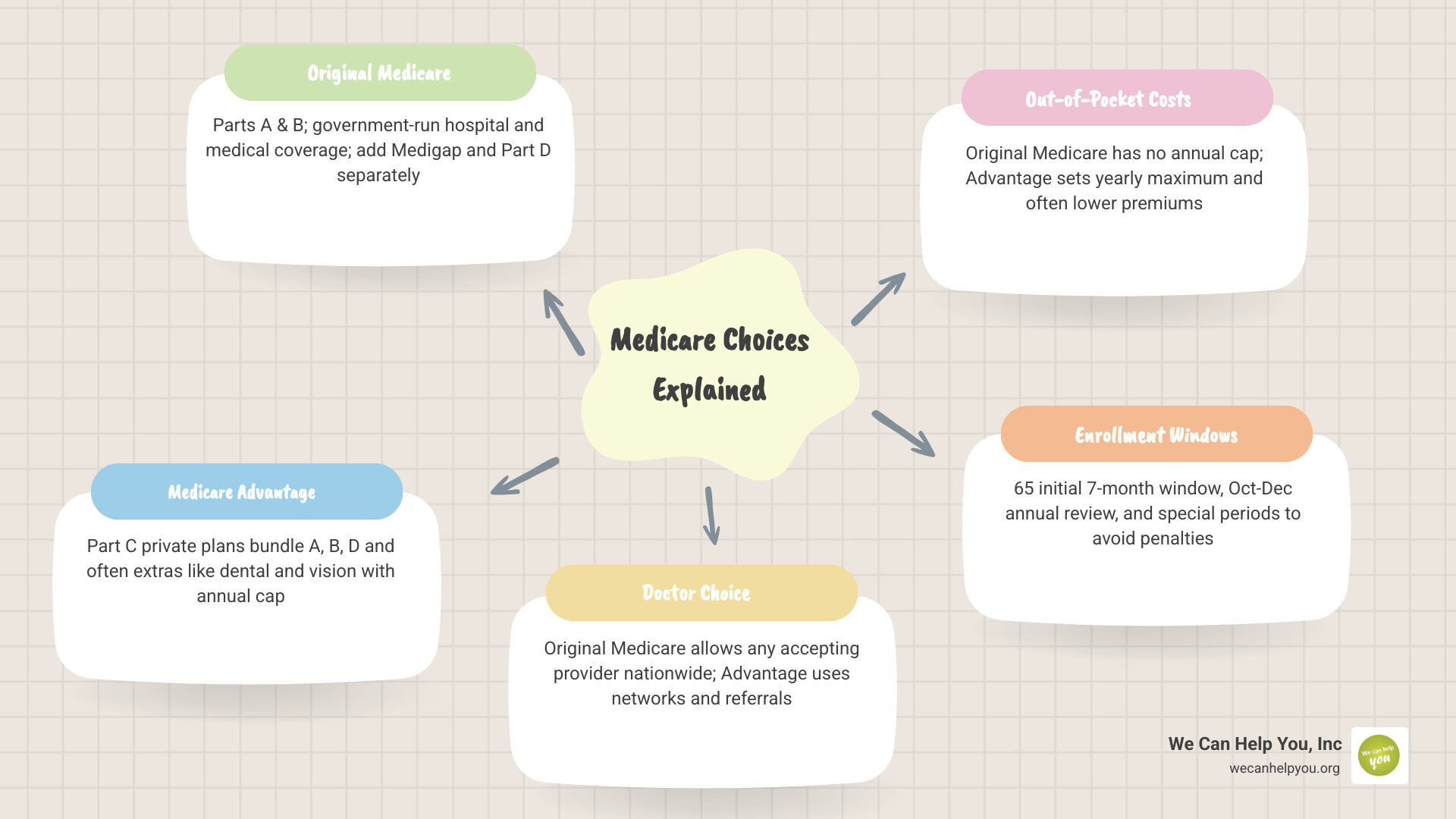
Simple guide to medicare choices explained:
Medicare choices explained: the 2 main ways to get coverage
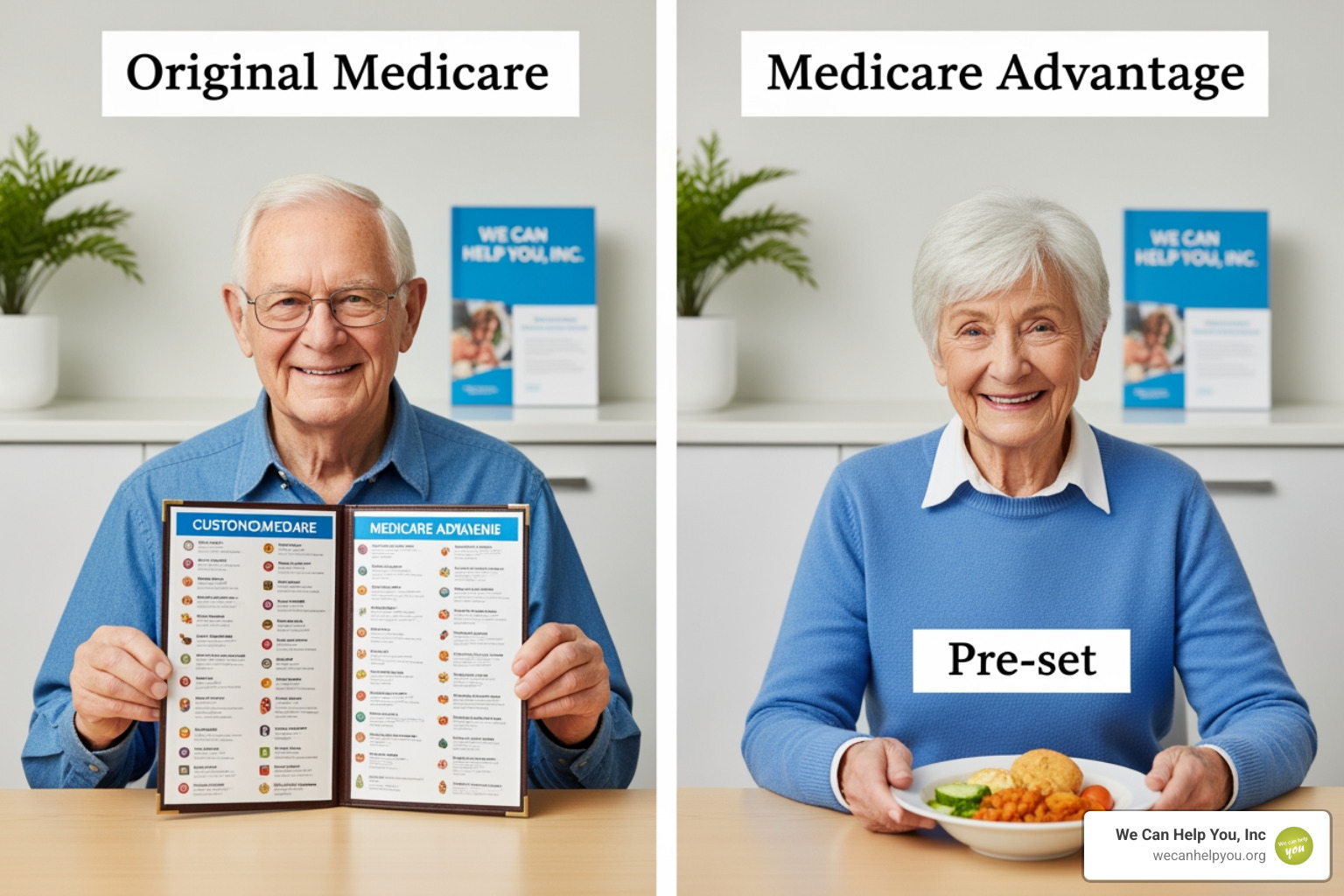
When we talk about medicare choices explained, we are really looking at two distinct roads. Think of it like deciding between a customizable à la carte menu and a pre-set value meal.
Road 1: Original Medicare. This is the traditional government program. It includes Part A (Hospital Insurance) and Part B (Medical Insurance). Because Original Medicare doesn’t cover everything—and has no limit on what you might pay out-of-pocket—most people on this road also buy a standalone Part D plan for drugs and a Medigap (Supplement) policy to pay the 20% coinsurance that Medicare leaves behind.
Road 2: Medicare Advantage (Part C). These are “all-in-one” plans offered by private companies approved by Medicare. They bundle Part A, Part B, and usually Part D into a single plan. They often look like the health insurance you had through an employer, featuring networks of doctors and extra perks like dental or vision.
For a deeper look at how these work, you can review What Medicare covers and how it works.
Medicare choices explained for beginners: what each part of Medicare covers
To understand your options, we first have to break down the “alphabet soup” of Medicare parts. Each letter covers a different slice of your healthcare:
- Part A (Hospital Insurance): Think of this as coverage for “room and board.” It helps pay for inpatient hospital stays, care in a skilled nursing facility, hospice care, and some home health care. Most people don’t pay a monthly premium for Part A if they worked for at least 10 years.
- Part B (Medical Insurance): This covers “doctors and doing things.” It includes outpatient care, doctor visits, preventive services (like flu shots or screenings), and durable medical equipment (like wheelchairs or oxygen). There is a monthly premium for Part B, which is $202.90 in 2026 for most people.
- Part D (Drug Coverage): This is for your prescriptions. These plans are run by private insurance companies. Even if you don’t take drugs now, we usually recommend signing up to avoid a lifelong late enrollment penalty.
- Part C (Medicare Advantage): This isn’t a separate benefit; it’s a different way to get your A and B benefits through a private plan.
Original Medicare vs Medicare Advantage: the simplest explanation
The biggest difference between the two is freedom vs. cost-control.
With Original Medicare, you can see any doctor or go to any hospital in the U.S. that accepts Medicare. You don’t need referrals to see a specialist, and you don’t need “prior authorization” (permission from the insurance company) for most services. It offers the most travel flexibility and choice.
Medicare Advantage plans usually require you to use a specific network of doctors and hospitals. You might need a referral to see a specialist, and the plan may require prior authorization before it agrees to pay for a surgery or expensive test. However, these plans often have lower monthly premiums (sometimes $0) and include “extra” benefits Original Medicare doesn’t offer.
For more details, see our guide on Medicare Advantage: Your Guide to Benefits and Drawbacks.
Where Medigap and standalone Part D fit in
If you choose Original Medicare, you have two gaps to fill: high out-of-pocket costs and prescription drugs.
- Medigap (Medicare Supplement Insurance): These plans are sold by private companies to pay the “gap” in Original Medicare—like the 20% you’d normally owe for a doctor’s bill. Medigap plans are standardized by letters (like Plan G or Plan N). This means a Plan G with one company has the exact same benefits as a Plan G with another.
- Standalone Part D: Since Original Medicare doesn’t include drug coverage, you’ll need to pick a separate plan. Each plan has a “formulary” (a list of covered drugs) divided into “tiers” that determine your cost.
Crucial Note: You cannot have a Medigap plan and a Medicare Advantage plan at the same time. It’s actually illegal for someone to sell you both.
To learn more about these combinations, check out Understanding the Differences Between Medigap and Medicare Advantage and The Complete Guide to Medicare Prescription Plans.
How Original Medicare and Medicare Advantage compare on doctors, costs, and coverage
When we look at medicare choices explained through the lens of daily life, the differences become very clear.
| Feature | Original Medicare + Medigap | Medicare Advantage (Part C) |
|---|---|---|
| Doctor Choice | Any doctor in the U.S. accepting Medicare | Usually local network (HMO/PPO) |
| Referrals | Never required | Often required (HMO) |
| Monthly Premium | Higher (B + Medigap + D) | Lower (often just Part B) |
| Out-of-Pocket Limit | Very low (Medigap covers most) | Yearly cap (Avg. $5,000-$6,000) |
| Extra Benefits | None (no dental/vision/hearing) | Often includes dental, vision, gym |
Doctor choice and referrals
If you value being able to see a specialist at a top-tier hospital in another state without asking for permission, Original Medicare is usually the winner. You just find a doctor who “accepts assignment” (meaning they agree to Medicare’s payment rates) and make an appointment.
Medicare Advantage plans are usually HMOs or PPOs. In an HMO, you generally must stay in-network and need a primary care doctor to give you a referral for a specialist. In a PPO, you have more flexibility to go out-of-network, but you’ll pay significantly more to do so.
Costs, out-of-pocket risk, and what “maximum” really means
One of the scariest things about Original Medicare is that it has no annual out-of-pocket limit. If you have a $100,000 hospital stay and don’t have supplemental insurance, you could be on the hook for $20,000 (the 20% coinsurance). This is why Medigap is so popular—it effectively creates a “safety net” for those costs.
Medicare Advantage plans, by law, must have an annual out-of-pocket maximum. In 2026, many plans have a limit around $5,000 to $6,000. Once you spend that much on covered services, the plan pays 100% for the rest of the year. This provides financial protection without needing a separate Medigap policy.
Extra benefits and trade-offs most people miss
Medicare Advantage plans often lure people in with “extra” benefits. These can include:
- Dental cleanings and X-rays
- Vision exams and allowances for glasses
- Hearing aids
- Gym memberships (like SilverSneakers)
- Allowances for over-the-counter items like aspirin or bandages
The trade-off? You are subject to “managed care.” This means the insurance company has more say in your treatment. You may face more paperwork for “prior authorizations” before a surgery is approved. Also, these plans can change their benefits, premiums, and doctor networks every single year.
You can Compare your Medicare plan options on the official site or read our detailed comparison: Medicare Advantage vs Medigap.
medicare choices explained when you’re enrolling: when to sign up and how to avoid penalties
Timing is everything. If you miss your windows, you could end up with a “late enrollment penalty” that stays with you for the rest of your life.
Your first Medicare signup window at 65
Most people get a 7-month Initial Enrollment Period (IEP). This window includes:
- 3 months before your 65th birthday month.
- Your birthday month.
- 3 months after your birthday month.
If you are already receiving Social Security benefits, you might be enrolled automatically. If not, you’ll need to sign up through the Social Security Administration.
For more on the “how-to,” see Getting ready for Medicare.
Late penalties for Part B and Part D, explained simply
We see people make this mistake often: they feel healthy, so they skip Part B or Part D. Don’t do this.
- Part B Penalty: For every 12-month period you were eligible but didn’t sign up, your premium goes up by 10%. This penalty is permanent.
- Part D Penalty: If you go 63 days or more without “creditable” drug coverage (coverage as good as Medicare’s), you’ll owe a penalty. In 2026, this is calculated based on 1% of the “national base beneficiary premium” ($38.99) for every month you waited.
When you can switch plans later
You aren’t locked into your choice forever. There are two main times to change your mind:
- Open Enrollment (Oct 15 – Dec 7): Anyone can switch from Original Medicare to Advantage, or vice versa, or change their Part D plan. Changes start Jan 1.
- Medicare Advantage Open Enrollment (Jan 1 – Mar 31): If you’re already in a Medicare Advantage plan, you can switch to a different one or go back to Original Medicare during this time.
Learn more about these dates here: Important Medicare Election Periods and How to Sign Up for Medicare Without Getting Penalized.
How Medicare works with employer insurance, Medicaid, and military coverage
Medicare doesn’t always work alone. Sometimes it’s the “primary” payer, and sometimes it’s “secondary.”
If you or your spouse still have employer coverage
If you are 65 but still working at a company with 20 or more employees, your employer insurance is usually primary. You can often delay Part B without penalty because you have “current employment” coverage. However, if the company has fewer than 20 employees, Medicare usually becomes primary at 65, and you must sign up for Part B to avoid massive coverage gaps.
Warning: COBRA and retiree insurance are not considered “current employment” coverage. If you rely on these and skip Part B, you will likely face penalties and a delay in coverage.
If you also qualify for Medicaid or cost-saving programs
About 20% of Medicare beneficiaries also have Medicaid. These “dual eligibles” get help paying for premiums and out-of-pocket costs.
- Medicare Savings Programs (MSPs): State programs that help pay Part B premiums.
- Extra Help: A federal program that helps pay for Part D drug costs (premiums, deductibles, and copays).
TRICARE, VA, and other coverage rules to know
If you have TRICARE for Life, you are generally required to have Medicare Part B to keep your TRICARE benefits. Medicare pays first, and TRICARE acts as a supplement. If you use VA benefits, the systems are separate. The VA doesn’t pay for care at non-VA facilities, and Medicare doesn’t pay for care at VA facilities. Many veterans choose to have both to give them more options.
How to choose the best Medicare setup for your health, budget, and lifestyle
Choosing between the two paths is a personal decision. Here is how we break it down for our clients at We Can Help You, Inc.
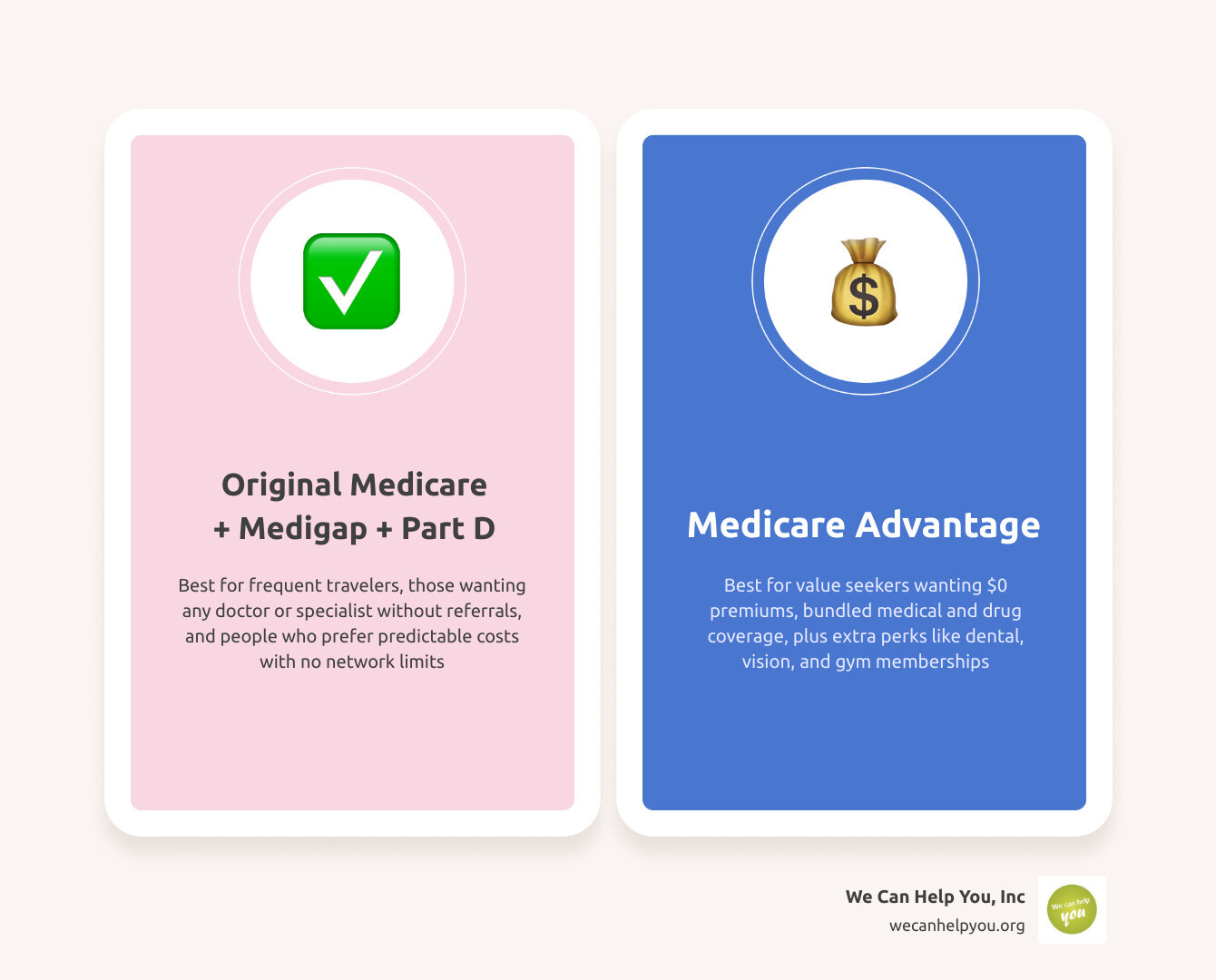
Best fit for Original Medicare + Medigap + Part D
- The Traveler: You spend months in Florida and months in New York (or travel in an RV). You need a plan that works everywhere.
- The Specialist Seeker: You want the right to go to the Mayo Clinic or MD Anderson without asking an insurance company for a referral.
- The Budgeter: You’d rather pay a higher monthly premium to know that your out-of-pocket costs for a hospital stay will be near zero.
Best fit for Medicare Advantage
- The Value Seeker: you want a $0 or low-premium plan and don’t mind staying within a local network of doctors.
- The “All-in-One” Fan: You want your medical and drug coverage on one single card.
- The Perk Lover: You really value the gym membership, dental, and vision benefits that come bundled with the plan.
Where to compare plans and get free personalized help
You don’t have to do this alone. Here are the best places to get medicare choices explained for your specific zip code:
- Medicare.gov Plan Finder: Enter your drugs and your zip code to see exactly what each plan will cost you.
- SHIP (State Health Insurance Assistance Program): Offers free, unbiased counseling.
- 1-800-MEDICARE: Available 24/7 to answer basic questions.
For a comprehensive walkthrough, visit our Medicare Planning Complete Guide.
Frequently Asked Questions about medicare choices explained
Can I have Medigap and Medicare Advantage at the same time?
No. They do not work together. If you have Medicare Advantage, it is illegal for someone to sell you a Medigap policy. If you want to switch from Advantage back to Original Medicare and buy a Medigap plan, you usually have to do it during Open Enrollment, and in many states, you may have to pass “medical underwriting” (a health check) to get a Medigap policy.
Do I need Part D if I do not take prescriptions right now?
Yes, we almost always recommend it. If you wait until you actually need a prescription to sign up, you will face a lifelong late enrollment penalty. Think of it like fire insurance—you don’t wait until the house is on fire to buy it. Plus, Part D now covers many vaccines at $0 cost.
Which option is usually better if I travel often or want any doctor?
Original Medicare with a Medigap supplement is the gold standard for travelers. It allows you to see any doctor in the 50 states who accepts Medicare. Most Medicare Advantage plans only cover “emergency” or “urgently needed” care when you are outside your plan’s local service area.
Conclusion
The road to Medicare doesn’t have to be paved with confusing paperwork. Whether you choose the flexibility of Original Medicare or the bundled convenience of Medicare Advantage, the most important step is reviewing your choices annually.
Plans change their costs and networks every year, so what worked for you in 2025 might not be the best fit in May 2026. At We Can Help You, Inc., we are dedicated to making sure you have the tools to maximize your retirement income and your healthcare.
Ready to take the next step? Download our Medicare Planning Guide or learn more about the Medicare Enrollment Periods Made Easy. We are here to help you navigate this transition with confidence.