
The Medicare Surcharge Most Retirees Never See Coming
How to avoid IRMAA is one of the most important questions you can ask before — or right after — you turn 65.
Here’s the quick answer:
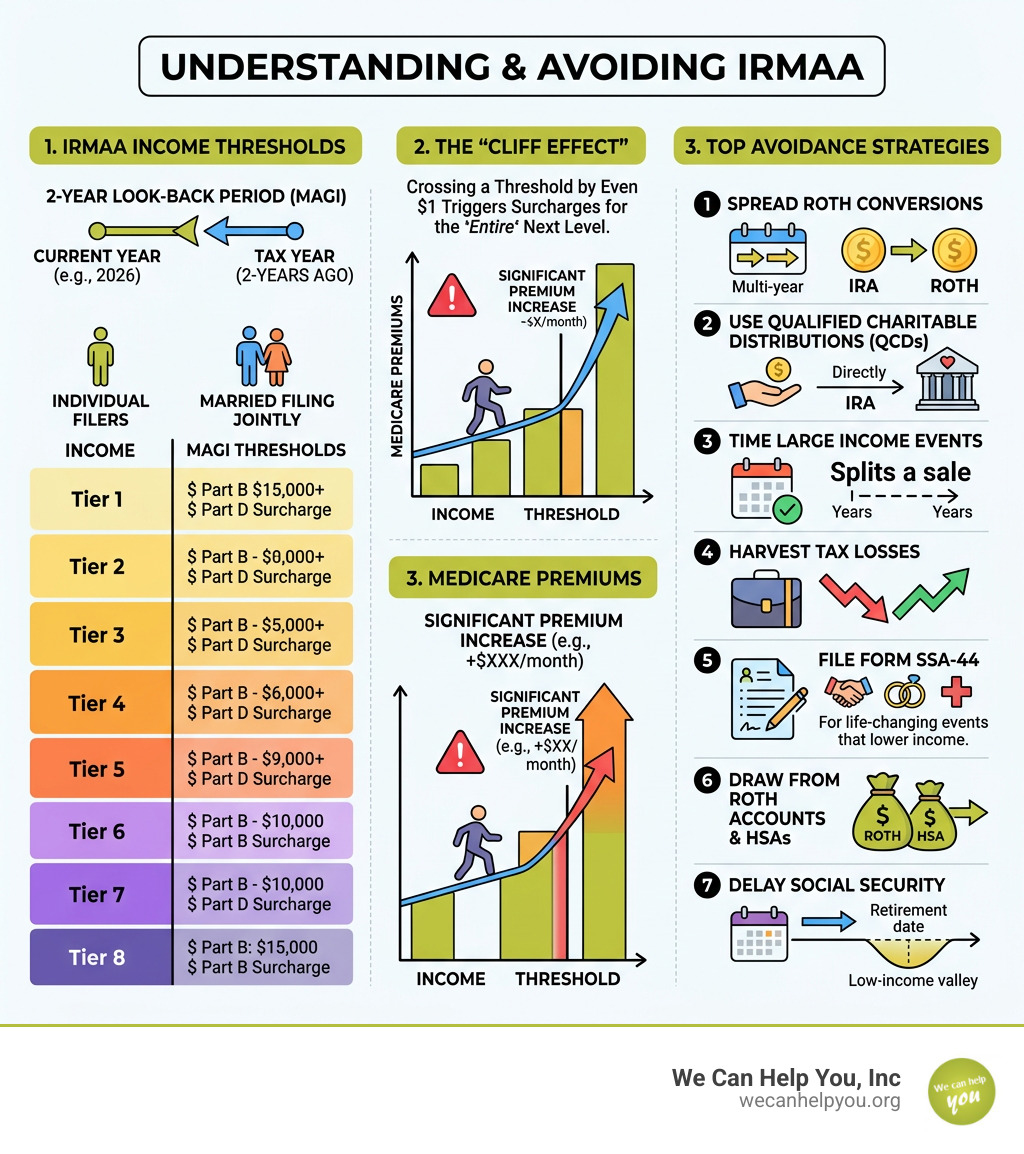
Top ways to avoid or reduce IRMAA surcharges:
- Spread Roth conversions over several years to keep income below the thresholds
- Use Qualified Charitable Distributions (QCDs) — up to $111,000/year — directly from your IRA to charity
- Time large income events (real estate sales, big withdrawals) across multiple tax years
- Harvest tax losses to offset capital gains that would push your income higher
- File Form SSA-44 if a life-changing event (retirement, divorce, death of spouse) lowered your income
- Draw from Roth accounts and HSAs since those withdrawals don’t count toward IRMAA income
- Delay Social Security to create a low-income window in early retirement for strategic planning
Most retirees plan carefully for Medicare premiums. What they don’t plan for is paying two or three times more than their neighbor for the exact same coverage.
That’s exactly what IRMAA can do.
IRMAA — the Income-Related Monthly Adjustment Amount — is a surcharge added on top of your standard Medicare Part B and Part D premiums if your income crosses certain thresholds. In 2025, that surcharge can push your Part B premium alone up by as much as $443.90 per month. For a couple, the total extra cost can exceed $12,000 in a single year.
The catch? Medicare looks at your tax return from two years ago. So a one-time income spike — a home sale, a big IRA withdrawal, even a well-meaning Roth conversion — can trigger a surcharge you didn’t expect and didn’t budget for.
Consider what happened to one retired couple with a combined income of around $210,000. They sold a piece of land and realized a $190,000 capital gain. That one transaction pushed their MAGI over the threshold and their Medicare premiums jumped by nearly $971 per month — an extra $11,652 that year. They didn’t change their lifestyle. They just had one high-income year on paper.
The good news? IRMAA is manageable. With the right income planning, many retirees can reduce or completely avoid these surcharges.
What is IRMAA and How Does the “Tax Torpedo” Work?
IRMAA is often called the “tax torpedo” because it can stay hidden below the surface for years before suddenly striking your retirement budget. It isn’t a tax in the traditional sense, but a surcharge applied to your Medicare Part B (medical insurance) and Medicare Part D (prescription drug coverage) premiums.
While only about 8% of Medicare enrollees are affected by these surcharges, those who are can see their healthcare costs double or triple. The Social Security Administration (SSA) is responsible for determining if you owe IRMAA based on the tax information they receive from the IRS.
The MAGI Calculation and the Two-Year Lookback
The most confusing part of IRMAA is the timing. The SSA uses a two-year lookback period. This means your 2025 premiums are determined by your 2023 tax return. If you had a high-income year in 2023 because you were still working or sold a business, you might be hit with a surcharge in 2025 even if you are now fully retired and living on a modest budget.
To determine your eligibility, the government looks at your Modified Adjusted Gross Income (MAGI). For Medicare purposes, your MAGI is your Adjusted Gross Income (AGI) plus any tax-exempt interest you earned (like interest from municipal bonds). This is a critical distinction: even “tax-free” muni-bond interest can trigger a Medicare surcharge.

To stay on top of these costs, it is helpful to review the CMS — Medicare Part B premium and deductible fact sheet and our guide on Understanding Medicare IRMAA Charges.
2025 and 2026 Income Thresholds
The IRMAA brackets are “cliffs.” If you go over a threshold by just one dollar, you pay the full surcharge for that entire tier. There is no pro-rating.
For 2025, the standard Part B premium is $185.00. If your 2023 MAGI was $106,000 or less (single) or $212,000 or less (joint), you pay the standard rate. Once you cross those lines, the surcharges begin.
| Filing Status | 2025 MAGI Threshold (2023 Tax Year) | 2026 Projected Threshold (2024 Tax Year) |
|---|---|---|
| Single | $106,000 | $109,000 |
| Married Joint | $212,000 | $218,000 |
| Married Separate | $106,000 | $109,000 |
Data source: Social Security — Monthly Medicare premiums & IRMAA brackets
In 2026, a married couple crossing from the base tier into the first IRMAA bracket will pay approximately $2,340 extra annually. In the highest bracket, a single person could pay over $6,000 per year in surcharges alone.
How to Avoid IRMAA Using Strategic Income Planning
The secret to how to avoid IRMAA lies in controlling your MAGI. Since the government looks back two years, the moves you make today are actually “pre-paying” for your Medicare costs two years from now.
Strategic income planning involves looking at your “low-tide” years—those years between retirement and the start of Required Minimum Distributions (RMDs)—and making moves that lower your future taxable income. You can learn more about these future impacts in our article Decoding 2026 IRMAA Brackets: What the Projections Mean for You.
Using Roth Conversions to Proactively Learn How to Avoid IRMAA
One of the most powerful tools in our arsenal is the Roth conversion. By moving money from a traditional IRA to a Roth IRA, you pay taxes now to avoid taxes (and RMDs) later.
Because Roth withdrawals are generally tax-free and do not count toward your MAGI, they are a primary way to keep your income below IRMAA thresholds in later years. However, you must be careful. A massive Roth conversion in one year could spike your MAGI and trigger a surcharge two years later. The best strategy is often a “gentle simmer”—converting just enough each year to stay within your current tax bracket and below the IRMAA cliff.
As noted by experts, How a Roth Conversion Can Spare You From Medicare’s IRMAA and Taxes is a strategy best implemented before age 63 to avoid the initial two-year lookback window when you first enroll in Medicare at 65.
Leveraging QCDs and HSAs: More Ways on How to Avoid IRMAA
If you are over age 70½, Qualified Charitable Distributions (QCDs) are your best friend. A QCD allows you to send up to $111,000 per year (for 2026) directly from your IRA to a qualified charity. This money never touches your bank account, so it isn’t included in your MAGI. This is much more effective than taking a distribution and then donating it, as the latter would still increase your MAGI.
Additionally, if you are still working, maxing out your Health Savings Account (HSA) is a brilliant move. HSA contributions reduce your AGI dollar-for-dollar, effectively lowering the income Medicare sees. Plus, HSA withdrawals for medical expenses are tax-free and don’t count toward IRMAA. Research shows that Charitable giving helps reduce MAGI, making it a cornerstone of high-income retirement planning.
Appealing Your Surcharge: How to Avoid IRMAA After Life-Changing Events
What if your income was high two years ago, but it has dropped significantly since then? You don’t have to just “deal with it.” The SSA allows you to request a new IRMAA determination if you have experienced a qualifying life-changing event (LCE).
Common life-changing events include:
- Work stoppage (Full retirement)
- Work reduction (Part-time status)
- Divorce or annulment
- Death of a spouse
- Loss of income-producing property (due to disaster or similar events)
- Loss or reduction of pension income
If you fit one of these categories, you can use our Don’t Overpay: A Step-by-Step Process for Appealing Medicare IRMAA to get your premiums lowered immediately.
When and How to File Form SSA-44
To appeal, you need to file Form SSA-44. This form allows you to report your updated income and provide documentation (like a termination letter from an employer or a death certificate).
You typically have a 60-day window to file this appeal after receiving your IRMAA initial determination notice. You can mail the form or visit your local SSA office to schedule an interview. You can find the official Social Security — Form SSA-44 (IRMAA appeal) online to start the process.
Does Delaying Social Security Help?
Delaying Social Security until age 70 can be a double-edged sword for IRMAA. In the short term, it keeps your MAGI lower during your early 60s, creating a “window” where you can perform Roth conversions or harvest capital gains without hitting IRMAA tiers.
However, once you start Social Security at age 70, your higher monthly benefit will be added to your MAGI. For some, this “larger check” might be the very thing that pushes them over a threshold. We recommend weighing the Benefits of delaying Social Security against your total projected income to see if the trade-off makes sense for your specific situation.
Avoiding the “Widow Penalty” and Other Common Pitfalls
One of the most painful IRMAA traps is the “Widow(er) Penalty.” When a spouse passes away, the surviving spouse often continues to receive similar levels of income (from RMDs, pensions, and Social Security), but they must now file as a Single taxpayer.
The IRMAA thresholds for single filers are exactly half of those for married couples. This means a surviving spouse can suddenly find themselves pushed into a much higher IRMAA tier despite having the same—or even less—household income. This makes early Roth conversions even more vital; reducing the size of future RMDs helps protect the surviving spouse from this “cliff effect.”
Another pitfall is asset location. By placing tax-inefficient investments (like bonds that pay taxable interest) inside tax-advantaged accounts and keeping tax-efficient investments (like index ETFs) in taxable accounts, you can lower your annual taxable interest. Experts agree that asset location can help minimize taxes and keep your MAGI in check.
Frequently Asked Questions about How to Avoid IRMAA
Does a Donor-Advised Fund (DAF) help reduce IRMAA?
Generally, no. While a DAF contribution is a great way to reduce your taxable income through an itemized deduction, it does not reduce your Adjusted Gross Income (AGI). Since IRMAA is based on MAGI (which starts with AGI), a DAF contribution won’t help you dodge the surcharge. However, donating appreciated securities to a DAF can help indirectly by allowing you to avoid the capital gains you would have realized if you sold the stock to give cash.
Can IRMAA surcharges go away once they are applied?
Yes! IRMAA is recalculated every single year. If your income drops below the threshold in a subsequent tax year, the surcharge will disappear automatically two years later. You can also make it go away sooner if you successfully appeal using Form SSA-44 due to a life-changing event.
Is IRMAA the same as a tax?
Technically, no. It is a “monthly adjustment amount” to your insurance premium. However, because it is based on your income and often deducted directly from your Social Security check, most retirees feel like it is a surtax. Whatever you call it, the result is the same: less money in your pocket.
Conclusion
Understanding how to avoid IRMAA is about more than just saving a few dollars on a bill; it’s about protecting your hard-earned retirement savings from unnecessary erosion. Whether you are in New York, Florida, Illinois, or any of the states we serve, proactive planning is the key.
At We Can Help You, Inc., our mission is to provide the education you need to navigate these complex rules. We offer a free Medicare Planning Guide and a free Social Security maximization report to help you keep more of your income. Don’t let a “tax torpedo” sink your retirement budget.
For more help, read our comprehensive guide on Understanding Medicare IRMAA: What It Is, How It Works, and How to Appeal and take control of your healthcare costs today.