Why Understanding Medicare Eye Exams Can Save You Hundreds of Dollars
Medicare eye exams are one of the most misunderstood parts of Medicare coverage — and that confusion can lead to some very unwelcome surprise bills.
Here’s the short answer most people need:
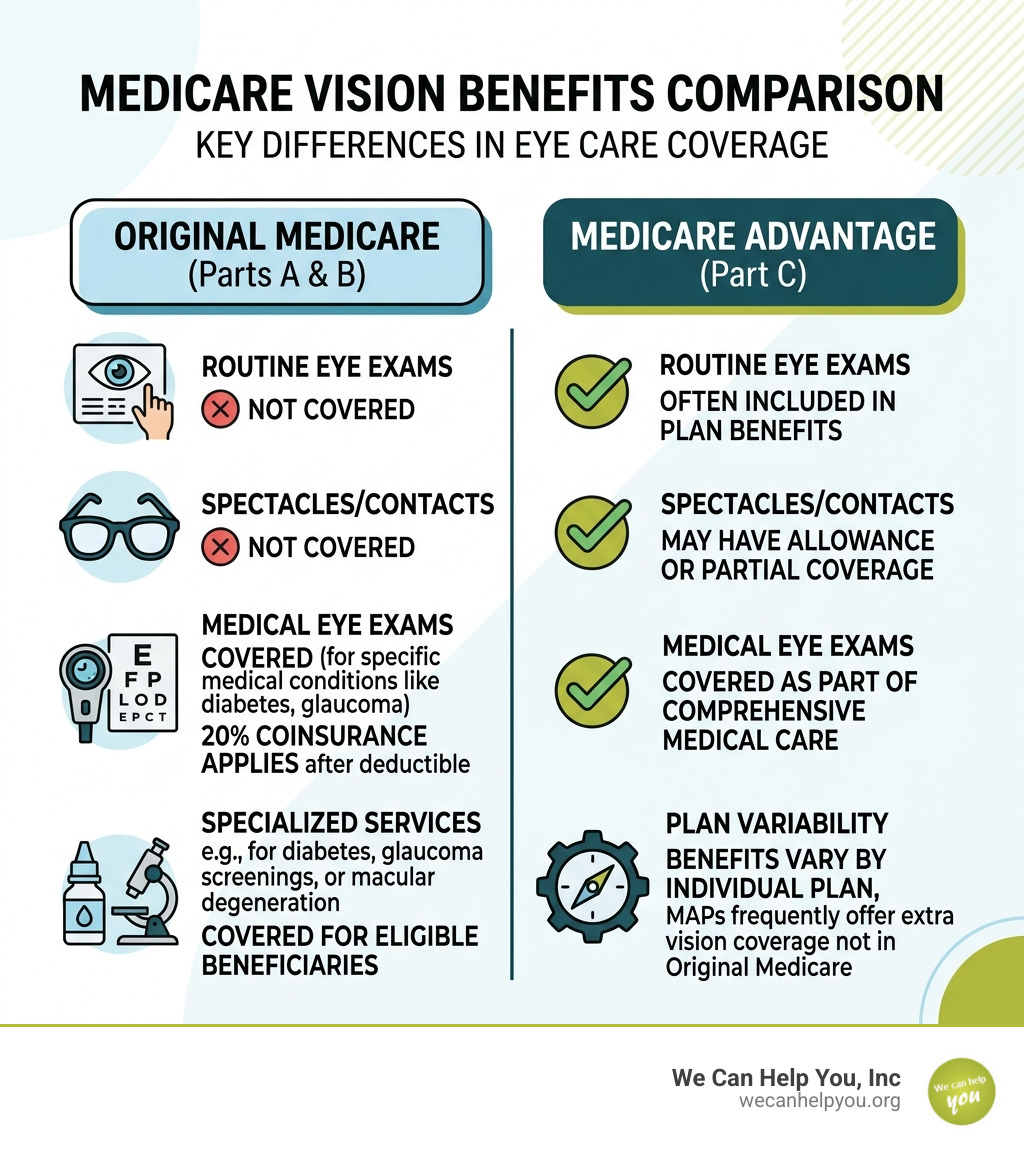
- Routine eye exams (to get glasses or contacts): Not covered by Original Medicare. You pay 100% out of pocket.
- Medical eye exams (for conditions like glaucoma, diabetes, or macular degeneration): Covered by Medicare Part B, with 20% coinsurance after your deductible.
- Medicare Advantage (Part C): Often does include routine vision benefits that Original Medicare skips entirely.
The gap matters. Without insurance, a routine eye exam typically costs $75 to $200. And consider this: roughly 92% of Medicare beneficiaries aged 65 and older rely on eyeglasses daily — yet Original Medicare won’t pay a cent toward the exam that produces the prescription.
This guide breaks down exactly what is and isn’t covered, who qualifies for special benefits, what things cost, and how to fill the gaps.
Does Original Medicare Cover Routine Medicare Eye Exams?
When we talk about “routine” eye care, we are referring to the standard checkup you get to see if your vision has changed and if you need a new pair of glasses or contact lenses. These exams often include a “refraction,” which is the part where the doctor asks, “Which is clearer: one or two?”
Unfortunately, for those enrolled in Original Medicare (Part A and Part B), the answer to whether these are covered is a resounding “no.” According to official Eye exams (routine) guidelines, Medicare does not cover eye refractions or exams for the purpose of fitting eyeglasses or contact lenses.
Here is the breakdown of why Original Medicare falls short for routine care:
- Part A (Hospital Insurance): This only covers vision care if it is part of an emergency or a required inpatient hospital stay (for example, if you have a traumatic eye injury).
- Part B (Medical Insurance): While Part B covers many preventive services, it specifically excludes routine vision screenings.
- The 100% Rule: Because it isn’t a covered benefit, you are responsible for 100% of the cost for a routine exam.
For many of our neighbors in states like Florida, New York, and California, this gap in Medicare Vision Insurance can be a shock. If you walk into an optometrist’s office expecting Medicare to pick up the tab for your new prescription, you might leave with a bill ranging from $75 to $200 just for the exam itself.
Medically Necessary Vision Services Under Part B
While routine care is excluded, Medicare Part B is much more generous when it comes to “medically necessary” services. This means if you have an eye disease, an injury, or a chronic condition that affects your sight, Medicare treats it like any other medical issue.
Part B will generally cover:
- Diagnostic testing: If you are experiencing new symptoms like blurred vision, flashes of light, or eye pain, Medicare covers the exam to find out what is wrong—even if the doctor eventually determines your eyes are healthy.
- Ocular injury: Treatment for a scratched cornea or a foreign object in the eye is covered.
- Chronic conditions: Management and treatment for diseases like cataracts, glaucoma, and age-related macular degeneration (AMD) fall under medical coverage.
Understanding Dental Vision and Hearing Aide Insurance Coverage with Medicare is essential because it helps you distinguish between “wanting to see better” (routine) and “needing to save your sight” (medical). For more technical details on how these distinctions are made, resources like Medicare and Eye Exams: Coverage, Cost, and More provide excellent deep dives into the clinical definitions used by the Centers for Medicare & Medicaid Services (CMS).
Medicare Eye Exams for High-Risk Groups
Medicare recognizes that some populations are at a significantly higher risk for certain eye diseases. To prevent permanent vision loss, Part B provides specific coverage for high-risk individuals.
Glaucoma Screenings Glaucoma is often called the “silent thief of sight” because it has no symptoms in the early stages. Medicare covers an annual glaucoma screening if you fall into one of these high-risk categories:
- You have a family history of glaucoma.
- You have diabetes.
- You are an African American aged 50 or older.
- You are a Hispanic American aged 65 or older.
Diabetic Retinopathy If you have diabetes, you qualify for an annual Eye exams (for diabetes) to check for diabetic retinopathy. This exam must be performed by an eye doctor who is legally authorized to do the exam in your state (such as an ophthalmologist or optometrist).
Medicare Eye Exams and Cataract Surgery
Cataracts are an extremely common part of aging. Fortunately, Medicare Part B covers medically necessary cataract surgery. This includes the removal of the cataract and the implantation of a conventional intraocular lens (IOL).
One of the rare exceptions where Medicare does pay for eyewear is after cataract surgery. If you have an IOL implanted, Medicare will cover:
- One pair of standard, untinted prescription eyeglasses OR
- One set of contact lenses.
You must get these items through a supplier that participates in Medicare. If you want “premium” upgrades like progressive lenses or designer frames, you will have to pay the difference in cost yourself. We always recommend checking your Medicare Vision Insurance options before scheduling surgery to understand exactly what your “one pair” allowance covers.
Out-of-Pocket Costs and Financial Responsibilities

Even when Medicare eye exams are covered, they aren’t usually free. Because most covered vision services fall under Medicare Part B, you are subject to the standard cost-sharing rules.
As of April 2026, here is what you should expect to pay for covered medical eye services:
- The Part B Deductible: In 2025, this deductible was $257. You must pay this amount out of pocket for medical services before Medicare begins to pay its share.
- The 20% Coinsurance: Once the deductible is met, Medicare pays 80% of the Medicare-approved amount. You are responsible for the remaining 20%.
- Facility Fees: If your exam or procedure takes place in a hospital outpatient setting, you may also owe a separate copayment to the facility.
Routine vs. Medical Eye Care Cost Comparison
| Service Type | Medicare Coverage | Your Typical Cost |
|---|---|---|
| Routine Eye Exam (Refraction) | Not Covered | 100% ($75 – $200) |
| Glaucoma Screening (High Risk) | Covered by Part B | 20% after Deductible |
| Diabetic Eye Exam | Covered by Part B | 20% after Deductible |
| Cataract Surgery | Covered by Part B | 20% after Deductible |
| Standard Glasses (Post-Cataract) | Covered by Part B | 20% after Deductible |
| Standard Glasses (Routine) | Not Covered | 100% ($150 – $400+) |
Expanding Coverage with Medicare Advantage and Supplemental Plans
If you find the limitations of Original Medicare frustrating, you aren’t alone. Many seniors in our service areas—from Charlotte, NC, to Las Vegas, NV—choose alternative ways to get vision coverage.
Medicare Advantage (Part C) Medicare Advantage plans are offered by private companies and are required to cover everything Original Medicare covers. However, most “MA” plans go further by offering “extra” benefits. This often includes:
- Annual routine eye exams with a $0 or low copay.
- An annual allowance (often ranging from $100 to $300) for frames, lenses, or contacts.
- Access to a specific network of vision providers.
Medigap (Medicare Supplement) Medigap plans help pay the 20% coinsurance and deductibles that Original Medicare leaves behind. While standard Medigap plans do not cover routine vision care, they are incredibly helpful if you have a chronic condition like macular degeneration, as they can bring your 20% medical coinsurance down to $0.
Standalone Vision Plans For those who prefer to stay on Original Medicare but want routine coverage, standalone vision insurance is an option. These plans function like traditional employer-sponsored vision insurance, providing a set schedule of benefits for a monthly premium.
To help you decide which path is right for your retirement, we offer a comprehensive Dental Vision Hearing Medicare Survival Guide that compares these different insurance types side-by-side.
Frequently Asked Questions about Medicare Eye Exams
Does Medicare cover eyeglasses or contact lenses?
Generally, no. Original Medicare only covers corrective lenses if you have had cataract surgery that implanted an intraocular lens. For all other situations, you pay 100%. If you have a Medicare Advantage plan, you likely have an annual allowance to help pay for frames or contacts. You can learn more about these specific plan differences in our section on Medicare Vision Insurance.
How often does Medicare pay for glaucoma screenings?
If you are in a high-risk group (diabetic, family history, or meeting the age/ethnicity criteria), Medicare Part B covers one screening every 12 months. This is considered a preventive service, but unlike some other preventive services, the Part B deductible and 20% coinsurance still apply.
What is the cost of a routine eye exam without insurance?
Without any insurance coverage, a routine eye exam usually costs between $75 and $200. This price can fluctuate based on your location (for example, costs in Chicago, IL, may differ from those in Roswell, NM) and whether the exam includes advanced digital imaging of the retina.
Conclusion
Navigating Medicare eye exams doesn’t have to feel like walking through a thick fog. The key is remembering the “Medical vs. Routine” divide. If your eyes are hurting or you have a chronic condition, Medicare Part B is there to help. If you just need a new pair of specs to read the morning paper, you’ll likely need to look toward Medicare Advantage or a standalone vision plan.
At We Can Help You, Inc., we are a non-profit dedicated to educating individuals on Medicare and Social Security for a more secure retirement. We know that every dollar counts when you’re on a fixed income, which is why we offer a free Medicare Planning Guide to help you map out your coverage before you enroll.
We also provide a free Social Security maximization report to help you increase your retirement income—money that could easily cover the cost of those new designer frames you’ve been eyeing! Whether you are in Albuquerque, NM, or Manchester, NH, we are here to ensure you see your future clearly.
Secure Your Vision and Retirement Future today by reaching out for your free planning resources.