
Understanding Your Medicare Coverage Gaps
Dental vision hearing Medicare coverage is one of the most confusing aspects of the program—and one of the biggest surprises for new beneficiaries. Here’s what you need to know right away:
Quick Answer: What Does Medicare Cover?
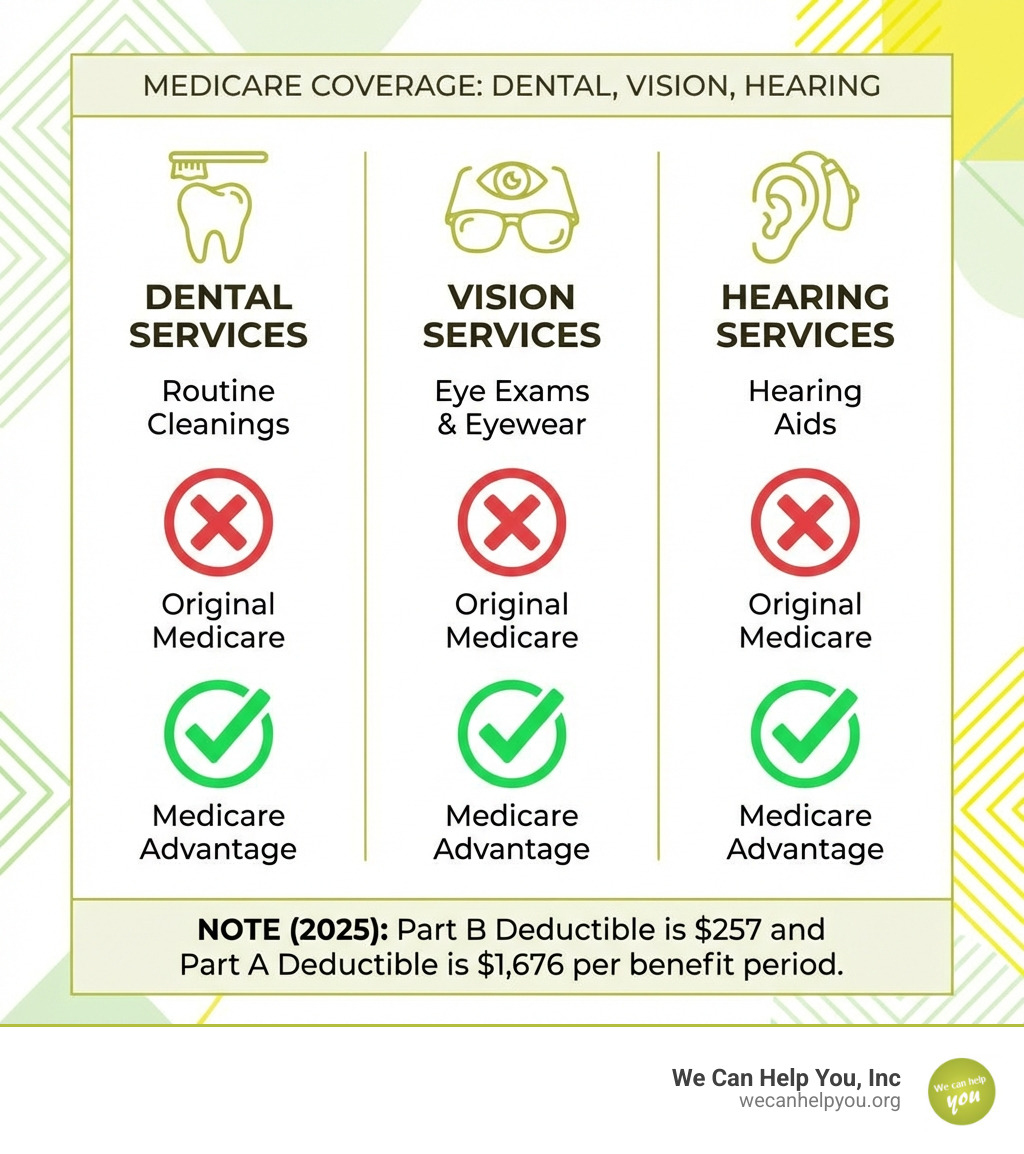
- Original Medicare (Parts A & B): Does NOT cover routine dental, vision, or hearing care
- Medicare Advantage (Part C): Often includes dental, vision, and hearing benefits as extras
- Medigap Plans: Generally do NOT cover these services
- Standalone Plans: Available separately for purchase
If you’re turning 65 or already enrolled in Medicare, you’ve probably discovered a hard truth: the program that covers hospital stays, surgeries, and doctor visits won’t pay for your teeth cleanings, eyeglasses, or hearing aids.
This creates real problems. 70% of Medicare beneficiaries who had trouble eating because of their teeth didn’t go to the dentist in the past year. Meanwhile, 75% of those who needed a hearing aid didn’t have one. These aren’t just comfort issues—they’re health risks that can lead to social isolation, poor nutrition, and even increased dementia risk.
The good news? You have options. Whether it’s through Medicare Advantage plans, low-cost community programs, or strategic use of medically necessary exceptions, you can get the care you need without breaking the bank.
This guide walks you through exactly what’s covered, what’s not, and how to fill the gaps.
Does Original Medicare Cover Routine Care?

When we talk about “Original Medicare,” we are referring to Part A (Hospital Insurance) and Part B (Medical Insurance). For most of us, these are the foundation of our healthcare in retirement. However, when it comes to dental vision hearing medicare services, Original Medicare is famously restrictive.
In most cases, Original Medicare does not cover routine dental care, such as cleanings, fillings, tooth extractions, or dentures. It also excludes routine eye exams, eyeglasses, contact lenses, hearing aids, and the exams needed to fit them. This can be a shock to the system, especially when you consider that Original Medicare (Parts A and B) limited coverage only applies in very specific, medically necessary circumstances.
For example, Part B may cover a diagnostic hearing and balance exam if your doctor orders it to see if you need medical treatment for a condition. However, it will not pay for the hearing aid itself. Similarly, while a routine cleaning is out of the question, Medicare might cover a dental exam if it’s required as part of a pre-surgery workup for a kidney transplant or heart valve replacement.
Medically Necessary Exceptions and 2025 Costs
While routine care is generally off the table, there are “silver linings” where Medicare steps in. Understanding these exceptions can save you thousands of dollars.
- Dental Exceptions: Medicare may pay for dental services that are integral to a covered medical procedure. This includes tooth extractions prior to radiation treatment for jaw cancer or oral exams before an organ transplant.
- Vision Exceptions: While you won’t get help with a standard prescription for reading glasses, Medicare covers cataract surgery. Following the surgery, Medicare will pay for one pair of eyeglasses with standard frames or one set of contact lenses. It also covers annual routine eye care services specifically for those with diabetes or at high risk for glaucoma.
- Hearing Exceptions: Diagnostic audiology visits are covered if you’ve had a hearing loss or balance issue for 12 months or more.
It is important to keep the 2025 costs in mind. If a service is covered under Part B, the Part B deductible is $257 per year in 2025. Once that is met, you typically pay 20% of the Medicare-approved amount. If you are hospitalized for a dental-related emergency that requires a stay, the Part A inpatient hospital deductible is $1,676 per benefit period in 2025.
How to Navigate Dental Vision Hearing Medicare Options
If you find that Original Medicare leaves too many gaps in your smile or your sight, you aren’t alone. Many people choose to move toward Medicare Advantage (Part C) to solve this problem. Medicare Advantage plans are offered by private companies approved by Medicare and they bundle Part A, Part B, and usually Part D (drug coverage) into one plan.
| Feature | Original Medicare | Medicare Advantage (Part C) |
|---|---|---|
| Routine Dental | No | Often Included |
| Routine Vision | No | Often Included |
| Hearing Aids | No | Often Included |
| Provider Choice | Any provider taking Medicare | Network-based (HMO/PPO) |
| Out-of-Pocket Limit | None | Yearly Limit Included |
Most Advantage plans offer extra benefits that Original Medicare doesn’t cover. To know exactly what your plan offers, you must check the Evidence of Coverage (EOC) document. This document lists every benefit, copay, and limitation. For those looking for more details, you can find more info about medicare dental insurance to help you decide if Part C is the right path for you.
Common Dental Vision Hearing Medicare Services in Part C
When you enroll in a Medicare Advantage plan, the “extra” benefits can vary wildly. However, most plans aim to cover the basics that keep you healthy.
In the dental category, you’ll often find coverage for:
- Preventive Care: Periodic oral exams, cleanings, and X-rays (often with a $0 copay).
- Comprehensive Care: Some plans include fillings, extractions, and even root canals or dentures, though these may require a coinsurance payment.
For vision, most plans provide a yearly eye exam and an “eyewear allowance.” This is a set dollar amount (e.g., $150–$300) that you can use toward the purchase of frames or contact lenses. If you’re interested in how these benefits work, you can find more info about medicare hearing aide insurance and vision perks through our educational resources.
Comparing Dental Vision Hearing Medicare Costs
Price is often the deciding factor. In Medicare Advantage, you need to understand the difference between HMO and PPO networks.
- HMO (Health Maintenance Organization): You generally must see in-network providers for your dental and vision care. If you go out-of-network, you might pay the full cost yourself.
- PPO (Preferred Provider Organization): You have more flexibility to see providers outside the network, but you will almost certainly pay a higher coinsurance or copay.
Keep an eye on annual maximums. A plan might cover dental, but only up to $1,500 per year. Once you hit that limit, you are responsible for the rest. Check more info about medicare vision insurance to see how different plans cap their eyewear and exam benefits.
Medigap and Standalone Coverage Solutions
What if you prefer Original Medicare because you like the freedom to see any doctor in the country? In that case, you likely have a Medigap (Medicare Supplement) plan like Plan G or Plan N.
Here is the catch: Medigap plans generally do not cover dental, vision, or hearing. Medigap is designed to pay for the “gaps” in Original Medicare, such as your 20% coinsurance or deductibles for hospital stays. Since Original Medicare doesn’t cover routine dental or vision in the first place, Medigap has nothing to “supplement.”
To fill this gap, you have two main choices:
- Standalone Policies: You can purchase a separate dental and vision policy from a private insurer. These have their own monthly premiums and networks.
- Add-on Packages: Some insurers allow you to add a “Dental, Vision, and Hearing” package to your Medigap policy for an extra monthly fee (often around $30–$50).
It is vital to review the Medicare Dental Vision Hearing Gaps Factsheet to understand how these gaps might impact your budget over time.
Finding Low-Cost Care and Assistance Programs
We know that even with insurance, costs can add up. If you are on a fixed income and struggling to afford the 70% dental gap or the 75% hearing aid gap, there are community resources available in our covered locations—from Florida to New York and beyond.
- Dental Schools: You can use The American Dental Association website to find dental schools in your region. These schools often provide high-quality care at a fraction of the cost because students are performing the work under the supervision of licensed dentists.
- Vision Assistance: EyeCare America® free services provides eye exams and care for eligible seniors through a network of volunteer ophthalmologists. Organizations like the Lions Club also offer programs to help seniors obtain eyeglasses.
- Hearing Help: Hearing aids can be incredibly expensive. Programs like “Help America Hear” or your local Lions Club chapter may offer assistance. Additionally, the recent availability of Over-the-Counter (OTC) hearing aids has made it much cheaper for those with mild-to-moderate hearing loss to get help without a prescription.
- Community Health Centers: You can find a community health center in your area that provides care on a sliding scale based on your income.
If you are feeling overwhelmed, SHIP (State Health Insurance Assistance Program) counselors provide free, unbiased guidance to help you navigate these choices.
Frequently Asked Questions about Medicare Coverage
Does Medicare cover dentures or dental implants?
Original Medicare almost never covers dentures or implants. These are considered “routine” or “cosmetic.” However, many Medicare Advantage plans offer a specific dollar allowance or a percentage of coverage for dentures. Implants are more rarely covered, even in Advantage plans, so check your Evidence of Coverage carefully.
How often does Medicare pay for eye exams?
If you have Original Medicare, it pays for $0 for routine eye exams. However, if you have diabetes, Medicare Part B covers one exam per year. If you have a Medicare Advantage plan, most will pay for one routine eye exam every 12 months.
Can I get free hearing aids through Medicare?
Original Medicare does not pay for hearing aids. Some Medicare Advantage plans offer hearing aids for a low copay (such as $500–$1,000 per ear), which is a significant discount from the retail price of $3,000+. For truly free options, you would likely need to look toward Medicaid (if you qualify) or charitable organizations like the Lions Club.
Conclusion
Navigating dental vision hearing medicare doesn’t have to be a solo journey. At We Can Help You, Inc., we are a non-profit dedicated to educating retirees across the United States—from Arizona and New Mexico to Massachusetts and Virginia. Our goal is to ensure you don’t face unexpected costs that drain your retirement savings.
We offer a free Medicare Planning Guide and a free Social Security maximization report to help you increase your retirement income and make informed choices about your healthcare. By understanding the gaps in Original Medicare and the opportunities in Part C or standalone plans, you can protect your health and your wallet.
Don’t let a lack of coverage keep you from seeing, hearing, and smiling through your best years. Get your Dental Vision Hearing Medicare Guide today and take control of your retirement wellness.