
The Medicare Surcharge Most Retirees Never See Coming
IRMAA penalty avoidance is one of the most valuable — and most overlooked — retirement planning moves you can make. If your income is above certain thresholds, Medicare charges you more for the same coverage everyone else gets. That extra charge is called IRMAA, and it can cost a single retiree over $1,000 more per year — sometimes much more.
Here’s a quick answer to help you avoid it:
Ways to avoid or reduce IRMAA surcharges:
- Keep your Modified Adjusted Gross Income (MAGI) below the threshold for your filing status ($109,000 single / $218,000 joint in 2026)
- Do Roth conversions before age 63, during low-income years
- Use Qualified Charitable Distributions (QCDs) from your IRA instead of cash donations
- Harvest tax losses to offset capital gains
- Maximize HSA and pretax retirement contributions while still working
- Appeal using Form SSA-44 if a life-changing event lowered your income
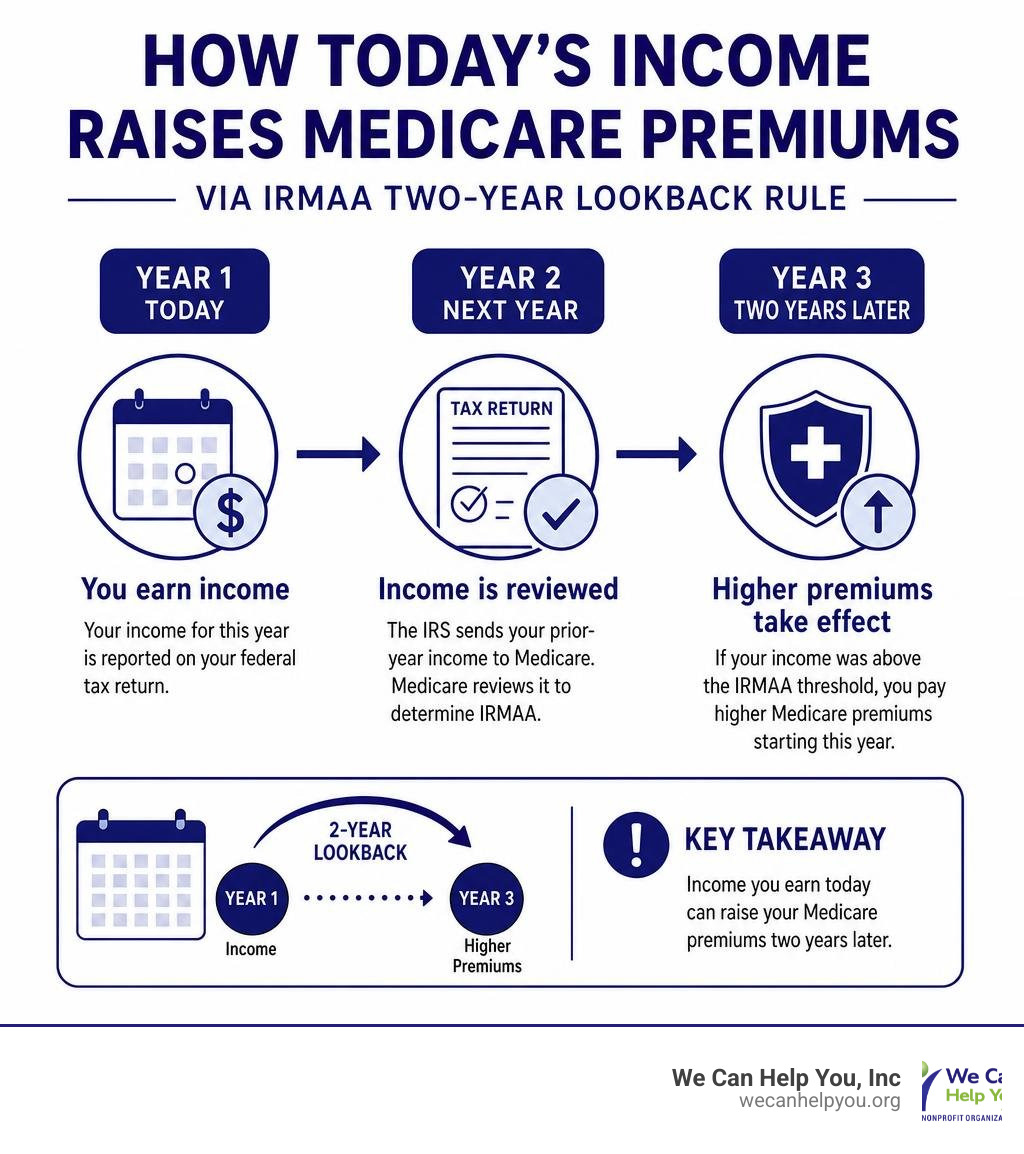
The catch? Medicare looks at your tax return from two years ago. So income you earn today can raise your premiums in two years — often long after you’ve forgotten about it.
Consider this: a retiree crosses the first IRMAA threshold by just $499 due to a single capital gain. The result? An extra $1,148 added to her Medicare bill the following year — with no way to appeal it, because no qualifying life event occurred.
That’s the IRMAA cliff in action. One dollar over the line, and you owe the full surcharge. No gradual phase-in. No partial penalty. Just a hard jump to the next tier.
About 8% of Medicare enrollees pay IRMAA each year. If you’re approaching retirement with a sizable income, investment portfolio, or tax-deferred account, there’s a real chance you’re one of them — or soon will be.
This guide walks you through exactly how IRMAA works, what the 2026 brackets look like, how to appeal if you qualify, and the smartest strategies to keep your Medicare premiums as low as possible.
IRMAA Penalty Avoidance Starts With Understanding the Surcharge
To beat the system legally, we first have to understand how it operates. The Income-Related Monthly Adjustment Amount (IRMAA) is not actually a tax—though it certainly feels like one. It is a monthly surcharge added to your baseline Medicare premiums if your income exceeds federal limits.
At We Can Help You, Inc., we see many retirees get blindsided by this extra charge because they assume Medicare is a flat rate for everyone. In reality, the federal government subsidizes about 75% of Medicare costs for the average citizen. However, for higher-income retirees, that subsidy is scaled back, forcing you to pay up to 85% of the total cost of your coverage.
The Social Security Administration (SSA) determines who pays this surcharge annually. If you are among the roughly 8% of beneficiaries affected, you will receive an IRMAA determination letter in the mail detailing your new monthly costs. Crucially, IRMAA applies to everyone on Medicare who crosses the income lines, even if you are enrolled in a private Medicare Advantage plan. To learn more about these extra fees, read our breakdown on Understanding Medicare IRMAA Charges.
What IRMAA Is and Which Medicare Premiums It Affects
The IRMAA surcharge affects two specific parts of your Medicare coverage:
- Medicare Part B (Medical Insurance): This covers doctor visits, outpatient care, and preventive services. The surcharge is added directly to your standard monthly Part B premium (which is $202.90 in 2026).
- Medicare Part D (Prescription Drug Coverage): This covers your medications. The IRMAA surcharge is a fixed extra fee added on top of your specific plan’s premium.
Because IRMAA is calculated on an individual basis, married couples filing jointly must look at their combined income, but each spouse will be assessed their own individual surcharge. If you both cross the threshold, your household Medicare bill will double the surcharge amount, turning a minor oversight into a multi-thousand-dollar annual hit.
How Medicare Calculates IRMAA Using MAGI
Medicare does not use your taxable income to determine your premium tier. Instead, it looks at your Modified Adjusted Gross Income (MAGI) from your IRS tax return.
The Medicare MAGI formula is relatively simple, but it has one major trap: $$text{Medicare MAGI} = text{Adjusted Gross Income (AGI)} + text{Tax-Exempt Interest}$$
Your AGI (found on Line 11 of Form 1040) includes ordinary wages, pensions, taxable Social Security benefits, traditional IRA withdrawals, Required Minimum Distributions (RMDs), and realized capital gains.
The trap is tax-exempt interest (such as interest earned from municipal bonds, found on Line 2a of Form 1040). While municipal bonds are tax-free on your regular federal return, Medicare pulls that interest back in to calculate your MAGI. If you hold a large portfolio of municipal bonds to keep your tax bill low, you might accidentally push yourself right over an IRMAA line.
The good news? Qualified distributions from a Roth IRA or Roth 401(k) are completely tax-free and do not count toward AGI or MAGI. This is why Roth accounts are the ultimate weapon for IRMAA penalty avoidance.
Why IRMAA Is a Cliff, Not a Phaseout
In the standard U.S. tax system, tax brackets are progressive. If you enter the 24% bracket by one dollar, only that single dollar is taxed at 24%.
IRMAA does not play by these friendly rules. IRMAA thresholds are hard cliffs.
If the threshold for joint filers is $218,000, and your MAGI is $218,000, you pay the standard premium. If your MAGI is $218,001—just one dollar over—you and your spouse are instantly pushed into Tier 1 of the surcharges. That single dollar triggers an extra $81.20 per month for Part B and $14.50 per month for Part D for each of you.
Over a full year, that one-dollar mistake costs your household an extra $2,296.80 in Medicare premiums!

This cliff structure makes meticulous bracket management and year-end income reviews absolutely vital. You must monitor your income down to the penny as December 31st approaches.
2026 IRMAA Brackets, Premiums, and the Two-Year Lookback Rule
Because Medicare premiums are indexed annually for inflation, the income brackets shift slightly every year. For 2026, the baseline thresholds have risen, offering a bit more breathing room for retirees. To see how these numbers fit into the broader historical trends, check out our guide on Decoding 2026 IRMAA Brackets: What the Projections Mean for You.
The 2026 IRMAA Income Thresholds to Know
For 2026, the standard monthly Part B premium is $202.90, and the national base Part D premium is $38.99. If your MAGI from two years prior (2024) falls within the brackets below, your monthly costs will adjust accordingly:
| 2026 Income Tier | Single Filer MAGI (2024 Return) | Joint Filer MAGI (2024 Return) | Extra Monthly Part B Surcharge | Extra Monthly Part D Surcharge | Total Combined Monthly Premium (B + D)* |
|---|---|---|---|---|---|
| Standard (Tier 0) | $109,000 or less | $218,000 or less | $0.00 | $0.00 | $241.89 |
| Tier 1 | $109,001 – $137,000 | $218,001 – $274,000 | $81.20 | $14.50 | $337.59 |
| Tier 2 | $137,001 – $171,000 | $274,001 – $342,000 | $202.90 | $37.40 | $482.19 |
| Tier 3 | $171,001 – $205,000 | $342,001 – $410,000 | $324.60 | $60.30 | $626.79 |
| Tier 4 | $205,001 – $499,999 | $410,001 – $749,999 | $446.40 | $83.10 | $771.39 |
| Tier 5 | $500,000 or more | $750,000 or more | $487.00 | $91.00 | $819.89 |
*Note: Part D totals assume a baseline plan premium of $38.99. Your actual Part D base premium will vary depending on your chosen plan.
How the Two-Year Lookback Creates a Planning Lag
The most confusing aspect of IRMAA is the two-year lookback rule. Medicare determines your 2026 premiums using your tax return filed for the 2024 tax year.
This creates a significant planning lag:
- Actions you take in 2026 will dictate your Medicare premiums in 2028.
- If you sell a business, cash in a large stock position, or execute a major Roth conversion today, the financial “aftershocks” won’t show up on your Medicare bill for two full years.
This lag creates what planners call the “Age 63 Trap.” Because Medicare enrollment typically begins at age 65, the income you earn at age 63 is the exact data Medicare will use to set your initial premium rates. Many retirees who work up until age 64 find themselves hit with massive IRMAA surcharges during their first year of retirement, simply because they failed to plan for the lookback period.
Why Retirees Should Forecast Income Before Medicare Starts
Because of this lookback delay, the optimal window for comprehensive tax planning is between ages 60 and 62. This “low-tide” tax window represents the years before your income begins impacting your Medicare costs.
During this period, you have maximum flexibility to restructure your assets, front-load taxable events, and complete heavy Roth conversions without worrying about triggering immediate Medicare surcharges.

How to Appeal an IRMAA Determination After a Life-Changing Event
What happens if your income in 2024 was high because you were working, but you retired in 2025 and now make a fraction of that amount? Do you still have to pay the 2026 surcharge?
Thankfully, no. The Social Security Administration provides an escape hatch through Form SSA-44 (Medicare Income-Related Monthly Adjustment Amount – Life-Changing Event). This form allows you to request a redetermination of your premiums if your income dropped due to a qualifying event. For a complete step-by-step walkthrough on how to file, check out our guide on How to Appeal Medicare IRMAA.
Qualifying Life-Changing Events for Form SSA-44
You cannot appeal an IRMAA surcharge simply because you don’t want to pay it. The SSA only recognizes eight specific life-changing events:
- Work Stoppage: You retired or completely stopped working.
- Work Reduction: You transitioned to part-time work, significantly lowering your earnings.
- Death of a Spouse: The loss of a spouse reduces household income and alters your tax filing status.
- Divorce or Annulment: A legal separation that changes your household tax structure.
- Loss of Income-Producing Property: A natural disaster, eminent domain, or theft destroyed your income source (voluntary sales do not count).
- Loss of Pension Income: Your pension plan ceased, failed, or was drastically reduced.
- Employer Settlement Payment: Your former employer entered bankruptcy or reorganization, ending your retirement benefits.
- Marriage: Changing your filing status mid-year.
If you have experienced one of these events, you can submit your request directly to the SSA online via the SSA request to lower IRMAA portal.
What Documentation Strengthens an IRMAA Appeal
To win your appeal, you must provide clear, verifiable proof of both the life-changing event and your new, lower estimated income. Excellent supporting documents include:
- A signed letter from your former employer stating your official retirement date.
- A copy of your final pay stub showing a drop in hours or pay.
- A certified copy of a death certificate, divorce decree, or marriage certificate.
- A copy of your most recent tax return or an official tax transcript.
You must file Form SSA-44 within 60 days of receiving your initial IRMAA determination notice. Do not delay—the sooner you submit your documentation, the faster the SSA can adjust your monthly premium.
What Usually Does Not Qualify for an Appeal
It is equally important to understand what the SSA will not accept as a valid reason for an appeal. According to the official IRMAA FAQ, voluntary, one-time spikes in income do not qualify as life-changing events.
The following events will not get your IRMAA surcharge dismissed:
- Selling a highly appreciated primary or vacation home.
- Executing a large, voluntary Roth IRA conversion.
- Realizing significant capital gains from selling stocks in a taxable brokerage account.
- Taking a large, one-time withdrawal from a traditional IRA or 401(k) to buy a boat or RV.
- Reaching age 73 (or 75) and being forced to take a massive Required Minimum Distribution (RMD).
Because these events are voluntary or predictable, the SSA expects you to plan around them. If you trigger an IRMAA surcharge through one of these actions, you must pay the penalty for that year.
Proactive IRMAA Penalty Avoidance Strategies That Reduce Future Exposure
If you do not qualify for a Life-Changing Event appeal, your only defense is a proactive offense. By managing your MAGI throughout the year, you can keep your income safely below the IRMAA cliffs. For more creative ideas, read our article on IRMAA Hacks to Keep Your Cash.
Roth Conversions for IRMAA Penalty Avoidance
Roth conversions are the single most powerful tool for long-term IRMAA penalty avoidance, but they must be handled with extreme care.
A Roth conversion involves moving pre-tax money from a traditional IRA or 401(k) into a Roth IRA. You pay ordinary income taxes on the converted amount today, but the money grows tax-free forever, and future distributions do not count toward your MAGI.
The strategy is to execute these conversions during your “gap years”—the golden window between your retirement date and the age when Required Minimum Distributions (RMDs) begin. By systematically converting your pre-tax assets to Roth assets, you shrink the size of your traditional IRA, drastically reducing the size of your future RMDs.
The Golden Rule of Roth Conversions near Medicare Age: Do not convert blindly up to your federal income tax bracket ceiling. Instead, convert up to the nearest IRMAA threshold.
For example, if you are a joint filer with a base MAGI of $180,000, you have $38,000 of “room” before you hit the first 2026 IRMAA cliff of $218,000. If you convert $37,000, you pay standard taxes on that money, but your Medicare premiums remain untouched. If you convert $45,000, you will trigger an extra $2,297 in Medicare surcharges two years later, erasing a massive chunk of your tax savings!
Qualified Charitable Distributions, QCDs, and RMD Control
Once you reach age 70½, the IRS allows you to make Qualified Charitable Distributions (QCDs) directly from your traditional IRA to a registered 501(c)(3) charity.
In 2026, you can donate up to $111,000 per person ($222,000 for married couples) annually through QCDs.
Why is this an IRMAA lifesaver?
- The donated amount goes directly from your custodian to the charity, meaning it never enters your AGI or MAGI.
- If you are age 73 or older, your QCD satisfies your Required Minimum Distribution (RMD) dollar-for-dollar.
- Because the donation is excluded from your income entirely, you get the full tax benefit even if you take the standard deduction (which most retirees do).
If you plan to give to charity anyway, using a QCD is infinitely superior to writing a personal check or donating cash.
Capital Gains Timing and Tax-Loss Harvesting
Realizing large capital gains can easily push you over an IRMAA threshold. To prevent this, you must actively manage your taxable brokerage accounts.
- Tax-Loss Harvesting: If you need to sell highly appreciated stock, look for underperforming investments in your taxable accounts that you can sell at a loss. You can use those capital losses to offset your capital gains dollar-for-dollar, keeping your AGI and MAGI flat.
- Installment Sales: If you are selling a business or a piece of real estate, consider structuring the transaction as an installment sale. This allows you to spread the capital gains over several tax years rather than taking a massive, single-year income spike that triggers top-tier IRMAA penalties.
Other Income-Reduction Tools to Consider Before Medicare
- Maximize Pretax Accounts: If you are still working in your early 60s, maximize your contributions to traditional 401(k)s and IRAs. In 2026, workers aged 60–63 can take advantage of a “super catch-up” contribution limit of $11,250, allowing you to shield up to $35,750 from your current-year MAGI.
- Health Savings Accounts (HSAs): HSA contributions are triple-tax-advantaged and directly reduce your AGI. However, you must stop contributing to an HSA at least six months before you enroll in Medicare to avoid tax penalties.
- Delay Social Security: Delaying your Social Security benefits until age 70 not only increases your monthly payout by 8% per year, but it also keeps your taxable income lower during your early retirement years, leaving more room for strategic Roth conversions.
Timing Income Events to Stay Below IRMAA Thresholds
Successful IRMAA penalty avoidance requires looking at your retirement income as a dynamic, multi-year puzzle rather than a series of isolated tax years. To see how these surcharges impact higher-income households, read our analysis on How IRMAA Surcharges Impact High Earners.
Build a Year-by-Year IRMAA Map Before Taking Extra Income
We highly recommend building a rolling 3-to-5-year retirement income map. Track all your guaranteed income sources—pensions, Social Security, annuity payments, and RMDs—and project your MAGI for each year.
By keeping a buffer of at least $5,000 to $10,000 below the nearest IRMAA cliff, you protect yourself against unexpected year-end capital gain distributions from mutual funds or minor errors in your tax calculations.
Common Mistakes That Accidentally Trigger IRMAA
Even the most diligent retirees can make simple mistakes that trigger expensive Medicare surcharges. Watch out for these common pitfalls:
- Executing Large December Roth Conversions: Doing a conversion late in the year leaves you no time to correct errors or offset the income with tax losses.
- Forgetting Tax-Exempt Interest: Assuming municipal bond interest is “invisible” to Medicare.
- Assuming Standard Deductions Lower MAGI: Standard or itemized deductions reduce your taxable income, but they do not reduce your Adjusted Gross Income (AGI) or MAGI.
- Taking an RMD Before a QCD: If you take your RMD first, you cannot retroactively label it as a QCD. The charity transfer must occur first.
When to DIY and When to Get Professional Help
If your retirement income is highly predictable—consisting solely of a modest pension and standard Social Security—you can likely handle your Medicare planning yourself.
However, you should seek the help of a qualified Certified Financial Planner (CFP) or CPA if:
- You own a business or are planning a business exit.
- You hold highly concentrated stock positions or stock options.
- You are planning to sell real estate or a vacation home.
- You are a widow or widower (the “widow penalty” drops your IRMAA threshold from $218,000 to $109,000, instantly doubling your risk of a surcharge).
- You want to model complex, multi-year Roth conversions.
Conclusion: Keep More Retirement Income by Planning Before the IRMAA Bill Arrives
At We Can Help You, Inc., our mission is to empower retirees with the education and tools they need to protect their hard-earned savings. IRMAA penalty avoidance isn’t about hiding income—it’s about making smart, legal, and highly coordinated financial moves to ensure you aren’t paying a penny more for Medicare than you have to.
By managing your MAGI, timing your capital gains, utilizing QCDs, and appealing when life throws you a curveball, you can easily slip past these premium surcharges.
To help you secure your retirement, we want to offer you our free Medicare Planning Guide and our free Social Security maximization report to help you increase your guaranteed retirement income.
Before you take your next financial step, take a moment to read our detailed guide on Understanding Medicare IRMAA Charges and How to File an Appeal. Let us help you keep your cash where it belongs—in your pocket.