
What You Need to Know About the 2027 Medicare Cost Increase
The 2027 Medicare cost increase is already taking shape — and if you’re on Medicare or approaching it, here’s what matters most:
Quick Summary: 2027 Medicare Cost Changes
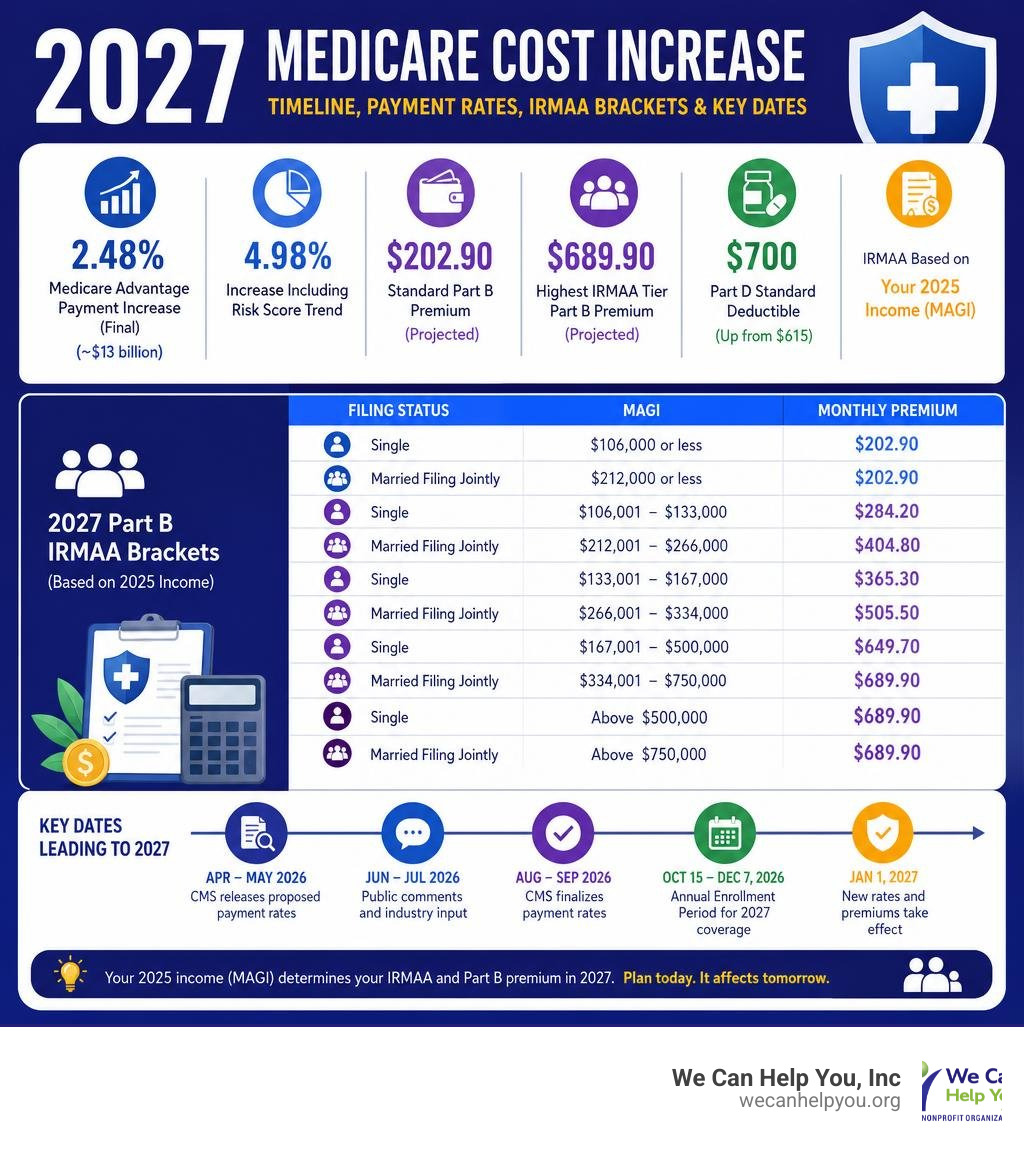
| What’s Changing | Key Numbers |
|---|---|
| Medicare Advantage payment increase (final) | 2.48% (~$13 billion) |
| Increase including risk score trend | 4.98% |
| Standard Part B premium (projected) | $202.90/month |
| Highest IRMAA tier Part B premium (projected) | $689.90/month |
| Part D standard deductible (proposed) | $700 (up from $615) |
| IRMAA based on | Your 2025 income (MAGI) |
If you’re nearing retirement, you’ve probably noticed that Medicare costs seem to creep up every year. But 2027 brings some changes that are worth paying close attention to — especially if your income in 2025 is higher than usual.
Here’s the short version: CMS originally proposed a modest 0.09% increase in Medicare Advantage payments. After public comments — including heavy industry input — the final rate landed at 2.48%, or over $13 billion in additional payments to plans. When you factor in risk score trends, that number climbs to 4.98%.
For most beneficiaries, the biggest direct impact will come through IRMAA — the income-related premium surcharge tied to what you earned two years ago. That means your 2025 financial decisions are quietly shaping what you’ll pay for Medicare in 2027.
This article breaks down everything you need to know: what’s driving costs up, what your premiums might look like, and what you can do right now to protect your wallet.
Understanding the 2027 Medicare Cost Increase for Medicare Advantage

To understand how the 2027 Medicare cost increase impacts your personal budget, we first have to look at how the government funds Medicare Advantage (MA) plans. Every year, the Centers for Medicare & Medicaid Services (CMS) updates the payment rates and policies that dictate how much private insurance companies receive to manage care for their members.
In early 2026, CMS finalized these rates for the upcoming 2027 calendar year. According to the CMS Finalizes 2027 Medicare Advantage and Part D Payment Policies that Strengthen Accountability and Long-Term Sustainability | CMS , the federal government is projecting a net average year-over-year payment increase of 2.48% to Medicare Advantage plans. This adjustment translates to over $13 billion in additional funding flowing to private plans in 2027.
However, when we factor in the expected growth in “risk scores”—which represent the health status and coding trends of enrolled beneficiaries—the overall payment increase to these plans is actually projected to be 4.98%.
These updates are closely tied to the Effective Growth Rate, which CMS calculates based on the projected cost of care under Original Medicare. For 2027, the National Per Capita MA Growth Percentage is finalized at 4.40% for combined aged and disabled beneficiaries, while the Fee-for-Service (FFS) Growth Percentage is set at 5.46%. To learn more about how these baseline shifts affect your coverage, check out our guide on how to Prepare for Tomorrow: What to Expect for 2027 Medicare Costs.
Why CMS Adjusted the 2027 Medicare Cost Increase from Proposed Rates
The final payment rates for 2027 look remarkably different from what CMS originally put on the table. In January 2026, CMS issued its Advance Notice proposing a tiny, flat-line increase of just 0.09%—amounting to roughly $700 million in additional funding.
So, how did we get from a near-zero proposal of 0.09% to a finalized 2.48% rate increase?
The answer lies in intense industry feedback and lobbying. Private insurance companies and industry groups argued that a 0.09% increase would force them to cut extra benefits or raise monthly premiums for seniors. In response, CMS adjusted several technical components of its calculations to deliver a much more favorable rate.
As detailed in an analysis of How Medicare Advantage Payments Increased in the Calendar Year … , this upward adjustment has drawn mixed reactions. While insurance companies breathed a sigh of relief, consumer advocacy groups point out that Medicare Advantage has historically never saved the government money. Some argue that these generous payment rates lead to overpayments, which ultimately inflate taxpayer costs and drive up Part B premiums for all Medicare beneficiaries, regardless of whether they are enrolled in a private plan or Original Medicare.
Risk Adjustment and Coding Policy Changes for 2027
To curb overpayments and ensure that taxpayer dollars are spent accurately, CMS is implementing several crucial policy updates regarding risk adjustment and coding practices for 2027:
- Continuation of the 2024 CMS-HCC Risk Adjustment Model: Rather than rolling out a brand-new risk adjustment model for 2027 as initially proposed, CMS decided to continue using the 2024 CMS-HCC model. This decision gives the Medicare Advantage market more time to stabilize and adapt to the ongoing risk adjustment changes.
- Exclusion of Unlinked Chart Reviews: Historically, plans could submit “unlinked” chart reviews—diagnoses found in medical records that were not tied to a specific clinical encounter—to increase a beneficiary’s risk score (and thereby increase the plan’s payment). Starting in 2027, CMS is finalizing the exclusion of diagnoses from unlinked chart review records, with a narrow exception made only for beneficiaries who switch from one Medicare Advantage organization to another.
- Exclusion of Audio-Only Encounters: CMS is continuing to clamp down on risk scores generated solely through telephone-only (audio-only) telehealth visits, insisting that diagnoses must stem from in-person or synchronous video-and-audio encounters to prevent coding inflation.
How 2027 Rate Changes Affect Beneficiary Premiums and Plan Offerings

While payment formulas and risk adjustment models sound highly technical, they have a direct, real-world impact on your wallet. When CMS adjusts funding to private plans, those plans must re-evaluate how they structure their monthly premiums, co-pays, and extra benefits.
Additionally, broker compensation rules are shifting. According to the 2027 Maximum Broker Commissions for Medicare Advantage … , broker limits are updated annually, which can influence how plans are marketed and sold in local communities. For a broader look at how these dynamics play out year-over-year, you can review our Medicare Premiums 2026 Complete Guide.
Impact on Medicare Advantage Plan Benefits and Competition
Even with a final 2.48% payment increase, many insurance carriers claim they are facing tighter margins due to rising healthcare utilization and regulatory changes. As a result, beneficiaries in certain regions may see subtle shifts in their plan designs.
We might see some plans trim back on “extra” non-medical benefits—such as dental, vision, hearing allowances, or over-the-counter gym memberships. In other cases, plans might raise co-pays slightly or increase their maximum out-of-pocket limits.
However, because the final rate increase was significantly higher than the proposed 0.09%, extreme benefit cuts or widespread premium hikes are less likely. The competitive landscape remains robust, meaning you should still have plenty of choices during the Fall Joint Enrollment Period.
Standalone Part D and Prescription Drug Cost Adjustments
If you rely on a standalone Medicare Part D prescription drug plan (PDP) or a Medicare Advantage Prescription Drug (MA-PD) plan, 2027 brings important structural updates, largely driven by the ongoing implementation of the Inflation Reduction Act (IRA).
For 2027, the standard Part D deductible is projected to rise to $700 (up from $615 in 2026). Additionally, the out-of-pocket threshold—the point at which you enter the “catastrophic coverage” phase where you owe nothing more for your covered medications—is projected to increase from $2,100 to $2,400.
To accommodate these changes, CMS has updated its Part D risk adjustment models to separately predict and manage costs for MA-PD plans versus standalone PDPs, ensuring that plans are fairly compensated for taking on high-cost prescription drug users.
Projected 2027 IRMAA Brackets and the Two-Year Lookback Rule
For higher-income retirees, the most significant 2027 Medicare cost increase will likely come in the form of the Income-Related Monthly Adjustment Amount (IRMAA). IRMAA is a surcharge added to your standard Medicare Part B (medical insurance) and Part D (prescription drug) premiums if your income exceeds certain thresholds.
To understand how this works, we must look at the two-year lookback rule. The Social Security Administration (SSA) determines your 2027 Medicare premiums using your tax return from two years prior. This means that the financial decisions you make, the income you realize, and the tax returns you file in 2025 will directly dictate your Medicare costs in 2027.
For context on how these surcharges have evolved, you can read about Decoding 2026 IRMAA Brackets: What the Projections Mean for You and see How IRMAA Surcharges in 2026 Impact High Earners.
Navigating the 2027 Medicare Cost Increase for High Earners
IRMAA is calculated using your Modified Adjusted Gross Income (MAGI). For Medicare purposes, MAGI is your Adjusted Gross Income (AGI) plus any tax-exempt interest income you received (such as municipal bond interest).
Unlike federal income tax brackets, which are progressive, IRMAA brackets operate on a “cliff” system. If you cross a bracket threshold by even a single dollar, you will owe the entire surcharge for that tier for the whole year.
Based on early economic data and inflation trends, here are the projected 2027 IRMAA brackets for Part B and Part D (determined by your 2025 tax returns):
| Tier | Single Filer 2025 MAGI | Joint Filer 2025 MAGI | Projected 2027 Part B Premium | Projected 2027 Part D Surcharge |
|---|---|---|---|---|
| Standard | $111,000 or less | $222,000 or less | $202.90 | $0.00 |
| Tier 2 | $111,001 – $138,000 | $222,001 – $276,000 | $284.00 | +$13.00 |
| Tier 3 | $138,001 – $172,000 | $276,001 – $344,000 | $405.80 | +$33.00 |
| Tier 4 | $172,001 – $207,000 | $344,001 – $414,000 | $527.50 | +$54.00 |
| Tier 5 | $207,001 – $499,999 | $414,001 – $999,999 | $649.30 | +$74.00 |
| Tier 6 | $500,000 or more | $1,000,000 or more | $689.90 | +$91.00 |
Note: These are projected figures based on current economic indicators. The final, official brackets will be released by CMS in the fall of 2026.
Proactive Strategies to Lower Your IRMAA Surcharges
Because of the two-year lookback rule, you must plan your income distributions well in advance. If you are living in Phoenix, Arizona, or Los Angeles, California, and want to keep your 2027 Medicare premiums as low as possible, here are some proactive tax-planning strategies to consider:
- Strategic Roth Conversions: If you have large balances in traditional IRAs or 401(k)s, you will eventually face Required Minimum Distributions (RMDs), which can easily push you into a higher IRMAA bracket. Converting portions of your traditional retirement accounts into a Roth IRA during lower-income “gap years” (after retirement but before RMDs begin) can help you control your future MAGI.
- Qualified Charitable Distributions (QCDs): If you are age 70½ or older, you can direct up to $105,000 per year directly from your traditional IRA to a qualified charity. Because the money goes directly to the charity, it does not count toward your AGI or MAGI, allowing you to satisfy your RMD requirements without triggering an IRMAA surcharge.
- Tax-Gain Harvesting and Asset Location: Be mindful of when you realize capital gains. Selling a vacation home or a large block of stock can create a massive, one-time spike in your MAGI, leading to a surprise IRMAA bill two years later. Try to spread capital gains over multiple tax years or offset them by harvesting investment losses.
- Appealing Your IRMAA with Form SSA-44: If your income has dropped significantly since 2025 due to a life-changing event, you do not have to accept a high IRMAA surcharge. You can file an appeal with the Social Security Administration using Form SSA-44. Qualifying life-changing events include:
- Work stoppage (retirement)
- Work reduction
- Loss of income-producing property (due to natural disaster or fraud)
- Loss of pension income
- Divorce or annulment
- Death of a spouse
Comparing Perspectives: CMS, Advocacy Groups, and Social Security
The discussion surrounding the 2027 Medicare cost increase highlights a delicate balancing act between program sustainability, plan accountability, and beneficiary protection.
In the official Announcement of Calendar Year (CY) 2027 Medicare Advantage (MA) Capitation Rates and Part C and Part D Payment Policies , CMS frames its policy updates as necessary measures to improve payment accuracy and protect the long-term financial health of the Medicare Trust Fund. By tightening coding rules and phasing out unlinked chart reviews, CMS aims to ensure that payments to private plans accurately reflect the actual health needs of their members.
On the other hand, consumer advocacy organizations, such as the Medicare Rights Center, argue that CMS did not go far enough. They point out that private plans consistently receive billions of dollars in overpayments due to aggressive coding practices. These advocacy groups believe that reining in these overpayments is essential to lower premiums for all Medicare beneficiaries and protect the program from privatization. For perspective on past premium debates, you can read our analysis of whether premiums would rise in previous cycles, such as Will My Medicare Premiums Rise in 2026?.
Finally, the Social Security Administration focus remains strictly administrative—ensuring that beneficiaries understand how their premiums are calculated, how tax returns are processed, and how the appeals process works for those facing sudden drops in retirement income.
Frequently Asked Questions About 2027 Medicare Costs
Will my Medicare Advantage premium increase in 2027?
While the base premium of your specific private Medicare Advantage plan (Part C) is determined by the insurance company and may remain low or even $0, you are still required to pay the standard Medicare Part B premium to the government. If your income triggers IRMAA, you must pay both the Part B IRMAA surcharge and the Part D IRMAA surcharge, even if you are enrolled in a private Medicare Advantage plan.
How does a one-time capital gain affect my 2027 Medicare costs?
Yes, a one-time capital gain—such as selling a home, a business, or a large portion of your investment portfolio—will increase your MAGI for that tax year. If this gain occurred in 2025, it will be reflected on your tax return and will likely trigger an IRMAA surcharge on your 2027 Medicare premiums. Since this is a one-time event, you will have to pay the higher premium for the duration of 2027, but your premium should reset back to normal in 2028, provided your 2026 income drops back below the threshold.
What should I do if my income decreased since 2025?
If your income has decreased significantly since 2025 due to a qualifying life-changing event (such as retiring or reducing your work hours), you do not have to wait two years for your premiums to adjust. You should proactively file Form SSA-44 with the Social Security Administration, along with documentation of your income reduction, to request a recalculation of your 2027 premiums.
Conclusion
Navigating the 2027 Medicare cost increase requires a proactive approach to both healthcare and financial planning. Because your current financial choices directly impact your retirement expenses two years down the road, staying informed is your best defense against unexpected costs.
At We Can Help You, Inc., we are a dedicated non-profit organization focused on educating individuals on Medicare and Social Security to help maximize retirement income and ensure long-term financial security. We operate across several states, including Michigan, New York, Ohio, Virginia, and many more, helping retirees make sense of complex government guidelines.
To help you take control of your future, we offer a completely free Medicare Planning Guide and a free Social Security maximization report. Beyond premiums and surcharges, understanding what is covered is just as critical. Learn more about Medicare preventative services to make sure you are getting the full value out of your coverage. Let us help you take the guesswork out of retirement planning!