
What to Expect From Social Security at Age 65 (2026 Guide)
If you’re wondering how much Social Security will I receive at 65, here’s the quick answer:
| Scenario | Monthly Benefit (2026) |
|---|---|
| Average benefit at age 65 | ~$1,607/month |
| Average retired worker at 65 | ~$1,612/month |
| As a % of your full benefit | ~86.7% of your FRA amount |
| Full Retirement Age benefit (FRA 67) | 100% of your PIA |
| Benefit if you wait until 70 | ~124% of your PIA |
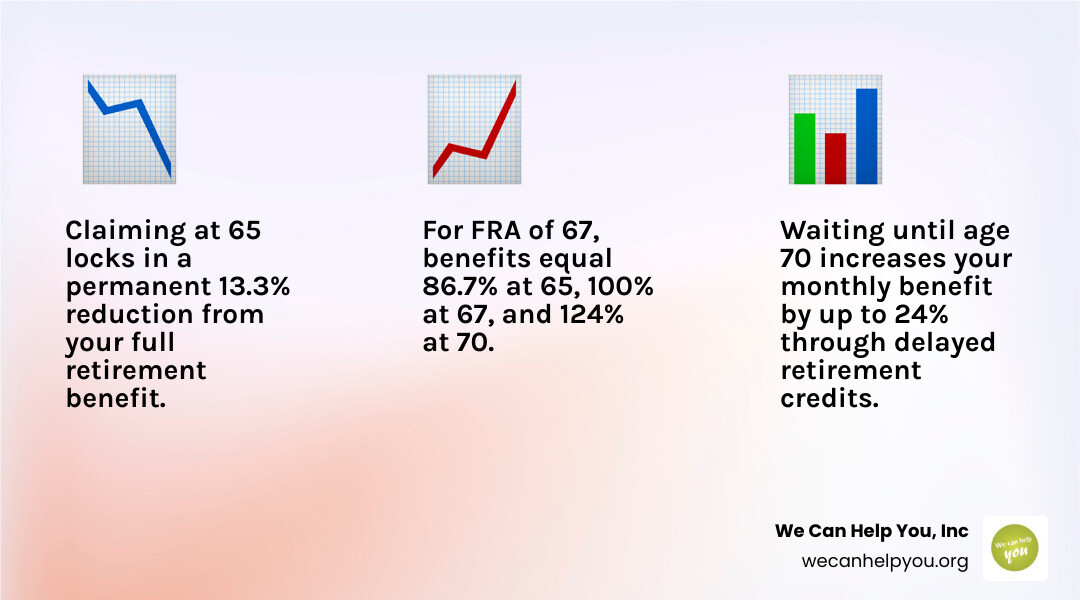
Your exact amount depends on your personal earnings history. But for most people born in 1960 or later, claiming at 65 means a permanent 13.3% reduction from your full benefit.
Age 65 feels like the natural finish line for retirement. It’s when Medicare kicks in, and for decades it was the standard retirement age. But the rules have shifted.
For anyone born in 1960 or later — which is most people retiring today — full retirement age is now 67, not 65. That two-year gap matters more than most people realize.
Claim at 65 and you lock in a smaller check for life. Wait until 67 or 70, and every month you delay puts more money in your pocket permanently.
This guide walks you through exactly how your benefit is calculated, what claiming at 65 really costs you, and how to get a personalized number from the Social Security Administration.
How Much Social Security Will I Receive at 65?
The honest answer is: probably less than your full benefit, but more than if you claimed at 62.
In 2026, research shows a few commonly cited averages for retired workers age 65:
- About $1,607 per month
- About $1,612 per month for retired workers
- About $1,563.06 per month in another SSA-based snapshot
That works out to roughly:
- $19,284 per year at $1,607/month
- $19,344 per year at $1,612/month
- $18,756.72 per year at $1,563.06/month
Those are useful benchmarks, but they are not promises. Social Security is highly personal. Two neighbors on the same street can turn 65 on the same day and get very different checks.
Average monthly and annual benefit at age 65
If we want the simplest benchmark, about $1,607 per month is a good 2026 average for a 65-year-old claimant. Another recent figure puts the average retired-worker benefit at 65 at $1,612 per month.
Why the slightly different numbers? Because averages can vary by:
- Data source timing
- Whether the figure includes all 65-year-olds or only retired workers
- Whether the data is from a prior year snapshot or a 2026 estimate
So if you’re just trying to sanity-check your estimate, here’s a practical way to think about it:
- Around $1,600/month is an average age-65 benefit
- Around $19,000/year is an average annual benefit
- Your own amount may be much lower or much higher
How much Social Security will I receive at 65 based on my record?
Your own record matters far more than the national average.
Social Security looks mainly at:
- Your 35 highest-earning years
- Whether those earnings were covered by Social Security taxes
- Your birth year
- The age you claim
- Whether you keep working
- Whether you have a pension from non-covered work that could trigger WEP or GPO
Also, only earnings up to the annual taxable maximum count for Social Security purposes. In 2026, that maximum is $184,500.
If you had many years of modest earnings, your benefit may be below average. If you had a long, high-earning career, your benefit may be well above average. If you have fewer than 35 years of earnings, Social Security plugs in zeros for the missing years, which can drag your monthly amount down.
Why age 65 is not your full retirement age for most people
This catches a lot of people off guard.
Age 65 is the Medicare eligibility age, but for most current retirees it is not full retirement age. If you were born in 1960 or later, your FRA is 67.
That means claiming at 65 is early retirement for Social Security purposes.
For that group, claiming at 65 gives you about 86.7% of your full benefit. In other words, you take about a 13.3% permanent reduction compared with waiting until 67.
One small technical wrinkle: if your birthday is January 1, Social Security treats you as if you were born in the previous year for certain calculation purposes. It’s a quirky rule, but it can affect retirement-age treatment.
How Social Security Calculates Your Benefit
Social Security uses a formula. Thankfully, we can translate it into normal-human language.
At a high level, SSA:
- Reviews your earnings history
- Adjusts older earnings for wage growth
- Uses your top 35 years
- Converts those earnings into a monthly average
- Applies a formula with bend points
- Adjusts up or down depending on when you claim
If you want to experiment with the official tool, SSA offers an Online Benefits Calculator.
Step 1: Your 35 highest-earning years and indexed wages
First, Social Security looks at your highest 35 years of earnings in covered employment.
Then it “indexes” many of those past earnings for wage growth. This helps keep your 1989 paycheck from being judged by 2026 standards without adjustment. In general, earnings are indexed through age 60.
A few key points:
- You need 40 credits, roughly 10 years of work, to qualify for retirement benefits
- In 2026, you earn one credit for each $1,890 in covered earnings, up to four credits per year
- But qualifying is not the same as maximizing
- Your benefit amount still depends on 35 years of earnings
If you worked only 25 years, Social Security still uses 35 years. The missing 10 years become zeros. Those zeros can shrink your benefit more than people expect.
Step 2: AIME, bend points, and PIA in plain English
Here are the terms that make most people want to take a nap:
- AIME = Average Indexed Monthly Earnings
- PIA = Primary Insurance Amount
AIME is your average monthly earnings after SSA adjusts and averages your top 35 years.
Then SSA applies a formula to that AIME using “bend points.” These bend points change by year. For workers reaching age 62 in 2026, the bend points are $1,286 and $7,749.
The 2026-style formula works like this:
- 90% of the first $1,286 of AIME
- 32% of AIME over $1,286 and through $7,749
- 15% of AIME over $7,749
The result is your PIA, which is basically your full retirement age benefit before early-claiming reductions or delayed retirement credits.
That means Social Security replaces a higher percentage of low earnings than high earnings. It is progressive by design.
How much Social Security will I receive at 65 if I had low, average, or high earnings?
These are rough illustrations, not official quotes, but they help show the range.
- Lower lifetime earnings: often around $1,300/month at FRA, which could mean roughly $1,127/month at 65
- Average career earnings: often somewhere near the middle national averages, around the $1,600 to low-$2,000 range depending on record and claim age
- Higher lifetime earnings: possibly $2,700/month or more at FRA, which could mean about $2,341/month at 65
- Maximum earners: the 2026 maximum benefit at FRA is about $4,152/month, and at 70 about $5,251/month
The takeaway: the answer to how much Social Security will I receive at 65 depends much more on your work history than on age alone.
Claiming at 65 vs Full Retirement Age vs 70
Claiming age changes your monthly check permanently.
For someone with FRA 67:
- At 65: about 86.7% of PIA
- At 67: 100% of PIA
- At 70: about 124% of PIA
That is why timing matters so much.
If you’d like a deeper look at delayed claiming, see Unlock More Money: A Guide to Delayed Social Security Credits.
| Claim Age | % of FRA Benefit | Monthly Benefit on $2,500 PIA |
|---|---|---|
| 65 | 86.7% | $2,167.50 |
| 67 | 100% | $2,500.00 |
| 70 | 124% | $3,100.00 |
What reduction happens if you claim at 65 instead of full retirement age?
If your FRA is 67, claiming 24 months early reduces your benefit by 13.3%.
The reduction formula for the first 36 months early is five-ninths of 1% per month. For 24 months early:
- 24 x 5/9 of 1% = 13.333…%
- You receive about 86.7% of your full benefit
And yes, that reduction is permanent in the sense that your base benefit remains lower for life, aside from future COLA increases that apply to the reduced amount.
Monthly benefit examples for age 65, FRA, and age 70
Let’s use simple examples.
If your PIA at FRA is $2,000:
- Claim at 65: about $1,734/month
- Claim at 67: $2,000/month
- Claim at 70: about $2,480/month
If your PIA at FRA is $2,500:
- Claim at 65: about $2,167.50/month
- Claim at 67: $2,500/month
- Claim at 70: about $3,100/month
That jump from 65 to 70 is large. In fact, waiting from 65 to 70 raises the benefit by about 43.1% compared with the age-65 amount for many retirees with FRA 67.
Lifetime payout and break-even analysis
A higher monthly benefit does not always mean a higher lifetime payout. It depends on how long you live.
That is where break-even analysis comes in. It asks: at what age does waiting catch up to claiming earlier?
In many common scenarios, the break-even point between claiming early and delaying falls somewhere around the late 70s to early 80s, often roughly 78 to 82.
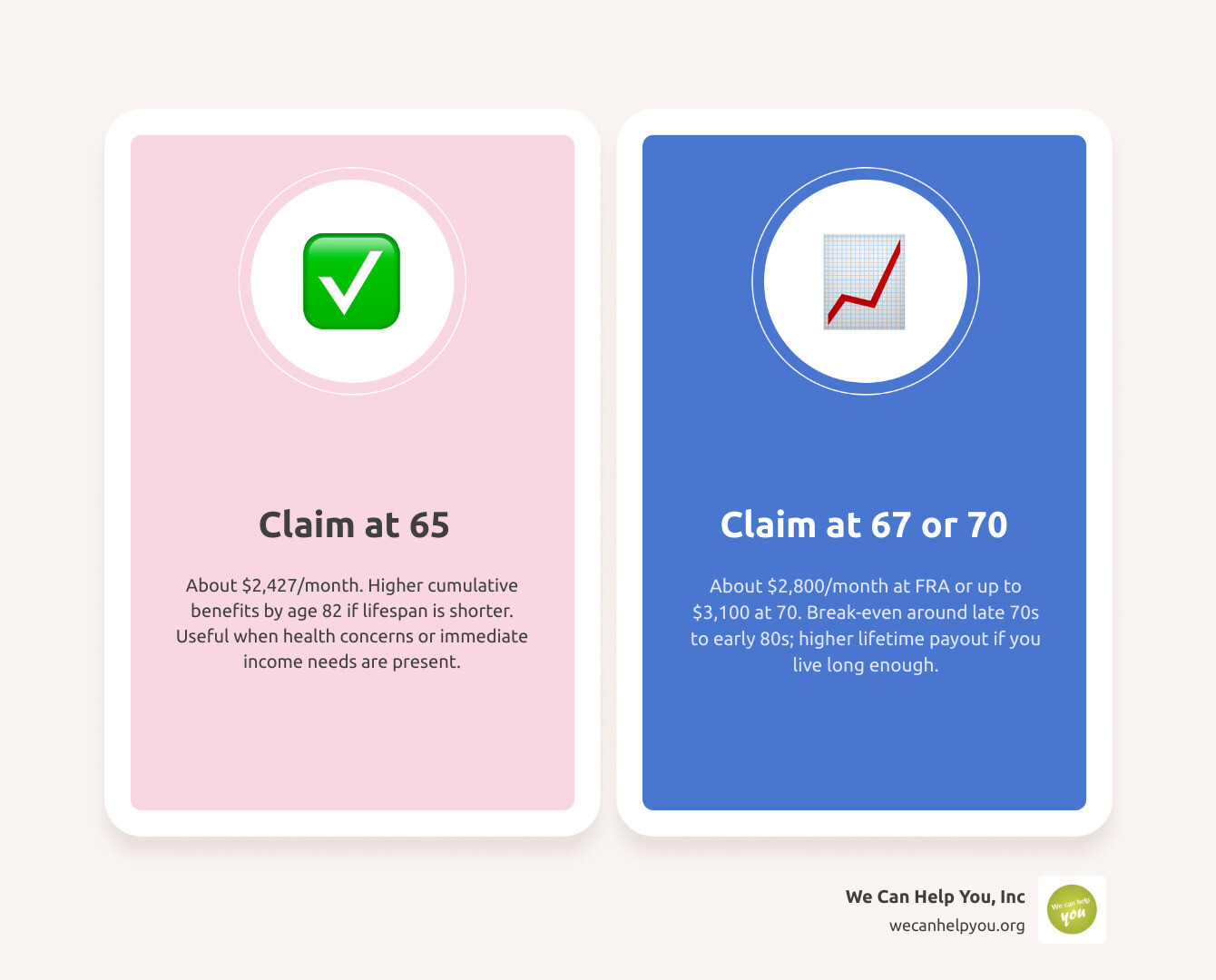
Example with a $2,800 FRA benefit:
- Claim at 65: about $2,427/month
- Claim at 67: $2,800/month
By age 85:
- Claiming at 65 could total about $582,480
- Claiming at 67 could total about $604,800
So if you live long enough, waiting can produce more total income.
But there is no universal winner. If someone has serious health concerns or a shorter life expectancy, claiming earlier can be perfectly reasonable.
The Real Trade-Offs of Claiming at 65
This is where the decision becomes personal, not just mathematical.
A claiming strategy should consider:
- Health and family longevity
- Need for income now
- Employment status
- Spousal and survivor benefits
- Taxes
- Medicare timing
- Other savings and pensions
For more on family coordination, see Are You Missing Out on Social Security Spousal Benefits? and When Do You Need to Enroll in Medicare?.
When claiming at 65 can make sense
Claiming at 65 may make sense if:
- You need income now and do not want to draw down savings further
- You lost a job or retired earlier than planned
- You have health concerns or shorter expected longevity
- You want to bridge income while coordinating Medicare and retirement cash flow
- Your personal break-even analysis suggests waiting is less valuable
Sometimes the “best” strategy is simply the one that keeps the lights on and reduces stress. Retirement planning is math, but it is also life.
When waiting may pay off more
Waiting can be powerful if:
- You expect to live a long time
- You want the biggest guaranteed monthly benefit
- You are the higher-earning spouse and want to increase a future survivor benefit
- You have enough other income to delay
- You value the delayed retirement credits, which add about 8% per year after FRA until age 70
For married couples, the higher earner delaying can be especially important because the survivor may step into that higher benefit later.
Mistakes that can shrink your age-65 benefit
A few common mistakes can make your benefit smaller than it should be:
- Not checking your earnings record for missing or incorrect wages
- Forgetting that fewer than 35 earning years means zeros in the formula
- Assuming Medicare eligibility at 65 means you should claim Social Security at 65
- Overlooking a pension from non-covered work that may trigger WEP or GPO
- Using rough calculators without entering realistic future earnings
- Filing early without understanding the earnings test if still working
WEP and GPO deserve special mention. If you receive a pension from work not covered by Social Security, your benefit or spousal/survivor benefit may be reduced. SSA offers special calculators for these situations.
How to Get a Personalized Estimate for Age 65
The average figures are helpful, but your best next move is to get your own estimate from SSA.
Useful tools include:
- Quick Calculator
- Benefit Calculators | SSA
- Don’t Guess, Calculate: A Guide to Your Future Social Security Payments
- Social Security Info Online: Navigating the SSA Website Like a Pro
Best way to check how much Social Security will I receive at 65
The best option is usually your personal SSA account. There, you can see:
- Your earnings record
- Your estimated retirement benefit
- Comparisons for different claiming ages
- Other benefit estimates for disability or survivors, if applicable
SSA’s own guidance is clear: personalized estimates based on your actual record are more accurate than rough online guesses.
Using calculators correctly and avoiding bad estimates
Calculators are helpful, but only if you use them well.
Best practices:
- Use your actual earnings history whenever possible
- Compare age 62, 65, FRA, and 70
- Pay attention to whether the calculator shows today’s dollars or future inflated dollars
- Update assumptions if you plan to keep working
- Use the WEP version if you have a non-covered pension
Also remember that the Quick Calculator is intentionally rough. It does not pull your actual earnings record for privacy reasons. The more precise tools require your actual wage history.
Review your earnings record before you file
This step is boring, but it can be worth real money.
Look for:
- Missing years
- Incorrect earnings amounts
- Years that should have been covered by Social Security
- Wages that do not match your records
If something is wrong, gather documents such as W-2s or tax returns and contact SSA to correct it. Fixing an error before filing is usually easier than untangling it later.
Frequently Asked Questions About How Much Social Security You Will Receive at 65
Is the average Social Security benefit at 65 enough to live on?
For many households, no.
An age-65 average benefit around $1,600 per month replaces only part of pre-retirement income. That means many people still need savings, pensions, part-time work, or a spouse’s income to cover the full budget.
Social Security is a foundation, not usually the whole house.
Can I claim Social Security at 65 and still work?
Yes, but the earnings test may apply if you claim before full retirement age.
In 2026, if you are under FRA for the full year, benefits may be withheld if your earnings exceed $24,480. In the year you reach FRA, a higher limit applies: $65,160, and only earnings before the month you reach FRA count under that special rule.
The good news: withheld benefits are not simply lost forever. SSA recalculates benefits later to give credit for months benefits were withheld.
Does Medicare enrollment mean I should start Social Security at 65?
No. These are separate decisions.
You can enroll in Medicare at 65 without claiming Social Security retirement benefits at 65. This is one of the biggest misconceptions we see.
Many people assume “Medicare starts, so Social Security must start too.” Not true. You can begin Medicare and delay Social Security if that better fits your income strategy.
Conclusion
If you’re asking how much Social Security will I receive at 65, the short answer is that the average 65-year-old retiree gets about $1,600 per month in 2026, but your actual number depends on your earnings record and filing age.
The bigger question is whether 65 is the right age for you to claim.
For some people, claiming at 65 is the practical choice. For others, waiting until full retirement age or 70 can create substantially more lifetime income and a stronger survivor benefit. The right move depends on your health, work plans, cash needs, family situation, and goals.
If you want help learning more about your options, start with our Social Security resources. And if you’d like a clearer picture of your claiming strategy, visit Don’t Leave Money on the Table: Get Your Free Social Security Analysis Today.
At We Can Help You, Inc., we educate individuals and families about Social Security and Medicare so they can make more confident retirement decisions. A little planning now can make a surprisingly big difference later.