
Why Retirement Planning for Couples Is Different — and More Complex
Retirement planning for couples is the process of aligning two people’s finances, goals, timelines, and expectations into one shared plan that works for both of you.
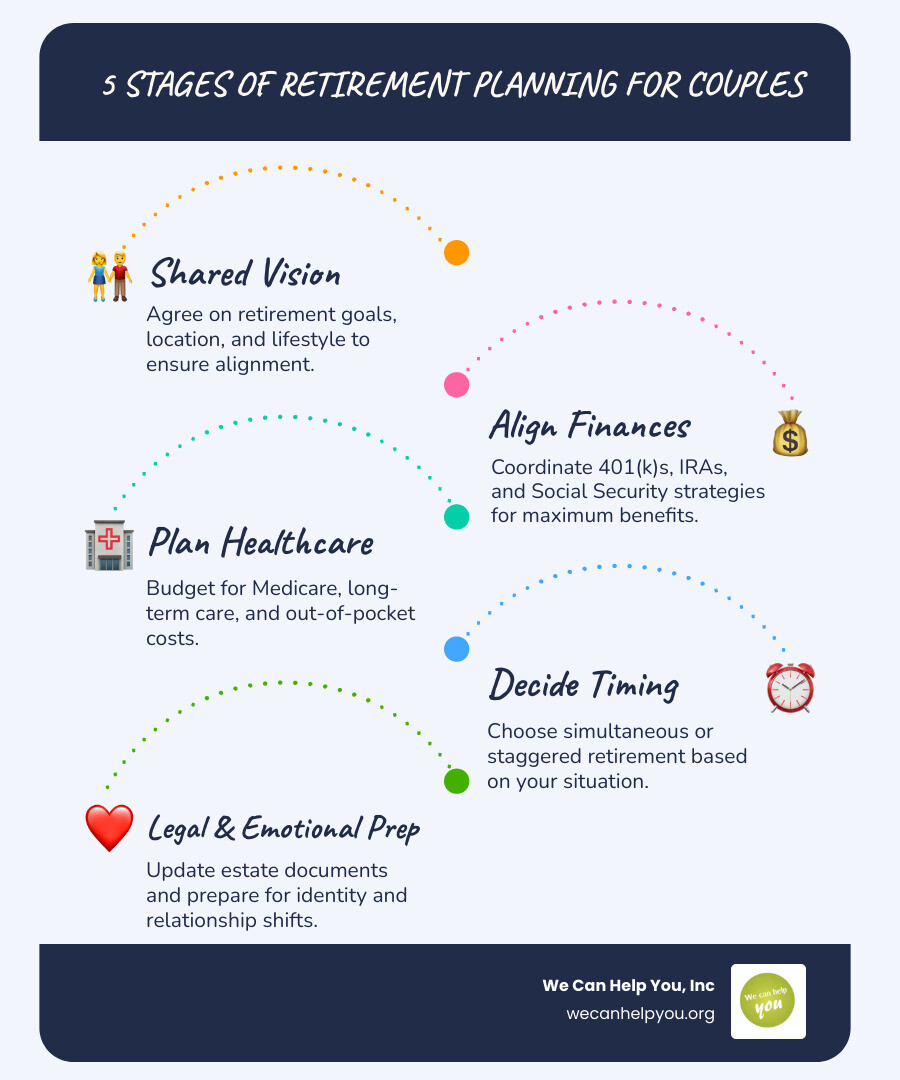
Here’s a quick overview of what it involves:
- Start with a shared vision — agree on when, where, and how you want to retire
- Align your finances — coordinate 401(k)s, IRAs, and Social Security claiming strategies
- Plan for healthcare — budget for Medicare, long-term care, and out-of-pocket costs
- Decide on timing — retire together or stagger your exits based on your situation
- Cover the legal basics — update beneficiaries, wills, and estate documents
- Prepare emotionally — retirement changes identity, roles, and your relationship dynamic
Retirement is one of the biggest financial decisions you’ll ever make. When two people are involved, it gets even more complicated.
You’re not just managing one person’s savings, timeline, or risk tolerance. You’re managing two — and they often don’t match up perfectly.
In fact, a 2024 Fidelity Investments study found that 53% of couples couldn’t agree on how much they need to save to retire comfortably. And about 45% of couples argue about money at least once in a while, with 1 in 4 calling it the biggest challenge in their relationship.
That tension doesn’t disappear when you stop working. If anything, retirement amplifies it.
Beyond the money, retirement also reshapes who you are. Your career gives you structure, identity, and purpose. When that’s gone, couples often find themselves navigating unexpected shifts in their daily roles, their independence, and even their sense of self — all at the same time.
The good news? With the right plan, most of these challenges are manageable. This guide walks you through everything you need to know — from savings strategies and Social Security to healthcare costs, housing, and keeping your relationship strong through the transition.
The Essential Steps for Retirement Planning for Couples
Successful retirement planning for couples doesn’t happen by accident. It requires a deliberate shift from “my money” and “my career” to “our future.” This transition starts with a series of deep, honest conversations.

Building a Shared Vision
Before you crunch any numbers, you need to know what those numbers are supposed to buy. We recommend couples sit down and answer these questions separately, then compare notes:
- Where do we want to live? (Stay put, downsize, or move to a new state like Florida or Arizona?)
- What will our daily life look like? (Travel, volunteering, part-time work, or hobbies?)
- How much do we expect to spend on “extras” like family trips or helping grandchildren?
The 70-80% Income Rule and Anticipatory Budgeting
A common rule of thumb is that you’ll need about 70% to 80% of your pre-retirement income to maintain your current lifestyle. However, this is just a starting point. We suggest “anticipatory budgeting”—creating a mock budget that eliminates expenses that will vanish (like commuting, professional wardrobes, or retirement account contributions) and adds new ones (like higher healthcare premiums or travel).
Research shows that 53% of couples disagree on their savings goals. To bridge this gap, you can use Your Retirement Roadmap to Financial Freedom to help align your expectations. By simulating your future expenses now, you can determine if your current savings rate is sufficient or if you need to adjust your “exit date.” For more personalized guidance, you can follow these 5 key steps to secure your future.
Coordinating Your Financial Engine: Savings and Social Security
When you’re a couple, your retirement accounts shouldn’t exist in silos. You have a unique opportunity to coordinate your “financial engine” to maximize every dollar.
Maximizing Retirement Planning for Couples Through 401(k)s and IRAs
One of the most common mistakes is failing to coordinate employer-sponsored plans. About 24% of couples miss out on maximizing their combined contributions.
- The “Better Plan” Strategy: If one spouse has a 401(k) with a higher employer match or lower investment fees, it often makes sense to maximize that account first before contributing to the other’s.
- Spousal IRAs: If one partner stops working or takes a career break, the working spouse can still contribute to a “Spousal IRA” for the non-working partner, provided they file a joint tax return.
- Catch-up Contributions: Once you hit age 50, you can both take advantage of catch-up contributions ($7,500 for 401(k)s and $1,000 for IRAs in 2024). Starting in 2025, those aged 60-63 may even have “super catch-up” options.
- HSA Coordination: Health Savings Accounts (HSAs) are powerful retirement tools. It is vital to understand how Medicare impacts your HSA once you turn 65, as you can no longer contribute to an HSA once enrolled in Medicare Part A or B.
Optimizing Social Security and Spousal Benefits
Social Security is often the bedrock of a couple’s retirement income, but the rules for married partners are complex.
- The Higher-Earner Delay: Experts like Andrew Constantinides often suggest that the higher-earning spouse should wait until age 70 to claim benefits. This locks in the maximum possible monthly payment (increasing by 8% each year after Full Retirement Age) and ensures a higher survivor benefit for the remaining spouse later.
- Spousal Benefits: Even if one spouse had limited earnings, they may be eligible for a benefit worth up to 50% of the other spouse’s Full Retirement Age amount. Are you sure you aren’t missing out on spousal benefits?
- Survivor Strategies: Planning for the inevitable is hard, but necessary. When one spouse passes, the survivor receives the higher of the two Social Security checks, while the smaller one disappears. Maximizing the larger check now protects the survivor’s future standard of living.
To ensure you aren’t leaving money on the table, we offer a free Social Security analysis to help you find the optimal claiming strategy for your specific situation.
Navigating Healthcare and Long-Term Care Costs
Healthcare is often the “wild card” in retirement planning for couples. Many underestimate just how much it will cost.
The $330,000 Reality Check
According to data from Fidelity, a typical 65-year-old couple retiring in 2024 will need approximately $330,000 to cover healthcare expenses throughout their retirement. This doesn’t even include the cost of long-term care.
- Medicare Eligibility: Most people qualify for Medicare at age 65. If you retire earlier, you must have a plan to bridge the insurance gap, which can be incredibly expensive. Our Medicare Guide covers the essentials you need to know about Parts A, B, and D.
- Long-Term Care (LTC): There is a nearly 70% chance that an average 65-year-old will need some form of long-term care. Median costs are staggering: over $64,000 a year for assisted living and upwards of $116,000 for a private nursing home room.
- Funding the Gap: Since most private health plans and Medicare do not cover extended LTC, couples should discuss whether to self-fund, look into LTC insurance, or utilize asset protection trusts.
The Lifestyle Shift: Timing, Housing, and Emotional Preparation
Once the finances are in order, you have to decide on the “logistics” of your exit.
Strategic Retirement Planning for Couples: When to Exit the Workforce
Should you retire together on the same Friday, or should one of you keep working? There are pros and cons to both.
| Strategy | Pros | Cons |
|---|---|---|
| Simultaneous | You start your new “adventure” together immediately; travel is easier to coordinate. | Sudden drop in total household income; major lifestyle shock for both at once. |
| Staggered | Maintains a stream of income and employer health benefits; allows the first retiree a “trial run.” | Can lead to resentment if the working spouse feels “stuck” while the other relaxes. |
As you finalize your timing, don’t forget the “boring” but critical legal steps. This includes reviewing your estate plan, ensuring your life insurance is sufficient, and updating your beneficiaries. Legal spouses are often defaults, but it’s vital to confirm this, especially for couples in domestic partnerships or civil unions. For a personalized look at your timeline, consider an individual consultation.
Managing Relationship Quality and Common Pitfalls
Retirement isn’t just a financial transition; it’s a relational one.
- The 45% Conflict Stat: Nearly half of couples argue about money. Clear communication about spending limits can prevent “spending shock” in the first few years.
- Identity and Roles: If one spouse handled the “breadwinning” and the other handled the “household,” those roles can blur in retirement. Negotiating household tasks early prevents friction.
- The Balance of Independence: Spending 24/7 together can be a strain. It’s healthy to maintain individual hobbies and friendships alongside your shared activities.
To help navigate these emotional waters, we invite you to attend a workshop or webinar where we discuss the non-financial aspects of a successful transition.
Common Questions About Joint Retirement Planning
How much savings does a married couple typically need for a comfortable retirement?
While it depends on your location (costs in New York or New Jersey are higher than in Nebraska or New Mexico), most experts suggest aiming for 25 to 30 times your annual planned expenses. If you plan to spend $80,000 a year, you may need a nest egg of $2 million to $2.4 million, supplemented by Social Security.
Should a husband and wife retire at the same time or stagger their exit?
Staggering is often safer financially, especially if one spouse is younger and not yet eligible for Medicare. However, if both are healthy and the finances are stable, retiring together allows you to enjoy your most active years of retirement while you both have the energy for travel and hobbies.
How do we handle different risk tolerances in our joint investment portfolio?
You don’t have to have identical portfolios. Often, it’s wise for the older spouse to have a more conservative allocation (focused on income) while the younger spouse maintains a growth-oriented posture. The key is ensuring the combined portfolio matches your shared goals.
Conclusion
Retirement planning for couples is a marathon, not a sprint. It requires patience, a lot of spreadsheets, and even more conversation. By aligning your vision early, coordinating your savings, and being realistic about healthcare costs, you can move into this next chapter with confidence instead of conflict.
At We Can Help You, Inc., we are dedicated to making this transition easier for couples across the country—from the busy streets of Chicago and Charlotte to the quiet neighborhoods of Concord and Carlsbad. Whether you need Social Security information or help navigating the complexities of Medicare, we are here to ensure you retire together with peace of mind.
Don’t leave your future to chance. Start the conversation today, and let us help you build a roadmap that works for both of you.