
Why a Medicare IRMAA Appeal Could Save You Thousands
A Medicare IRMAA appeal is a formal process through which you can request a reduction in the Income-Related Monthly Adjustment Amount added to your Medicare Part B and Part D premiums if you’ve experienced a qualifying life-changing event that reduced your income. Here’s what you need to know:
Quick Answer: How to Appeal Medicare IRMAA
- Identify a qualifying life-changing event (retirement, divorce, death of spouse, loss of income, etc.)
- Complete Form SSA-44 (Medicare Income-Related Monthly Adjustment Amount – Life-Changing Event)
- Gather supporting documentation (tax returns, death certificate, employer letter, etc.)
- Submit to Social Security within a reasonable time of the event
- Await decision (typically 30-90 days)
- If denied, pursue formal appeals through reconsideration, ALJ hearing, Appeals Council, or Federal Court
Your client calls, frustrated. Their Medicare Part B premium just jumped by hundreds of dollars, and they want to know why. This scenario plays out thousands of times each year when retirees find they’re paying the IRMAA surcharge—an additional premium that can cost anywhere from roughly $1,148 to $6,936 per year in 2026.
The problem? IRMAA is based on your income from two years ago. If you retired last year, your premiums are still calculated using your old working income. That’s not fair, and more importantly, it’s not final.
The good news is that you don’t have to overpay. If your income has dropped due to specific life events, you have the right to appeal—and if approved, you can get retroactive refunds for premiums you’ve already paid.
This guide walks you through every step of the Medicare IRMAA appeal process, from understanding whether you qualify to navigating the formal appeal levels if your initial request is denied.
Understanding IRMAA: Who Pays and Why?
The Income-Related Monthly Adjustment Amount, or IRMAA, is a fancy way of saying “higher Medicare premiums for higher earners.” It’s an additional amount that some beneficiaries have to pay on top of their standard Medicare Part B (medical insurance) and Medicare Part D (prescription drug coverage) premiums. This surcharge applies if your modified adjusted gross income (MAGI) exceeds certain thresholds set by the government.
The Social Security Administration (SSA) determines who pays IRMAA based on the tax data they receive from the IRS. Essentially, if your income was high two years ago, you’ll likely face an IRMAA surcharge in the current year. We’ve seen this catch many people off guard, especially those who recently retired or experienced a significant income change.
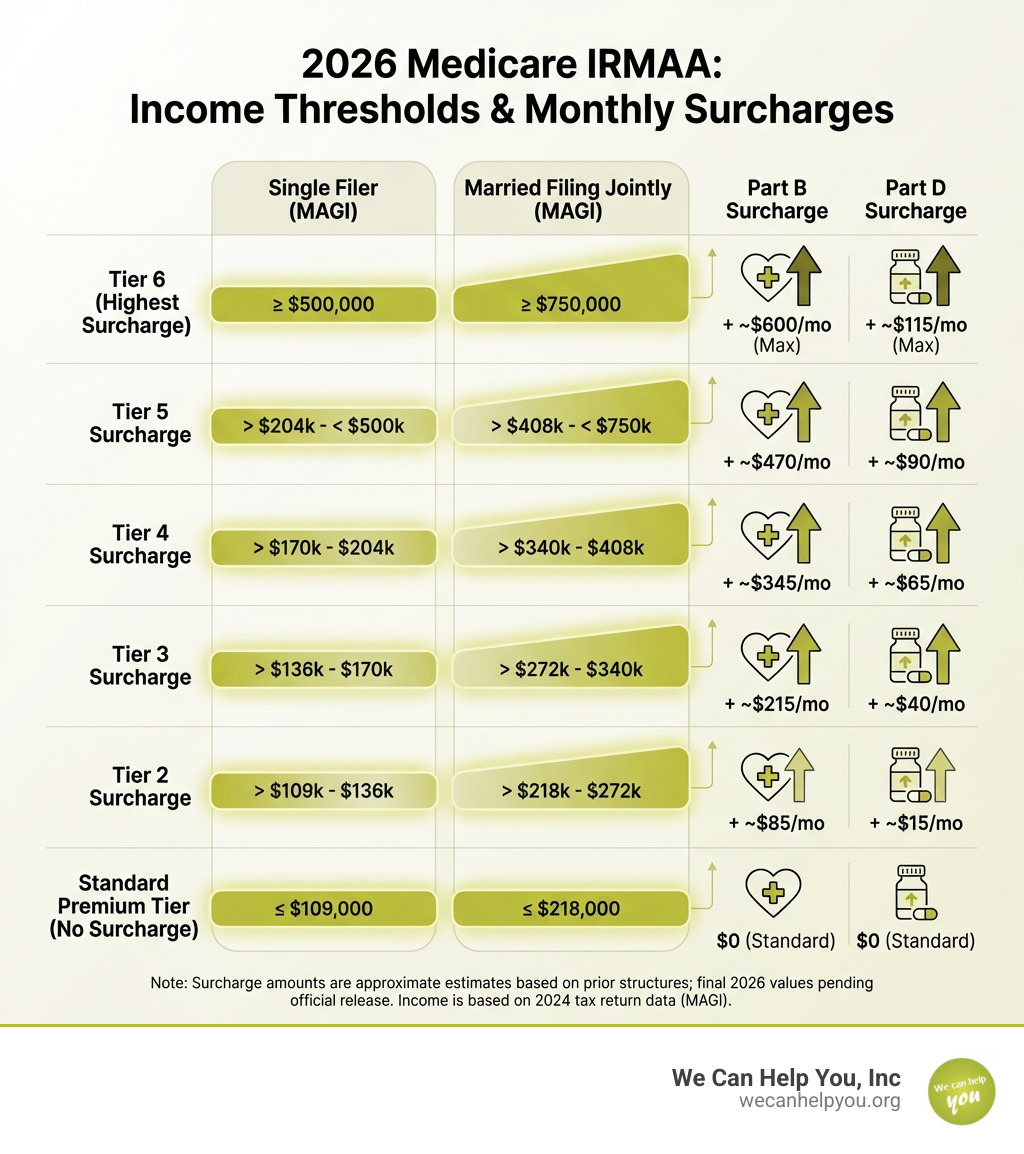
The IRMAA is often referred to as a “cliff” surcharge because it’s not a gradual increase. If your MAGI goes even $1 over a threshold, you’ll jump to the next IRMAA bracket, triggering a higher premium. For example, in 2026, earning just $1 above a threshold could cost you an additional $1,148.40 annually in Medicare surcharges ($974.40 for Part B and $174 for Part D). The maximum surcharge in 2026 can go as high as $6,936 ($5,844 for Part B and $1,092 for Part D). This makes understanding and potentially appealing IRMAA incredibly important for your financial well-being in retirement.
For a deeper dive into the basics of this surcharge, check out our guide on Understanding Medicare IRMAA Charges.
What is the Two-Year Lookback Period?

One of the most confusing aspects of IRMAA is the “two-year lookback period.” The Social Security Administration doesn’t use your current income to determine your IRMAA. Instead, they look at your MAGI from your IRS tax return filed two years prior. So, for your 2026 Medicare premiums, the SSA will review your 2024 tax return.
This two-year delay is precisely why IRMAA can “sneak up on you,” as some experts put it. Many people experience a significant drop in income when they transition from full-time employment to retirement. They might go from a high-earning salary to living on Social Security, pension income, and modest withdrawals from savings. However, due to the lookback period, their Medicare premiums might still reflect their old, higher working income. This creates a mismatch that can lead to unexpected and often frustratingly high surcharges.
Imagine you retired in 2025. Your 2026 Medicare premiums would be based on your 2024 income, which was your last full year of high earnings. This means you could be paying IRMAA based on an income level that no longer reflects your financial reality. This is a common scenario that often leads beneficiaries to seek a Medicare IRMAA appeal.
How IRMAA is Calculated
IRMAA is calculated based on your Modified Adjusted Gross Income (MAGI). Your MAGI is your Adjusted Gross Income (AGI) as reported on your federal tax return, plus certain tax-exempt income. This typically includes:
- Your Adjusted Gross Income (AGI)
- Tax-exempt interest (e.g., from municipal bonds)
- Interest from U.S. savings bonds used for education
- Income earned abroad
- Nontaxable income from U.S. territories
Once your MAGI is determined, the SSA compares it to specific income thresholds for your tax filing status (single, married filing jointly, married filing separately). These thresholds are adjusted annually. The moment your MAGI crosses a threshold, even by a single dollar, you’re placed into a higher IRMAA bracket, and a surcharge is added to both your Part B and Part D premiums.
For example, in 2026, the standard Medicare Part B premium rose to $202.90, up from $185 in 2025. But if your 2024 MAGI was above $109,000 as a single filer or $218,000 as a couple filing jointly, you’d pay more. The surcharges increase significantly with each income tier, with Part B premiums for high-income beneficiaries ranging from $284.10 to $689.90, and Part D surcharges from $14.50 to $91.00.
Understanding these income tiers is crucial for financial planning and for determining if you have grounds for a Medicare IRMAA appeal. You can find detailed information on the latest thresholds in our article, 2026 Medicare IRMAA.
The Complete Guide to Your Medicare IRMAA Appeal
If you’ve received a notice about IRMAA and your income has significantly decreased since the tax year used for the calculation, you may be able to request a new initial determination. This is often the first step in a successful Medicare IRMAA appeal.

The key to this process is demonstrating that a “life-changing event” (LCE) has occurred, which has reduced your Modified Adjusted Gross Income (MAGI). The Social Security Administration (SSA) has a specific list of events they recognize.
Step 1: Identify a Qualifying Life-Changing Event
Not every income drop qualifies you for a Medicare IRMAA appeal. The SSA specifically outlines certain life-changing events that can lead to a reconsideration of your IRMAA. These are events that fundamentally alter your financial situation, causing a significant and lasting reduction in your income.
The qualifying life-changing events recognized by the SSA include:
- Work Stoppage: You stopped working entirely. This is one of the most common reasons for a successful appeal, especially for retirees.
- Work Reduction: You significantly reduced your work hours, leading to a substantial decrease in income. Barbara Hughes, a retired attorney, successfully appealed her IRMAA twice after reducing her work hours and then fully retiring.
- Loss of Income-Producing Property: You experienced an involuntary loss of property that generated income (e.g., rental property destroyed by a natural disaster, or a business closing).
- Loss of Pension Income: You lost certain types of pension income (e.g., a defined benefit pension plan that was terminated). This generally does not include distributions from a 401(k) or IRA.
- Marriage: If your marital status changed, impacting your combined MAGI.
- Divorce or Annulment: If you separated from your spouse, and your income will now be calculated individually.
- Death of a Spouse: If your spouse passed away, affecting your household income and filing status.
- Employer Settlement Payment: You received a one-time settlement payment from an employer that artificially inflated your income for a specific tax year, and this income is not expected to be recurring.
These events must have occurred after the tax year that the SSA used to calculate your current IRMAA. If your income declined because of one of these reasons, you likely have grounds to file a Medicare IRMAA appeal. You can find more details on these qualifying events directly from the SSA: More on qualifying events from the SSA.
Step 2: Gather Your Documents and Complete Form SSA-44
Once you’ve identified a qualifying life-changing event, the next crucial step is to gather all necessary documentation and complete Form SSA-44, also known as the “Medicare Income-Related Monthly Adjustment Amount – Life-Changing Event” form. This form is your primary tool for requesting a new initial determination.
The documentation you’ll need will vary depending on your specific life-changing event, but generally, you’ll need:
- Proof of the event:
- Work Stoppage/Reduction: A letter from your former employer(s) confirming your retirement date or reduction in hours, along with your last pay stubs.
- Death of a Spouse: A copy of the death certificate.
- Divorce/Annulment: A copy of the final divorce decree or annulment order.
- Loss of Income-Producing Property: Documentation of the loss (e.g., insurance claim, police report, property sale documents) and evidence of the resulting income reduction.
- Loss of Pension Income: Official notification from the pension plan administrator.
- Proof of income reduction:
- Your most recent federal income tax return (even if it’s from a year after the one the SSA is using).
- Pay stubs, pension statements, or other income statements showing your current reduced income.
- If you’re estimating your current year’s MAGI, be prepared to explain how you arrived at that figure.
Form SSA-44 requires you to provide your estimated MAGI for the current year or the year the life-changing event occurred, along with details about the event itself. Be thorough and accurate. This form is designed to be completed by beneficiaries or their representatives, and it’s quite detailed.
You can download the official form and start preparing your documentation here: Download the official SSA-44 form. For information specifically related to Part B, visit Medicare Part B IRMAA.
Step 3: Submit Your Request and Await a Decision
With your completed Form SSA-44 and all supporting documentation in hand, it’s time to submit your request to the Social Security Administration. You have a few options for submission:
- Mail: You can mail the form and copies of your documents to your local Social Security office.
- Fax: Many local Social Security offices accept faxes.
- In-person: You can visit your local Social Security office in person. This can be beneficial for complex cases or if you prefer direct interaction, as a representative can review your documents with you. We have offices conveniently located throughout Arizona, California, Colorado, Connecticut, Florida, Georgia, Illinois, Indiana, Maine, Massachusetts, Michigan, Nebraska, Nevada, New Hampshire, New Jersey, New Mexico, New York, North Carolina, Ohio, Pennsylvania, Rhode Island, South Carolina, Tennessee, Texas, Vermont, and Virginia. You can find your nearest office using the SSA locator: Find your local Social Security office.
Once submitted, the SSA will process your request. Appeals typically take between 30 and 90 days to process. During this time, they will review your submitted information against their records.
If your Medicare IRMAA appeal is approved, the adjustment to your premiums may be retroactive to the date of your life-changing event. This is fantastic news because it often means you’ll receive a refund for any overpaid premiums since that date. We’ve seen many clients receive substantial refunds, which can make a real difference in their retirement budget!
What If Your Request Is Denied? The Formal IRMAA Appeal Levels
Even with a strong case and thorough documentation, sometimes your initial request for a new determination (using Form SSA-44) might be denied. Don’t despair! The Medicare system has multiple levels of appeal designed to ensure you receive a fair hearing. This formal appeals process kicks in if your initial request is rejected or if you disagree with the SSA’s decision for other reasons (e.g., an error in their data).
It’s important to be aware of the strict deadlines for each level of appeal, typically 60 days from receiving a denial notice. Missing these deadlines can mean losing your right to appeal further.
Level 1: Reconsideration
If your initial request for a new determination is denied, or if you believe the SSA’s original IRMAA determination was simply incorrect (not necessarily due to a life-changing event), your first step in the formal appeals process is to request a reconsideration.
To do this, you’ll need to complete and submit Form SSA-561-U2, “Request for Reconsideration.” This form asks you to explain why you disagree with the SSA’s decision. The SSA will then conduct a full review of your case, including any new evidence you provide, by someone who was not involved in the original decision. This is your chance to present your argument more formally and ensure all relevant information is considered.
For more details on navigating this stage, you can refer to our article on Appealing Medicare IRMAA Charges.
Level 2: Hearing by an Administrative Law Judge (ALJ)
Should your request for reconsideration also be denied, the next step is to request a hearing before an Administrative Law Judge (ALJ) at the Office of Medicare Hearings and Appeals (OMHA). This is a more formal proceeding where you (or your representative) can present your case, call witnesses, and submit additional evidence. The ALJ is an impartial decision-maker who will review all the facts and applicable laws.
You must file your request for an ALJ hearing within 60 days of receiving the reconsideration denial. At this stage, having clear, organized documentation and a well-reasoned argument is vital. While you can represent yourself, some beneficiaries choose to have a lawyer or other qualified representative assist them, especially if the case is complex.
To learn more about what to expect at this level, visit the OMHA website: Learn about the OMHA hearing process.
Levels 3 & 4: Medicare Appeals Council and Federal Court
If the Administrative Law Judge’s decision is unfavorable, you have two more levels of appeal:
- Level 3: Review by the Medicare Appeals Council: This is the final administrative appeal within the Department of Health and Human Services. The Medicare Appeals Council will review the ALJ’s decision to determine if there was a legal error or if the decision was not supported by the evidence. You must request this review within 60 days of the ALJ’s decision. For more information on this stage, see Review by the Medicare Appeals Council.
- Level 4: Federal District Court Action: If the Medicare Appeals Council denies your request for review, or if they issue an unfavorable decision, your final option is to file a lawsuit in a federal district court. This is typically considered a last resort and often requires legal representation. You must file within 60 days of the Appeals Council’s decision.
While these higher levels of appeal exist, most successful Medicare IRMAA appeal cases are resolved at the initial request or reconsideration stage. It underscores the importance of getting it right from the beginning.
Proactive Planning and Common Mistakes
Successfully navigating a Medicare IRMAA appeal is often about being proactive and avoiding common pitfalls. While we can’t predict every life event, we can certainly plan for them and be prepared. This section focuses on what not to do during an appeal and smart strategies to avoid triggering IRMAA in the first place.
Common Mistakes to Avoid in Your Medicare IRMAA Appeal
When pursuing a Medicare IRMAA appeal, beneficiaries often make several key mistakes that can jeopardize their chances of success:
- Assuming Automatic Adjustments: A common misconception is that the SSA will automatically adjust your IRMAA once you retire or experience a life change. This is incorrect. The SSA relies on your tax data, and you must proactively file Form SSA-44 to initiate the adjustment process.
- Missing Deadlines: Each stage of the appeal process has strict deadlines, typically 60 days. Missing a deadline can mean forfeiting your right to appeal further. Keep track of all correspondence and respond promptly.
- Appealing for Non-Qualifying Reasons: Not every income reduction qualifies. For instance, a temporary dip in investment income or a one-time bonus (unless it’s a specific employer settlement payment) generally won’t be accepted. Focus only on the specific life-changing events recognized by the SSA; retirement, for example, is a common and valid reason for reconsideration.
- Incomplete or Insufficient Documentation: Your appeal is only as strong as the evidence you provide. Ensure all forms are fully completed, and you include clear, official documentation to support both the life-changing event and the resulting income reduction.
- Not Estimating Future Income Correctly: When completing Form SSA-44, you’ll need to estimate your current or future year’s MAGI. Be realistic and accurate. Overestimating can lead to a lower, but still incorrect, premium, while underestimating might raise questions or lead to further review.
Smart Income Strategies to Avoid IRMAA
The best Medicare IRMAA appeal is often the one you don’t have to file because you’ve managed your income proactively. Here are some smart strategies to help keep your MAGI below IRMAA thresholds:
- Strategic Roth Conversions: While Roth conversions increase your MAGI in the year they occur, potentially triggering IRMAA, they can be highly beneficial in the long run. Future Roth withdrawals are tax-free and don’t count towards MAGI. Consider spreading conversions over several years to avoid a single large spike that pushes you into a higher IRMAA bracket. When planning these conversions, it’s important to factor in the potential for Medicare premium hikes.
- Use Qualified Charitable Distributions (QCDs): If you’re 70½ or older and have a traditional IRA, you can donate up to $110,000 (in 2026) directly to a qualified charity. These QCDs count towards your Required Minimum Distributions (RMDs) but are excluded from your MAGI, effectively lowering your taxable income and potentially your IRMAA.
- Manage Capital Gains: Large capital gains from selling investments can significantly inflate your MAGI. Consider tax-loss harvesting to offset gains, or strategically spread out asset sales over multiple years. If you’re selling a primary residence, remember you can exclude up to $250,000 in profits (single) or $500,000 (married filing jointly) from your income.
- Avoid Large, One-Time IRA Withdrawals: Taking a substantial lump sum from a traditional IRA or other tax-deferred accounts can trigger IRMAA. For example, a large IRA withdrawal to buy an RV could trigger the surcharge, whereas taking out a loan might have been a better option. Plan your withdrawals carefully.
- Contribute to Tax-Deferred Accounts: Continuing to contribute to 401(k)s, traditional IRAs, or SEP IRAs (if applicable) can reduce your current year’s AGI, which in turn lowers your MAGI for the two-year lookback period.
By carefully planning your retirement income and tax strategies, you can minimize your MAGI and potentially avoid the IRMAA surcharge altogether, saving you thousands of dollars over your retirement. For comprehensive resources on managing your retirement income, explore our Social Security section.
Frequently Asked Questions about the Medicare IRMAA Appeal Process
We understand that the Medicare IRMAA appeal process can seem daunting. Here are answers to some of the most common questions we hear from beneficiaries.
How long does a medicare irmaa appeal take?
The timeline for a Medicare IRMAA appeal can vary:
- Initial Request (Form SSA-44): If you’re requesting a new initial determination based on a life-changing event, the Social Security Administration typically processes these requests within 30 to 90 days.
- Formal Appeal Levels: If you proceed to formal appeals (reconsideration, ALJ hearing, Appeals Council, Federal Court), each stage can add several months, or even over a year, to the total process.
While the formal appeals can be lengthy, many cases are resolved at the initial or reconsideration stages. If approved, IRMAA adjustments may be retroactive to the date of the life-changing event, often resulting in refunds for overpaid premiums.
Can I get a refund for past IRMAA overpayments?
Yes, absolutely! If your Medicare IRMAA appeal is approved, the adjustment to your premiums is often made retroactive to the date of your qualifying life-changing event. This means that if you’ve been paying an IRMAA surcharge since that event, the Social Security Administration will issue you a refund for the overpaid amounts. These refunds can sometimes be substantial, providing a welcome boost to your retirement finances.
Do I need a lawyer for my medicare irmaa appeal?
For the initial request using Form SSA-44, you generally do not need a lawyer. The form is designed to be completed by beneficiaries, and many successfully steer this stage on their own, especially if they have clear documentation of a qualifying life-changing event.
However, if your case is complex, if your initial request is denied, and you choose to pursue higher levels of appeal (like an ALJ hearing or federal court), having a lawyer or other qualified representative can be beneficial. They can help you understand the legal nuances, present your case effectively, and meet strict deadlines. The decision to seek legal counsel often depends on the complexity of your situation and the amount of money at stake.
Conclusion
Understanding the Income-Related Monthly Adjustment Amount (IRMAA) and knowing how to file a Medicare IRMAA appeal is a powerful tool for protecting your retirement income. The two-year lookback period can create a disconnect between your current financial reality and your Medicare premiums, but it doesn’t have to be a permanent burden.
By familiarizing yourself with qualifying life-changing events, diligently gathering documentation, and following the outlined appeal process, you can ensure your Medicare premiums accurately reflect your current income. Don’t let an outdated income figure lead to overpayments.
At We Can Help You, Inc., we are dedicated to educating individuals on Medicare and Social Security for retirement. We believe in empowering you with the knowledge to make informed decisions that maximize your retirement income. If you’re facing an IRMAA surcharge, you have rights and options.
For a complete overview of IRMAA and how it impacts your retirement finances, explore our comprehensive guide. We also offer a free Medicare Planning Guide and a free Social Security maximization report to help you steer your retirement journey with confidence. Visit us today to learn more: For a complete overview of IRMAA and how it impacts your retirement finances, explore our comprehensive guide.