The Ultimate Guide to Medicare Premiums for 2027
Your 2025 Income Is Already Shaping Your Medicare Premiums for 2027

Here is the quick answer most people need:
| Filing Status | Standard 2027 Part B Premium | IRMAA Starts When MAGI Exceeds |
|---|---|---|
| Single | ~$218.60/month | $111,000 |
| Married Filing Jointly | ~$218.60/month | $222,000 |
| Married Filing Separately | ~$218.60/month | $111,000 |
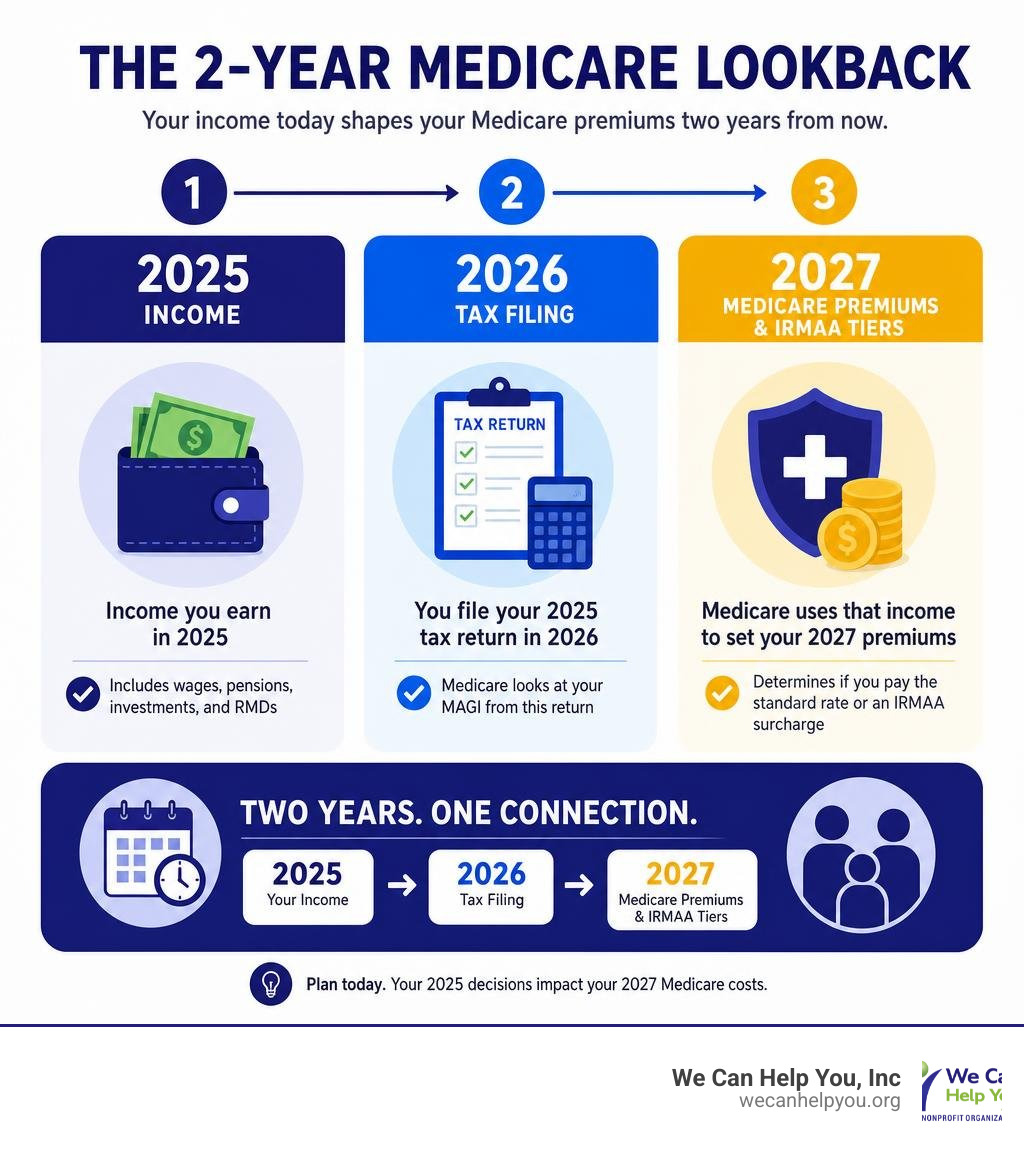
The key fact: The income you earn in 2025 — reported on the tax return you file in 2026 — is what Medicare uses to set your 2027 premiums. This is called the two-year lookback rule.
If your Modified Adjusted Gross Income (MAGI) stays below the thresholds above, you pay only the standard Part B premium. Cross a threshold, and you pay an additional surcharge called IRMAA (Income-Related Monthly Adjustment Amount) on top of the standard rate.
About 7% of Medicare beneficiaries — roughly 4.5 million people — pay these surcharges. If you are retired or approaching retirement with investment income, pensions, or required minimum distributions (RMDs), there is a real chance IRMAA applies to you.
The decisions you make right now in 2025 can directly raise or lower what you pay for Medicare two years from now. That is why understanding how this system works — and acting before December 31, 2025 — matters so much.
This guide walks you through everything: how the brackets are projected, what income counts, how the “cliff effect” can cost you thousands over a single dollar, and what steps you can take to protect your retirement budget.
Projected Medicare Premiums for 2027 and the Standard Part B Rate
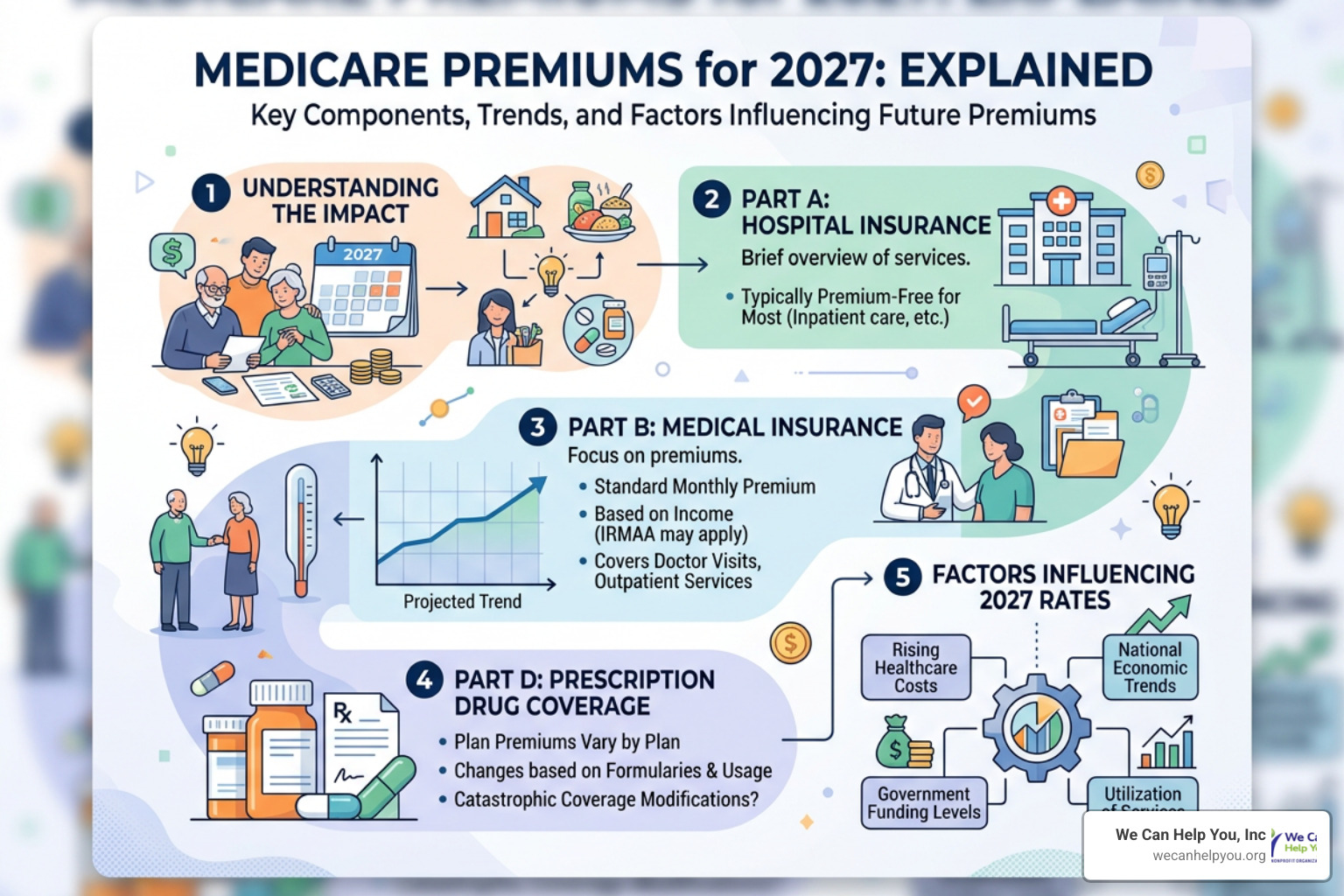
As we look ahead from our current vantage point in June 2026, understanding the trajectory of Medicare costs is essential for keeping your retirement budget on track. The standard monthly Part B premium for 2026 is officially set at $202.90 per person, which was a notable increase from previous years. You can read all about those official figures in the 2026 Medicare Parts A & B Premiums and Deductibles | CMS fact sheet.
For 2027, early projections and actuarial estimates indicate that the standard Part B premium will rise to approximately $218.60 per month. This projected increase is driven by standard annual inflation adjustments, rising healthcare delivery costs, and program adjustments.
While the federal government subsidizes about 75% of the standard Part B premium for most beneficiaries (with individuals paying the remaining 25%), higher-income earners are required to pay a much larger share of the program’s actual costs. This means that if your income crosses certain thresholds, your monthly premium will quickly climb far beyond that baseline $218.60.
To see how these costs have evolved, check out our Medicare Premiums 2026 Complete Guide to compare how the baseline rates and surcharges have changed over time.
Understanding IRMAA and the Two-Year Lookback Rule
The term “IRMAA” stands for the Income-Related Monthly Adjustment Amount. It is not a separate insurance plan; rather, it is a regulatory surcharge added to your Medicare Part B (medical insurance) and Part D (prescription drug coverage) premiums if your income is deemed “high” by the Social Security Administration (SSA).
To determine if you owe IRMAA, the government uses a strict two-year lookback rule. This means your Medicare premiums for 2027 are determined by your tax returns filed in 2026 for the 2025 tax year.
Because of this two-year lag, financial moves you make today have a delayed reaction. A large capital gain or a massive retirement account withdrawal in 2025 will not affect your premiums in 2026, but it will come back to greet you on your Medicare bills in 2027. For a deeper dive into the fundamental structure of these charges, take a look at The Ultimate Guide to Medicare Premiums.
How MAGI Determines Your Medicare Premiums for 2027
The SSA does not just look at your base salary or pension. Instead, they calculate your Modified Adjusted Gross Income (MAGI). For Medicare purposes, MAGI is defined as your Adjusted Gross Income (AGI) from your federal tax return plus any tax-exempt interest income you received.
- What is included in MAGI for IRMAA:
- Wages, salaries, and self-employment net earnings.
- Taxable Social Security benefits.
- Pensions and traditional IRA distributions (including Required Minimum Distributions, or RMDs).
- Interest (including tax-exempt interest from municipal bonds).
- Capital gains from selling real estate, stocks, or mutual funds.
- Dividend income.
- What is excluded from MAGI for IRMAA:
- Qualified distributions from a Roth IRA or Roth 401(k).
- Health Savings Account (HSA) distributions used for qualified medical expenses.
- Life insurance payouts.
- The return of principal/cost basis from non-qualified annuities or investments.
This means that even “tax-free” municipal bond interest, which is generally excluded from federal income tax, is added back to your AGI when calculating your Medicare premiums.
The Cliff Effect: Why One Dollar Matters
Unlike the federal income tax system, which uses marginal brackets where only the money within that specific bracket is taxed at the higher rate, IRMAA operates on a cliff system.
If you go over a bracket threshold by a single dollar, you do not just pay the surcharge on that one dollar. Instead, you are pushed entirely into the next tier, and you must pay the higher surcharge on your entire premium for the whole year.
The $1 Mistake: Imagine you are a single filer with a 2025 MAGI of $111,000. You pay the standard Part B premium of $218.60 per month in 2027. However, if your MAGI is $111,001—just one dollar over the threshold—you are pushed into Tier 2. This increases your Part B premium to $306.00 per month and adds a Part D surcharge of $15.40 per month. Over the course of 12 months, that single extra dollar of income will cost you an extra $1,233.60 in premiums!
For couples where both spouses are enrolled in Medicare, the cliff effect is doubled because the surcharge is assessed individually on each person’s premium.
Projected 2027 IRMAA Brackets for Part B and Part D
Based on current inflation trends and actuarial projections, the tables below outline the expected 2027 IRMAA brackets. These brackets are designed to help you plan your 2025 tax strategies before the year ends. For additional background on these projections, see Projected 2027 IRMAA Brackets and Surcharges for Medicare Part B … and our detailed post on how to Prepare for Tomorrow: What to Expect for 2027 Medicare Costs.
Income Thresholds for Single and Joint Filers
Here is how the projected monthly premiums break down across the various income tiers for 2027:
Table 1: Single Filers (Projected 2027)
| Tier | 2025 MAGI Threshold | Projected Monthly Part B Premium | Projected Monthly Part D Surcharge | Total Monthly Premium Impact |
|---|---|---|---|---|
| Tier 1 (Standard) | $111,000 or less | $218.60 | $0.00 (Plan Premium Only) | $218.60 + Plan Premium |
| Tier 2 | $111,001 to $140,000 | $306.00 | +$15.40 | $321.40 + Plan Premium |
| Tier 3 | $140,001 to $175,000 | $437.20 | +$39.70 | $476.90 + Plan Premium |
| Tier 4 | $175,001 to $210,000 | $568.40 | +$64.00 | $632.40 + Plan Premium |
| Tier 5 | $210,001 to $499,999 | $699.50 | +$88.10 | $787.60 + Plan Premium |
| Tier 6 | $500,000 or more | $743.20 | +$96.50 | $839.70 + Plan Premium |
Table 2: Married Filing Jointly (Projected 2027)
| Tier | 2025 MAGI Threshold | Projected Monthly Part B Premium | Projected Monthly Part D Surcharge | Total Monthly Premium Impact (Per Person) |
|---|---|---|---|---|
| Tier 1 (Standard) | $222,000 or less | $218.60 | $0.00 (Plan Premium Only) | $218.60 + Plan Premium |
| Tier 2 | $222,001 to $280,000 | $306.00 | +$15.40 | $321.40 + Plan Premium |
| Tier 3 | $280,001 to $350,000 | $437.20 | +$39.70 | $476.90 + Plan Premium |
| Tier 4 | $350,001 to $420,000 | $568.40 | +$64.00 | $632.40 + Plan Premium |
| Tier 5 | $420,001 to $749,999 | $699.50 | +$88.10 | $787.60 + Plan Premium |
| Tier 6 | $750,000 or more | $743.20 | +$96.50 | $839.70 + Plan Premium |
Table 3: Married Filing Separately (Projected 2027)
Because the tax code discourages married couples from filing separately to avoid higher tax brackets, the IRMAA thresholds for this status are exceptionally low:
| Tier | 2025 MAGI Threshold | Projected Monthly Part B Premium | Projected Monthly Part D Surcharge |
|---|---|---|---|
| Tier 1 (Standard) | $111,000 or less | $218.60 | $0.00 |
| Tier 2 | $111,001 to $387,000 | $699.50 | +$88.10 |
| Tier 3 | $387,001 or more | $743.20 | +$96.50 |
How CMS Policy Changes Impact Medicare Premiums for 2027
Beyond standard inflation, regulatory adjustments made by the Centers for Medicare & Medicaid Services (CMS) also shape your premiums.
In the finalized CY 2027 Rate Announcement, CMS established policy updates designed to improve payment accuracy and protect the long-term sustainability of the Medicare trust fund. According to the official press release, CMS Finalizes 2027 Medicare Advantage and Part D Payment Policies that Strengthen Accountability and Long-Term Sustainability | CMS, the government is implementing a net average payment increase of 2.48% to Medicare Advantage (MA) plans, which represents over $13 billion in additional funding to plans in 2027. This final rate was an upward adjustment from the initially proposed 0.09% increase outlined in the CMS Proposes 2027 Medicare Advantage and Part D Payment Policies to Improve Payment Accuracy and Sustainability | CMS document.
Key changes in these policies include:
- Risk Adjustment Model Updates: CMS is continuing the transition to updated risk adjustment models to ensure payments are based on accurate, verified clinical diagnoses rather than coding practices.
- Exclusion of Unlinked Chart Reviews: To curb artificial cost inflation, CMS is officially excluding diagnosis information from “unlinked” chart review records when calculating risk scores.
- Part D Redesign: Continued structural updates to Part D risk adjustment reflect the ongoing phase-in of the Inflation Reduction Act, which caps out-of-pocket drug costs but shifts risk-sharing responsibilities among plans, drug manufacturers, and the government.
While these technical adjustments primarily impact how the government pays private insurance companies for Medicare Advantage and Part D plans, they ultimately influence the base premiums, deductibles, and surcharges that you pay out of pocket.
Proactive Strategies to Lower Your MAGI and Appeal IRMAA

Because your 2025 income directly dictates your medicare premiums for 2027, you must take a proactive approach to managing your tax bracket before the end of the 2025 calendar year. Once December 31 passes, your 2025 MAGI is locked in, and your 2027 premiums are virtually set in stone.
Strategic Income Management in 2025
Here are several highly effective wealth-management strategies we recommend to keep your MAGI below the IRMAA cliffs:
- Strategic Roth Conversions: If you are in a “gap year”—the period between retirement and when your Required Minimum Distributions (RMDs) begin—converting a portion of your traditional IRA into a Roth IRA can be incredibly smart. While you will pay income tax on the converted amount in 2025, future withdrawals from the Roth IRA will be completely tax-free and will not count toward your MAGI for IRMAA calculations in future years.
- Qualified Charitable Distributions (QCDs): If you are age 70½ or older, you can direct up to $105,000 per year directly from your traditional IRA to a qualified charity. This distribution satisfies your RMD requirement (if applicable) but is completely excluded from your Adjusted Gross Income, keeping your MAGI safely below the IRMAA thresholds.
- Tax-Loss and Tax-Gain Harvesting: If you plan to sell investments in a taxable brokerage account, balance your capital gains by selling underperforming assets at a loss. Conversely, if you are well below a threshold, you can strategically harvest gains up to the cliff boundary.
- Asset Location: Keep high-yield, dividend-producing assets inside tax-deferred accounts (like traditional IRAs) and hold long-term growth stocks (which only trigger capital gains taxes when sold) in taxable accounts.
How to Appeal an IRMAA Determination
If you receive an IRMAA initial determination letter from the Social Security Administration stating that you owe a surcharge for 2027, do not panic. If your income has dropped significantly since 2025, you have the legal right to appeal.
To request a reduction in your premium, you must file Form SSA-44 (Medicare Income-Related Monthly Adjustment Amount – Life-Changing Event). The SSA will only grant an appeal if you have experienced a qualifying “life-changing event” that caused your income to decrease.
Qualifying Life-Changing Events include:
- Work Stoppage: You retired or fully stopped working.
- Work Reduction: You transitioned to part-time work or saw a major decrease in hours.
- Death of a Spouse: Your household income dropped, and your filing status changed.
- Divorce or Annulment: Your joint filing status ended.
- Loss of Income-Producing Property: Due to a natural disaster, theft, or circumstances beyond your control.
- Loss or Reduction of Pension Income: Due to a plan termination or reorganization.
- Employer Settlement Payment: A one-time payout due to an employer’s bankruptcy or closure.
When submitting Form SSA-44, you must provide official documentation, such as a letter from your former employer confirming your retirement date, a death certificate, or tax transcripts showing your updated, lower income.
Frequently Asked Questions About Medicare Premiums for 2027
Will my Medicare Advantage premium also increase?
Your private Medicare Advantage (Part C) plan’s base premium is set by the private insurer and does not change based on your personal income. However, you are still required to pay the standard Part B premium to the government, as well as any applicable Part B and Part D IRMAA surcharges, even if you are enrolled in a private Medicare Advantage plan.
What happens if I file an amended tax return for 2025?
If you file an amended tax return with the IRS that lowers your 2025 MAGI below an IRMAA threshold, the IRS does not automatically notify the Social Security Administration. You must proactively contact the SSA, provide a copy of your amended tax return (Form 1040-X), and request a recalculation of your 2027 premiums.
Does a one-time capital gain trigger IRMAA?
Yes. If you sell a primary residence, a vacation home, or a large block of stock in 2025, that capital gain will inflate your MAGI for the year. This can trigger an IRMAA surcharge for 2027. Fortunately, IRMAA is calculated on a year-by-year basis. If your income drops back to normal levels in 2026, your 2028 premiums will automatically adjust back down to the standard rate.
Conclusion
Navigating the complexities of Medicare premiums, IRMAA brackets, and tax-planning timelines can feel overwhelming. However, taking control of your financial picture today is the single best way to protect your retirement savings from unexpected healthcare surcharges tomorrow.
At We Can Help You, Inc., our mission is to educate retirees and those preparing for retirement so they can make informed, confident decisions. We operate across a wide range of locations — from East Greenwich, RI, and Albany, NY, to Albuquerque, NM, Omaha, NE, and beyond — helping individuals optimize their retirement income.
To help you take the next step, we offer a completely free Medicare Planning Guide and a free Social Security maximization report designed to help you increase your retirement income while keeping your healthcare costs low.
Before you make any major financial decisions, make sure you understand how your healthcare coverage works. Read our companion guide on Understanding Medicare’s Preventative Services to maximize the valuable, zero-cost health benefits already available to you under your plan.