
What Is a Medicare Part B Giveback Plan — and Could It Lower Your Monthly Costs?
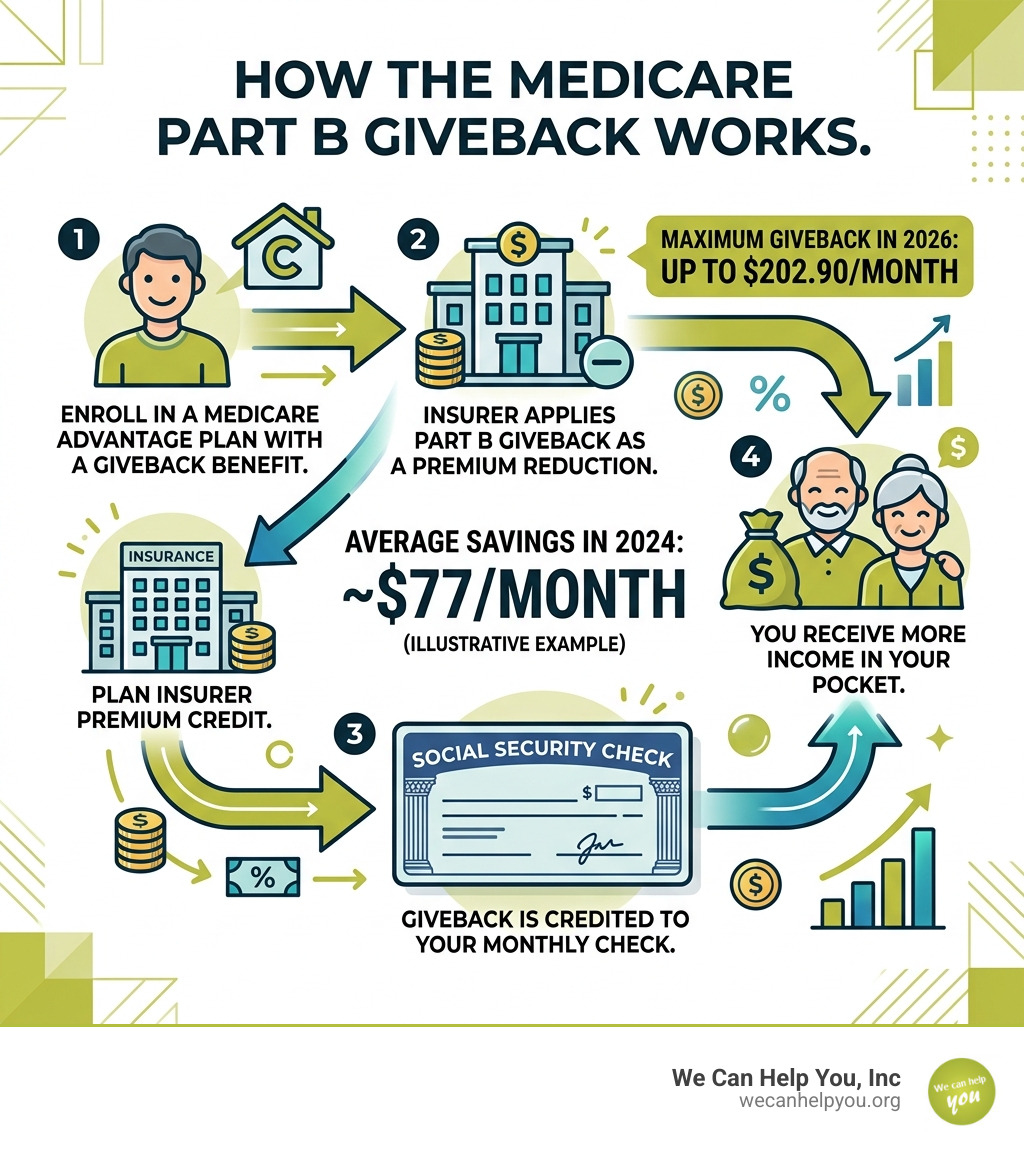
A medicare part b giveback plan is a type of Medicare Advantage (Part C) plan that pays back a portion — or even all — of your monthly Medicare Part B premium, reducing what gets deducted from your Social Security check each month.
Here’s a quick summary of the key facts:
- What it is: A benefit offered by select Medicare Advantage plans that reduces your Part B premium (up to $202.90/month in 2026)
- Who qualifies: Anyone enrolled in Medicare Parts A and B who pays their own premium and lives in a plan’s service area
- How you get it: As a credit on your Social Security check, or a reduced premium bill if you pay Medicare directly
- How much you can save: Anywhere from a few cents to the full $202.90/month — the average in 2024 was about $77/month
- Where to find it: About 25% of Medicare Advantage plans (1,369 plans) offer this benefit in 2026 — availability depends on your ZIP code
If you’re approaching or already in retirement, every dollar of fixed monthly income matters. The standard Part B premium of $202.90 per month in 2026 is a cost every Medicare enrollee faces — but not everyone knows it can sometimes be reduced or even eliminated through the right Medicare Advantage plan.
You may have already seen the TV commercials promising to “put money back in your Social Security check.” Those ads are referring to exactly this benefit. But as with most things in Medicare, the details matter a lot — and the reality is often more nuanced than the marketing suggests.
This guide breaks down how the giveback works, who can get it, and what to watch out for before you switch plans.
Simple guide to medicare part b giveback plan terms:
What is a Medicare Part B Giveback Plan?
At its core, a medicare part b giveback plan is a Medicare Advantage plan (Part C) that includes a “Part B Premium Reduction” benefit. While most people associate Medicare Advantage with “extra” perks like dental or vision, the giveback is a financial perk that targets your monthly overhead.
To understand how this works, we have to look at the “plumbing” of Medicare funding. Private insurance companies bid to provide Medicare benefits to enrollees. When an insurer can provide those services for less than the benchmark set by the government, they receive a “rebate.” The insurance company can use this rebate to offer lower copays, extra benefits, or—in the case of a giveback—to pay a portion of your Part B premium for you.
Even though you are joining a private plan, you are still technically in the Medicare program. This means you are still responsible for the standard Part B premium, which is $202.90 per month in 2026. A giveback plan simply steps in and says, “We’ll cover $50 (or another amount) of that for you.”
For more details on the mechanics, you can explore our Medicare Part B Giveback Complete Guide or read how carriers like Humana explain the Part B Giveback Benefit.
How Much Can You Save with a Medicare Part B Giveback Plan?
The amount of money you see back in your pocket isn’t a “one size fits all” figure. It varies significantly based on the specific plan and where you live. In 2026, the standard Part B premium is $202.90. A giveback can range from a nominal $0.10 to the full $202.90, though full givebacks are relatively rare.
Recent data shows a wide spread in these offers:
- High-End Savings: About 36% of plans offering a giveback provide $100 or more per month.
- Mid-Range Savings: Roughly 23% offer between $50.01 and $100.
- Modest Savings: About 28% of these plans offer $10 or less per month.
On average, enrollees in these plans see a mean reduction of approximately $77 per month. While $10 might not change your life, a $100 monthly reduction adds up to $1,200 a year in extra retirement income. To see how these amounts are calculated, check out our resource on Understanding Medicare Part B Giveback Offers.
Finding a Medicare Part B Giveback Plan in Your Area
The most important thing to know is that these plans are location-specific. A plan available in Chicago, IL, or Phoenix, AZ, might not be available in a rural part of New Mexico or New Hampshire.
For 2026, there are 1,369 Medicare Advantage plans offering a Part B giveback. This represents about 25% of all available plans, a slight dip from 2025 but still a significant portion of the market. To find one, you can use the official Medicare Plan Finder tool and look specifically under the “Plan Details” for a “Part B Premium Reduction.”
We also maintain a dedicated section for these updates under our Tag/Medicare Part B Giveback page, which tracks availability across the states where we operate, including Florida, New York, Texas, and Ohio.
Eligibility and How the Reimbursement Works
Who can actually get this money back? It isn’t a need-based grant or a lottery. Eligibility is strictly tied to your Medicare status and your choice of plan.
To be eligible for a medicare part b giveback plan, you must:
- Be enrolled in both Medicare Part A and Part B.
- Pay your own Part B premium. (If you are on Medicaid or a Medicare Savings Program where the state pays your premium, you aren’t eligible for a giveback because you aren’t the one paying the premium in the first place!)
- Live in the service area of a Medicare Advantage plan that offers the benefit.
- Be a U.S. citizen or a lawfully present resident for at least five years.
If you’re wondering if you meet the criteria, our guide Do You Qualify For The Medicare Giveback Lets Find Out walks through the checklist. You can also read more about what to know about the Medicare Give Back Benefit from independent health sources.
Receiving the Benefit via Social Security
Most beneficiaries have their Part B premium deducted directly from their Social Security check. If this is you, the giveback is handled automatically. You won’t receive a separate check in the mail from the insurance company. Instead, the Social Security Administration simply deducts less from your monthly payment.
For example, if your Social Security benefit is $1,500 and the standard Part B deduction is $202.90, you’d normally receive $1,297.10. If your plan has a $100 giveback, your deduction drops to $102.90, and your check increases to $1,397.10.
Note on Timing: It can take 1 to 3 months for the Social Security Administration to process the change after you join a new plan. Don’t panic! The benefit is retroactive. If it takes three months to start, your first adjusted check will include a lump-sum “catch-up” for those missing months.
Receiving the Benefit via Direct Billing
If you aren’t yet collecting Social Security and you pay Medicare directly (via “Medicare Easy Pay,” check, or credit card), the giveback still applies. In this case, your quarterly or monthly bill from CMS (Centers for Medicare & Medicaid Services) will be credited with the giveback amount, reducing the total balance you owe.
Evaluating the Value of a Medicare Part B Giveback Plan
This is where we need to be careful. At We Can Help You, Inc., we always tell our members: A “free” premium reduction isn’t always a bargain.
In the insurance world, there is no such thing as a free lunch. Often, plans that offer a high Part B giveback may “balance the scales” by having higher copays, a more restrictive network of doctors, or fewer extra benefits like dental and vision.
Consider this comparison:
- Plan A: $0 Giveback, $0 Primary Care copay, $3,400 Out-of-Pocket Max.
- Plan B: $100 Giveback, $20 Primary Care copay, $6,700 Out-of-Pocket Max.
If you see the doctor frequently or have a chronic condition, Plan B could actually cost you more over the course of the year, despite the $1,200 annual giveback. You must look at the “Total Cost of Care.” For a deeper dive into this trade-off, see our article on Understanding Medicare Part B Giveback Offers.
Marketing and Advertising Transparency
You’ve likely seen the flashy ads on TV featuring celebrities talking about “getting your money back.” In 2023, CMS implemented strict new marketing rules to curb misleading advertisements. These rules were a response to “bait-and-switch” tactics where ads promoted huge givebacks that were only available in a few ZIP codes (often in California or Florida), leaving seniors in other states disappointed.
When you see an ad promising “up to $202.90 back,” remember that “up to” is the keyword. Always verify the specific amount available in your county before making a move.
How Givebacks Differ from Other Assistance Programs
It is very common to confuse the medicare part b giveback plan with other financial assistance programs. However, they are legally and functionally very different.
Medicare Part B Giveback Plan vs. Medigap
Medigap (Medicare Supplement) plans are designed to pay the “gaps” in Original Medicare, like your 20% coinsurance.
- Medigap: Does NOT offer Part B givebacks. In fact, you pay a separate monthly premium for a Medigap plan on top of your Part B premium.
- Giveback: Only available through Medicare Advantage.
If you prefer the flexibility of seeing any doctor in the country who accepts Medicare (a hallmark of Medigap), a giveback plan might not be for you, as most are HMOs or PPOs with specific networks.
Medicare Part B Giveback Plan vs. Medicare Savings Programs (MSP)
Medicare Savings Programs are state-run programs for people with limited income and assets.
- MSP: If you qualify for an MSP (like QMB or SLMB), the state pays your entire Part B premium.
- Giveback: This is a private insurance perk.
As mentioned earlier, if the state is already paying your premium through an MSP, you cannot “double dip” and get a giveback on top of that. You can read more about this distinction in Humana’s explanation of giveback benefits.
Frequently Asked Questions about Part B Givebacks
Is the Medicare giveback benefit income-based?
No. Unlike Medicaid or Medicare Savings Programs, the medicare part b giveback plan is not based on your income. Whether you have a modest pension or a large IRA, you are eligible as long as you enroll in a plan that offers the benefit and you pay your own Part B premiums.
Do Medigap plans offer a Part B premium reduction?
No. Medigap plans (Medicare Supplement) do not offer premium reductions or givebacks. These are exclusive to Medicare Advantage plans.
How long does it take for the giveback to start?
While the benefit is effective the day your plan starts (usually January 1st if you signed up during Open Enrollment), it typically takes the Social Security Administration 1 to 3 months to update their system. You will be reimbursed for any “missed” months in a lump sum.
Conclusion
Navigating Medicare is about more than just finding the lowest premium; it’s about maximizing your total retirement income while protecting your health. A medicare part b giveback plan can be a fantastic tool to lower your fixed costs, especially for those in relatively good health who live in areas with competitive Medicare Advantage markets like New Jersey, North Carolina, or Arizona.
However, the “giveback” is just one piece of the puzzle. At We Can Help You, Inc., we specialize in helping you see the full picture. Beyond just Medicare, we provide a free Social Security maximization report to help you ensure you’re getting every penny you deserve from the government.
Before you make a switch based on a TV ad, we encourage you to download our free Medicare Planning Guide. We are here to help you weigh the savings of a giveback against the total value of your coverage.
Ready to see if a giveback plan makes sense for your budget? Visit our guide on how to get a rebate on your Medicare Part B premium to start your comparison today. We operate across a wide range of locations—from the bustling streets of Chicago and Charlotte to the quiet corners of New Hampshire and New Mexico—and our mission is always the same: educating you for a more secure retirement.