
What Medicare Actually Requires From Hospice Social Workers
Medicare guidelines for hospice social workers are more specific than most people realize — and understanding them can make a real difference in the quality of care you or a loved one receives at end of life.
Here is a quick summary of the core requirements:
- Eligibility: The patient must be entitled to Medicare Part A and certified as terminally ill with a prognosis of six months or less
- Team requirement: Every hospice interdisciplinary group (IDG) must include at least one social worker, marriage and family therapist (MFT), or mental health counselor (MHC) — this became a formal requirement on January 1, 2024
- Qualifications: Social workers must hold a Master of Social Work (MSW) from a CSWE-accredited school, or a baccalaureate degree with at least one year of healthcare experience under MSW supervision
- Supervision: Non-MSW social workers must be actively supervised by an MSW, with that supervision documented
- Plan of Care: Social workers must help create and review the patient’s Plan of Care (POC) — at minimum every 15 calendar days
- Background checks: All hospice staff with direct patient contact must pass criminal background checks per state law, or within three months of hire if no state rule applies
These rules come directly from the Medicare Conditions of Participation (CoPs), specifically 42 CFR § 418.56 and § 418.114.
For families navigating end-of-life care, knowing these requirements helps you ask the right questions and make sure your loved one’s care team is properly staffed and compliant.
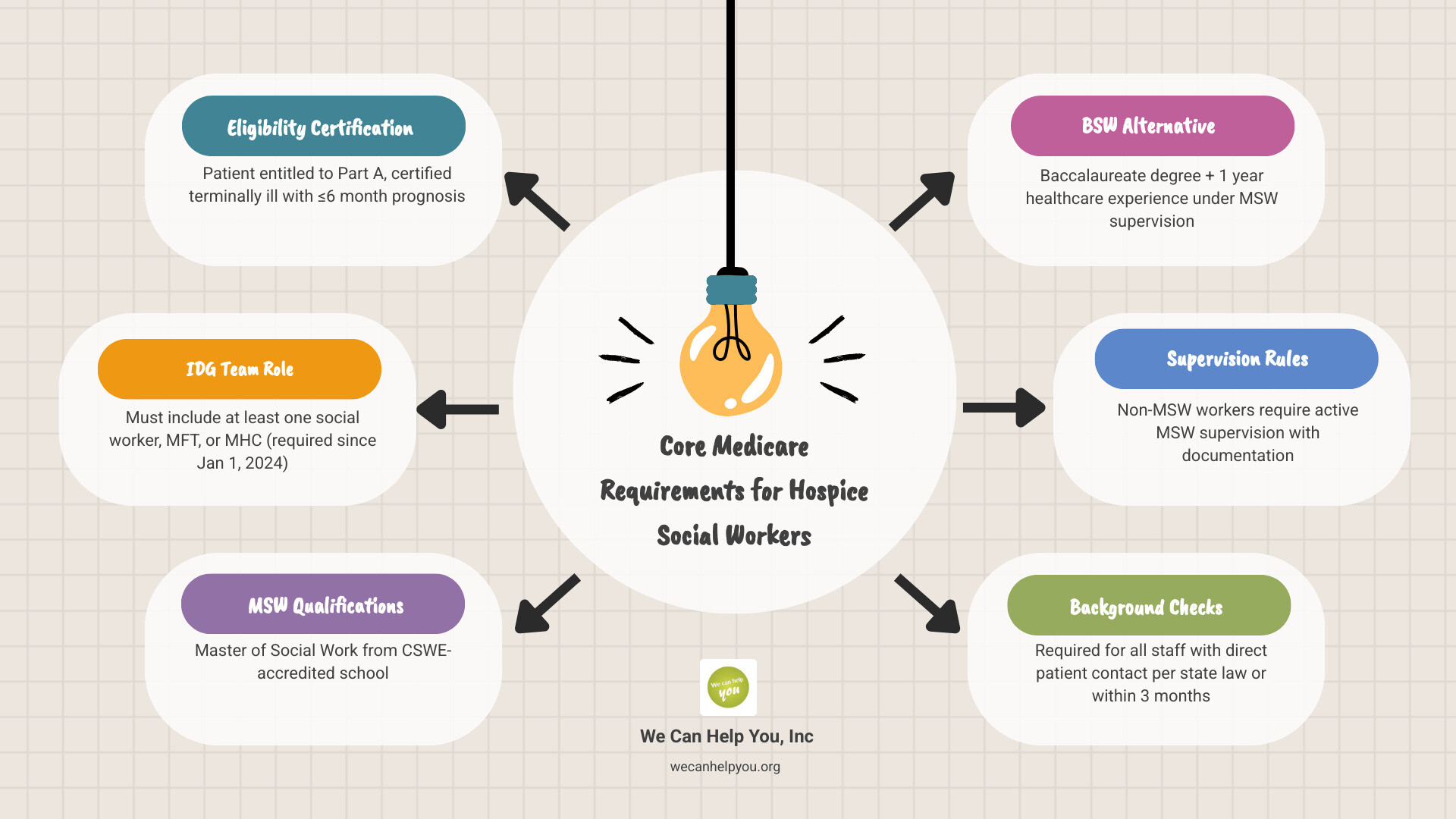
Medicare guidelines for hospice social workers word guide:
Medicare Eligibility and the Social Worker’s Role in Certification
To understand how a social worker fits into the hospice picture, we first have to look at how a patient qualifies for the benefit. Under Medicare Part A, hospice is designed for individuals who have a terminal illness. This means a physician must certify that the patient has a life expectancy of six months or less if the illness runs its normal course.
While the medical diagnosis comes from doctors, social workers play a vital role in the initial assessment phase. They help families understand the “election statement,” which is the formal document a patient signs to choose hospice care. By signing this, the patient acknowledges they are choosing palliative care (comfort-focused) over curative treatment. We often see social workers acting as the bridge, explaining these complex Official Medicare hospice coverage criteria to families who may be in a state of crisis or grief.
Clinical Narratives and Physician Collaboration
Medicare requires a “narrative” to accompany the certification of terminal illness. This isn’t just a checkbox; it’s a brief explanation of the clinical findings that support a six-month prognosis. The hospice medical director and the patient’s attending physician must collaborate on this.
Social workers contribute to this process by providing “biopsychosocial” data. For example, if a patient’s declining physical state is exacerbated by a lack of caregiver support or severe emotional distress, the social worker documents these factors. These insights help the physician paint a complete picture of the patient’s status for Medicare’s review. Furthermore, for patients entering their third benefit period (after the first 180 days), a Hospice Face-to-Face Encounter is required. While social workers don’t perform the medical exam, they often coordinate these visits to ensure the hospice remains compliant with Medicare’s strict timelines.
Medicare Guidelines for Hospice Social Workers: Qualifications and Supervision

Medicare is very particular about who can call themselves a “hospice social worker.” According to the Conditions of Participation (§418.114), the gold standard is the Master of Social Work (MSW).
Educational Requirements
A qualified hospice social worker must meet one of the following:
- Master of Social Work (MSW): Must be from a school accredited by the Council on Social Work Education (CSWE).
- Baccalaureate Degree (BSW): Must be from a CSWE-accredited school.
- Related Baccalaureate Degree: A degree in psychology, sociology, or another related field.
However, there is a catch for those without an MSW. If a social worker has a BSW or a related degree, they must have at least one year of social work experience in a healthcare setting. More importantly, they must be supervised by an MSW.
Supervision Standards for Baccalaureate Social Workers
If a hospice employs BSW-level staff, they are required by Medicare to also employ or contract with at least one MSW to provide supervision. This isn’t just a “check-in” once a year; it must be regular and documented.
| Requirement | MSW Social Worker | BSW/Related Degree Social Worker |
|---|---|---|
| Education | Master’s from CSWE school | Baccalaureate from CSWE or related field |
| Experience | Not specified by CMS (Hospice discretion) | 1 year in a healthcare setting |
| Supervision | Can work independently | Must be supervised by an MSW |
| Documentation | Self-documents clinical notes | Must have supervision sessions documented |
The Hospice Personnel Qualifications specify that supervision can happen in person, over the phone, or via electronic communication. The MSW supervisor acts as an advisor, helping the BSW-level worker navigate complex family dynamics, ethical dilemmas, and care plan development. This ensures that even if your direct social worker is at the baccalaureate level, their clinical decisions are being vetted by a master’s-level professional.
The Social Worker’s Role in the Interdisciplinary Group (IDG)
In hospice, no one works in a vacuum. Medicare requires an Interdisciplinary Group (IDG) to manage every patient’s care. This group usually includes a doctor, a nurse, a chaplain, and a social worker.
The social worker’s primary job in the IDG is to conduct a comprehensive assessment of the patient’s social, emotional, and spiritual needs. They don’t just look at the “now”; they look at the family’s history, their financial stressors, and their coping mechanisms. This information is used to build the Plan of Care (POC).
Medicare guidelines state that the POC must be reviewed and updated at least every 15 days. During these “IDG meetings,” the social worker reports on how the family is holding up. If a caregiver is burning out, the social worker might recommend Navigating Medicare And Hospice Care Understanding Costs And Coverage options like inpatient respite care, which Medicare covers for up to five days at a time.
Impact of 2024 Changes on Medicare Guidelines for Hospice Social Workers
A major shift occurred on January 1, 2024, thanks to the Consolidated Appropriations Act of 2023. Previously, the IDG was strictly required to have a social worker. Now, Medicare has introduced more flexibility to address staffing shortages, particularly in rural areas.
The updated CMS QSO-24-12-Hospice Update clarifies that the IDG must now include at least one of the following:
- A Social Worker
- A Marriage and Family Therapist (MFT)
- A Mental Health Counselor (MHC)
While this gives hospices more options for staffing, the core “social work” functions remain the same. Whether it’s an MSW or an MFT, the professional must be able to address the psychological and social strains of terminal illness. For many of our clients in states like Florida, New York, and California, this change has actually improved access to mental health support within the hospice benefit.
Essential Services and Documentation Standards
What does a hospice social worker actually do all day? Medicare covers a wide range of “medical social services,” but they must all be “reasonable and necessary” for the palliation and management of the terminal illness.
Key services include:
- Counseling: Providing emotional support to the patient and their family members.
- Bereavement Support: Medicare requires hospice social workers (or other qualified staff) to provide bereavement counseling for at least 12 months after the patient passes away.
- Resource Referral: Helping families find financial assistance, meal programs, or legal aid.
- Funeral Planning: Assisting families with the logistical and emotional burden of end-of-life arrangements.
To ensure Medicare pays for these services, the documentation must be impeccable. Every visit must be logged, and the notes must show progress toward the goals listed in the Plan of Care. For instance, if the goal is “reduce caregiver anxiety,” the social worker’s notes should detail the specific interventions used during the visit. You can learn more about how these daily services are tracked in our guide on Daily Hospice Care Understanding Medicares Contribution.
Navigating Patient Rights and Medicare Guidelines for Hospice Social Workers
One of the social worker’s most important (and often overlooked) roles is that of a patient advocate. Medicare grants hospice patients specific rights, and the social worker is often the one to ensure those rights are respected.
If a hospice decides to discharge a patient because they are no longer “terminally ill” (meaning their condition has stabilized), the patient has the right to an expedited appeal. The social worker helps the family contact the Quality Improvement Organization (QIO) to fight the discharge.
Additionally, if there are services or supplies the hospice believes Medicare won’t cover, they must issue an Advance Beneficiary Notice (ABN). This notice tells the patient they might be financially responsible for the service. We always advise our clients to talk to their hospice social worker immediately if they receive an ABN or a notice of discharge. They are trained to help you navigate these “Hospice Huddle” moments and understand the latest CMSS 2026 Guidelines.
Frequently Asked Questions about Hospice Social Work
Are criminal background checks required for hospice social workers?
Yes. Medicare requires hospices to obtain criminal background checks on all employees and volunteers who have direct patient contact or access to patient records. This must be done in accordance with state law. If a state (like New Jersey or Illinois) doesn’t have a specific timeframe, Medicare requires the check to be completed within three months of the date of hire.
How does hospice social work differ from regular Medicare home health social work?
The main difference is the “core service” status. In hospice, social work is a core service, meaning the hospice must provide it. In regular Medicare home health, social work is a “dependent” service — it can only be provided if the patient also needs skilled nursing, physical therapy, or speech therapy. Furthermore, hospice social work focuses on comfort and bereavement, whereas home health social work often focuses on recovery and rehabilitation.
Can a social worker help with Medicare Advantage hospice denials?
Generally, when a person with Medicare Advantage (Part C) enters hospice, the billing “carves out” and reverts to Original Medicare Part A. However, CMS is currently testing models (like the VBID model) where some Medicare Advantage plans manage the hospice benefit. In either case, the social worker is your point of contact for appeals. They can help gather supporting evidence from the attending physician to prove that hospice care is still medically necessary.
Conclusion
Navigating the end of life is never easy, but the medicare guidelines for hospice social workers are designed to ensure you have a qualified professional by your side. From the moment of certification to the months of bereavement support following a loss, social workers are the glue that holds the hospice team together.
At We Can Help You, Inc., we believe that education is the best way to secure your future. Whether you are planning for retirement or helping a loved one through a difficult transition, understanding your Medicare benefits is essential. We offer a free Medicare Planning Guide and a free Social Security maximization report to help you increase your retirement income and ensure you’re getting every benefit you deserve.
If you have more questions about how to manage your care, explore our full guide on Navigating Medicare And Hospice Care Understanding Costs And Coverage. We are here to help you every step of the way.