
What Medicare Actually Covers When You Travel (And What It Doesn’t)
Medicare travel insurance is one of the most misunderstood topics for people approaching retirement. Here’s the short answer most people need:
Quick Answer: What Does Medicare Cover When Traveling?
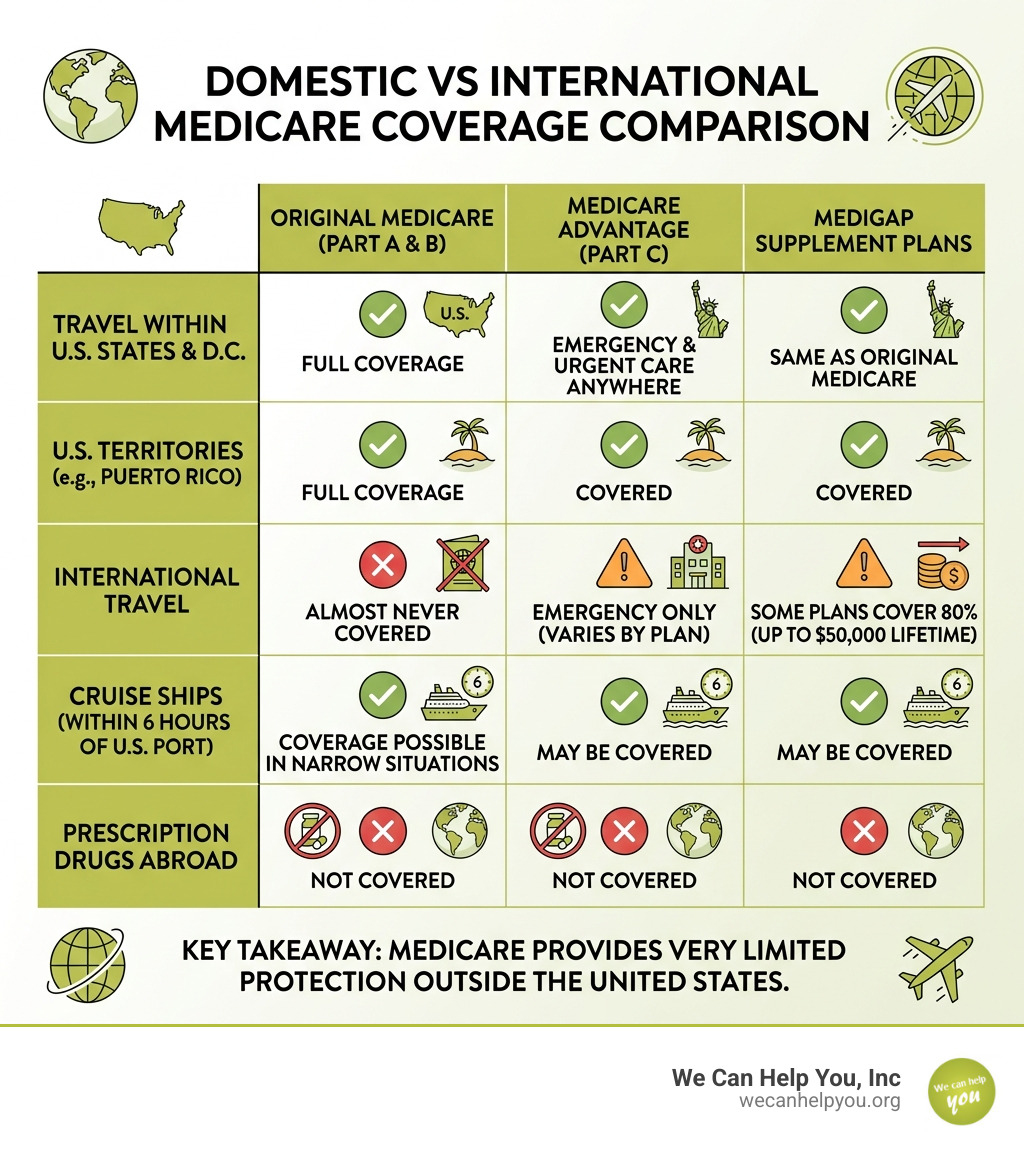
| Situation | Original Medicare | Medicare Advantage | Medigap |
|---|---|---|---|
| Travel within the U.S. | ✅ Full coverage | ✅ Emergency/urgent care anywhere | ✅ Same as Original Medicare |
| U.S. territories (Puerto Rico, Guam, etc.) | ✅ Full coverage | ✅ Covered | ✅ Covered |
| International travel | ❌ Almost never | ⚠️ Emergency only (varies by plan) | ⚠️ Some plans cover 80% up to $50,000 |
| Cruise ships (within 6 hours of U.S. port) | ✅ May be covered | ✅ May be covered | ✅ May be covered |
| Prescription drugs abroad | ❌ Not covered | ❌ Not covered | ❌ Not covered |
The hard truth? Most Medicare beneficiaries are largely unprotected the moment they leave U.S. soil.
Millions of Americans rely on Medicare for their health coverage in retirement. But Medicare was built around domestic care. When you travel internationally, those protections mostly disappear — and the financial risk can be enormous. A single hospital stay abroad can cost tens of thousands of dollars out of pocket.
There are some narrow exceptions, and some plan types offer more protection than others. But understanding the gaps before you board a flight is what separates a worry-free trip from a financial nightmare.
This guide breaks down exactly what you’re covered for — domestically and internationally — and what steps you can take to protect yourself.
Does Original Medicare Cover You Outside the United States?
As we head into April 2026, many of our members are planning their dream retirement trips. One of the most common questions we hear at We Can Help You, Inc. is: “Can I just use my red, white, and blue card anywhere?”
The answer depends entirely on your definition of “anywhere.” Original Medicare (Part A and Part B) provides robust coverage across all 50 U.S. states and the District of Columbia. It also covers you in U.S. territories, including Puerto Rico, the U.S. Virgin Islands, Guam, American Samoa, and the Northern Mariana Islands. If you are visiting family in Chicago, IL, or vacationing in Miami, FL, your coverage travels with you seamlessly.
However, once you cross the border into a foreign country, the rules change drastically. According to Travel Medical Coverage, Medicare usually does not cover health care services received outside the U.S. This means if you have a medical emergency in Paris or Tokyo, you are generally responsible for 100% of the bill.

There is one notable exception involving the high seas: cruise ships. Medicare may cover medically necessary services on a cruise ship if the doctor is authorized to provide them and the ship is in a U.S. port or no more than six hours away from a U.S. port. If you are seven hours out, you are likely on your own. For a deeper dive into these nuances, check out our resource on Medicare And International Travel.
Rare Exceptions for Foreign Hospital Coverage
While the “no coverage abroad” rule is strict, there are three very specific, rare scenarios where Original Medicare might pay for care in a foreign hospital:
- The Border Exception: You are in the U.S. when a medical emergency occurs, and a foreign hospital is closer than the nearest U.S. hospital that can treat you. This is most common for those living or traveling near the Mexico or Canada borders.
- The Transit Exception: You are traveling through Canada on the “most direct route” between Alaska and another U.S. state when a medical emergency happens, and a Canadian hospital is closer than a U.S. one.
- The Proximity Exception: You live in the U.S., and a foreign hospital is closer to your home than the nearest U.S. hospital, regardless of whether it is an emergency.
In these cases, Medicare Part A covers inpatient care, and Part B covers emergency and non-emergency ambulance and doctor services. However, Medicare will not pay for any services once your inpatient stay ends or for the ambulance ride back home. You can find more about these specific scenarios in our Tag/International Travel section.
Medicare Advantage and Domestic Travel Rules
Medicare Advantage (Part C) plans operate differently. These plans are offered by private companies and are tied to a specific “service area,” usually defined by the county or ZIP code where you live.
When traveling domestically, all Medicare Advantage plans are required by law to cover emergency and urgent care anywhere in the U.S. without charging you extra out-of-network rates. If you are visiting the Grand Canyon in Arizona and need an ER, your plan has you covered.
However, for routine care—like a check-up or a skin screening—you may be restricted to “in-network” providers. If you go out-of-network for non-emergency care, you could be stuck with the entire bill unless your plan is a PPO (Preferred Provider Organization) that allows out-of-network care at a higher cost.
A critical rule to remember is the 6-month disenrollment rule. If you travel outside your plan’s service area for more than six months consecutively, you will typically be automatically disenrolled. This is a major concern for “snowbirds” moving between places like New York and Florida. Some plans offer “visitor or travel benefits” that can extend this window to 12 months, but you must verify this with your provider. For more tips on navigating these rules, read our guide on Medicare Coverage While Traveling.
Understanding Medicare Travel Insurance Options for Advantage Members
If you are an Advantage member who travels frequently, look for plans with “Travel Advantage” or “Explorer” features. These often include:
- Multistate Provider Networks: Access to in-network doctors in multiple states.
- National Pharmacy Networks: The ability to fill prescriptions at preferred rates at major chains nationwide.
- International Emergency Coverage: Some Part C plans offer a supplemental benefit for emergency care abroad, though they rarely cover follow-up care or routine services once you are stabilized.
Always review your plan’s Evidence of Coverage (EOC) before a trip. We discuss these nuances further under our Tag/Medicare Coverage While On Vacation resources.
Using Medigap as Medicare Travel Insurance
For those who keep Original Medicare, a Medicare Supplement (Medigap) policy can act as a form of Medicare travel insurance. This is often the most reliable way to get international medical protection.
Medigap plans C, D, F, G, M, and N provide a foreign travel emergency benefit. This is a standardized benefit across these plans, which is vital for peace of mind when heading overseas. You can Learn what Medigap Covers | Medicare to see how these plans bridge the gap.
| Medigap Benefit | Coverage Detail |
|---|---|
| Applicable Plans | C, D, F, G, M, N |
| Deductible | $250 annual deductible |
| Coverage Level | 80% of billed charges for emergency care |
| Lifetime Limit | $50,000 |
| Trip Limit | Care must begin during the first 60 days of the trip |
This benefit only kicks in for care that Medicare doesn’t cover and that begins within the first two months of your trip. If you are planning a year-long world tour, Medigap will only protect you for the first 60 days. For a comprehensive look at these plans, see The Ultimate Guide To Medicare Coverage While Traveling.
Financial Responsibility and Claim Filing
It’s important to understand that foreign hospitals are not required to file claims with Medicare or your Medigap company. In most cases, you will need to pay the hospital upfront and then seek reimbursement.
To do this, you must obtain an itemized bill (ideally translated into English) for all services, including doctor fees and hospital charges. You will then manually submit these to Medicare. If Medicare denies the claim (which they will for most international care), you then submit that denial and the bill to your Medigap provider. For more on this process, visit Tag/International Coverage On Medicare.
Why You Need Supplemental Medicare Travel Insurance
Even with a Medigap plan, there are significant “holes” in your coverage. Medigap only covers 80% of emergency care, leaving you with 20% of the bill and a $50,000 lifetime cap. In modern healthcare, $50,000 can be exhausted in just a few days in an intensive care unit.
Furthermore, Medicare and Medigap never cover:
- Prescription drugs purchased outside the U.S.
- Routine care (like a physical or dental exam).
- Dialysis for ESRD (except in rare border hospital cases).
- Medical Evacuation: This is the big one. If you need to be flown home via an air ambulance, the cost can exceed $100,000. Medicare does not pay for this.
This is why we strongly recommend a dedicated Medicare travel insurance policy—specifically a travel medical plan. These plans are designed to fill the gaps left by Medicare. For residents in Illinois, the Travel – Illinois Department of Insurance provides excellent local guidance on choosing these supplements.
Choosing the Best Medicare Travel Insurance for International Trips
When shopping for a plan, look for “Travel Medical Insurance” rather than just “Trip Cancellation Insurance.” While trip cancellation protects your flight costs, travel medical insurance protects your life and savings.
Key features to look for include:
- High Medical Limits: Look for at least $250,000 to $1,000,000 in coverage.
- Emergency Medical Evacuation: Ensure it covers the cost to get you to a high-quality hospital or back to the U.S.
- Pre-existing Condition Waivers: Many plans exclude pre-existing conditions unless you buy the policy within a certain window (usually 14–21 days) of your first trip payment.
- 24/7 Assistance: A hotline that can help coordinate care and guarantee payment to foreign hospitals.
As noted in the article “Does Medicare cover international travel?“, these plans are temporary and relatively inexpensive compared to the risk of being uninsured.
How to Prepare for Your Trip
Preparation is the key to a healthy retirement vacation. Before you leave, we suggest taking these steps:
- Check Vaccines: Medicare Part D now covers most travel vaccines recommended by the Advisory Committee on Immunization Practices (ACIP) at no cost to you. This includes vaccines for Yellow Fever, Japanese Encephalitis, and more. Talk to your doctor at least 6 weeks before you travel.
- Pack Your Records: Carry a digital or paper copy of your medical history, current medications, and your insurance cards.
- Find a Local PCP: If you are traveling domestically for a long period, identify an in-network primary care provider at your destination ahead of time.
- Review the “6-Hour Rule”: If you are cruising, check the ship’s itinerary. If you are far out at sea, your Medicare won’t help.
For more official details, refer to Travel outside the U.S. – Medicare.
Frequently Asked Questions about Medicare Travel
Does Medicare cover dialysis treatments outside the U.S.?
Generally, no. Medicare will not pay for dialysis outside the United States unless it is part of a covered inpatient stay under one of the rare exceptions (like being near the border). If you require dialysis, you must plan your travel carefully and be prepared to pay the full cost out of pocket in foreign countries.
Can I buy prescription drugs in a foreign country with my Medicare plan?
No. Medicare Part D and Medicare Advantage plans cannot cover any prescription drugs purchased outside the 50 states, D.C., and U.S. territories. If you lose your medication abroad, you will have to pay the local price for a replacement.
What happens if I stay outside my Medicare Advantage service area for more than 6 months?
In most cases, you will be automatically disenrolled from your plan. You will then be given a Special Enrollment Period (SEP) to join a plan in your new location or return to Original Medicare. To avoid this, check if your plan has a “visitor benefit” that allows for longer domestic travel.
Conclusion
At We Can Help You, Inc., our mission is to ensure you have the education needed to enjoy a secure retirement. Whether you are exploring the coast of Maine or the streets of Rome, knowing the limits of your Medicare travel insurance options is vital.
Don’t leave your financial health to chance. We offer a free Medicare Planning Guide and a Social Security maximization report to help you increase your retirement income—giving you more “adventure money” for your next trip!
Get your free Medicare Coverage While Traveling guide today and travel with the confidence that you’re truly protected. Safe travels!