What Are IRMAA Surcharges in 2026 and Who Pays Them?
IRMAA surcharges 2026 are extra monthly fees added to your Medicare Part B and Part D premiums if your income exceeds certain thresholds. Here’s a quick overview:
| Filing Status | 2026 IRMAA Starts At | Part B Surcharge Range | Part D Surcharge Range |
|---|---|---|---|
| Single | $109,000 MAGI | $81.20 – $487.00/mo | $14.50 – $91.00/mo |
| Married Filing Jointly | $218,000 MAGI | $81.20 – $487.00/mo | $14.50 – $91.00/mo |
| Married Filing Separately | $109,000 MAGI | $446.30 – $487.00/mo | $83.30 – $91.00/mo |
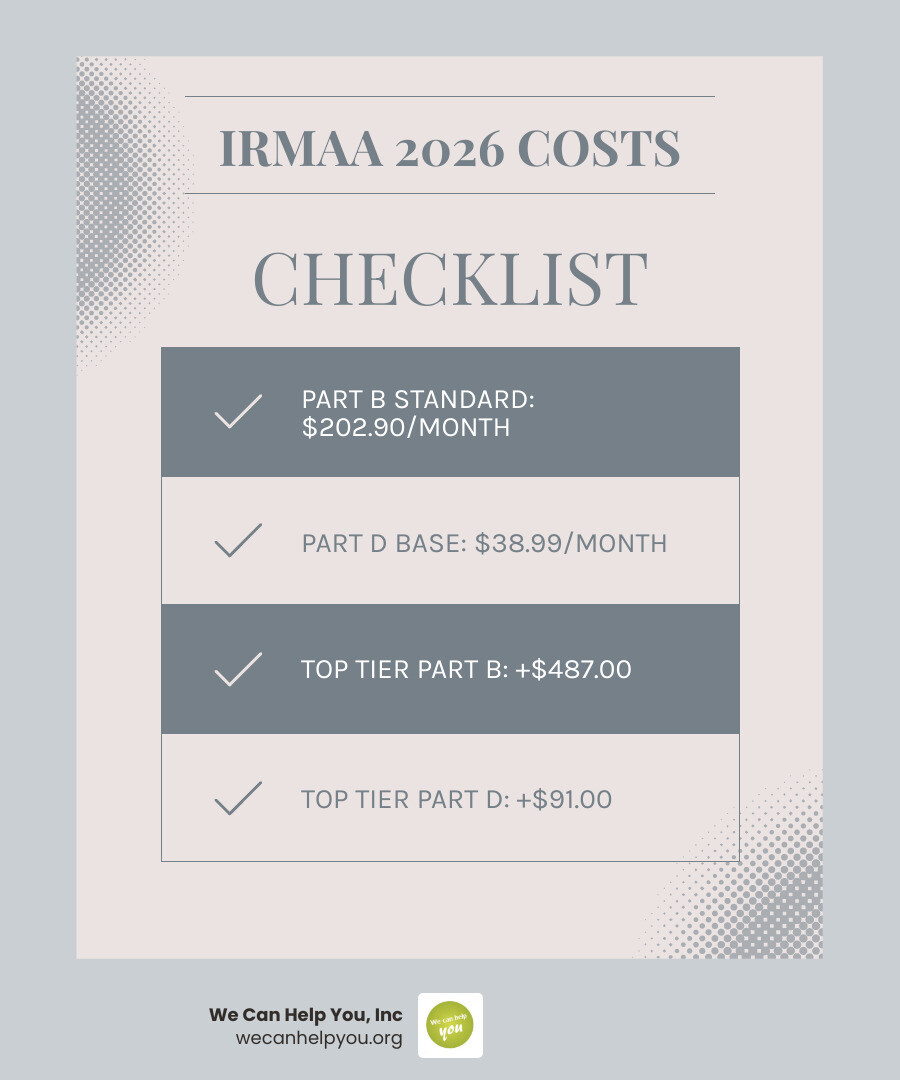
Key fact: The 2026 Part B standard premium is $202.90/month. With IRMAA, your total can reach up to $689.90/month — more than three times the base rate.
If you’re approaching Medicare age or already enrolled, a surprise premium bill can throw off your entire retirement budget. Yet most people don’t find out they owe IRMAA until a notice arrives in the mail — based on income from two years ago.
That’s the part that catches so many people off guard.
About 5.1 million Medicare beneficiaries paid Part B IRMAA surcharges in 2025. That’s roughly 7–8% of all enrollees. And with the 2026 first income threshold rising to $109,000 (up from $106,000 in 2025), more people are at risk of crossing into surcharge territory each year.
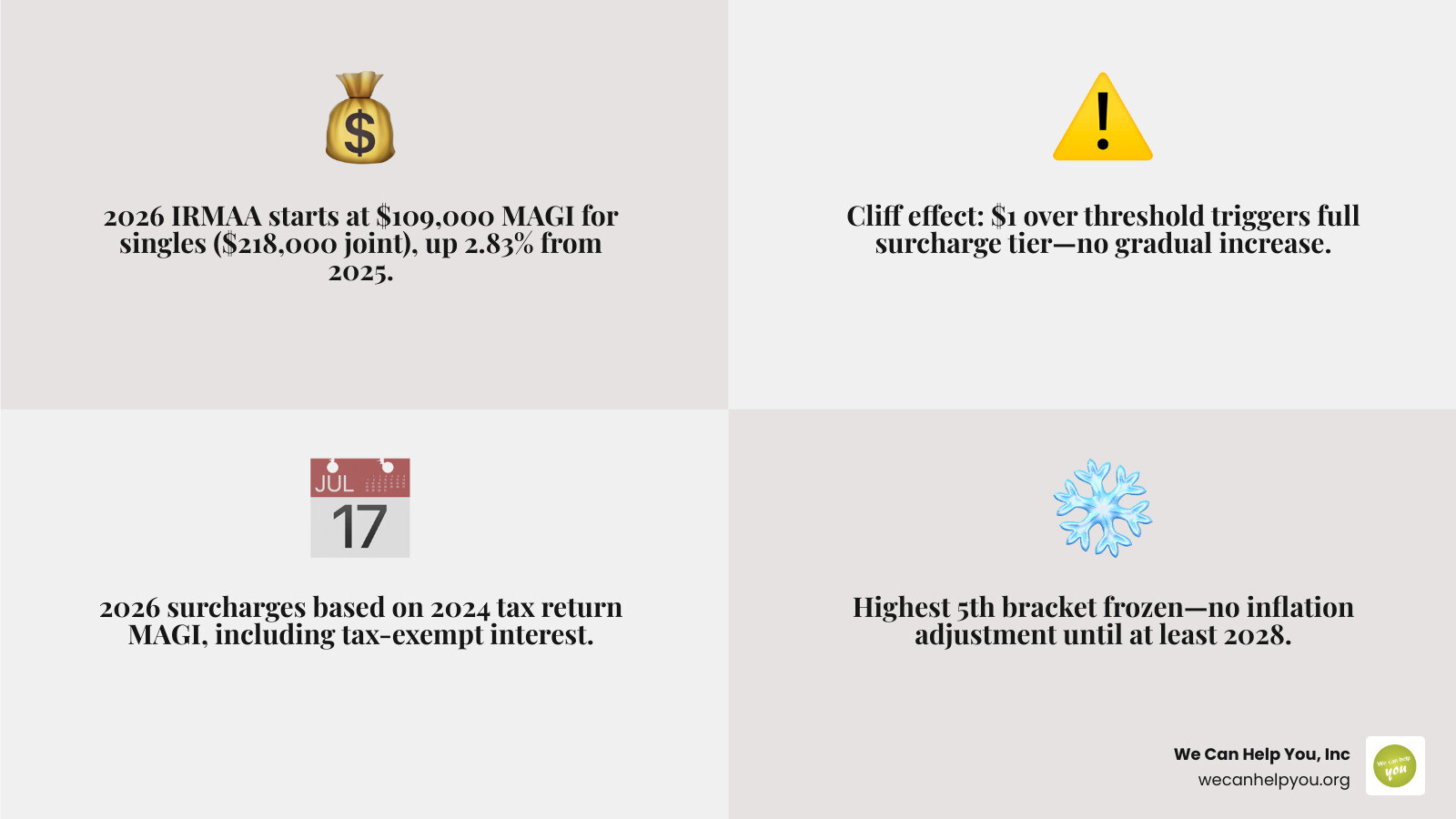
The surcharge is a “cliff” system — meaning if your income is even $1 over a threshold, you owe the full surcharge for that entire tier. There’s no gradual increase. That single dollar can cost you hundreds more per year.
The income used to set your 2026 IRMAA is from your 2024 tax return — specifically your Modified Adjusted Gross Income (MAGI). And yes, tax-exempt interest from municipal bonds counts too, which surprises many retirees.
This guide breaks down every bracket, every dollar, and every strategy you can use to manage — or even avoid — IRMAA in 2026.
Understanding the IRMAA Surcharges 2026 Brackets and Income Thresholds
Navigating Medicare costs can feel like trying to solve a puzzle where the pieces keep changing shape. For 2026, the Social Security Administration (SSA) has updated the IRMAA thresholds to account for inflation. While the standard Part B premium is set at $202.90, those of us with higher incomes will see an “Income-Related Monthly Adjustment Amount” tacked onto that bill.
The 2026 brackets represent a roughly 2.83% increase from 2025 levels. This is generally good news, as it provides a bit more “breathing room” before you hit a higher surcharge tier. However, the 5th and highest bracket remains frozen and is not scheduled for inflation indexing until at least 2028.
How Your Income is Calculated (The MAGI Formula)
To determine if you owe a surcharge, the SSA looks at your Modified Adjusted Gross Income (MAGI). For IRMAA purposes, this isn’t just the number at the bottom of your tax return. We calculate it by taking your Adjusted Gross Income (AGI) from Form 1040 Line 11 and adding back any tax-exempt interest reported on Form 1040 Line 2a.
This “add-back” of tax-exempt interest is a common trap. Many of our clients in places like Florida or Arizona hold municipal bonds thinking the interest is “invisible” to the government. While it may be federal tax-free, it is very much visible to Medicare.
The Two-Year Lookback Rule
Your IRMAA surcharges 2026 are determined by the income you reported on your 2024 tax returns. This two-year lag exists because the IRS needs time to process returns and share that data with the SSA. If you had a high-income year in 2024 due to a business sale or a large Roth conversion, you will feel the impact in your 2026 Medicare premiums.
Filing Status Matters
The thresholds vary significantly based on how you file your taxes:
- Single Filers: The first surcharge kicks in at $109,000.
- Married Filing Jointly: The threshold is doubled to $218,000.
- Married Filing Separately: This is the most punitive status. If you lived with your spouse at any time during the year but filed separately, you hit the highest surcharge tiers much faster, starting at just $109,000.
If you are confused about how these numbers apply to you, we recommend understanding-medicare-irmaa-charges-and-how-to-file-an-appeal to see how your specific filing status impacts your bottom line.
Breakdown of IRMAA Surcharges 2026 for Part B
Medicare Part B covers outpatient services like doctor visits and lab tests. While the government subsidizes about 75% of the cost for most people, high earners are required to pay a larger share.
For 2026, the surcharge details for Part B are divided into five tiers. If your MAGI is between $109,000 and $137,000 (individual), you’ll pay an extra $81.20 per month. At the highest tier (over $500,000 individual), the surcharge jumps to $487.00, bringing your total monthly Part B cost to $689.90.
Breakdown of IRMAA Surcharges 2026 for Part D
Part D covers prescription drugs, and the IRMAA rules apply here too, whether you have a standalone plan or Part D coverage info through a Medicare Advantage plan.
The 2026 Part D base beneficiary premium is $38.99. The IRMAA surcharges for Part D range from $14.50 to $91.00 per month. Unlike Part B, which is usually deducted from your Social Security check, Part D IRMAA is often billed directly to you by Medicare, even if your employer pays your base plan premium.
Strategies to Minimize or Avoid IRMAA Surcharges
Since IRMAA is a “cliff,” staying just one dollar under a threshold can save a couple over $2,300 a year in combined premiums. We often help people look for ways to lower their MAGI to stay within a lower bracket. If you’re wondering is-it-possible-to-reduce-my-medicare-part-b-premium, the answer is a resounding yes—with proper planning.
- Strategic Roth Conversions: Converting a traditional IRA to a Roth IRA creates a one-time spike in income. If you do this before you are within the two-year Medicare lookback window (typically before age 63), you can enjoy tax-free withdrawals later that don’t count toward MAGI.
- Qualified Charitable Distributions (QCDs): If you are 70½ or older, you can send up to $111,000 (in 2026) directly from your IRA to a charity. This counts toward your Required Minimum Distribution (RMD) but is excluded from your Adjusted Gross Income.
- Manage Capital Gains: Be mindful of selling stocks or property that could trigger large gains. Consider “tax-loss harvesting” to offset gains with losses, effectively lowering your MAGI.
- Timing of Income: If you are close to a threshold, consider deferring a bonus or a business payout to the following year to avoid a “cliff” jump.
- SECURE Act 2.0 Impact: With RMD ages pushed back to 73 or 75, you have more time to perform Roth conversions or manage distributions before they start pushing you into higher IRMAA brackets.
How to Appeal an IRMAA Determination Using Form SSA-44
What if your income in 2024 was high, but you’ve since retired and your income has plummeted? You don’t have to just “deal with it” for two years. You can request a “new initial determination” if you have experienced a qualifying Life-Changing Event (LCE).
Qualifying events include:
- Work Stoppage: You retired or stopped working.
- Work Reduction: You moved from full-time to part-time.
- Death of a Spouse: A significant change in household income and filing status.
- Divorce or Annulment: Changing from joint to single filing.
- Loss of Income-Producing Property: Due to a disaster or similar event beyond your control.
- Loss of Pension Income: An employer’s pension plan stops or is reduced.
To start this process, you will need to fill out Form SSA-44 download. You generally have 60 days from the date you receive your IRMAA notice to file an appeal. We’ve put together a guide on dont-overpay-a-step-by-step-process-for-appealing-medicare-irmaa to help you navigate the evidence requirements, such as providing a retirement letter from your employer or a death certificate.
Frequently Asked Questions about IRMAA Surcharges 2026
Which tax year is used for 2026 IRMAA determinations?
The SSA uses your 2024 tax return data to set your 2026 premiums. This two-year lag is standard. If you haven’t filed your 2024 taxes yet (perhaps due to an extension), they may use your 2023 data until the 2024 info becomes available.
Does tax-exempt interest trigger IRMAA surcharges?
Yes. While interest from municipal bonds is often “tax-exempt” for income tax purposes, it is added back to your AGI to calculate your MAGI for Medicare. This is one of the most common reasons high-net-worth retirees unexpectedly trigger IRMAA surcharges 2026.
What happens if I don’t pay the IRMAA surcharge?
Paying your IRMAA is not optional. If you don’t pay the surcharge, you risk losing your Medicare Part B and Part D coverage entirely. If you receive Social Security, the amount is deducted automatically. If you don’t, you’ll receive a bill from Medicare that you can pay via your MyMedicare account or Medicare Easy Pay.
Conclusion
Understanding IRMAA surcharges 2026 is vital for anyone looking to protect their retirement savings from rising healthcare costs. With roughly 8% of beneficiaries paying these higher rates, being proactive about your 2024 and 2025 income can save you thousands of dollars down the road.
At We Can Help You, Inc., our mission is to educate individuals across the country—from New York to California and everywhere in between—on how to navigate these complex rules. Whether you are in Chicago, IL, or Charlotte, NC, we want to ensure you have the tools to maximize your retirement income.
Don’t leave your Medicare costs to chance. We offer a free Medicare Planning Guide and a free Social Security maximization report to help you stay ahead of the curve. For more personalized assistance or More info about Medicare services, reach out to us today. We are here to help you retire with confidence!