
Is the Medicare Giveback Benefit Available to You?
Medicare give back benefit qualifications are simpler than most people expect — and you may already meet them without knowing it.
Here’s a quick look at who qualifies:
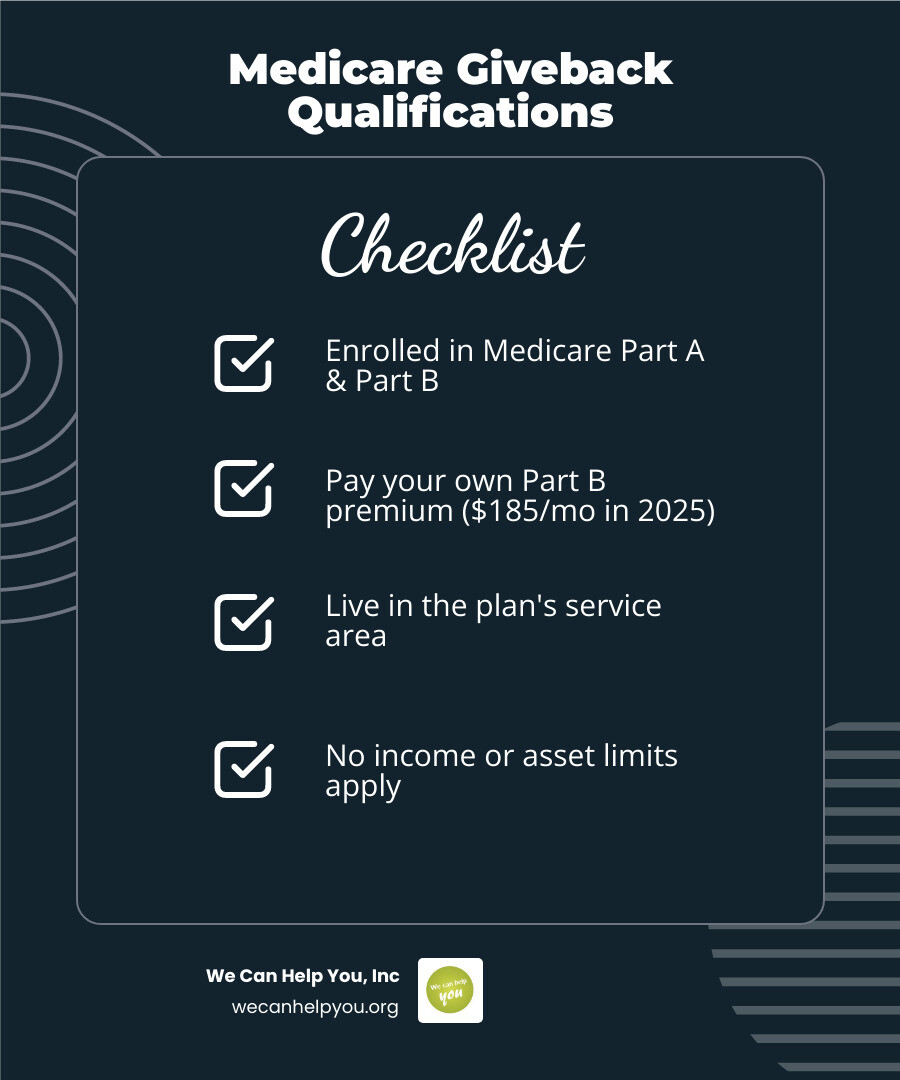
- Enrolled in Medicare Part A and Part B (Original Medicare)
- Pay your own Part B premium — it is not covered by Medicaid or a Medicare Savings Program
- Live in the service area of a Medicare Advantage plan that offers the giveback
- No income limits — this benefit is not means-tested
- No asset requirements — your savings or property don’t affect eligibility
In short: if you’re on Medicare and enrolled in the right plan for your zip code, you may qualify — regardless of your income.
Every year during Open Enrollment, TV ads promise to “give you money back” on your Medicare Part B premium. It sounds almost too good to be true. And honestly? The marketing can be confusing — even misleading at times.
But the benefit itself is real. Some Medicare Advantage plans do reduce — or even eliminate — your monthly Part B premium, which runs $185 per month in 2025. That’s up to $2,220 back in your pocket each year.
The catch is that not every plan offers it, and not every area has access to it. In 2025, only about 1 in 3 Medicare Advantage plans include a giveback benefit. So knowing whether you qualify — and where to look — makes all the difference.
This guide will walk you through exactly what you need to check.
Understanding the Medicare Part B Giveback Benefit
To understand the giveback, we first have to look at how Medicare Advantage (Part C) works. Unlike Original Medicare, which is managed by the federal government, Medicare Advantage plans are offered by private insurance companies. These companies receive a set amount of money from the government — often called “the bid” — to provide your healthcare coverage.
When an insurance company can provide that care for less than the government payment, they have “rebate” dollars left over. By law, they must use these funds to provide extra benefits to you. While many plans use this money for dental, vision, or hearing coverage, some choose to offer a “Part B Premium Reduction.”
This is the technical name for the “giveback.” Essentially, the insurance company pays a portion (or all) of your $185 monthly Part B premium on your behalf. It is important to understand medicare part b giveback offers because the benefit varies wildly. Some plans might give back a modest $10 a month, while others might cover over $100.

Essential Medicare Give Back Benefit Qualifications
While the marketing makes it sound like a secret government program, the medicare give back benefit qualifications are actually tied to the specific insurance policy you choose. You don’t “apply” for the giveback with Social Security; you “enroll” in a plan that includes it.
Here is the essential checklist to see if you can participate:
- Active Enrollment in Parts A and B: You must be entitled to Medicare Part A and enrolled in Part B. You cannot get a “giveback” on a premium you aren’t already required to pay.
- Financial Responsibility for Premiums: You must be the one paying your Part B premium. If you have “dual eligibility” (meaning you have both Medicare and full Medicaid) or if you are enrolled in a Medicare Savings Program where the state pays your premium, you do not qualify for a giveback. You can’t get a rebate on a cost you don’t personally incur.
- Residency Requirements: You must live within the plan’s specific service area. These benefits are highly localized. A plan available in Chicago, IL, might offer a $50 giveback, while the same company’s plan in Naperville, IL, might offer $0.
- Medicare Advantage Enrollment: This benefit is strictly for Part C. According to federal regulations, this mechanism for premium reduction is a feature of the Medicare Advantage payment system.
- Medigap Exclusion: If you prefer to stay on Original Medicare and use a Medigap (Medicare Supplement) policy, you cannot receive a giveback. Medigap plans do not offer premium reductions.
Do You Meet the Medicare Give Back Benefit Qualifications for Income?
One of the biggest misconceptions we hear at We Can Help You, Inc. is that you have to be “low income” to get the giveback. This is not true.
Unlike Medicare Savings Programs (like QMB or SLMB), which have strict income and asset limits, the Medicare Advantage giveback is available to anyone who joins the plan. Whether you have $5,000 in the bank or $5,000,000, if you live in the right zip code and pick the right plan, the reduction is yours.
However, if your income is very high, you might pay an “Income Related Monthly Adjustment Amount” (IRMAA) surcharge on your Part B. The giveback will still apply to your base premium, but it won’t eliminate the IRMAA surcharge.
Geographic Medicare Give Back Benefit Qualifications and Zip Codes
The most frustrating part of the medicare give back benefit qualifications is geography. These plans are not available everywhere.
In 2025, we see a significant increase in availability, with 32% of plans offering some form of giveback (up from 19% in 2024). However, these are concentrated in certain “hot spots.” You are more likely to find high giveback amounts in areas with high competition among insurers, such as:
- Florida: Large populations in cities like Miami or Jacksonville often see robust giveback options.
- Arizona & Nevada: Areas like Phoenix, Las Vegas, and Henderson frequently have multiple giveback plans.
- The Northeast: Many of our clients in New Jersey (Jersey City, Newark) and New York (Buffalo, Rochester, Albany) find these plans available.
- North Carolina: Cities like Raleigh, Charlotte, and Greensboro have seen an uptick in these offers.
If you move out of your plan’s service area — for example, moving from Chicago, IL, to a rural part of Nebraska — you will likely lose your specific giveback plan and will need to find a new plan available in your new zip code. You can find more updates on local availability by checking our tag/medicare-part-b-giveback section.
How the Part B Premium Reduction Works
The giveback is not a “check in the mail” from the insurance company. Instead, it is handled through an administrative dance between your insurance company, the Centers for Medicare & Medicaid Services (CMS), and the Social Security Administration (SSA).
Here is the timeline of how you actually see the money:
- The Reduction: If your Part B premium is deducted from your Social Security check, the SSA simply reduces the amount they take out. If the premium is $185 and your giveback is $50, they only deduct $135. Your check “grows” by $50.
- Direct Billing: If you aren’t taking Social Security yet and you pay Medicare directly, your quarterly or monthly bill will be reduced by the giveback amount.
- The Lag Time: It usually takes 1 to 3 months for the systems to sync up after you enroll.
- Retroactive Payments: Don’t worry about the lag! If you enroll in January and the system doesn’t update until March, you will receive a “lump sum” adjustment in your March check to cover the missed giveback amounts for January and February.
2025 Giveback Amount Ranges
Among the plans offering a reduction in 2025, the amounts are distributed as follows:
| Monthly Giveback Amount | Percentage of Offering Plans |
|---|---|
| $100 or more | 28% |
| $50.01 to $100 | 25% |
| $10.01 to $50 | 17% |
| $10 or less | 30% |
Finding and Comparing Giveback Plans
The best way to see if you meet the medicare give back benefit qualifications for your specific area is to use the official Medicare Plan Finder.
When you enter your zip code and look at the list of Medicare Advantage plans, you’ll want to click on “Plan Details.” Look specifically for a line item labeled “Part B premium reduction.” If it says “$0.00,” that plan does not offer a giveback. If it shows an amount, that is what will be “given back” to your Social Security check.
Evaluating Total Value Beyond the Rebate
We always caution our members: Don’t choose a plan based on the giveback alone.
Insurance companies are businesses. If they are giving you $100 back every month, they have to get that money from somewhere. Often, plans with high givebacks have:
- Higher Co-pays: You might save $1,200 a year in premiums but pay $500 more for a single hospital stay.
- Smaller Networks: Your favorite doctor in Charlotte or Raleigh might not be in the plan’s network.
- Higher Out-of-Pocket Maximums: The safety net for your total yearly spending might be higher than a plan without a giveback.
Always check the drug formulary to ensure your medications are covered and verify that your doctors are “In-Network.” CMS has recently cracked down on misleading marketing, ensuring that insurers cannot advertise a $185 giveback in an area where only a $10 giveback is actually available.
Frequently Asked Questions about Giveback Benefits
Can I get the giveback with a Medigap plan?
No. Medigap (Medicare Supplement) plans are designed to pay the “gaps” in Original Medicare (like your 20% coinsurance). They do not have the rebate structure that allows for Part B premium reductions. To get a giveback, you must be in a Medicare Advantage plan.
How long is the waiting period for the rebate to start?
There is no “waiting period” in terms of eligibility — it starts the day your plan is active. However, there is a processing lag of usually 60 to 90 days before the Social Security Administration updates your check amount. You will be reimbursed retroactively for those months.
What happens to my benefit if I move to a new area?
If you move to a new zip code, even within the same state (like moving from Asheville, NC to Wilmington, NC), you must notify your plan. If the plan isn’t offered in your new area, you will have a Special Enrollment Period to choose a new plan. The giveback amount may change or disappear depending on what is available in your new location.
Conclusion
The Medicare giveback is a fantastic way to lower your fixed costs in retirement, but it requires a careful look at the medicare give back benefit qualifications. You must pay your own premium, live in a participating service area, and choose a Medicare Advantage plan that offers the benefit.
At We Can Help You, Inc., we want to make sure you aren’t just saving on premiums, but also protecting your health and your nest egg. We encourage you to download our free Medicare Planning Guide or request a free Social Security maximization report to see how these benefits fit into your larger retirement picture.
For more personalized help navigating your options in your specific city or state, visit our Medicare services page today. We are here to help you make sense of the math so you can enjoy your retirement with peace of mind.