
Why Understanding Medicare Coverage While Traveling Matters
Medicare coverage while traveling varies dramatically based on where you go and which plan you have. Here’s what you need to know right now:
Domestic Travel (Within the U.S.):
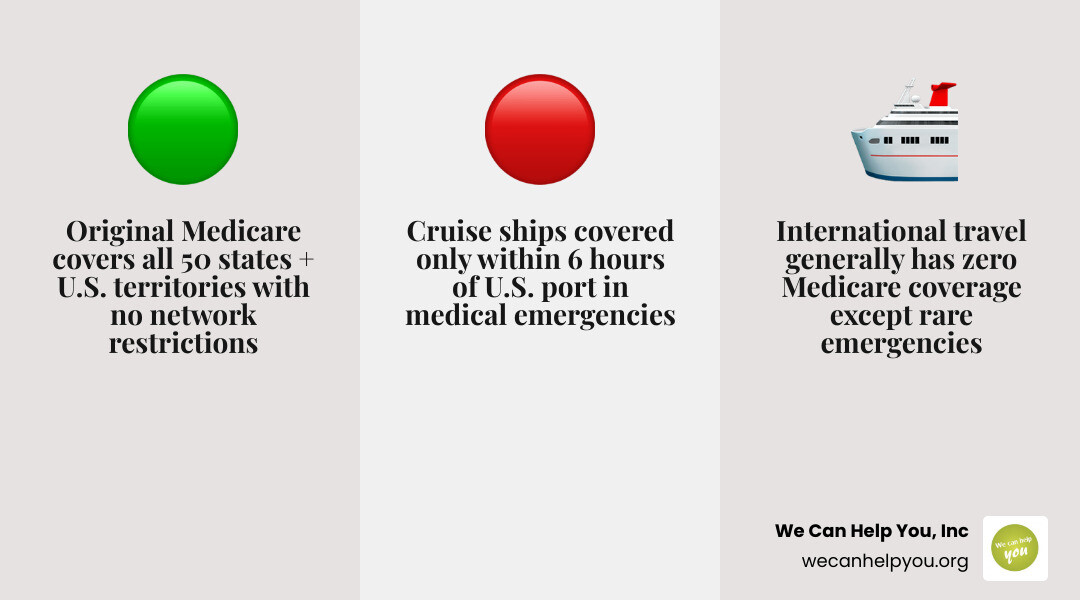
- Original Medicare (Parts A and B) covers you in all 50 states, Washington D.C., and U.S. territories with no restrictions
- Medicare Advantage plans must cover emergency and urgent care nationwide, but routine care may be limited to your service area
- Most plans allow 6 months outside your service area before disenrollment
International Travel:
- Medicare generally does not cover medical care outside the U.S.
- Three rare exceptions exist: emergencies when a foreign hospital is closer, travel between Alaska and another state through Canada, or cruise ships within 6 hours of a U.S. port
- Part D does not cover prescriptions purchased abroad
- Medigap plans C, D, F, G, M, and N cover 80% of foreign emergency care (after $250 deductible, up to $50,000 lifetime)
Getting sick or injured while traveling is stressful enough without facing unexpected medical bills. Many Medicare beneficiaries don’t realize their coverage changes the moment they cross state lines or international borders. A 5-day hospital stay in Florida can cost over $50,000, and if you’re traveling abroad without proper coverage, you could be responsible for 100% of those costs.
The rules are complex and vary significantly between Original Medicare, Medicare Advantage, and Medigap plans. Understanding these differences before you travel can save you thousands of dollars and prevent serious financial surprises.
This guide breaks down exactly what Medicare covers in every travel scenario, helps you identify gaps in your coverage, and shows you how to protect yourself whether you’re a snowbird spending winters in Arizona or planning an international vacation.
Understanding Medicare Coverage While Traveling Within the U.S.
When we talk about domestic travel, the peace of mind you enjoy depends largely on whether you have Original Medicare or a Medicare Advantage plan. For those of us using Original Medicare, the process is remarkably straightforward.
Original Medicare (Parts A and B) covers your hospital care and doctor visits in all 50 U.S. states, as well as Washington, D.C., Puerto Rico, the U.S. Virgin Islands, Guam, American Samoa, and the Northern Mariana Islands. One of the greatest benefits of Original Medicare is that there are no network restrictions. As long as the doctor or hospital accepts Medicare, you are covered. This is why many of our clients in locations like Chicago, IL, or Charlotte, NC, prefer Original Medicare if they plan to spend their retirement years road-tripping across the country.
| Coverage Feature | Original Medicare | Medicare Advantage (Part C) |
|---|---|---|
| Geographic Range | All 50 states & U.S. Territories | Limited to Plan Service Area |
| Provider Choice | Any provider accepting Medicare | Primarily In-Network Providers |
| Emergency Care | Covered Nationwide | Covered Nationwide |
| Urgent Care | Covered Nationwide | Covered Nationwide |
| Routine Care | Covered Nationwide | Often Out-of-Network (Higher Cost) |
| Prior Authorization | Rarely Required | Often Required for Out-of-Network |
For more detailed insights on how these plans differ during your trips, you can explore More info about Medicare coverage while traveling.
Medicare Coverage While Traveling and Medicare Advantage Restrictions
Medicare Advantage (Part C) plans operate differently. These plans are typically tied to a specific “service area,” which is usually the county or group of counties where you live. While these plans are required by law to cover emergency and urgent care anywhere in the U.S. without additional restrictions, routine care is a different story.
If you are visiting family in Phoenix, AZ, or vacationing in Virginia Beach, VA, and you need a non-emergency check-up, your Medicare Advantage plan may consider that “out-of-network.” This often results in higher out-of-pocket costs or a requirement for prior authorization.
We also need to highlight the “6-month rule.” Most Medicare Advantage plans will automatically disenroll you if you spend more than six consecutive months outside of your service area. This is a critical point for “snowbirds”—those of us who might live in Rochester, NY, during the summer but head to Florida for the winter. If you stay at your winter home for seven months, you could lose your Medicare Advantage coverage and be moved back to Original Medicare, potentially losing your drug coverage or being unable to find a new plan until the next enrollment period.
However, some plans offer “visitor” or “travel” benefits that allow you to stay outside the service area for up to 12 months while still receiving coverage for certain non-emergency services. Always check your specific Evidence of Coverage (EOC) before planning an extended stay.
Managing Routine Care and Prescriptions Domestically
Managing your health on the road involves more than just doctor visits; you also need to think about your medications. Medicare Part D plans (prescription drug coverage) generally use pharmacy networks. If you are traveling from your home in Newark, NJ, to visit a friend in Las Vegas, NV, you should check if your plan’s network includes national chains like CVS or Walgreens. This ensures you can pick up refills without paying full price.
Telehealth has also become a vital tool for medicare coverage while traveling. Many plans now offer 24/7 access to doctors via phone or video chat. This is perfect for minor issues that aren’t emergencies but can’t wait until you get home. It’s often cheaper and faster than finding a local urgent care clinic in an unfamiliar city.
For those of us who require specialist care, Medicare Advantage plans often require a referral from a Primary Care Physician (PCP). If you are spending several months in a new location, such as Albuquerque, NM, you may need to temporarily select a local PCP within your plan’s network to facilitate those referrals.
International Travel: Does Medicare Cover You Abroad?
The most important thing to remember about international travel is that Original Medicare generally stops at the water’s edge. Medicare Coverage Outside the United States is extremely limited, and in most cases, you will be responsible for 100% of the costs for healthcare services received abroad.

This general exclusion applies to all foreign countries. Whether you are exploring the streets of Rome or hiking in the Swiss Alps, Medicare will not pay for your hospital stay, doctor visits, or ambulance rides. This is why we always emphasize the importance of understanding Medicare and International Travel limitations before you book your flights.
Specific Exceptions for Foreign Coverage
While the general rule is “no coverage,” there are three very specific, rare exceptions where Original Medicare might pay for services in a foreign hospital:
- The “Closer Hospital” Rule: You are in the U.S. when a medical emergency occurs, and a foreign hospital is closer than the nearest U.S. hospital that can treat your condition.
- The Canada Transit Rule: Medicare will cover emergency services in Canada if you are traveling “without unreasonable delay” between Alaska and another U.S. state, and a Canadian hospital is closer than the nearest U.S. hospital.
- The Border Resident Rule: You live in the U.S. and a foreign hospital is closer to your home than the nearest U.S. hospital, regardless of whether it’s an emergency.
There is also the “6-hour rule” for cruise ships. Medicare may cover medically necessary services you receive on a cruise ship if the doctor is authorized to provide services on the ship and the ship is in a U.S. port or no more than six hours away from a U.S. port. If the ship is seven hours out at sea, you are on your own.
Limitations on Prescription Drugs and Dialysis
It is a common misconception that Medicare Part D will cover prescriptions if you lose your pills or run out while abroad. Unfortunately, Medicare drug plans cannot cover medications purchased outside the United States. You will have to pay 100% out-of-pocket at a foreign pharmacy.
However, there is a silver lining regarding vaccinations. Medicare Part D covers all vaccines recommended by the Advisory Committee on Immunization Practices (ACIP). This includes specific travel vaccines you might need before you leave, such as:
- Yellow fever
- Japanese encephalitis
- Chikungunya
Regarding dialysis, Medicare does not cover these treatments outside the U.S. unless they are part of a covered inpatient hospital stay under one of the three exceptions mentioned above. Routine dialysis while on vacation in a foreign country is not covered.
Medigap and Medicare Advantage: Global Protection
If you are a frequent international traveler, you likely need more protection than what Original Medicare provides. This is where supplemental insurance comes into play.
Medigap Benefits for Medicare Coverage While Traveling Abroad
Certain Medigap (Medicare Supplement) plans offer a “Foreign Travel Emergency” benefit. If you have Medigap Plan C, D, F, G, M, or N, your policy provides coverage for medically necessary emergency care that begins during the first 60 days of your trip.
Here is how the Medigap foreign travel benefit works:
- Deductible: You pay a $250 annual deductible first.
- Coinsurance: The plan covers 80% of the billed charges for emergency care.
- Lifetime Limit: There is a lifetime maximum benefit of $50,000.
This is a significant safety net. If you are in London and have a sudden medical emergency, your Medigap plan could save you tens of thousands of dollars. You can learn more about these specific plan benefits by visiting International Coverage on Medicare or reading about Medicare Coverage While on Vacation.
Medicare Advantage International Emergency Benefits
While Medicare Advantage (Part C) plans must follow the same basic rules as Original Medicare, many private insurers choose to offer “Worldwide Emergency” or “Worldwide Urgent Care” benefits as an extra perk.
These benefits vary wildly between plans. Some might have a $50,000 annual limit, while others might have a higher copay for foreign emergencies. It is vital to check your plan’s summary of benefits before you leave. Also, keep in mind that even if your Medicare Advantage plan covers the medical bill, it almost never covers “medical evacuation”—the cost of flying you back to the U.S. in a medically equipped plane, which can cost upwards of $100,000.
For those of us planning extensive International Travel, we often recommend purchasing a separate travel insurance policy to cover evacuation and repatriation costs that Medicare and Medigap leave behind.
Essential Steps for Filing Claims and Managing Costs
If you do receive care that Medicare covers while you are abroad, be prepared for some paperwork. Foreign hospitals are not required to file claims with Medicare. This means you will likely have to pay the bill upfront and then ask Medicare for reimbursement.
To get reimbursed, you must:
- Collect Itemized Bills: Ensure every service, from the aspirin to the X-ray, is listed separately.
- Get Doctor Signatures: The more documentation you have from the attending physician, the better.
- Complete Form CMS-1490S: This is the “Patient’s Request for Medical Payment.” You will need to submit this form along with your itemized bills and a letter explaining why you needed the care.
The financial stakes are high. Consider the real-world example of a traveler who faced a $50,000 bill for a 5-day hospital stay in Florida. If they had been an international traveler relying on a plan with limited reimbursement, they might have only received $5,000 back, leaving them with a $45,000 out-of-pocket debt.
Frequently Asked Questions about Medicare Coverage While Traveling
Does Medicare cover me on a cruise ship?
Only in very limited circumstances. Medicare may cover services if the ship is in a U.S. port or within six hours of a U.S. port. Once the ship is further out, or if it is docked in a foreign port like Cozumel or Nassau, Original Medicare will not provide coverage.
Can I use my Medicare Advantage plan in another state?
Yes, but primarily for emergency and urgent care. If you need routine care, such as a physical or a follow-up for a chronic condition, you will likely pay much higher out-of-network rates unless your plan has a specific “travel” benefit or a national network.
Does Medicare cover medical evacuation from a foreign country?
No. Original Medicare and most Medigap plans do not cover the cost of a medical flight back to the United States. This is a common gap that is best filled by a dedicated travel insurance policy.
Conclusion
Navigating medicare coverage while traveling doesn’t have to be a headache, but it does require proactive planning. Whether you are staying within the U.S. or heading overseas, knowing the boundaries of your plan is the best way to ensure your retirement travels remain joyful rather than stressful.
At We Can Help You, Inc., we are dedicated to helping you make sense of these complex rules. As a non-profit, our goal is to provide you with the education you need to maximize your retirement income and protect your health. We encourage you to take advantage of our free resources, including our comprehensive Medicare Planning Guide and our Social Security maximization report.
Before you head out on your next adventure, make sure your coverage is as ready for the trip as you are. Get your free Medicare Planning Guide today and travel with the confidence that you’re protected. Safe travels!