
Introduction: The Power of Waiting
Delayed Social Security credits are increases to your monthly Social Security benefit that you earn for each month you wait to claim benefits past your Full Retirement Age, up until age 70.
Key Facts About Delayed Retirement Credits:
- How much they increase your benefit: 8% per year (or two-thirds of 1% per month) for people born in 1943 or later
- When they start: The month you reach your Full Retirement Age (currently 67 for most people)
- When they stop: Age 70 – there’s no benefit to waiting past this age
- Maximum increase: 24% more per month if you delay from age 67 to 70
- Who gets them: Anyone who waits to claim Social Security past their Full Retirement Age
If you’re approaching retirement, you’ve probably heard conflicting advice about when to claim Social Security. Some experts say to wait as long as possible. Others warn that you might never break even. The truth? It depends on your situation.
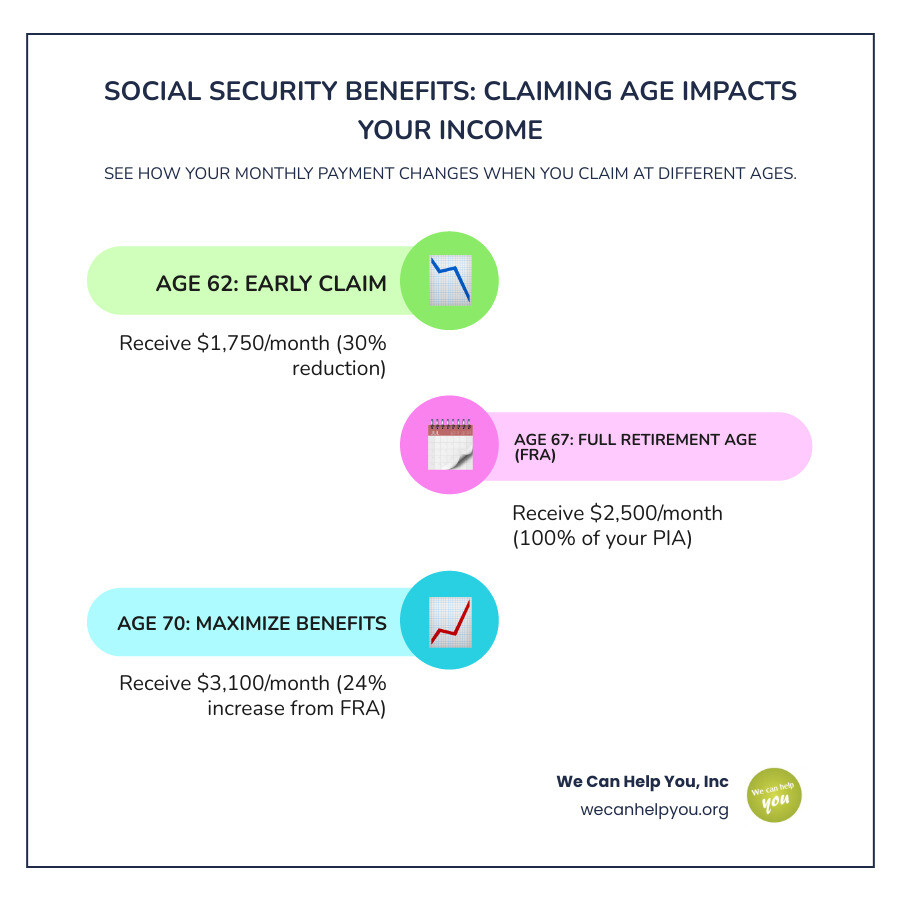
Here’s what you need to know: For every year you delay claiming Social Security past your Full Retirement Age, the government increases your monthly check by 8%. That means someone reaching Full Retirement Age at 67 who waits until 70 will receive 24% more every month for the rest of their life.
But this decision isn’t just about math. It’s about your health, your savings, your spouse’s situation, and your confidence in the system’s future. In December 2022, 64% of retired workers claimed benefits before their Full Retirement Age – many at age 62, the earliest possible age. Only 10% waited until age 70.
This guide will help you understand exactly how delayed retirement credits work, when delaying makes sense, and when it doesn’t. We’ll show you the numbers, explain the tradeoffs, and give you the tools to make the right choice for your retirement.
Understanding How Delayed Social Security Credits Boost Your Income
When it comes to your Social Security benefits, patience truly can be a virtue – a highly compensated one, at that! The Social Security Administration (SSA) offers a powerful incentive for those who delay claiming their retirement benefits past their Full Retirement Age (FRA): Delayed Social Security credits. These aren’t just a minor perk; they’re a significant boost designed to provide a larger monthly income for the rest of your life.

Think of it like this: the longer you wait (up to a point), the more your monthly benefit grows. This growth isn’t just a one-time adjustment; it’s a compounding effect that can lead to substantially higher payments over your retirement years. For many, this could mean the difference between a comfortable retirement and one where every dollar is stretched thin.
What Are Delayed Retirement Credits and How Do They Work?
Delayed retirement credits are essentially a financial reward from Social Security for postponing your retirement benefit claim. Once you reach your Full Retirement Age (FRA), which varies depending on your birth year, you become eligible to start receiving your full, unreduced Social Security benefit. However, if you choose to wait, the Social Security Administration automatically increases your eventual monthly benefit.
How much does it increase? For individuals born in 1943 or later, your monthly benefit increases by two-thirds of 1 percent for each month you delay. This adds up to a substantial 8 percent for every full year you wait past your FRA. This means if your FRA is 67, and you delay claiming until age 70, you’ll see a 24 percent increase tacked onto your monthly payment. This is a powerful, guaranteed return on your decision to wait, making it an attractive option for many.
The mechanics are straightforward: for every month you are eligible for benefits but do not receive them (either because you haven’t filed an application or you’ve voluntarily suspended your benefits), you earn a credit. These credits are then applied to your benefit amount, making your future checks larger. The Social Security Administration provides detailed information on delayed retirement credits.
The Earning Window: When Credits Start and Stop
Understanding the timeline for earning Delayed Social Security credits is crucial. The clock for these credits starts ticking the month you reach your Full Retirement Age (FRA). Your FRA is determined by your birth year: for those born between 1943 and 1954, it’s 66. For those born in 1960 or later, it’s 67. If you were born between 1955 and 1959, your FRA is somewhere between 66 and 67.
Once you hit your FRA, every month you delay claiming your benefits (up until age 70) is considered an “increment month” for which you earn credits. This means you have a specific window of time – from your FRA up to your 70th birthday – to accrue these valuable increases.
It’s vital to remember that these credits stop accumulating once you reach age 70. There is no further increase to your monthly benefit for waiting beyond your 70th birthday. So, while delaying can be highly beneficial, waiting indefinitely won’t yield additional rewards. We offer more information about Social Security to help you steer these important decisions.
Calculating the Value of Your Delayed Social Security Credits
The exact percentage increase you receive for delaying your Social Security benefits depends on your birth year. While everyone born in 1943 or later receives an 8% annual increase (or 2/3 of 1% per month), the rates were slightly different for earlier birth years. This is part of the historical evolution of the Social Security program.
Here’s a table illustrating the yearly rate of increase for Delayed Social Security credits based on your birth year:
| Birth Year | Monthly Rate of Increase | Yearly Rate of Increase |
|---|---|---|
| 1933-1934 | 11/24 of 1% | 5.5% |
| 1935-1936 | 1/2 of 1% | 6.0% |
| 1937-1938 | 13/24 of 1% | 6.5% |
| 1939-1940 | 7/12 of 1% | 7.0% |
| 1941-1942 | 5/8 of 1% | 7.5% |
| 1943 or later | 2/3 of 1% | 8.0% |
To calculate how much your benefit will increase, you’ll need to know your Primary Insurance Amount (PIA). Your PIA is the benefit you would receive if you started claiming at your Full Retirement Age. Let’s consider an example:
Imagine you were born in 1960, making your Full Retirement Age 67. Let’s say your PIA is $2,000 per month. If you decide to delay claiming until age 70, you would have delayed for 36 months (3 years).
- Monthly increase rate: 2/3 of 1% = 0.00667
- Total percentage increase: 36 months * 0.00667 = 0.24 (or 24%)
- Increased monthly benefit: $2,000 * 1.24 = $2,480
So, by delaying for three years, your monthly benefit would increase from $2,000 to $2,480 – an extra $480 each month for the rest of your life! It’s a significant bump that can make a real difference in your retirement income. We encourage you to explore our guide on Don’t Guess, Calculate: A Guide To Your Future Social Security Payments for more detailed insights into planning your Social Security.
It’s also worth noting that if you retire before age 70, some of your delayed retirement credits might not be applied until the January after you start receiving benefits. However, if you wait until you turn 70, all your credits are applied right from your very first payment.
The Pros and Cons of Delaying Your Benefits
Deciding when to claim Social Security is one of the most significant financial choices you’ll make for retirement. While the allure of Delayed Social Security credits and a larger monthly check is strong, it’s not a one-size-fits-all solution. There are compelling arguments for waiting, but also scenarios where it might not be the best path for you.

This decision often comes down to balancing the guaranteed increase in lifetime benefits against your immediate financial needs, health outlook, and overall retirement strategy.
Key Advantages of Waiting
The primary advantage of delaying your Social Security benefits is straightforward: a significantly higher monthly payment for the rest of your life. This isn’t just a minor adjustment; it’s a permanent increase that compounds over time.
- Higher Monthly Benefit for Life: As we’ve discussed, delaying from your Full Retirement Age (FRA) to age 70 can result in a 24% (for those born in 1943 or later) or more increase in your monthly check. This larger guaranteed income stream acts as a powerful form of longevity insurance, protecting you against outliving your other savings. The Social Security Administration’s 2023 actuarial life table for a 62-year-old female is 84 years, and 81 years for a 62-year-old male. If you live a long life, these higher payments truly add up. For example, if you live to age 90, delaying benefits could result in tens of thousands of dollars more in total income.
- Increased Survivor Benefits: This is a huge, often overlooked, benefit for married couples. If you are the higher-earning spouse and you delay your benefits, you are also increasing the potential survivor benefit for your spouse. Should you pass away first, your surviving spouse will receive 100% of your increased benefit amount. This provides crucial financial security for the surviving partner.
- Inflation Protection (COLA on a Larger Base): Social Security benefits are adjusted annually for inflation through Cost-of-Living Adjustments (COLAs). When you delay and start with a higher base amount, each COLA increase will be applied to that larger figure, further amplifying your purchasing power over time.
- Tax Diversification Strategy: Delaying Social Security can be a smart tax move. If you have substantial pre-tax retirement accounts (like 401(k)s or traditional IRAs), you might consider drawing from those accounts in your earlier retirement years (e.g., from FRA to age 70) while your Social Security benefits grow. This strategy can help you manage your taxable income, potentially reduce your Required Minimum Distributions (RMDs) later on, and defer taxes on your Social Security income, as only 85% of Social Security benefits are taxable even at the highest income levels.
When Delaying Might Not Be the Best Choice
While the benefits of delaying can be substantial, it’s not always the optimal strategy. Several individual circumstances might make claiming benefits earlier a more sensible financial decision.
- Immediate Income Needs: Perhaps the most common reason people claim early is a pressing need for income. If you’ve lost your job, have unexpected expenses, or simply need the funds to cover your daily living costs, waiting might not be feasible. In December 2022, 64% of all retired workers receiving Social Security benefits had chosen to begin receiving benefits before their Full Retirement Age, with 27% choosing the earliest possible age of 62. This statistic suggests that for many, liquidity constraints outweigh the long-term benefit growth.
- Shorter Life Expectancy: This is a crucial, albeit sensitive, consideration. If you have significant health issues or a family history of shorter lifespans, the “breakeven point” for delaying benefits might be beyond your expected lifetime. The breakeven point is when the larger monthly payments from delaying eventually make up for the payments you missed by waiting. This often takes 12 to 14 years after your Full Retirement Age. If you don’t anticipate living past that point, claiming earlier might result in more total lifetime benefits. For instance, with a 4% real return, a person has to live to 89 for it to be beneficial to delay the start of benefits from age 67 to 70. However, 77% of 67-year-old males and 65% of 67-year-old females die before age 89.
- Spousal Benefit Strategies: While delaying can boost survivor benefits, it doesn’t always increase spousal benefits. Spousal benefits are generally capped at 50% of the primary worker’s Primary Insurance Amount (PIA) at their FRA, not including any Delayed Social Security credits. If your spouse is much younger or has a significantly lower earning history, a complex claiming strategy might involve one spouse claiming earlier while the other delays, or claiming spousal benefits while deferring your own.
- Concerns About Social Security’s Future: Some individuals worry about the long-term solvency of the Social Security program. While it’s important to note that Social Security has never missed a payment and is projected to be able to pay a significant portion of benefits even if no changes are made, this concern can influence claiming decisions. According to a 2022 SSA report, the Social Security trust fund reserves are projected to run out by 2035 without changes, potentially reducing benefits to about 80% of what is scheduled. This uncertainty leads some to prefer taking benefits sooner rather than later.
- Specific Scenarios Where Claiming Early May Be Better:
- Poor Health: If you are in poor health and do not expect to live beyond your mid-70s or early 80s, you might receive more total lifetime benefits by claiming earlier.
- Need Funds to Pay Off High-Interest Debt: If you have high-interest debt (like credit card debt), using earlier Social Security payments to eliminate this debt could provide a better financial return than waiting for Delayed Social Security credits.
- Investment Opportunities: For some, the 8% annual increase from delaying is seen as a guaranteed return. However, if you have the discipline and expertise to invest your Social Security payments and earn a higher real rate of return elsewhere (e.g., in a diversified portfolio), claiming earlier and investing might be considered. This perspective challenges the idea that the 8% increase is a “true” rate of return, arguing it’s a benefit of not taking payments rather than an investment return.
- Earnings Test: If you claim benefits before your Full Retirement Age and continue to work, your benefits may be reduced if your earnings exceed certain limits. For 2023, you lose $1 in benefits for every $2 earned above $21,240. This penalty can incentivize delaying until at least FRA, but not necessarily until age 70.
How Delaying Interacts with Other Benefits and Programs
The decision to delay your Social Security benefits doesn’t exist in a vacuum; it interacts with other crucial aspects of your retirement, particularly Medicare enrollment and benefits for your family members. Understanding these interdependencies is key to making a holistic and informed choice.
The Crucial Medicare Connection
One of the most critical aspects to coordinate when considering Delayed Social Security credits is your Medicare enrollment. While you can delay Social Security benefits until age 70, Medicare eligibility typically begins at age 65.
It is absolutely crucial to sign up for Medicare at age 65, even if you are delaying your Social Security benefits. Why? Because delaying Medicare enrollment can lead to significant penalties and gaps in coverage:
- Initial Enrollment Period (IEP): Your Initial Enrollment Period for Medicare is a seven-month window: three months before your 65th birthday, the month of your 65th birthday, and three months after your 65th birthday.
- Late Enrollment Penalties: If you don’t enroll in Medicare Part B (medical insurance) or Part D (prescription drug coverage) during your IEP, and you don’t have other creditable coverage (like through an employer), you could face permanent late enrollment penalties. These penalties mean higher premiums for the rest of your life.
- Coverage Gaps: Delaying Medicare could also leave you without essential health coverage, potentially leading to substantial out-of-pocket medical expenses.
So, even if you’re holding out for those higher Social Security checks, make sure your Medicare ducks are in a row by age 65. We Can Help You, Inc. offers resources to guide you through this process, including a free Medicare Planning Guide to help you steer these important decisions.
The Impact of Delayed Social Security Credits on Spousal and Survivor Benefits
The decision to delay your benefits can have a ripple effect on your family members, particularly your spouse and potential survivors.
- Spousal Benefits: If you delay your own retirement benefits, the amount your spouse can claim based on your work record (known as spousal benefits) generally does not increase due to your Delayed Social Security credits. Spousal benefits are typically capped at 50% of your Primary Insurance Amount (PIA) at your Full Retirement Age, regardless of how long you delay your own claim. This is an important distinction, as many people mistakenly believe their spouse’s benefit will also grow.
- Survivor Benefits: This is where delaying can have a profound positive impact. If you are the higher-earning spouse and you delay your benefits until age 70, your increased benefit amount will become the basis for your surviving spouse’s benefit. Should you pass away first, your surviving spouse will receive your higher, delayed benefit amount for the rest of their life. This can provide invaluable financial security. The Social Security Administration’s regulations confirm that DRCs increase the benefit amount for a surviving spouse or surviving divorced spouse, effective from the month of your death.
- Family Maximum Benefits: While your individual benefit increases with DRCs, there’s a limit to the total amount of benefits that can be paid to a family on one worker’s record. This is called the family maximum benefit. DRCs are generally added to your benefit after the family maximum is computed. However, for a surviving spouse’s benefit, DRCs are added before reduction for the family maximum, further emphasizing the benefit for survivors.
Understanding these nuances is crucial for couples planning their retirement. Strategies often involve the higher earner delaying their benefits to maximize the survivor benefit, while the lower earner might claim earlier. For more insights, explore our resources on Social Security Benefits.
Frequently Asked Questions about Delayed Credits
We know that understanding Delayed Social Security credits can bring up a lot of questions. Here are some of the most common ones we hear, with straightforward answers to help clarify your options.
Can I start benefits and then stop them to earn delayed credits?
Yes, this is a strategy known as “voluntary suspension of benefits.” If you’ve already started receiving your Social Security retirement benefits, but you’re between your Full Retirement Age (FRA) and age 70, you can request that the Social Security Administration suspend your benefits. While your benefits are suspended, you will earn Delayed Social Security credits for each month you go without receiving payments, just as if you had never filed.
This can be a great option if your financial situation improves after you initially claimed benefits, or if you decide you want to maximize your future monthly payments. When you restart your benefits (which you can do at any time, or they will automatically restart at age 70), they will be permanently higher, reflecting the credits you earned during the suspension period. However, be aware that during the suspension, anyone receiving benefits based on your record (like a spouse, with some exceptions for divorced spouses) will also have their benefits suspended.
How do I know what my benefit will be at different ages?
The Social Security Administration (SSA) provides excellent tools to help you estimate your future benefits based on different claiming ages, including the impact of Delayed Social Security credits.
my Social SecurityAccount: We highly recommend creating a secure my Social Security account online. This personalized account allows you to view your earnings record, get estimates of your future benefits at age 62, Full Retirement Age, and age 70, and even apply for benefits when you’re ready. It’s the most accurate way to see your specific numbers.- SSA’s Online Calculators: The SSA also offers various online calculators that can help you understand how early or delayed retirement affects your benefits. These tools are fantastic for running different scenarios and seeing the potential impact of your claiming decision.
These resources allow you to compute the effect of early or delayed retirement as a percentage of your primary insurance amount, giving you a clear picture of your potential income.
Do I have to do anything to get these credits?
No, you generally do not have to do anything proactive to “apply” for Delayed Social Security credits. The credits are applied automatically by the Social Security Administration for each month you delay claiming benefits past your Full Retirement Age (FRA) up until age 70.
The key action on your part is simply not claiming your benefits during this period. When you eventually apply for your Social Security retirement benefits, the SSA will review your record, determine how many months you delayed past your FRA, and automatically calculate and include the appropriate credits in your monthly payment.
So, while you don’t need to fill out a special form for the credits themselves, you do need to make the conscious decision to defer your benefit application until your chosen age.
Making the Right Decision for Your Retirement
Deciding when to claim your Social Security benefits, and whether to leverage Delayed Social Security credits, is a highly personal decision. There’s no universal “best age” because what’s optimal for one person might be detrimental to another. Your choice should align with your unique personal financial plan, health outlook, life expectancy, and risk tolerance.
We’ve seen that delaying benefits can lead to a significantly higher monthly income for life, offering robust longevity insurance and potentially boosting survivor benefits. For those who can afford to wait, this guaranteed increase can be a cornerstone of a secure retirement. However, we’ve also explored scenarios where claiming earlier might be more advantageous, such as immediate income needs, a shorter expected lifespan, or specific spousal benefit strategies.
The journey to an informed decision involves:
- Assessing Your Health and Longevity: Honestly evaluate your health, family history, and personal expectations for how long you might live.
- Analyzing Your Financial Needs: Determine whether you have sufficient savings and other income sources to cover your expenses if you delay Social Security.
- Considering Your Spouse’s Situation: Plan together to maximize combined lifetime benefits and ensure survivor protection.
- Using Available Tools: Take advantage of the SSA’s online calculators and your
my Social Securityaccount to model different claiming ages.
At We Can Help You, Inc., we are dedicated to educating individuals on Medicare and Social Security for retirement. We understand the complexities involved and believe in empowering you with the knowledge to make the best choices. That’s why we offer a free Medicare Planning Guide and a free Social Security maximization report to help you increase your retirement income. Don’t leave your retirement security to chance.
For personalized guidance on navigating your Social Security options and to see how Delayed Social Security credits could impact your future, consider reaching out to a financial professional. You can also explore options to get help from local Medicare insurance agents who can assist with coordinating your benefits for a comprehensive retirement plan. We’re here to help you open up more money and achieve the retirement you deserve.