
Why Medicare Enrollment in Illinois Matters More Than You Think
Medicare enrollment Illinois can feel overwhelming, but it doesn’t have to be. With over 2.4 million Illinois residents—nearly 18% of the state’s population—enrolled in Medicare, understanding your options is crucial to avoid costly penalties and coverage gaps.
Quick Answer: How to Enroll in Medicare in Illinois
- Check Eligibility: You qualify at 65, or earlier with a qualifying disability (after 24 months of SSDI), ESRD, or ALS.
- Know Your Window: Your 7-month Initial Enrollment Period is centered around your 65th birthday.
- Apply: Enroll online through Social Security, call 1-800-772-1213, or visit a local office.
- Choose Your Path: Select Original Medicare (Parts A & B), or add a Medicare Advantage or Medigap plan.
- Meet Deadlines: Missing your initial window can cause lifelong penalties and delayed coverage.
Missing your enrollment window has real costs. Delaying Part B enrollment can trigger a lifelong 10% penalty for each year you wait. You’ll also face a coverage gap, as you can only sign up during the General Enrollment Period (Jan. 1 – Mar. 31) for coverage starting July 1.
Illinois offers unique advantages, including a long-standing rule requiring Medigap insurers to cover beneficiaries under 65 with disabilities. With about 43% of Illinois beneficiaries choosing Medicare Advantage plans, you have plenty of options.
This guide walks you through everything you need to know about enrolling in Medicare in Illinois, from eligibility and deadlines to choosing the right coverage and avoiding common pitfalls.
Understanding Your Medicare Eligibility in Illinois
Medicare is the federal health insurance program for millions of Americans. In Illinois, where nearly 2.4 million people are enrolled, eligibility typically begins at age 65. However, you may qualify earlier due to certain disabilities or medical conditions.
Here’s a closer look at the eligibility requirements:
- Age 65 or Older: You must be a U.S. citizen or a legal resident who has lived in the U.S. for at least five continuous years.
- Disability (Under 65): You are eligible if you’ve received Social Security Disability Insurance (SSDI) for 24 months. About 10% of Illinois’s Medicare beneficiaries (232,000 people) qualify this way.
- Specific Diseases: You can qualify at any age if you have End-Stage Renal Disease (ESRD) or Amyotrophic Lateral Sclerosis (ALS), often without a waiting period.
Understanding your eligibility is the first step in Medicare enrollment Illinois. For more details on Medicare basics, visit our page: More info about Medicare.
Who Qualifies for Premium-Free Part A?
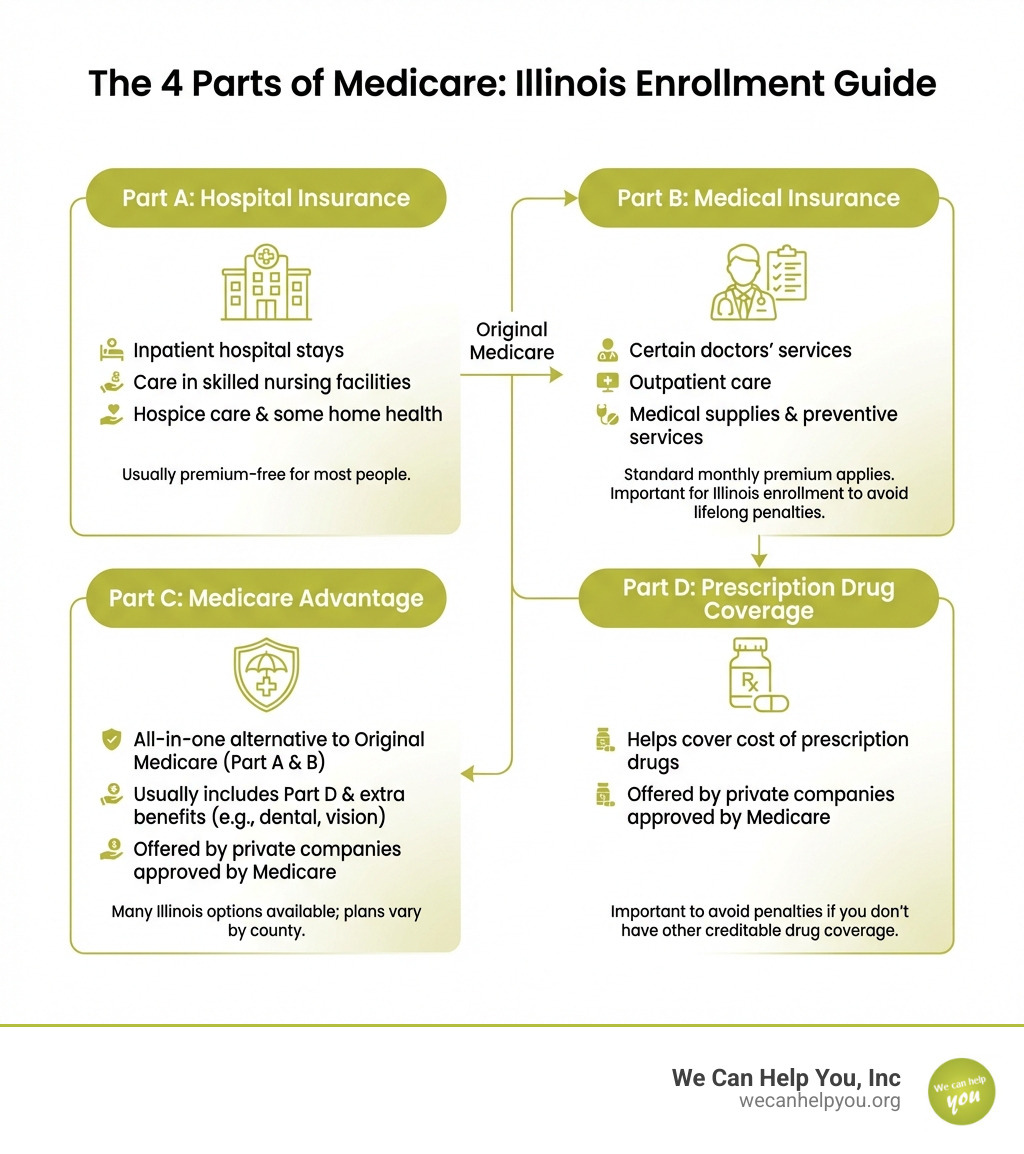
Medicare Part A (Hospital Insurance) is often premium-free. You typically qualify if you or your spouse worked and paid Medicare taxes for at least 10 years (40 quarters). If you’re already receiving Social Security or Railroad Retirement Board (RRB) benefits four months before turning 65, you’ll likely be enrolled in Part A and B automatically.
If you don’t have enough work credits, you can still purchase Part A, though it will have a monthly premium. If you need to prove you are ineligible for premium-free Part A (for instance, to coordinate other benefits), you must get a written statement from the Social Security Administration. For a comprehensive overview of Medicare, refer to: What is Medicare?.
How to Apply for Original Medicare (Parts A & B)
Applying for Original Medicare is a critical step. The process depends on your situation:
- Automatic Enrollment: If you’re already getting Social Security or RRB benefits at least four months before your 65th birthday, you’ll be automatically enrolled in Parts A and B. Your Medicare card should arrive about three months before your 65th birthday or your 25th month of disability.
- Manual Enrollment: If not automatically enrolled, you must apply. The easiest way is to Apply online for Medicare. You can also call the Social Security Administration at 1-800-772-1213 or visit a local office.
- Coordinating with Employer Coverage: If you’re still working past 65 with employer health insurance, you might be able to delay Part B enrollment without penalty. This generally applies if your employer has 20 or more employees. If the employer is smaller, you will likely need to enroll in Part B to avoid coverage gaps. For detailed guidance, read: Working Past 65: Do You Need Medicare Part B?.
Certain Illinois residents, like state retirees, may need to take additional steps to coordinate their benefits with the state. It’s always best to confirm specific requirements with your benefits administrator.
Key Medicare Enrollment Periods You Can’t Miss
Missing Medicare’s enrollment windows can lead to delayed coverage, gaps in care, and lifelong late enrollment penalties. These specific timeframes dictate when you can join, switch, or drop plans, making them essential for a seamless Medicare enrollment Illinois.
If you’re concerned about penalties, learn more here: Medicare Late Enrollment Penalties.
Initial Enrollment Period (IEP)
Your IEP is your first chance to sign up for Medicare. This 7-month window begins three months before your 65th birthday month, includes your birthday month, and ends three months after. For example, a May birthday means an IEP from February 1st to August 31st. Enrolling in the first three months ensures your coverage starts on time, helping you avoid penalties. To learn more about timing your enrollment, check out: When Do You Need to Enroll in Medicare?.
General Enrollment Period (GEP) & Special Enrollment Periods (SEP)
If you miss your IEP, you can sign up during the General Enrollment Period (GEP) from January 1st to March 31st each year. However, your coverage won’t start until July 1st, and you may face a lifelong Part B late enrollment penalty. This penalty increases your premium by 10% for each full year you were eligible but didn’t enroll.
Special Enrollment Periods (SEP) allow you to enroll outside standard windows due to specific life events, such as losing employer coverage, moving, or qualifying for Medicaid or Extra Help. These events typically give you an 8-month SEP to enroll in Part B without penalty. For more information, visit: Medicare Special Election Periods.
Annual Enrollment Period (AEP) for Plan Changes
The Annual Enrollment Period (AEP), from October 15th to December 7th, is your yearly chance to review and change your coverage. During AEP, you can:
- Switch between Original Medicare and Medicare Advantage.
- Change your Medicare Advantage plan.
- Join, drop, or switch a Medicare Part D prescription drug plan.
Changes made during AEP take effect on January 1st. Before AEP, you’ll receive an Annual Notice of Change (ANOC) from your current plan detailing upcoming changes to costs and benefits. Reviewing it is crucial to ensure your plan still fits your needs. For helpful advice, see our Tips for the Medicare Annual Enrollment Period.
Your Guide to Medicare Enrollment in Illinois: Choosing Your Path
After determining when to enroll, your next step in the Medicare enrollment Illinois journey is choosing a coverage path. In Illinois, you have two main options: Original Medicare or a private Medicare Advantage plan. With about 43% of Illinois beneficiaries choosing private plans, it’s clear many residents prefer these integrated options.

To understand the differences, explore our guide: Medicare Advantage vs Medigap.
Option 1: Original Medicare + Additional Coverage Through We Can Help You, Inc.
Original Medicare, run by the federal government, includes Part A (Hospital Insurance) and Part B (Medical Insurance). While it covers many essential services, it leaves gaps like deductibles, 20% coinsurance for most Part B services, and no coverage for most prescriptions, dental, or vision.
To fill these gaps, you can add supplemental coverage:
- Part D Plan: A stand-alone prescription drug plan. In 2025, Illinois residents have 17 plans to choose from.
- Medigap Plan: A Medicare Supplement plan helps pay for out-of-pocket costs like deductibles and coinsurance. Learn more here: More on Medigap.
Option 2: Medicare Advantage (Part C) Plans Offered by We Can Help You, Inc.
Medicare Advantage (Part C) plans are an alternative offered by private insurers. They bundle Part A, Part B, and usually Part D into one plan. They must cover everything Original Medicare does but often include extra benefits like dental, vision, hearing, and fitness programs. Many have low or $0 monthly premiums (beyond your Part B premium).
However, most MA plans have provider networks (HMOs or PPOs), which means you may need to use specific doctors and hospitals to keep costs down. The growing popularity of these plans in Illinois reflects their comprehensive nature. You can Review and sign up for Medicare Advantage and drug plans and find more details here: More on Medicare Advantage.
Navigating Medigap Enrollment in Illinois
Medigap plans are standardized to help cover Original Medicare’s out-of-pocket costs. While a Plan G from one company has the same benefits as a Plan G from another, premiums can differ among the 49 insurers in Illinois.
- Medigap Open Enrollment: The best time to buy a policy is during your 6-month Medigap Open Enrollment Period, which starts when your Part B coverage begins at age 65 or older. During this window, you have guaranteed issue rights, meaning insurers can’t deny you for health reasons.
- Illinois Protections: Illinois offers unique Medigap rules:
- “Birthday Rule”: Enrollees aged 65-75 have a 45-day window starting on their birthday to switch to a Medigap plan with equal or lesser benefits without medical underwriting.
- Under-65 Coverage: Illinois has long required insurers to offer Medigap plans to Medicare beneficiaries under 65 with disabilities, a protection not available in many states.
Standardized Medigap plans include A, B, D, G, K, L, M, and N (Plans C and F are unavailable to new enrollees). You cannot have a Medigap plan and a Medicare Advantage plan at the same time.
Illinois-Specific Resources and Financial Assistance
Illinois offers several state-specific resources and financial aid programs to help residents steer Medicare.
- Illinois Department of Insurance (IDOI): Regulates insurance companies and assists consumers with complaints and plan information.
- Senior Health Insurance Program (SHIP): Provides free, unbiased counseling to Medicare beneficiaries and their families to help compare plans and answer questions.
- Programs for State Retirees: Illinois state retirees have specific requirements related to the TRAIL Medicare Advantage Prescription Drug (MAPD) program. It’s crucial for these individuals to enroll in Medicare Part B and elect a TRAIL plan to maintain state benefits.
For general information, refer to: Enrolling in Medicare in Illinois.
Financial Help with Medicare Costs
Several programs can help manage Medicare expenses for those with limited income and resources.
- Medicare Savings Programs (MSPs): State programs that help pay for Part A and/or Part B premiums, deductibles, and coinsurance.
- Extra Help (LIS): The Low-Income Subsidy helps with the costs of Medicare Part D prescription drug plans.
- Illinois Medicaid: Individuals who qualify for both Medicare and Medicaid (“dual-eligibles”) can receive significant financial assistance through the HealthChoice Illinois program. Medicaid can cover Medicare premiums and other costs not covered by Medicare. Learn more about applying here: Apply for Illinois Medicaid.
For a broader understanding of expenses, visit: Medicare Costs.
Where to Find Local Help
You don’t have to steer Medicare alone. Key resources in Illinois include:
- Illinois Department on Aging: Offers resources and services for older adults.
- Senior Health Insurance Program (SHIP): An excellent first stop for free, personalized advice.
- Social Security Administration (SSA): Your primary contact for enrolling in Original Medicare (1-800-772-1213).
- We Can Help You, Inc.: As a non-profit, we provide educational resources like a free Medicare Planning Guide and a Social Security maximization report.
- Local Medicare Insurance Agents: For personalized assistance, our licensed agents can help you compare plans and enroll. Find Medicare Insurance Agents in IL.
Frequently Asked Questions about Medicare Enrollment in Illinois
Here are answers to common questions about Medicare enrollment Illinois.
What happens if I don’t enroll in Medicare Part B when I’m first eligible?
If you delay Part B enrollment without having other creditable coverage (like from a current employer), you face two main consequences:
- A gap in coverage: You must wait for the General Enrollment Period (Jan. 1 – Mar. 31) to sign up, with coverage not starting until July 1.
- A lifelong late enrollment penalty: Your monthly Part B premium will permanently increase by 10% for each full 12-month period you could have had Part B but didn’t.
You can avoid this penalty if you have qualifying health coverage, such as from your or your spouse’s current job.
Can I get Medicare in Illinois if I’m under 65?
Yes. While most people qualify at 65, you can get Medicare at a younger age if you:
- Have received Social Security Disability Insurance (SSDI) for 24 months.
- Have End-Stage Renal Disease (ESRD) or Amyotrophic Lateral Sclerosis (ALS).
In Illinois, about 10% of Medicare beneficiaries (around 232,000 people) are under 65.
How does Medicare coordinate with my employer health plan in Illinois?
How Medicare works with your job-based insurance depends on your employer’s size.
- Large Employers (20+ employees): Your employer’s plan is the primary payer, and Medicare is secondary. You can often delay Part B enrollment without penalty.
- Small Employers (fewer than 20 employees): Medicare is the primary payer. You should enroll in Part B when first eligible to avoid coverage gaps and penalties.
Always talk to your HR department before making any decisions about delaying Medicare. For more details on how Medicare works with other insurance, see the official Medicare handbook.
Conclusion
Navigating Medicare enrollment Illinois is manageable with the right information. Remember to enroll on time to avoid penalties, understand your choices between Original Medicare and Medicare Advantage, and take advantage of Illinois’s unique protections like the Medigap “birthday rule.”
Your healthcare needs can change, so review your options annually during the Annual Enrollment Period (October 15 – December 7). Financial assistance programs and local resources like SHIP are available to help.
While Medicare can be complex, you don’t have to do it alone. We Can Help You, Inc. is a non-profit dedicated to providing educational resources, including a free Medicare Planning Guide, to empower your decisions. For personalized guidance, find a local expert to walk you through your Medicare insurance options in Illinois.