
Understanding the Medicare Part B Premium Giveback
The Medicare Part B premium giveback is a benefit offered by some Medicare Advantage plans that reduces the amount you pay for your Medicare Part B premium each month. Instead of paying the full standard premium (which is $185 per month in 2025), the insurance company pays part or all of it for you. This isn’t a separate check—it appears as a smaller deduction from your Social Security check or a reduced bill if you pay Medicare directly.
Quick Answer: What You Need to Know
- What it is: A premium reduction offered by certain Medicare Advantage plans
- How much you save: Anywhere from 10 cents to the full $185 monthly premium
- Who qualifies: You must be enrolled in Medicare Parts A and B, pay your own premium, and choose a plan that offers this benefit
- How you receive it: Through a reduced Social Security deduction or lower direct bill
- Availability: About one-third of Medicare Advantage plans offer this benefit in 2025
If you’re nearing retirement and feeling overwhelmed by Medicare choices, you’re not alone. Many people worry about missing out on benefits that could save them hundreds of dollars each year. The Part B premium giveback is one of those benefits—but it comes with important considerations.
During the annual Medicare open enrollment period, you’ll likely see commercials advertising a “giveback” or “premium reduction” that promises to put money back in your pocket. While this benefit is real and can provide meaningful savings, it’s crucial to understand how it works and whether it’s truly the best option for your specific healthcare needs.
In 2025, almost one-third of Medicare Advantage plans offer some form of Part B premium reduction, up from just 19% in 2024. The amount varies significantly—from less than $10 per month to more than $100 per month, depending on the plan and your location.
This guide will walk you through everything you need to know about the Medicare Part B premium giveback, from how it’s funded to how to find plans that offer it. Most importantly, we’ll help you understand why the size of the giveback shouldn’t be your only consideration when choosing a Medicare plan.
What Is the Part B Giveback and How Does It Work?
The Medicare Part B premium giveback benefit, sometimes called a Part B premium reduction or Social Security giveback, is a fantastic way for some Medicare beneficiaries to save money on their monthly healthcare costs. But what exactly is it, and how does this magic happen? Let’s break it down.
Essentially, the giveback is a benefit offered by certain Medicare Advantage (Part C) plans. These are health plans offered by private insurance companies that Medicare approves. Unlike Original Medicare (Parts A and B), Medicare Advantage plans often bundle your Part A and Part B coverage, and sometimes Part D (prescription drug coverage), along with additional benefits like dental, vision, and hearing. The Medicare Part B premium giveback is one of these additional benefits.
This isn’t a direct payment or a check you receive in the mail. Instead, it’s a reduction in the amount you pay for your monthly Medicare Part B premium. So, if your standard Part B premium is, say, $185 per month in 2025, a plan offering a $25 giveback means you’d only effectively pay $160 for your Part B premium that month. It’s a clever way to keep more money in your pocket!
How the “Giveback” is Funded
You might be wondering how private insurance companies can afford to pay part of your Part B premium. It’s a good question with an interesting answer rooted in how Medicare Advantage plans are structured.
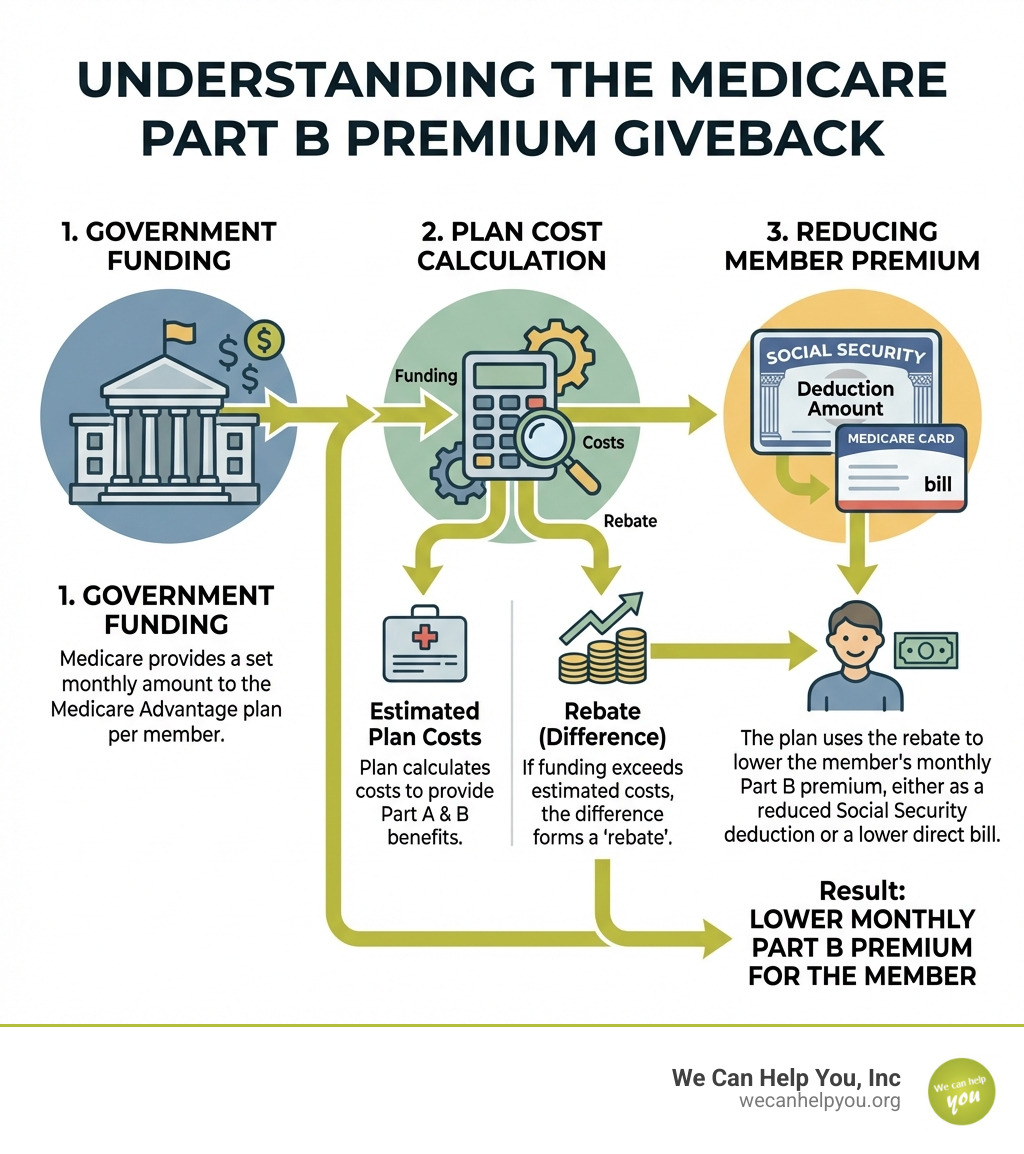
Medicare provides private insurers with a specific amount of funding, known as the bid, for each Medicare Advantage member. Think of it as Medicare saying, “Here’s what we estimate it costs to cover this beneficiary.” Insurance companies then “bid” for a specific figure to provide care for their members.
If a Medicare Advantage plan can provide comprehensive medical care for its members at a cost that is less than Medicare’s benchmark (the maximum amount Medicare would pay), they generate a rebate. This difference between a higher benchmark and lower service costs is what allows plans to offer additional benefits or reduce premiums. In 2025, the average rebate per enrollee is around $188, which can be used in several ways.
These rebates can be used by the private insurance companies to:
- Fund extra benefits beyond what Original Medicare covers (like dental, vision, or gym memberships).
- Reduce the plan’s monthly premium (which is why many Medicare Advantage plans have $0 premiums).
- Or, as we’re discussing, offer a Medicare Part B premium reduction for their enrollees.
So, while it feels like a “giveback” to you, it’s actually a smart use of cost efficiencies within the Medicare Advantage system. The plan is essentially using its savings from managing your care effectively to help you pay your Part B premium.
How You Receive the Benefit
The way you receive your Medicare Part B premium giveback depends on how you typically pay your Part B premium.
For most Medicare beneficiaries, the cost of Medicare Part B is automatically deducted from their Social Security checks. If this is you, and you enroll in a Medicare Advantage plan that offers a giveback, you won’t see a separate payment. Instead, the amount deducted from your Social Security check for your Part B premium will be lower. For example, if your check is normally $1,400 and your Part B premium deduction is $185, a $25 giveback means only $160 will be deducted, and your Social Security check will effectively increase to $1,425. It’s a nice little bump in your monthly income!
If you don’t receive Social Security retirement benefits, you are invoiced directly for their Medicare Part B premiums. In this scenario, the giveback amount will be applied as a reduction to your monthly Part B bill. So, if your bill is usually $185, a $25 giveback would mean your bill is reduced to $160. You still pay Medicare directly, but you pay a smaller amount.
In either case, it’s crucial to remember that you won’t receive a separate check or direct deposit for the giveback amount. It’s always applied as a credit or reduction to your Part B premium payment.
Are You Eligible for the Medicare Part B Premium Giveback?
Eligibility for the Medicare Part B premium giveback isn’t universal; it depends on a few key factors. It’s not something every Medicare beneficiary automatically qualifies for, so let’s check if you could be one of the lucky ones.

Core Eligibility Requirements
To be eligible for a Medicare Part B premium giveback, you generally need to meet these criteria:
- Enrolled in Medicare Part A and Part B: This is foundational. The giveback specifically relates to your Part B premium, so you must be enrolled in both parts of Original Medicare.
- Live in the plan’s service area: Medicare Advantage plans are localized. A plan offering a giveback in one county or state might not offer it in another. You must reside in the specific geographic area (service area) where the Medicare Advantage plan that offers the giveback is available. Given that We Can Help You, Inc. serves many areas including Arizona, California, Florida, Illinois, Nebraska, Nevada, New Hampshire, New Jersey, New Mexico, New York, North Carolina, Ohio, Pennsylvania, Tennessee, Texas, Vermont, and Virginia, among others, check plans specific to your county.
- Must not receive state assistance (Medicaid) for Part B premiums: If a state or local program, like Medicaid or a Medicare Savings Program, is already covering your Part B premiums, you typically won’t be eligible for the giveback. The benefit is designed for those who are personally responsible for paying their Part B premiums.
- Enrolled in a qualifying Medicare Advantage plan: The giveback is a feature of certain private Medicare Advantage plans, not Original Medicare itself. You must choose and enroll in a Medicare Advantage plan that specifically includes this benefit.
For more information on reducing your Part B premium, you can visit our guide: Is It Possible to Reduce My Medicare Part B Premium?.
Why Availability Varies by Location
The availability and amount of the Medicare Part B premium giveback can differ significantly from one area to another. This is because Medicare Advantage plans are offered by private companies, and they tailor their plan offerings, including benefits like the giveback, to specific service areas.
Think of it like this: an insurance company might have a strong network of providers and a competitive market position in one county, allowing them to offer a substantial giveback. In a neighboring county, however, their costs might be higher, or there might be less competition, leading them to offer a smaller giveback or none at all.
This means that while Medicare Advantage plans that offer a premium reduction benefit are available in most, but not all, areas, it’s crucial to check what’s available specifically where you live. Just because your friend in a different state or even a different county has a plan with a great giveback doesn’t mean you’ll find the same benefit in your area. This local variation is a key reason why personalized research is so important when choosing a Medicare Advantage plan.
The Financial Impact: How Much Can You Save and When?
The allure of the Medicare Part B premium giveback is undeniable: who wouldn’t want to save money on their monthly healthcare costs? But let’s get down to the numbers and the timing so you know exactly what to expect.

How Much Money Can You Expect to Save?
The amount of money you can save with a Medicare Part B premium giveback is not a fixed sum. It varies significantly based on the specific Medicare Advantage plan you choose and your geographic location.
Here’s what we know:
- Range of Savings: The Part B premium reduction can be as little as 10 cents, or as much as the full Part B premium, which is $185 per month in 2025. It’s fairly rare to see premium reductions that are equal to or close to the full amount of the Part B premium, but they do exist in some areas.
- Average Rebates: While the average rebate per enrollee across all Medicare Advantage plans was around $188 in 2025, this isn’t solely for Part B givebacks. However, it indicates the potential for savings.
- Prevalence: In 2024, 19% of all Medicare Advantage plans reduced the Part B premium for their enrollees in some way. For 2025, this number has grown significantly, with almost one-third, or 32%, of Medicare Advantage plans now offering a Part B premium reduction benefit. This means more options for potential savings!
- Typical Amounts: Of the plans that offer this rebate in 2025, the rebate amounts vary from less than $10 per month to more than $100 per month.
For example, if the standard Medicare Part B premium is $185/month in 2025, and you find a plan with a $50 giveback, you’d save $600 over the year. That’s a substantial saving that can add up quickly, especially when you consider other aspects of Paying for Medicare Premiums.
When Will the Giveback Start?
You’ve enrolled in a fantastic Medicare Advantage plan with a Medicare Part B premium giveback – hooray! But don’t be alarmed if you don’t see the benefit reflected immediately. There’s a slight processing delay involved.
While your Medicare Advantage plan coverage typically starts on the effective date you chose, it can take some time for the Social Security Administration (if your premium is deducted from your Social Security check) or Medicare (if you pay directly) to process the change.
According to the Centers for Medicare and Medicaid Services (CMS), the first giveback payment may take up to 2 months to become visible as a higher Social Security check or a discounted premium. Some sources suggest it could take up to three months.
The good news is that you won’t lose out on any savings. Once the change is processed, you should receive a lump-sum adjustment or retroactive credit for any months where the giveback should have been applied but wasn’t. So, if your giveback starts showing up in your third month of coverage, you’ll receive the giveback amount for the first two months in that initial adjustment. After that, the giveback will be applied automatically each month. Patience is a virtue, especially when it comes to saving money!
How to Find and Choose the Right Giveback Plan
Finding a Medicare Advantage plan that offers a Medicare Part B premium giveback is exciting, but choosing the right plan requires a bit more than just chasing the highest giveback amount. It’s about finding a plan that offers true value for your unique healthcare needs.
How to Find a Plan with a Medicare Part B Premium Giveback
The easiest and most reliable way to find Medicare Advantage plans that offer a Medicare Part B premium giveback in your area is by using the official Medicare Plan Finder tool on Medicare.gov.
Here’s how we recommend you use it:
- Visit Medicare.gov: Go to the Medicare Plan Finder tool.
- Enter Your Information: Input your ZIP code and other requested details to personalize your search.
- Select Plan Type: Choose to search for “Medicare Advantage Plans.”
- Filter for Giveback: When comparing plans, look for options to filter or view plan details. Many plans will have a “Part B premium reduction” line in their summary or details section. This will typically indicate “Yes” if the benefit is offered and specify the amount.
- Review Plan Details: Click on “plan details” for each plan that interests you. An overview page will appear, and the section at the top is all about premiums. The bottom line in that section is labeled “Part B premium reduction,” and it will either indicate “Yes” and the amount or “No.”
You can also contact Medicare Advantage insurers directly in your area. They can provide specific details about their plans and whether they include a Medicare Part B premium giveback. We’re here to help educate you on all aspects of Medicare Part B and its costs.
What to Consider Before Choosing a Plan for its Medicare Part B Premium Giveback
While a Medicare Part B premium giveback is a fantastic bonus, we cannot stress enough that it should not be the sole factor in choosing your Medicare Advantage plan. A larger giveback doesn’t automatically mean a better plan for your specific situation. You need to consider the total value.
Here’s a table illustrating why focusing only on the giveback amount might be a pitfall:
| Feature | High Giveback Plan Example (Plan A) | Lower Giveback Plan Example (Plan B) |
|---|---|---|
| Part B Giveback | $50/month | $20/month |
| Monthly Plan Premium | $0 | $0 |
| Primary Care Visit Copay | $15 | $0 |
| Specialist Visit Copay | $50 | $20 |
| Hospital Stay Copay | $350/day (Days 1-5) | $150/day (Days 1-5) |
| Prescription Drug Tier 1 Copay | $10 | $5 |
| Provider Network | Smaller HMO network | Larger PPO network |
| Dental/Vision Benefits | Basic cleaning only | Comprehensive (cleanings, X-rays, some fillings) |
| Out-of-Pocket Max | $7,500 | $5,000 |
In this example, Plan A offers a higher giveback, saving you an extra $30/month on your Part B premium. However, if you frequently see specialists, have a hospital stay, or need more comprehensive dental care, Plan B’s lower copays, broader network, and better supplemental benefits could save you far more in annual out-of-pocket costs, despite the smaller giveback.
When evaluating plans, we advise you to look at the following:
- Overall Costs: Beyond the premium and giveback, consider copayments, coinsurance, and deductibles for services you regularly use. What’s the plan’s Maximum Out-of-Pocket (MOOP) limit?
- Provider Networks: Are your preferred doctors, specialists, and hospitals in the plan’s network? Will you have to change providers?
- Prescription Drug Coverage (Formulary): Does the plan’s formulary cover all your necessary medications at an affordable cost? Check the tiers and copays for your specific drugs.
- Supplemental Benefits: Many Medicare Advantage plans offer extra benefits like dental, vision, hearing aids, fitness programs, and even transportation. Do these benefits align with your needs?
- Plan Type (HMO vs. PPO): Understand the difference in flexibility and referrals.
CMS has been looking into the marketing around giveback rebates, and addressed it in proposed rulemaking that was issued in late 2022 and finalized in mid-2023. They’ve noted that nationwide marketing of giveback rebates equal to or near the full amount of the Part B premium can be a “misleading tactic.” This is why it’s so important to do your homework and not be swayed by flashy ads. A plan with a giveback rebate might not be the best option if it has higher pharmacy costs or a limited provider network.
Frequently Asked Questions about Medicare Cost Savings
Understanding the nuances of Medicare, especially when it comes to potential cost savings like the Medicare Part B premium giveback, can raise many questions. Here, we address some of the most common ones to ensure you have a clear picture.
Is the Giveback Benefit the same as a Medicare Savings Program (MSP)?
No, the Medicare Part B premium giveback benefit is not the same as a Medicare Savings Program (MSP). It’s a common point of confusion, but they are distinct ways to save money on Medicare costs.
- Medicare Savings Programs (MSPs) are state-run programs designed to help people with limited income and resources pay for some of their Medicare costs. These programs can help cover Part B premiums, deductibles, coinsurance, and copayments. MSPs are primarily for beneficiaries enrolled in Original Medicare. You can learn more about these programs at Medicare Savings Programs.
- The Medicare Part B premium giveback, on the other hand, is a feature offered exclusively by certain Medicare Advantage plans (private insurance plans). It’s a benefit tied to your enrollment in a specific Medicare Advantage plan and is funded by the plan’s efficiency, not by state or federal income-based assistance programs. If a state program is already covering your Part B premium, you would typically not be eligible for a giveback from a Medicare Advantage plan.
So, while both can save you money on your Part B premium, they operate under different rules and eligibility criteria.
Does the Giveback affect my other Medicare costs?
The Medicare Part B premium giveback directly reduces your Part B premium. However, it’s crucial to understand that it doesn’t directly affect other Medicare costs like your Medicare Advantage plan’s deductible, copayments, coinsurance, or prescription drug costs.
What it does affect is your overall financial picture. A plan that offers a giveback might have trade-offs in other areas. For instance, a plan with a generous giveback might have:
- Higher copays for specialist visits.
- A more restrictive provider network (e.g., an HMO that requires referrals).
- Higher prescription drug costs or a less comprehensive formulary for your specific medications.
- A higher annual out-of-pocket maximum.
This is why we emphasize looking at the “total value” of a plan. The giveback is a valuable piece of the puzzle, but it’s only one piece. You need to weigh the monthly premium savings against all other potential costs and benefits to determine if it’s truly saving you money in the long run, based on your individual health needs and usage.
Does the Giveback affect high-income earners paying IRMAA?
This is an excellent question for those who pay higher Part B premiums due to their income. The Income-Related Monthly Adjustment Amount (IRMAA) is an additional amount you pay for Medicare Part B (and Part D) if your income is above a certain threshold.
The Medicare Part B premium giveback reduces your standard Part B premium. It does not reduce the IRMAA surcharge itself. You would still be responsible for paying the full IRMAA amount.
For example, if the standard Part B premium is $185 per month in 2025, and your IRMAA adds an extra $74 per month, your total Part B premium would be $259 ($185 + $74). If you enroll in a Medicare Advantage plan with a $25 giveback, your standard premium would be reduced to $160. Your total Part B premium would then be $234 ($160 + $74). So, you still benefit from the giveback on the standard portion of your premium, but IRMAA remains unaffected. For a deeper dive into IRMAA, check out our resource: Understanding Medicare IRMAA Charges.
Get the Full Picture Before You Choose
The Medicare Part B premium giveback is an increasingly popular benefit offered by Medicare Advantage plans, and for good reason—it can put real money back in your pocket each month. In 2025, with almost one-third of Medicare Advantage plans offering some form of this reduction, the opportunities for savings are growing.
However, as we’ve explored, the giveback is a bonus, not the sole determinant of a plan’s value. We encourage you to adopt a holistic approach when evaluating your Medicare options. Consider your overall health needs, preferred doctors, necessary prescriptions, and potential out-of-pocket costs. A plan with a smaller giveback, or even no giveback, might offer better coverage, lower copays, or a more suitable provider network that ultimately saves you more money and provides better care throughout the year.
At We Can Help You, Inc., our mission is to educate individuals like you on Medicare and Social Security so you can make informed decisions for your retirement. We believe that understanding all your options is the first step to maximizing your benefits and securing your financial future.
Don’t let the promise of a giveback distract you from finding the plan that truly fits your life. Take the time to compare plans thoroughly, weigh all the benefits and costs, and ask questions.
We’re here to help you steer these complex choices. To get started on your path to a more secure retirement, we invite you to explore our resources, including our comprehensive Understanding Medicare Part B Giveback Offers guide. We also offer a free Medicare Planning Guide and a free Social Security maximization report to help increase your retirement income.