f you’re enrolled in Medicare and have a higher income, you may be subject to IRMAA, which stands for Income-Related Monthly Adjustment Amount. IRMAA is an extra charge added to your standard Medicare Part B and Medicare Part D premiums when your income exceeds certain thresholds set by the federal government.
What Is IRMAA and Who Pays It?
IRMAA applies only to Medicare beneficiaries whose income is above specific limits. These limits are based on your Modified Adjusted Gross Income (MAGI) from two years prior, as reported to the IRS. For example, your 2026 Medicare premiums are based on your 2024 tax return.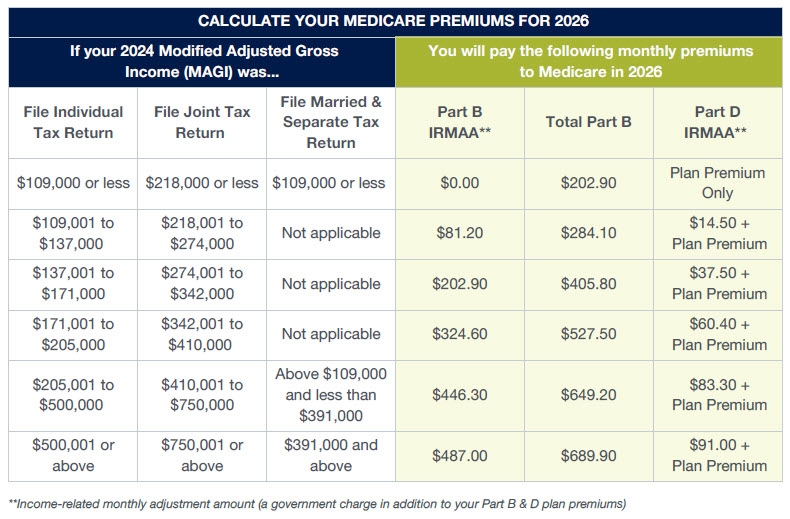
- Medicare Part B IRMAA is added to your standard Part B monthly premium.
- Medicare Part D IRMAA is an additional monthly charge paid directly to Medicare, not to your Part D prescription drug plan.
The Social Security Administration (SSA) determines whether IRMAA applies and how much you must pay. If IRMAA applies to you, SSA will notify you with an Initial IRMAA Determination Notice, outlining your income, the surcharge amount, and your appeal rights.
Common Reasons People Are Hit with IRMAA
Because IRMAA uses income from two years ago, it often affects people who recently retired or experienced a one-time income spike. Common triggers include:
- Retirement or reduction in work hours
- Sale of a business or property
- Large capital gains
- Roth IRA conversions
- Required Minimum Distributions (RMDs)
The key point: IRMAA does not automatically adjust when your income goes down—unless you take action.
How to Appeal IRMAA with Social Security
If your income has gone down due to a life-changing event, you may be able to reduce or eliminate your IRMAA by filing an appeal with Social Security Administration.
Eligible life-changing events include:
- Retirement or work stoppage
- Reduction in work hours
- Marriage, divorce, or death of a spouse
- Loss of income-producing property
- Employer settlement payment ending
To appeal, you must file Form SSA-44, titled “Medicare Income-Related Monthly Adjustment Amount – Life-Changing Event.” Along with the form, you’ll submit documentation showing both the event and your reduced income (such as a retirement letter, pay stubs, or a signed statement estimating your current-year income).
Once submitted, Social Security will review your appeal and may:

- Reduce your IRMAA
- Eliminate it entirely
- Or request additional information
Appeals can be filed by mail, in person at a Social Security office, or in some cases by phone.
Why Appealing Matters
IRMAA can add thousands of dollars per year to your Medicare costs. Successfully appealing can result in immediate premium reductions and, in some cases, refunds of overpaid amounts.
Many people assume IRMAA is permanent or unavoidable—it’s not. If your income has dropped due to retirement or another qualifying event, an appeal is often both appropriate and successful.
The Bottom Line
IRMAA is an income-based surcharge applied to Medicare Part B and Part D premiums, based on income from two years prior. If that income no longer reflects your financial reality, you have the right to appeal. Understanding the rules—and acting quickly—can significantly reduce your Medicare costs and protect your retirement income.
If you need additional help understanding how telemedicine works with Medicare or if you have any other questions about Medicare, please connect with one of our Member Agents. There are never any fees for their educational or enrollment services!