
Why Planning Your Retirement Is Your Most Important Financial Decision
Plan your retirement and you’re not just securing money for later—you’re building peace of mind, protecting your lifestyle, and ensuring you don’t outlive your savings. Here’s what you need to know:
Essential Steps to Plan Your Retirement:
- Calculate your income needs – Most people need 60-80% of their pre-retirement income to maintain their lifestyle
- Identify all income sources – Social Security, pensions, personal savings, and investment accounts
- Start saving early – Even small amounts grow significantly through compounding interest
- Prepare for unexpected costs – 61% of pre-retirees haven’t considered health or long-term care expenses
- Create a withdrawal strategy – Convert savings into sustainable retirement income
- Apply for benefits on time – Submit Social Security and Medicare applications 3-9 months before retirement
The good news? 77% of retirees report enjoying retirement, and 70% say their standard of living is the same or better than before they retired. But this satisfaction doesn’t happen by accident.
Without a clear plan, you risk making costly mistakes with Social Security timing, Medicare enrollment, or investment choices. You might pay more in taxes than necessary, run out of money too soon, or miss benefits you’ve earned.
The research shows that nearly half of retirees face an unexpected financial event—most commonly long-term disability or health costs. Yet most working people haven’t planned for these possibilities. Starting your retirement planning today, regardless of your age, gives you the best chance to build the retirement you actually want.
Why You Must Plan Your Retirement Today
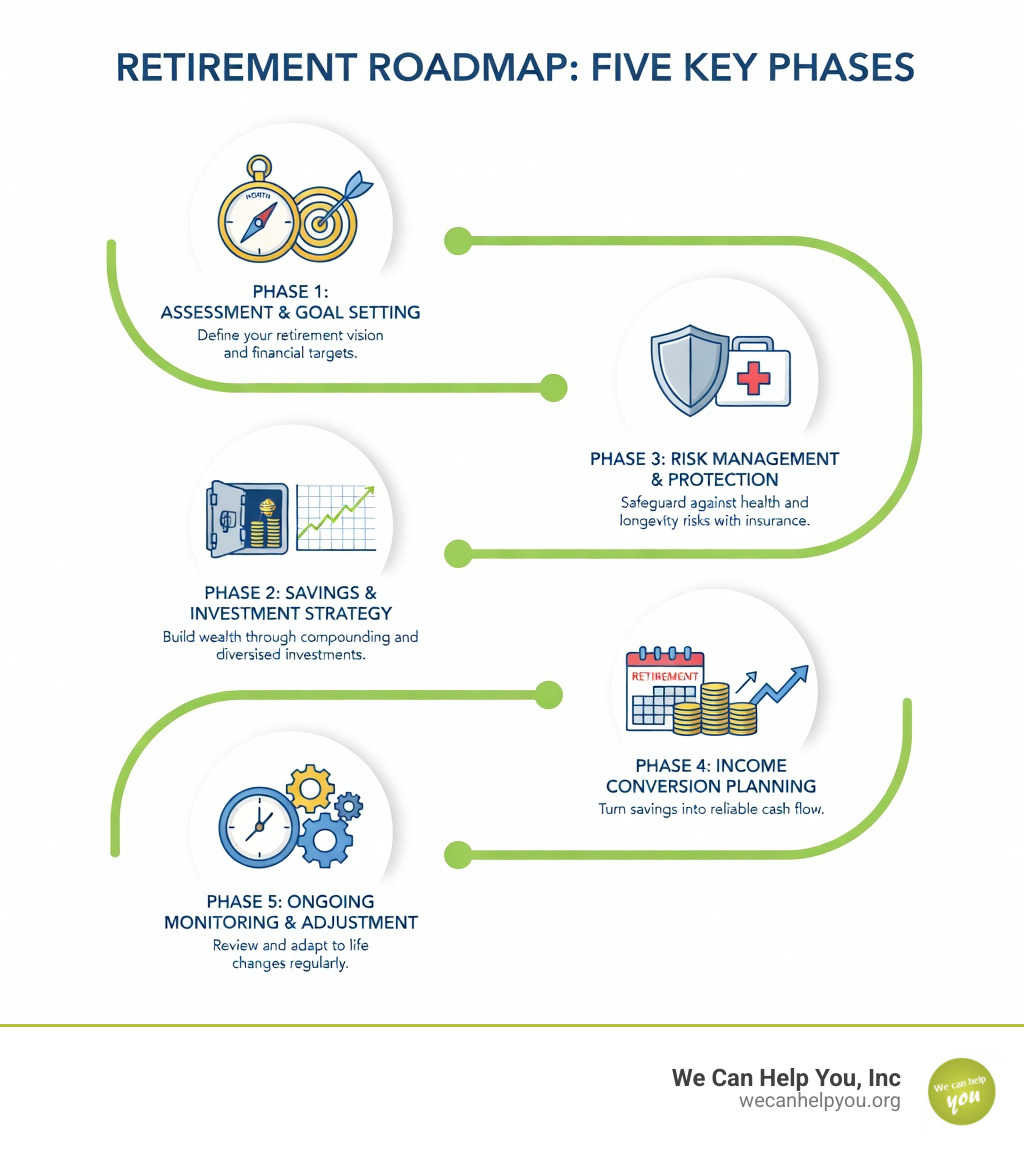
If we think of our working years as a long road trip, retirement is the destination. You wouldn’t drive across the country without a GPS or at least a crumpled map, right? To plan your retirement is to set that GPS. It provides financial direction and the peace of mind that comes from knowing you won’t run out of fuel halfway there.
One of the most compelling reasons to act now is the magic of compounding interest. When you reinvest the earnings from your savings, those earnings start generating their own earnings. Over decades, this creates a snowball effect that can turn modest monthly contributions into a significant nest egg.
Furthermore, having a plan is the key to financial independence. It allows you to make choices based on what you want to do, rather than what you have to do. Since 77% of retirees report they are genuinely enjoying their post-work years, the effort you put in now pays off in happiness later. However, a major part of that happiness depends on your Social Security strategy. Knowing when to claim can make a massive difference in your monthly “paycheck” for the rest of your life.

The Power of Starting Early to Plan Your Retirement
Time is your greatest asset. When you have a long time horizon, you don’t have to save nearly as much per month to reach your goals. For example, if you want to save $100,000, saving at a 5% return over 20 years requires roughly $243 a month. If you wait until you only have 10 years left, that monthly requirement jumps to $643! By starting 10 years earlier, you earn nearly $19,000 more in interest alone.
We also need to talk about fees. They might seem small, but they are the “silent killers” of wealth accumulation. Research shows that saving just 1% a year in fees over 30 years could result in over $45,000 more in your pocket by the time you retire. Over a long career, those small percentages add up to the price of a luxury car or several years of travel.
Mitigating Long-Term Financial Risks
A solid plan doesn’t just look at the best-case scenario; it prepares for the “what-ifs.” Three major risks can derail an unplanned retirement:
- Inflation: The rising cost of goods means $100 today won’t buy the same amount of groceries in 20 years. Your plan must include investments that outpace inflation.
- Market Volatility: A market dip right as you retire can be scary. We help you transition to more stable assets to cushion against these swings.
- Longevity Risk: This is the “risk” of living a long, healthy life! You need to ensure your money lasts as long as you do.
One of the biggest oversights we see is failing to account for health changes. It is vital to learn if you need long-term care early on, as these costs can quickly deplete a lifetime of savings if you aren’t protected.
Determining Your Retirement Income Needs
How much is enough? It’s the golden question. A common rule of thumb is the 60-80% replacement rule. This suggests you’ll need about 60% to 80% of your pre-retirement income to maintain your current lifestyle. If you earn $100,000 now, you should aim for $60,000 to $80,000 in annual retirement income.
Why the drop? Usually, your expenses shift. You’re no longer paying for commuting, professional wardrobes, or—most importantly—saving for retirement itself! However, other costs like healthcare and travel often increase.
| Expense Category | Pre-Retirement | Post-Retirement |
|---|---|---|
| Housing/Mortgage | High | Low (if paid off) |
| Taxes | Higher | Lower |
| Healthcare | Moderate | High |
| Travel & Hobbies | Low/Moderate | High |
| Work Expenses | Moderate | Zero |
Estimating Your Future Lifestyle Costs
To plan your retirement accurately, you have to get specific about your “Day 1.” Do you plan to travel the world? Or is your dream to spend time in the garden and volunteer locally?
- Hobbies: Some hobbies (like golf or sailing) are pricier than others (like hiking or reading).
- Family Support: Are you planning to help grandchildren with college or provide a down payment for a child’s home?
- Housing: Will you downsize, or perhaps move to a state with lower taxes?
Using Tools to Plan Your Retirement Income
You don’t have to do the math on a napkin. There are sophisticated tools available to help you visualize your future. We highly recommend you don’t guess, calculate your future Social Security payments to see exactly what your baseline income will look like.
Once you have your Social Security estimate, you can use a Retirement Decision Guide to factor in your other assets and lifestyle goals. These tools help you see the “income replacement ratio”—the percentage of your current income that your total retirement sources will provide.
Navigating Your Retirement Income Sources
A secure retirement is built like a sturdy table, supported by several different legs. If one leg is shorter, the others need to be stronger to keep things balanced.
Maximizing Government and Workplace Benefits
For most of us, the foundation starts with Social Security. But that’s just the beginning.
- Employer Pensions: If you’re lucky enough to have a defined benefit plan, understand how it pays out.
- Workplace Savings: 401(k) or 403(b) plans often come with employer matches—this is essentially free money that doubles your saving power.
- Individual Accounts: IRAs (both Traditional and Roth) provide tax-advantaged ways to grow your wealth.
As you approach age 65, your focus must also shift to healthcare. Navigating the transition from employer insurance to government programs is tricky. Our Medicare Guide is a great place to start learning about your options and enrollment periods.
Considerations for Working or Retiring Abroad
Some of us aren’t ready to stop completely. Working part-time can provide a sense of purpose and a nice “cushion” for your budget. However, be aware that earning too much while collecting Social Security before your full retirement age can temporarily reduce your benefits.
If you’re dreaming of a villa in Tuscany or a beach house in Mexico, retiring abroad adds layers of complexity. You’ll need to research residency rules, tax treaties between the U.S. and your new home, and how your healthcare will be covered, as Medicare generally does not provide coverage outside the United States.
How to Plan Your Retirement Savings Strategy
Your strategy should evolve as you age. When you’re 30, you can afford to be aggressive because you have time to recover from market dips. When you’re 60, stability becomes the name of the game.
Choosing the Right Savings Vehicles
Where you put your money matters as much as how much you save.
- Tax-Deferred Accounts: These give you a tax break now (like a Traditional IRA), but you pay taxes when you take the money out later.
- Tax-Free Accounts: You pay taxes now, but the withdrawals are tax-free (like a Roth IRA). This is often better if you expect to be in a higher tax bracket later.
- Creditor Protection: Some retirement accounts offer protection from legal judgments, which can be an important part of safeguarding your legacy.
Adjusting for Health and Unexpected Costs
Here is a sobering statistic: 61% of pre-retirees have not considered unexpected costs related to health or long-term care. Almost half of current retirees have experienced an unexpected event that significantly impacted their finances, with long-term disability being a leading cause.
To plan your retirement effectively, you must build an emergency fund that is separate from your long-term investments. This prevents you from having to sell stocks during a market downturn just to pay for a new roof or a medical bill. We also suggest looking into the research on the chances of needing long-term care to decide if insurance is a right fit for your strategy.
Protecting Your Future and Converting Assets
The transition from “saving mode” to “spending mode” is often the most stressful part of the journey. You’ve spent 40 years watching your accounts grow; now you have to start taking money out.
Safeguarding Your Nest Egg
As your assets grow, you unfortunately become a bigger target for scams. Protecting your retirement involves more than just picking the right stocks:
- Appoint a Power of Attorney: Ensure someone you trust can manage your affairs if you become unable to do so.
- Trusted Contacts: Most financial institutions now allow you to name a “trusted contact” they can call if they suspect fraudulent activity on your account.
- Insurance Review: Periodically review your life and health insurance to ensure it still meets your needs.
Transitioning from Saving to Spending
To create a “retirement paycheck,” many people use a combination of:
- Annuities: These can provide a guaranteed stream of income for life, protecting you from longevity risk.
- Sustainable Withdrawal Rates: The “4% rule” is a common starting point, suggesting you can withdraw 4% of your portfolio in the first year and adjust for inflation thereafter.
- RMDs: Once you reach age 73 (for most), the government requires you to start taking Required Minimum Distributions from certain accounts.
You should aim for a plan that offers predictable income for your bills, growth potential to beat inflation, and flexibility for life’s surprises. For more detailed steps on this transition, you can prepare for retirement by following official checklists and timelines.
Frequently Asked Questions about Retirement Planning
How much income will I need compared to my current salary?
Most experts suggest aiming for 60-80% of your pre-retirement income. However, if you plan to travel extensively or still have a mortgage, you might need closer to 100%. If you plan a very modest lifestyle and have your home paid off, 50-70% might suffice.
When is the best time to start saving for retirement?
The best time was yesterday; the second best time is today! Starting early allows compound interest to do the heavy lifting. Even if you are in your 50s, increasing your savings rate now can still have a massive impact on your comfort later.
What are the main risks to my retirement savings?
The “Big Four” risks are inflation (rising costs), market volatility (investment drops), longevity (outliving your money), and health/long-term care costs (unexpected medical bills).
Conclusion
Creating a roadmap to financial freedom doesn’t have to be overwhelming. By taking small, consistent steps—like paying off high-interest debt, reviewing your insurance, and working with a professional to create a personalized plan—you can turn your retirement dreams into a reality.
At We Can Help You, Inc., our mission is to ensure you have the education you need to make these big decisions with confidence. Whether you are in Arizona, Florida, Illinois, or any of the other states we serve, we are here to help you maximize your benefits.
Ready to take the next step? Don’t leave your future to chance. You can find a Medicare insurance agent near me to help steer your healthcare options, or reach out to us for your free Social Security maximization report. Your journey to a secure retirement starts with a single plan. Let’s build yours today.