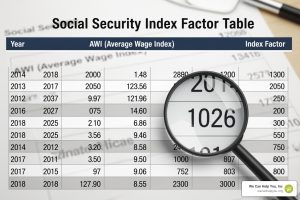

Why Understanding How AIME is Calculated Is the First Step to Retirement Confidence
How AIME is calculated is the foundation of your Social Security retirement benefit. Here’s the quick answer:
The 3-Step Process:
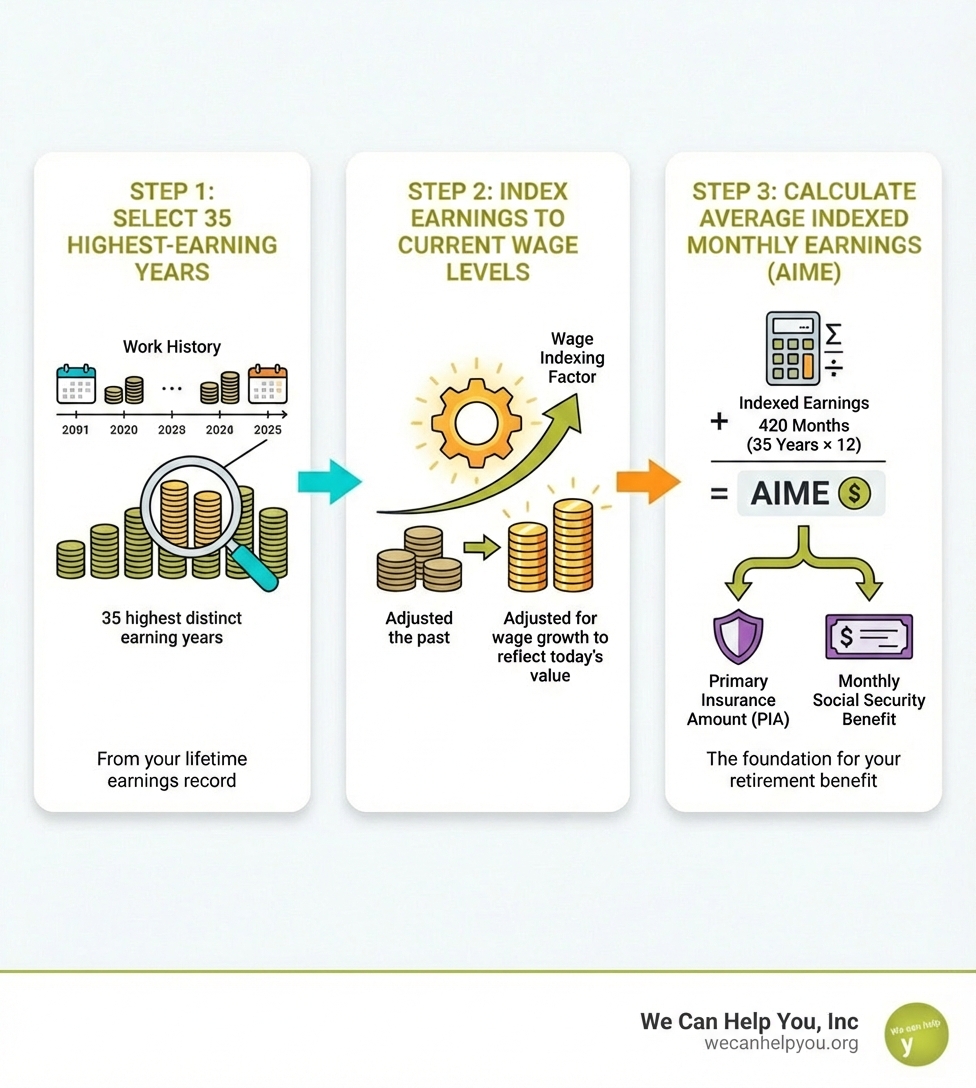
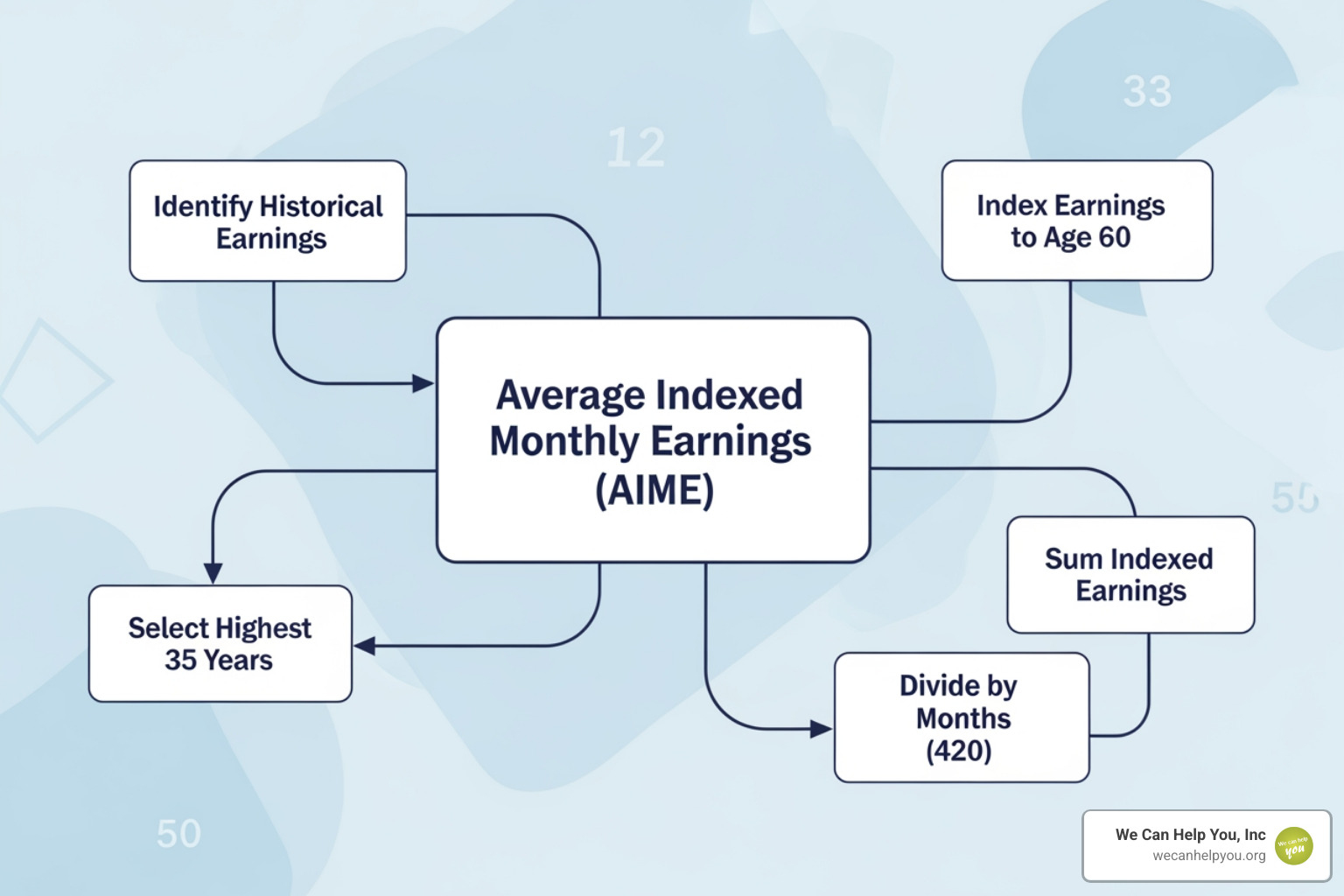
- Gather Your Earnings: The Social Security Administration selects your 35 highest-earning years from your work history.
- Index for Wage Growth: Each year’s earnings are adjusted using a wage indexing factor to reflect today’s wage levels (earnings up to age 60 are indexed).
- Calculate the Average: Add up those 35 years of indexed earnings, divide by 420 months (35 years × 12 months), and round down to the nearest dollar.
That’s your Average Indexed Monthly Earnings—the number that determines your Primary Insurance Amount (PIA) and ultimately your monthly Social Security check.
If you’re approaching retirement, you’ve probably looked at your Social Security statement and wondered: How did they come up with this number?
The answer lies in a calculation called Average Indexed Monthly Earnings, or AIME. This isn’t just bureaucratic math—it’s the key to understanding what you’ll receive in retirement and how to potentially increase it.
To calculate an individual’s old-age benefits, the Social Security Administration first considers a beneficiary’s 35 highest-earning years, with each year’s earnings adjusted for national wage growth, to determine their AIME. This ensures that your $30,000 salary from 1990 is fairly compared to your $60,000 salary from 2015—both adjusted to today’s dollars.
Your AIME directly impacts your Primary Insurance Amount (PIA)—the monthly benefit you’d receive at full retirement age. The higher your AIME, the higher your benefit (though the formula is progressive, meaning lower earners get a higher percentage of their earnings replaced).
The good news? Once you understand how AIME is calculated, you can make informed decisions about your career, retirement timing, and benefit maximization strategies.
What is AIME and Why Does It Matter for Your Social Security?
Average Indexed Monthly Earnings (AIME) is a crucial concept when it comes to understanding your Social Security benefits. In simple terms, AIME is a summary of your lifetime earnings, adjusted for wage growth, and then averaged into a monthly figure. It’s the very foundation upon which your Social Security retirement benefit is built.
Why is this so important? Because your AIME directly determines your Primary Insurance Amount (PIA), which is the monthly benefit you’re entitled to at your full retirement age. A higher AIME generally means a higher PIA, and thus a larger monthly Social Security check. For many, Social Security represents a significant portion of their retirement income, making an understanding of how AIME is calculated essential for sound retirement planning.
The Social Security Administration (SSA) uses AIME to ensure fairness across generations. By adjusting past earnings for national wage growth, your earnings from decades ago are brought into today’s economic context. This indexing accounts for the general rise in the standard of living over your working life, ensuring that your benefits reflect a comparable value regardless of when you earned your wages.
To put it another way, AIME helps us bridge the gap between nominal earnings and indexed earnings. Nominal earnings are simply the dollar amounts you earned each year. Indexed earnings are those same dollar amounts, but adjusted upwards to reflect the increase in average wages over time. Without indexing, someone who earned $20,000 in 1970 would have their earnings drastically undervalued compared to someone earning $20,000 today, even if those amounts represented similar purchasing power at the time. This thoughtful approach helps protect the value of your lifetime contributions to Social Security.
The Goal of AIME: A Fair Look at Your Lifetime Earnings
The core goal of AIME is to express your lifetime earnings in terms of today’s wage levels. This allows the Social Security Administration to calculate a benefit that accurately reflects your contributions and maintains your standard of living in retirement. Imagine if your past earnings were only considered at their face value; a dollar earned in 1980 would be worth much less in calculating your benefit today, which wouldn’t be fair.
By indexing your earnings, the SSA ensures that your benefit calculation accounts for the economic reality of wage growth. This process is a cornerstone of the progressive benefit formula that Social Security uses. The formula is designed to replace a larger percentage of earnings for lower-income workers compared to higher-income workers, while still providing higher dollar amounts to those with higher lifetime earnings. It’s a delicate balance of social adequacy and individual equity.

How AIME is Calculated: A 3-Step Breakdown
Now that we know what AIME is and why it’s so important, let’s roll up our sleeves and dive into the actual calculation. While the SSA handles the complex computations, understanding the steps involved can give you valuable insight into your future benefits. This is where the rubber meets the road in figuring out how AIME is calculated.
The calculation focuses on your earnings from Social Security-covered employment—that is, wages on which you and your employer paid Social Security taxes. Your entire earnings history, from your first job to the year before you claim benefits, is considered.
Step 1: Gather Your 35 Highest Earning Years
The first step in calculating your AIME is to identify your 35 highest-earning years. The Social Security Administration looks at your entire work record, usually starting from age 21, and picks out the 35 years where you earned the most. This is often referred to as the “35-year rule.”
These 35 years don’t have to be consecutive. The SSA simply selects the highest-earning years, no matter when they occurred during your career. This means if you had a period of high earnings early in your career, followed by a mid-career break, and then returned to high earnings, all those top years would be considered.
What happens if you haven’t worked for 35 years in Social Security-covered employment? Don’t worry, you’ll still get a benefit, but the calculation will include zeros for any missing years. For example, if you’ve only worked for 30 years, the SSA will add five years of zero earnings to your record to reach the 35-year requirement. As you might expect, these zeros will lower your overall average, which is why working for at least 35 years is often a key strategy for maximizing your benefits.
Another crucial factor in this step is the contribution and benefit base, also known as the taxable maximum. Each year, there’s a limit to how much of your earnings are subject to Social Security taxes and, consequently, how much is counted towards your AIME. For instance, in 2023, the contribution and benefit base was $160,200. Any earnings above this amount in a given year are not included in your AIME calculation. So, even if you earned $200,000 in a year, only $160,200 would be considered for Social Security purposes. This limit ensures that the system focuses on a broad base of earnings rather than disproportionately high incomes. For More info about Social Security, we offer many educational resources.
Step 2: Adjust Your Earnings with Wage Indexing
Once your 35 highest-earning years are identified, the next step is to adjust those earnings for wage inflation. This process is called wage indexing, and it’s essential for making your past earnings comparable to current wage levels. Without it, a dollar earned in the 1980s would be treated the same as a dollar earned today, which we all know isn’t a fair comparison!
The Social Security Administration uses a specific tool for this adjustment: the National Average Wage Index (NAWI). This index reflects the average wages of all U.S. workers each year. To index your past earnings, the SSA calculates an indexing factor for each year. This factor is determined by dividing the national average wage for the year you turn 60 by the national average wage for the year the earnings were received.
Here’s the trickiest part: earnings are indexed up to the year you turn age 60. This is known as the “indexing year.” For any earnings you have in the year you turn 60 or in subsequent years, they are not indexed. Instead, they are counted at their nominal (face) value. This means that earnings from age 60 onwards are considered as is, without adjustment for further wage growth.
For example, if you turned 60 in 2024, your earnings from 1980 up to 2023 would be indexed using the 2024 NAWI as the base. Your earnings in 2024 and any years after would be included at their actual dollar value. This ensures that your benefit calculation reflects the general rise in the standard of living during the bulk of your working life.
Step 3: The Final Math for How AIME is Calculated
You’ve gathered your 35 highest-earning years and adjusted them for wage inflation. Now, it’s time for the final calculation to determine your AIME. This step is fairly straightforward:
- Sum Your Indexed Earnings: Add up all the indexed earnings from those 35 selected years. If you had fewer than 35 years of earnings, any “zero” years added in Step 1 will be part of this sum.
- Divide by 420 Months: Once you have the total sum of your indexed earnings, you divide this total by 420. Why 420? Because 35 years multiplied by 12 months per year equals 420 months. This division gives you your average monthly indexed earnings.
- Round Down: The final step is to round this monthly average down to the nearest whole dollar amount. The Social Security Administration always rounds down, never up.
The resulting figure is your Average Indexed Monthly Earnings (AIME). This is the number that the SSA will then use to determine your Primary Insurance Amount (PIA), which is the basis for your actual monthly Social Security benefit.
From AIME to PIA: Turning Your Earnings into a Benefit Amount
Your AIME is a crucial stepping stone, but it’s not your final monthly benefit. The next step is to convert your AIME into your Primary Insurance Amount (PIA). The PIA is the amount you would receive each month if you start receiving benefits exactly at your full retirement age (FRA). It’s the base figure from which all other benefit amounts (like early retirement or delayed retirement benefits) are calculated.
The Social Security Administration uses a progressive benefit formula to calculate your PIA from your AIME. This formula is designed to replace a higher percentage of earnings for low-wage earners than for high-wage earners, making the system more progressive. The formula uses different “bend points” that divide your AIME into segments, and each segment is multiplied by a different percentage.
For example, for those becoming eligible in 2025, the PIA formula uses these rates:
- 90% of the first $1,226 of your AIME
- 32% of your AIME between $1,226 and $7,391
- 15% of your AIME over $7,391
These dollar amounts, known as bend points, are adjusted annually based on the national average wage index. While the percentages (90%, 32%, 15%) remain fixed by law, the bend points increase each year to ensure that benefits keep pace with general wage growth. This weighting means that lower earners receive a proportionately higher replacement rate of their past earnings. For more details on this, you can explore our resources on Social Security Benefits.
A Hypothetical Example of How AIME is Calculated
Let’s walk through a simplified example to illustrate how AIME is calculated and then converted to a PIA.
Suppose we have a hypothetical worker, “Sarah,” who turns 60 in 2024 and plans to retire at her full retirement age. Let’s assume her highest 35 years of earnings, after indexing, total $1,500,000.
Step 1 & 2 (Simplified): Indexed Earnings Sum
Sarah’s highest 35 indexed earnings years sum to $1,500,000. (In a real scenario, we’d list each of her 35 highest nominal earnings, apply an indexing factor for each, and then sum them.)
Step 3: Calculate AIME
To find Sarah’s AIME, we divide her total indexed earnings by 420 months:
AIME = $1,500,000 / 420 = $3,571.428…
Rounding down to the nearest dollar, Sarah’s AIME is $3,571.
Now, let’s calculate Sarah’s PIA using the 2025 bend points (assuming she becomes eligible in 2025 for simplicity, even though her indexing year was 2024):
- 90% of the first $1,226 of AIME
- 32% of AIME between $1,226 and $7,391
- 15% of AIME over $7,391
Sarah’s AIME is $3,571.
- First segment: 90% of $1,226 = $1,103.40
- Second segment: The portion of her AIME between $1,226 and $3,571 is $3,571 – $1,226 = $2,345.
32% of $2,345 = $750.40 - Third segment: Sarah’s AIME does not exceed $7,391, so there is no third segment.
Total PIA: $1,103.40 + $750.40 = $1,853.80
So, Sarah’s Primary Insurance Amount (PIA) would be $1,853.80. This is the monthly benefit she could expect to receive if she claims at her full retirement age. If she claims earlier, her benefit would be reduced; if she claims later, it would be increased by Delayed Retirement Credits.
How to Maximize Your AIME (and Your Future Benefits)
Understanding how AIME is calculated isn’t just an academic exercise; it’s a powerful tool for planning your financial future. Once you grasp the mechanics, you can take proactive steps to potentially increase your AIME and, in turn, boost your monthly Social Security benefit. This is all part of smart career and retirement strategy.
Every dollar you earn in Social Security-covered employment contributes to your AIME, up to the annual taxable maximum. By strategically managing your career and earnings, you can significantly impact the size of your future benefits. We believe in empowering you with this knowledge, because your AIME directly influences your retirement lifestyle. For a deeper dive into planning, check out Don’t Guess: Calculate a Guide to Your Future Social Security Payments.
List of Strategies to Boost Your AIME
Here are some actionable strategies we often recommend to help you maximize your AIME and, consequently, your Social Security benefits:
- Work at least 35 years: As we’ve learned, the SSA uses your 35 highest-earning years. If you work fewer than 35 years, zeros will be factored into your calculation, significantly lowering your AIME. Aiming for at least 35 years of solid earnings is one of the most impactful things you can do.
- Increase your income: This might seem obvious, but higher earnings in any given year (up to the taxable maximum) directly translate to a higher AIME. This means seeking promotions, acquiring new skills, or even working overtime can make a difference, especially during your peak earning years. Earnings are indexed up to age 60, so those higher earnings earlier in your career get the benefit of more indexing.
- Replace low-earning years: If you’ve had years with low earnings (or even zero earnings) earlier in your career, continuing to work in your later years at a higher income can replace those lower years in the “highest 35” calculation. Your highest earning years will always be chosen, even if they come later in life.
- Delay retirement: While delaying retirement beyond your full retirement age (FRA) doesn’t directly change your AIME, it does increase your monthly benefit through Delayed Retirement Credits (DRCs). For those born in 1943 or later, DRCs can add 8% to your annual benefit for each year you delay, up to age 70. This can provide a substantial boost to your final monthly payment.
- Check your earnings record for errors: It’s crucial to regularly review your Social Security earnings statement to ensure all your earnings have been accurately reported. Mistakes can happen, and missing earnings could reduce your AIME. You can access your statement by creating an account on the SSA website.
Taking these steps can significantly impact your retirement security. For further guidance and personalized insights, consider joining our Social Security on Demand Webinar.
Frequently Asked Questions about AIME
We understand that how AIME is calculated can be a bit complex, so we’ve compiled some frequently asked questions to help clarify common points of confusion.
What is the difference between AIME and my Primary Insurance Amount (PIA)?
Think of AIME as the raw material, and PIA as the finished product. Your Average Indexed Monthly Earnings (AIME) is the average of your 35 highest indexed earnings years, expressed as a monthly figure. It’s a measure of your average lifetime earnings. Your Primary Insurance Amount (PIA), on the other hand, is the actual monthly benefit amount you’re entitled to receive at your full retirement age. The PIA is calculated by applying a progressive formula with “bend points” to your AIME. So, AIME is a crucial step in the process, while PIA is the direct result that determines your base benefit.
What happens if I have fewer than 35 years of earnings?
If you haven’t worked in Social Security-covered employment for at least 35 years, the Social Security Administration will include years of zero earnings in your calculation. For example, if you’ve worked for 25 years, the SSA will add 10 years of zero earnings to make up the 35 years. The total sum of your indexed earnings (including these zeros) will then be divided by 420 months (35 years x 12 months). This means that each year of zero earnings will effectively lower your overall average, resulting in a lower AIME and, consequently, a lower PIA. This is why working for at least 35 years is such a strong recommendation for maximizing your benefits.
Does my AIME change after I start receiving benefits?
No, your AIME is calculated once based on your earnings up to the year you turn 60 (with earnings after 60 counting at face value). Once your AIME is determined, it generally does not change after you start receiving benefits. However, your actual monthly benefit amount will change. After you begin receiving benefits, your payments are subject to annual Cost-of-Living Adjustments (COLAs). These COLAs are designed to help your benefits keep pace with inflation, ensuring your purchasing power doesn’t erode over time. So, while your AIME remains constant, your monthly check typically increases with these adjustments.
Conclusion
Understanding how AIME is calculated is more than just knowing a Social Security acronym; it’s about gaining clarity and control over a significant part of your retirement income. Your Average Indexed Monthly Earnings are the bedrock of your Social Security benefits, directly influencing the monthly payments that will support you in your golden years.
By grasping the three-step process—gathering your highest 35 years of earnings, adjusting them through wage indexing, and then doing the final math—you’re better equipped to make informed decisions about your career and retirement planning. We’ve seen how factors like working longer, increasing your income, and even simply checking your earnings record can have a tangible impact on your AIME and, ultimately, your financial security.
At We Can Help You, Inc., we are dedicated to educating individuals in locations like Arizona, California, Florida, New York, North Carolina, and many more across the country, on the intricacies of Social Security and Medicare. We believe that empowering you with knowledge is the first step to a confident retirement. Don’t leave your future to chance. Take control of your financial future by understanding these vital calculations.
To dig deeper and learn more about how your earnings history translates into your future benefits, we invite you to Learn more about Average Indexed Monthly Earnings (AIME) through our extensive resources. We’re here to help you steer the path to a secure and well-planned retirement.