
Why Extra Help Matters for Your Medicare Prescription Costs
Apply for Extra Help if you struggle with Medicare prescription drug costs—this federal program could save you about $5,300 per year by covering premiums, deductibles, and copayments for your Medicare Part D plan.
Quick Answer: How to Apply for Extra Help
- Apply online at SSA.gov/extrahelp (fastest method)
- Call Social Security at 1-800-772-1213 (TTY: 1-800-325-0778)
- Visit your local Social Security office in person
You may qualify if:
- Your 2025 income is below $23,475 (individual) or $31,725 (married couple)
- Your resources are below $17,600 (individual) or $35,130 (married couple)
If you’re on Medicaid, SSI, or receive state help with Medicare premiums, you automatically qualify—no application needed.
Medicare prescription costs can feel overwhelming when you’re on a fixed income. The good news? The Extra Help program exists specifically to ease this burden. This isn’t a small benefit—it covers your monthly premiums, annual deductibles, and most copayments for Part D prescription drug coverage.
Many people who qualify don’t even know Extra Help exists. Others assume the application process is too complicated or time-consuming. The reality is much simpler than you might think.
In this guide, we’ll walk you through everything you need to know: who qualifies, what documents you’ll need, how to submit your application, and what happens after you apply. We’ll also cover what to do if your application is denied and share additional ways to lower your prescription costs.
Understanding Your Eligibility for Extra Help
The Extra Help program, also known as the Low-Income Subsidy (LIS), is a lifeline for many Medicare beneficiaries. It’s designed to help those with limited income and resources afford their prescription medications. We’ve seen how much peace of mind this program can bring, potentially saving beneficiaries an estimated $5,300 per year.

To qualify for Extra Help, you must be receiving Medicare and have limited income and resources. You must also reside in one of the 50 states or the District of Columbia. If you live in any of the states where we have offices, such as Arizona, California, Florida, New York, North Carolina, or Texas, you’re eligible to apply, provided you meet the financial criteria.
Automatic Qualification
The good news is that some individuals automatically qualify for Extra Help without needing to apply for Extra Help. This happens if you receive:
- Full Medicaid coverage: If your state’s Medicaid program covers your medical expenses, you’ll automatically get Extra Help.
- Medicare Savings Programs (MSPs): If your state helps pay your Medicare Part B premiums through an MSP, you’ll automatically qualify. MSPs are state-run programs that help people with limited income and resources pay for Medicare costs. We’ll dive deeper into MSPs later, but know that qualifying for one can open the door to Extra Help.
- Supplemental Security Income (SSI) payments: If you receive SSI benefits from Social Security, you’re also automatically enrolled in Extra Help.
If you fall into one of these categories, you’ll receive a notice in the mail from Medicare or Social Security confirming your automatic qualification. This notice will explain your benefits and, if you don’t already have one, inform you about the Medicare drug plan you’ve been automatically enrolled in. For more information on your Medicare options, we encourage you to explore our resources on More info about Medicare.
Who Should Apply for Extra Help?
Even if you don’t automatically qualify through Medicaid, an MSP, or SSI, you may still be eligible and should apply for Extra Help. We encourage anyone with:
- Limited Income: If your annual income is below certain thresholds (which we’ll detail next), you should consider applying.
- Limited Resources: This includes savings, investments, and real estate (other than your primary home). If your total countable resources are below the program’s limits, you might qualify.
- Medicare Beneficiaries: You must be enrolled in Medicare Part A and/or Part B to be eligible.
- Not Automatically Enrolled: If you haven’t received a notice confirming automatic Extra Help, applying is your next step.
- Reside in 50 States or DC: The program is available throughout the United States.
It’s always worth checking, as the savings can be substantial. Don’t let assumptions keep you from getting the financial relief you deserve.
2025 Income and Resource Limits
The income and resource limits for Extra Help are updated annually. These figures help determine who qualifies for assistance. For 2025, the limits for most states (including all the states where We Can Help You, Inc. has offices) are as follows:
| Category | 2025 Income Limit (Annual) | 2025 Resource Limit |
|---|---|---|
| Individual | $23,475 | $17,600 |
| Married Couple | $31,725 | $35,130 |
It’s important to understand what counts towards these limits:
What Counts as Income? Generally, “income” includes money you receive from various sources before taxes or other deductions. This can include:
- Social Security benefits (unless it’s SSI, which is automatic qualification)
- Pensions and annuities
- Wages from employment
- Net earnings from self-employment
- Veterans’ benefits
- Railroad Retirement Board benefits
- Interest and dividends
However, some types of income are not counted, such as food stamps, housing assistance, and some assistance from others if it’s for specific needs.
What Counts as Resources? “Resources” are assets you own that could be converted to cash and used for your support. These typically include:
- Money in checking and savings accounts
- Stocks, bonds, and mutual funds
- IRAs and 401(k)s (balances)
- Other investments
- Real estate (other than the home you live in, which is usually exempt)
Certain items are not counted as resources, including your primary residence, one vehicle, household goods, and personal effects. If your marital status changes, or if your income or resources change significantly, it’s important to report these changes to Social Security, as it can affect your eligibility.
How to Apply for Extra Help: A Step-by-Step Guide
Ready to take control of your prescription costs? Applying for Extra Help is a straightforward process, and we’re here to guide you every step of the way. You can apply for Extra Help any time of the year, whether you’re already enrolled in a Medicare Part D plan or not.

The application itself is managed by the Social Security Administration (SSA). We understand that government forms can sometimes feel daunting, but the SSA has made it relatively easy to submit your application. If you need personalized assistance with your application, please don’t hesitate to reach out to us at Get help with your application from We Can Help You, Inc..
Three Ways to Submit Your Application
There are several convenient options available for you to apply for Extra Help:
- Online: This is often the fastest and most preferred method. The Social Security Administration’s website provides a secure and user-friendly online application. You can complete it from the comfort of your home, at your own pace.
- By Phone: If you prefer to speak with someone directly, you can call the Social Security Administration. Their representatives can guide you through the application questions over the phone. You can reach them at 1-800-772-1213 (TTY users can call 1-800-325-0778), available Monday through Friday, 8 a.m. to 7 p.m. in most U.S. time zones.
- In-Person: For those who prefer face-to-face assistance, you can visit your local Social Security office. An SSA representative can help you complete the application and answer any questions you might have. You can also request a paper application to fill out and mail in or drop off.
What Documents Do You Need to Apply for Extra Help?
Before you start your application, it’s a good idea to gather some important documents. Having these on hand will make the process much smoother and faster. You’ll need information for yourself and, if applicable, your spouse.
Here’s a checklist of common documents and information you might need:
- Bank Statements: Recent statements for all checking and savings accounts.
- Tax Returns: Your most recent federal income tax return.
- Pension Statements: Documentation of any pension income you receive.
- Social Security Benefit Statements: Proof of your Social Security benefits.
- Investment Account Balances: Statements for stocks, bonds, mutual funds, IRAs, and 401(k)s.
- Other Income Statements: Any other sources of income, such as Veterans’ benefits, annuities, or Railroad Retirement Board benefits.
- Real Estate Information: Details about any real estate you own other than your primary home.
The goal is to provide a clear picture of your income and resources so the SSA can accurately determine your eligibility. Don’t worry if you don’t have every single document immediately; the SSA can often help you retrieve necessary information or provide guidance.
Once you have your documents ready, you can Start your online application with the SSA or proceed with one of the other application methods.
After You Apply: What to Expect and Next Steps
Once you’ve submitted your application to apply for Extra Help, the waiting game begins. The Social Security Administration will review your information to determine your eligibility. It’s a bit like waiting for a reply to a very important letter, but knowing what to expect can ease the anticipation.
Approval or Denial Notice
After reviewing your application, the SSA will send you a letter in the mail. This letter will inform you whether your application for Extra Help has been approved or denied.
- If Approved: Congratulations! The letter will outline your level of Extra Help and explain the cost-sharing reductions you’ll receive. If you don’t already have a Medicare Part D plan, Medicare will automatically enroll you in one to ensure you start receiving benefits. You’ll also learn that you won’t have to pay a Part D late enrollment penalty while receiving Extra Help.
- If Denied: Don’t despair! A denial doesn’t mean the end of the road. You have appeal rights, which we’ll discuss shortly. It’s possible there was missing information, a misunderstanding, or a slight miscalculation.
The Extra Help assistance typically begins once you are enrolled with an approved Medicare prescription drug provider. We’re dedicated to helping you steer these waters, and you can find more information on Help to Pay for Prescription Drugs on our site.
Understanding Your Costs with Extra Help in 2026
One of the most significant benefits of Extra Help is the dramatic reduction in your prescription drug costs. The program covers much of what you’d typically pay for your Medicare Part D plan. Let’s look at the estimated costs for beneficiaries receiving Extra Help in 2026:
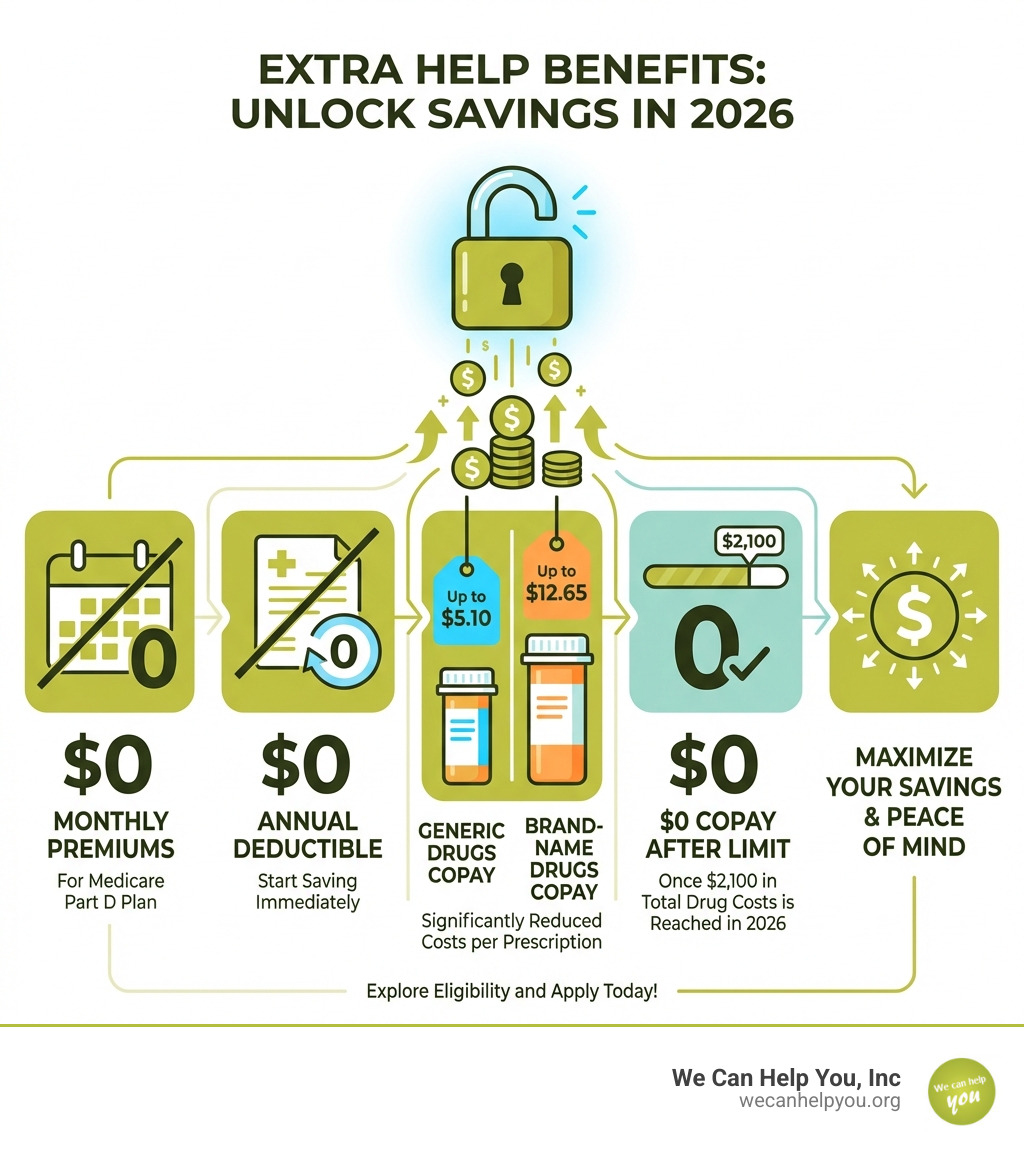
- $0 Plan Premiums: That’s right, you won’t pay a monthly premium for your Medicare Part D plan.
- $0 Deductibles: The annual deductible, which can be hundreds of dollars, will be eliminated for you.
- Reduced Copayments: Instead of potentially high copayments or coinsurance, you’ll pay a much lower, fixed amount for your medications:
- Up to $5.10 for each generic drug
- Up to $12.65 for each brand-name drug
- Catastrophic Coverage: This is a huge relief! Once your total drug costs (what you and your plan have paid) reach $2,100, you will pay $0 for each covered drug for the remainder of the year. This means your out-of-pocket costs are capped, providing immense financial protection.
These cost savings are why we estimate the Extra Help program is worth about $5,300 per year for each beneficiary. It’s a powerful tool to make your essential medications affordable.
What If You’re Denied or Paying the Wrong Amount?
Life isn’t always smooth sailing, and sometimes things don’t go as planned. If your application for Extra Help is denied, or if you believe you’re paying too much for your prescriptions even with Extra Help, here’s what you can do:
Appeal Process: If your application is denied, you have the right to appeal the decision. Social Security will send you a notice with instructions on how to do this. You typically have 60 days from the date on the denial letter (plus an assumed 5 days for mailing) to file your appeal. During the appeal, you can submit additional information or explain why you believe you qualify. We encourage you to use this right if you feel the decision was incorrect.
Contacting your drug plan: If you’re approved for Extra Help but find yourself paying more than you should at the pharmacy, the first step is to contact your Medicare Part D drug plan. There might be a lag in communication, or the pharmacy might not have updated information. Your plan can verify your Extra Help status and help correct the costs.
Call 1-800-MEDICARE: If your drug plan can’t resolve the issue, or if you need further assistance, call 1-800-MEDICARE (1-800-633-4227). They can confirm your level of Extra Help and work with your plan to ensure you’re paying the correct amount.
Medicare’s LI NET Program: What if you qualified for Extra Help but had to pay out-of-pocket for your prescriptions before you were enrolled in a Medicare drug plan or before your Extra Help benefits kicked in? That’s where Medicare’s Limited Income Newly Eligible Transition (LI NET) Program comes in. LI NET provides temporary Part D coverage. If you paid for covered Part D drugs during this transition period, keep your receipts and call LI NET at 1-800-783-1307. They can help you get reimbursed.
Proof of Eligibility: Sometimes, a pharmacy or plan might ask for proof that you receive Extra Help. This could be your official award letter from Social Security or a printout from Medicare.gov. If you have full Medicaid, your Medicaid card can also serve as proof.
Beyond Extra Help: More Ways to Lower Drug Costs
While Extra Help is an incredible resource, it’s not the only way to manage your prescription drug expenses. We believe in exploring all available avenues to ensure you have access to affordable medication. Here are some other strategies and programs that can help:
- Medicare Savings Programs (MSPs): As we mentioned earlier, MSPs are state programs that help pay for other Medicare costs, such as your Part A (hospital insurance) and Part B (medical insurance) premiums, deductibles, coinsurance, and copayments. If you qualify for certain MSPs, you’ll automatically get Extra Help. These programs can significantly reduce your overall Medicare burden. We recommend checking with your state’s Medicaid office to see if you qualify for an MSP, even if you don’t think you’d qualify for full Medicaid.
- State Pharmaceutical Assistance Programs (SPAPs): Many states offer their own programs to help residents pay for prescription drugs. These SPAPs can work alongside Medicare and Extra Help to provide additional financial assistance. Each state has different eligibility criteria and benefits, so it’s worth checking if your state offers one.
- Manufacturer Patient Assistance Programs (PAPs): Pharmaceutical companies often have programs to help patients who can’t afford their medications. These PAPs typically provide free or low-cost drugs to eligible individuals. You can often find information about these programs on the drug manufacturer’s website or by asking your doctor.
- Generic Drugs: This might seem obvious, but always ask your doctor or pharmacist if a generic version of your medication is available. Generic drugs contain the same active ingredients and work the same way as their brand-name counterparts but are significantly cheaper.
- Mail-Order Pharmacies: For maintenance medications you take regularly, using a mail-order pharmacy through your Medicare Part D plan can often result in lower costs and the convenience of having your prescriptions delivered to your home. Always compare prices, as sometimes local pharmacies might have competitive pricing or discounts.
Combining these strategies with Extra Help can create a comprehensive plan to keep your prescription drug costs as low as possible. Additionally, you can learn more about managing your medication expenses through the Understanding the Medicare Prescription Payment Plan.
Frequently Asked Questions about Applying for Extra Help
We often hear similar questions from individuals exploring the Extra Help program. Let’s address some of the most common ones to ensure you have a complete understanding.
What is the difference between Extra Help and a Medicare Savings Program (MSP)?
This is a great question! While both Extra Help and Medicare Savings Programs (MSPs) assist with Medicare costs, they target different areas:
- Extra Help is a federal program specifically designed to lower your Medicare Part D (prescription drug coverage) costs. This includes premiums, deductibles, and copayments for your medications.
- Medicare Savings Programs (MSPs) are state-run programs that help you pay for other Medicare costs, specifically Part A (hospital insurance) and Part B (medical insurance). MSPs can help with your Part B premiums, deductibles, coinsurance, and copayments.
A key connection is that if you qualify for certain MSPs, you will automatically qualify for Extra Help. So, while they are distinct programs, they often work hand-in-hand to provide broader financial assistance for your healthcare needs.
Does applying for Extra Help enroll me in a Medicare Part D plan?
No, the application process to apply for Extra Help does not directly enroll you in a Medicare Part D prescription drug plan. Extra Help is about getting financial assistance for your drug costs, not about choosing a specific plan.
However, if you qualify for Extra Help and are not already enrolled in a Part D plan, Medicare will automatically enroll you in a basic plan. This ensures you immediately start receiving the benefits of Extra Help. While this automatic enrollment is convenient, you always have the option to choose a different Medicare Part D plan that better suits your needs and preferred pharmacies. In fact, if you receive Extra Help, you have special enrollment periods throughout the year to change your plan. You can explore your options and Find a Medicare Prescription Plan that works for you.
How often do I need to re-apply for Extra Help?
You typically don’t need to re-apply for Extra Help every year in the traditional sense. The Social Security Administration conducts an annual review (redetermination process) of your eligibility. They will send you a form (SSA-1020-OCR-SM) to complete and return, asking about your current income and resources.
It’s crucial to complete and return this form by the deadline to ensure your benefits continue without interruption. If your income or resources change significantly during the year, it’s also important to report these changes to Social Security. This helps ensure your continued eligibility and that you receive the correct level of assistance.
Conclusion
Navigating Medicare and its associated costs can feel complex, but programs like Extra Help are designed to simplify and lighten the load. By taking the time to apply for Extra Help, you can open up significant savings on your prescription medications, providing invaluable financial relief and peace of mind. The estimated value of this program is around $5,300 per year, a sum that can make a substantial difference in your budget.
Whether you qualify automatically or need to submit an application, the process is manageable, and the benefits are profound. Don’t hesitate to gather your documents and reach out to the Social Security Administration or to us if you need guidance. We at We Can Help You, Inc. are dedicated to educating individuals on Medicare and Social Security, helping you make informed decisions for a more secure retirement. We believe everyone deserves to understand and access the benefits they’re entitled to.
Take action today to secure your savings and ensure you have access to the medications you need. To learn more about all your options and how to optimize your coverage, we invite you to Learn more about Medicare Part D options.