
Why Medicare Cost Assistance Matters for Your Financial Security
Medicare cost assistance helps millions of Americans afford their healthcare by reducing or eliminating premiums, deductibles, and prescription drug costs. If you have a limited income and resources, you may qualify for programs that could save you thousands of dollars each year.
Quick Answer: Main Types of Medicare Cost Assistance
- Medicare Savings Programs (MSPs) – Help pay Medicare Part A and Part B premiums, deductibles, coinsurance, and copayments
- Extra Help (Low-Income Subsidy) – Reduces or eliminates Medicare Part D prescription drug costs
- Medicaid – Provides additional health coverage for those who qualify
- Dual Eligibility – Combines Medicare and Medicaid benefits for comprehensive coverage
If you’re entering retirement and feeling overwhelmed by Medicare costs, you’re not alone. Many people don’t realize they qualify for financial help until they apply. These programs exist to reduce your out-of-pocket expenses.
The challenge is understanding what’s available and whether you qualify, as income and resource limits change annually, and each program has different rules. Some programs help with medical costs, while others focus on prescription medications. You might even qualify for multiple programs at once.
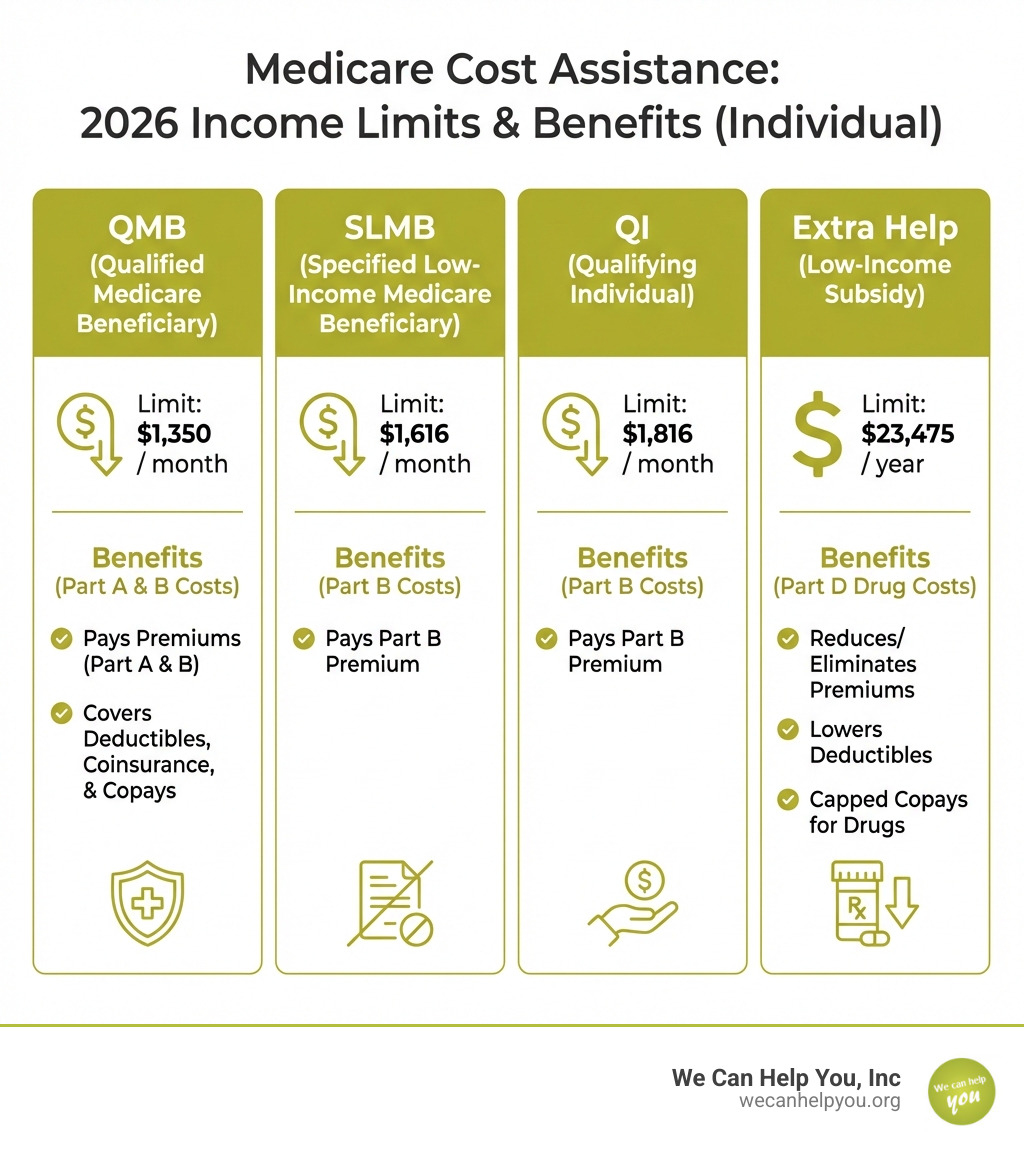
In 2025, people who qualify for Extra Help pay no plan deductible, no premiums for Part D drug plans, and no more than $12.15 for each brand-name drug and $4.90 for generic medications. For Medicare Savings Programs, the 2026 income limits range from $1,350 to $5,405 per month for individuals, depending on which program you qualify for.
The application process can be straightforward, with help available from state and local organizations. Many people qualify automatically, while others need to apply directly.
Understanding Your Options for Medicare Cost Assistance
Navigating Medicare costs can be complex, but several programs can help. Key programs include Medicare Savings Programs (MSPs), Extra Help, and Medicaid, all designed to provide Medicare cost assistance for those with limited income and resources.
Medicare Savings Programs (MSPs) are state-run programs that help cover out-of-pocket costs for Medicare Parts A and B, such as premiums, deductibles, and copayments.
Extra Help, also known as the Low-Income Subsidy (LIS), is a federal program that specifically targets prescription drug costs under Medicare Part D. It can significantly reduce or even eliminate your medication costs.
Medicaid is a joint federal and state program providing health coverage to low-income Americans. If you qualify for both Medicare and Medicaid, you’re considered “dual eligible,” gaining access to benefits like home or nursing care that Medicare may not cover.
These programs often work together. For instance, qualifying for an MSP automatically qualifies you for Extra Help, creating a strong financial safety net. Understanding these options is key to reducing your healthcare costs.
The Four Medicare Savings Programs (MSPs)
There are four primary Medicare Savings Programs, each designed to help with specific Medicare costs based on your income and resources. These programs are administered by your state and can make a significant difference in your budget.
Let’s break down the details for 2026:
| Program Name | Monthly Income Limit (Individual) | Monthly Income Limit (Married Couple) | Resource Limit (Individual) | Resource Limit (Married Couple) | What It Covers – – |
|---|---|---|---|---|---|
| Qualified Medicare Beneficiary (QMB) | Individual: $1,350 | Married Couple: $1,824 | Individual: $9,950 | Married Couple: $14,910 | Helps pay Part A premiums (if applicable), Part B premiums, deductibles, coinsurance, and copayments. Automatically qualifies you for Extra Help. – |
| Specified Low-Income Medicare Beneficiary (SLMB) | Individual: $1,616 | Married Couple: $2,184 | Individual: $9,950 | Married Couple: $14,910 | Helps pay Part B premiums. Automatically qualifies you for Extra Help. – |
| Qualifying Individual (QI) | Individual: $1,816 | Married Couple: $2,455 | Individual: $9,950 | Married Couple: $14,910 | Helps pay Part B premiums. Automatically qualifies you for Extra Help. (Note: Funds are limited and applications are first-come, first-served.) – |
| Qualified Disabled & Working Individual (QDWI) | Individual: $5,405 | Married Couple: $7,299 | Individual: $4,000 | Married Couple: $6,000 | Helps pay Part A premiums for certain disabled individuals who returned to work and lost premium-free Part A. Automatically qualifies you for Extra Help. – |
Note: Income and resource limits for these programs are subject to change annually. Limits are slightly higher in Alaska and Hawaii. Your state may have higher limits or different rules, so it’s always worth contacting your State Medical Assistance (Medicaid) office to find out if you qualify.
These programs offer distinct benefits:
- Qualified Medicare Beneficiary (QMB) Program: As the most comprehensive MSP, QMB pays your Part A and B premiums, deductibles, coinsurance, and copayments. A key benefit is that providers cannot bill you for these costs. QMB also automatically qualifies you for Extra Help.
- Specified Low-Income Medicare Beneficiary (SLMB) Program: SLMB helps pay your Medicare Part B premiums. You must have both Part A and B. Qualifying for SLMB also automatically enrolls you in Extra Help.
- Qualifying Individual (QI) Program: The QI program also helps pay Part B premiums, with slightly higher income limits than SLMB. Funding is limited and granted on a first-come, first-served basis, with priority for renewals. You must reapply annually and will also get Extra Help.
- Qualified Disabled & Working Individual (QDWI) Program: This program helps pay Part A premiums for certain disabled individuals under 65 who have returned to work and lost their premium-free Part A. QDWI has higher income limits and also provides automatic qualification for Extra Help.
Extra Help for Prescription Drug Costs
Prescription drug costs can be a significant concern, which is where Extra Help, or the Low-Income Subsidy (LIS), comes in. This federal program specifically helps with costs related to Medicare Part D prescription drug plans.

Extra Help significantly reduces your out-of-pocket expenses for medications by covering monthly premiums, annual deductibles, and copayments. It also waives any Part D late enrollment penalties, which is a major relief if you delayed signing up for Part D.
Key benefits for those who qualify:
- In 2025, if you qualify for Extra Help, you will pay no plan deductible and no premiums for Part D drug plans.
- Your out-of-pocket costs for medications will be capped at no more than $12.15 for each brand-name drug and $4.90 for generic medications.
These savings can make a world of difference in managing your health.
For 2025, to qualify for Extra Help, your income and resources must be below certain limits:
- Individual: Income less than $23,475 per year, with resources at or below $17,600.
- Married Couple: Income less than $31,725 per year, with resources at or below $35,130.
These figures can change annually, and income limits are higher in Alaska and Hawaii.
You might qualify for Extra Help automatically if you are enrolled in Medicaid, receive Supplemental Security Income (SSI), or qualify for an MSP. If so, Medicare will send you a letter confirming your enrollment. For more details, visit the official Extra Help program page.
Who is Eligible for Medicare Cost Assistance?
Eligibility for Medicare cost assistance primarily depends on your income and resources, but there are important details to consider.
Income & Resource Limits: Each program has specific financial thresholds. For example, in 2026, individual monthly income limits for MSPs range from $1,350 (QMB) to $5,405 (QDWI). For Extra Help in 2025, the individual annual income limit is $23,475. However, certain assets are not counted, such as your home, one car, and burial plots. This is a crucial detail, as many people mistakenly believe their home disqualifies them.
State Variations: States have some flexibility in setting their eligibility criteria, and some may not count resources at all for certain programs. This is why we always encourage you to Contact your state to get the most accurate information for your situation. Don’t assume you don’t qualify without checking.
Automatic Enrollment: You may be automatically enrolled in Extra Help if you receive full Medicaid coverage, Supplemental Security Income (SSI), or are enrolled in a Medicare Savings Program.
Working Individuals: If you’re still working, your income limits might be adjusted, or you could still qualify even with higher earnings. The QDWI program, for instance, is specifically for disabled individuals who have returned to work. Always discuss your unique circumstances when you apply.
How to Apply and Get Help
Applying for Medicare cost assistance can seem overwhelming, but you don’t have to do it alone. Help is available to guide you through the process. The application involves submitting information about your income and resources to the Social Security Administration (SSA) for Extra Help, or to your State Medical Assistance (Medicaid) office for Medicare Savings Programs and Medicaid. The effort is worthwhile for the potential savings.
How to Apply
- For Extra Help (Low-Income Subsidy): The easiest way to apply is online through the Social Security Administration’s website. You can also call the SSA at 1-800-772-1213 (TTY 1-800-325-0778) or visit a local office.
- For Medicare Savings Programs (MSPs) and Medicaid: Contact your State Medicaid office to apply. They will provide the necessary forms and guidance. Applying for an MSP often serves as an application for Extra Help as well.
What Documents You’ll Need
Having your documents ready will streamline the process. You’ll likely need:
- Proof of Income: Pay stubs, Social Security benefit statements, or tax returns.
- Proof of Resources: Bank statements, stocks, or bonds. Your primary home, one car, and burial plots are typically not counted.
- Social Security Number(s).
- Medicare Card.
While the SSA may not require all documents upfront for an Extra Help application, it’s good to have them on hand.
Where to Find Free Application Support
Several organizations offer free help with applications:
- Your State Medicaid office: This is your primary contact for MSPs and Medicaid. You can find their information by visiting Contact your state.
- Local Area Agencies on Aging (AAAs): They provide a wide range of services for older adults, including counseling and assistance with Medicare.
- Community-based organizations and local senior centers: These local resources often have staff who can guide you through the application process.
Don’t hesitate to seek help to ensure you get the financial support you’re entitled to.
After You Apply: What to Expect and Other Resources
After applying for Medicare cost assistance, you’ll receive notices about your status and need to understand how these programs work with other benefits. Here’s what to expect.
Notices, Enrollment, and Staying Covered
Keep an eye out for important mail from Social Security or Medicare. You may receive:
- LIS & MSP Outreach Notice: Indicates you may qualify for assistance and should apply.
- Deemed Status Notice: Confirms you automatically qualify for Extra Help (often because you receive SSI or Medicaid).
- Loss of Deemed Status Notice: Informs you that you no longer automatically qualify and must reapply.
- Eligibility Review Notice: A request from Social Security to confirm you still qualify for Extra Help.
- Reassignment Notices: Explains your options if your current Medicare drug plan changes.
To keep your benefits, you must confirm your eligibility annually. This may involve a review for Extra Help or a reapplication for the QI program. Respond to all notices promptly to avoid a lapse in coverage. For more information, visit Medicare’s page on Help with costs and learn about Keeping Extra Help.
How Assistance Programs Work with Medicaid
If you’re eligible for both Medicare and Medicaid, you are considered “dual eligible,” which significantly maximizes your benefits. Medicare acts as your primary insurer, while Medicaid covers most remaining costs like deductibles and copayments. Medicaid may also cover services Medicare doesn’t, such as long-term care. Dual-eligible individuals may also enroll in special Medicare Advantage plans called D-SNPs, which offer extra, custom benefits. Learn more at the official Medicaid site.
Other Programs and Cost-Saving Strategies
Beyond MSPs and Extra Help, other programs and strategies can help you save:
- Supplemental Security Income (SSI): This SSA program provides monthly payments to older adults and people with disabilities who have limited income. SSI recipients automatically qualify for Extra Help and often Medicaid. Learn more about Supplemental Security Income.
- State Pharmaceutical Assistance Programs (SPAPs): Many states offer their own programs to help with prescription drug costs. Check with your state’s Medicaid office to see if a program is available where you live.
- Manufacturer’s Pharmaceutical Assistance Programs (PAPs): Drug companies often have programs to help people afford their medications. Check the manufacturer’s website or ask your doctor.
- Generic Drugs & Mail-Order Pharmacies: Ask your doctor about lower-cost generic alternatives. Using a mail-order pharmacy for a 90-day supply of maintenance medications can also be cheaper than a monthly retail pharmacy visit.
- U.S. Territories Assistance: Residents of U.S. territories like Puerto Rico may not be eligible for Extra Help, but local assistance programs are available. Contact your territory’s Medicaid office for details.
Frequently Asked Questions about Medicare Cost Help
We know you’ve got questions, and we’ve got answers! Here are some common inquiries about Medicare cost assistance to help clarify things further.
What is the difference between Medicare Savings Programs and Extra Help?
Think of it this way: MSPs help with Original Medicare costs (Parts A & B), like premiums and deductibles. Extra Help specifically assists with Part D prescription drug costs.
The good news is they often work together. Qualifying for an MSP automatically qualifies you for Extra Help. You can apply for Extra Help through Social Security, but MSPs require an application through your state’s Medicaid office.
Can I qualify for assistance if my income is slightly above the federal limits?
Yes, you should still apply even if you think your income is slightly too high. Here’s why:
- State-Specific Rules: Your state may have higher income and resource limits than the federal guidelines. It’s always worth checking.
- Higher Limits in Alaska & Hawaii: Income limits for federal programs are typically higher in Alaska and Hawaii.
- What Isn’t Counted: Certain assets like your home, one car, and burial funds are not counted toward resource limits, which can help you qualify.
- Income from Working: If you’re still working, some programs have special rules for earned income that may help you qualify.
The only way to know for sure is to apply. Contact your state Medicaid office to get started.
What happens if I get a bill when I’m in the QMB program?
If you’re in the QMB program, you should not be billed for Medicare-covered services, including deductibles, coinsurance, and copayments.
If you receive a bill:
- Show Your Cards: Present both your Medicare and QMB/Medicaid cards at every appointment to inform providers of your status.
- Contact the Provider: If you get a bill, call the provider’s billing office. Explain that you have QMB and should not be billed.
- Proof of Enrollment: Your Medicare Summary Notice (MSN) shows your QMB status and can be used as proof.
- Contact Your State Medicaid Office: If the provider still bills you, contact your state’s Medicaid office for help.
- Contact Medicare: You can also call 1-800-MEDICARE for guidance.
Do not pay an incorrect bill. QMB provides billing protection, and providers are prohibited from billing you for these costs.
Conclusion
Understanding and accessing Medicare cost assistance programs can significantly impact your financial well-being. From MSPs covering Part A and B costs to Extra Help for prescriptions and comprehensive Medicaid coverage, multiple layers of support are available.
Navigating these programs can seem daunting, but this guide should empower you to seek the assistance you deserve. Since eligibility rules can change, always check with your State Medical Assistance (Medicaid) office or the Social Security Administration for the latest information.
At We Can Help You, Inc., we’re dedicated to helping you make informed decisions about your retirement and healthcare. Explore these options to secure your financial future.
Ready to take the next step? Find local help from licensed Medicare insurance agents near you who can guide you through these programs and help you maximize your savings.