
Why Understanding the Medicare Prescription Payment Plan Matters
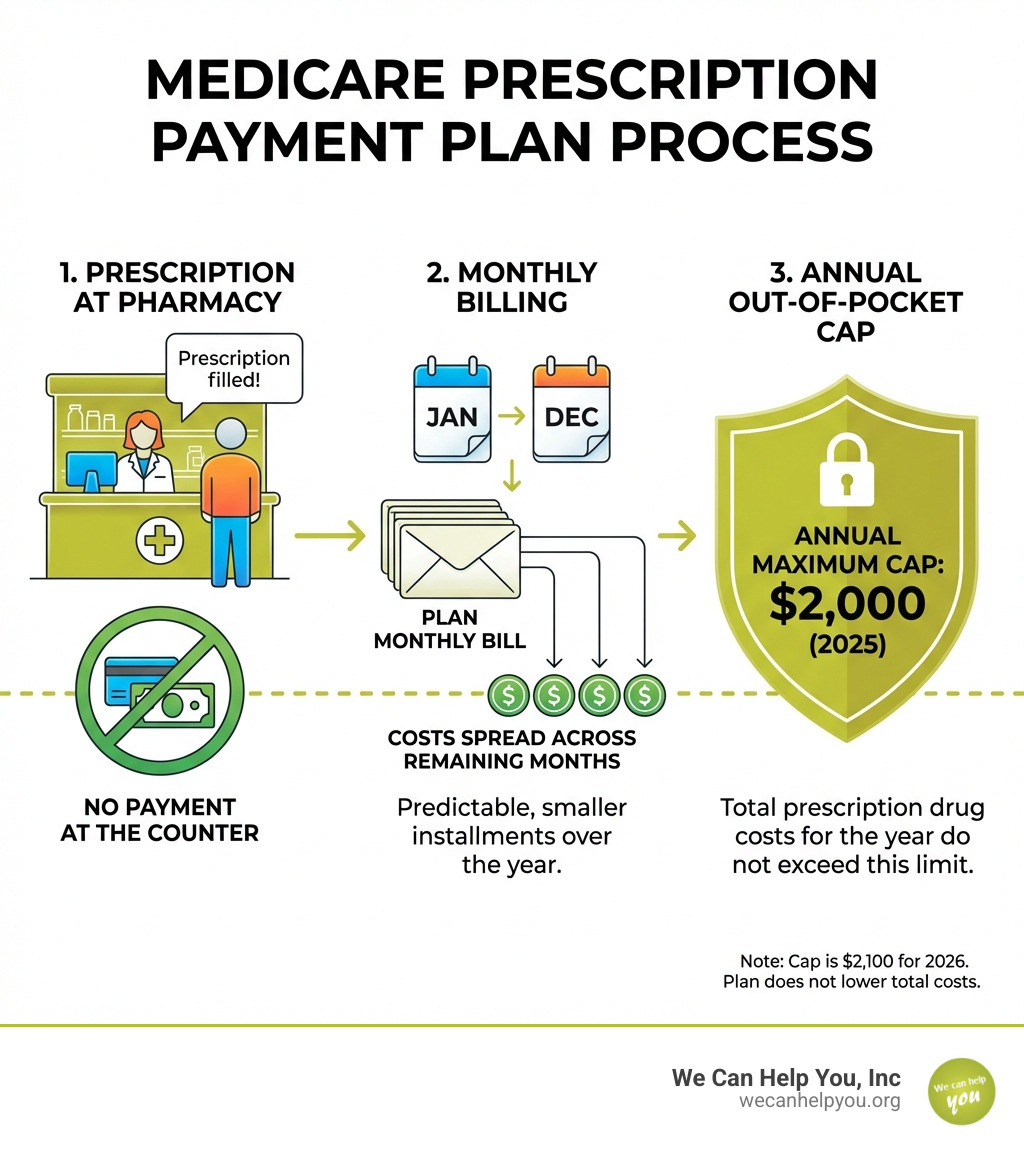
The Medicare Prescription Payment Plan is a new, voluntary payment option starting in 2025 that lets you spread your out-of-pocket prescription drug costs across the year in monthly installments, instead of paying everything upfront at the pharmacy.
Quick Facts About the Medicare Prescription Payment Plan:
- What it is: A budgeting tool that spreads your drug costs over 12 months (January-December)
- Who can use it: Anyone with Medicare Part D or Medicare Advantage with drug coverage
- Cost to join: Free – no fees or interest charges
- What it does: Helps manage monthly expenses by spreading costs evenly
- What it doesn’t do: Lower your total prescription drug costs
- When to enroll: Best to join before or early in the plan year
- Annual cap: Your total out-of-pocket costs still can’t exceed $2,000 (2025) or $2,100 (2026)
If you’re like many Medicare beneficiaries, you’ve probably felt the sting of high prescription costs hitting your wallet all at once. Maybe you picked up a new medication in February and suddenly owed $600 at the pharmacy counter. Or perhaps your drug costs vary wildly from month to month, making it hard to budget.
This is exactly the problem the Medicare Prescription Payment Plan aims to solve. Think of it as a payment plan for your prescriptions – similar to how you might pay off a large purchase over time, except with no interest or fees.
Here’s the catch: This plan doesn’t save you money. It simply spreads out what you already owe. You’ll pay the same total amount by year’s end, just in smaller, more predictable monthly chunks.
Understanding whether this plan fits your situation requires looking at your prescription costs, when you incur them during the year, and how you prefer to manage your budget. Let’s break down exactly how this new option works and who benefits most from it.
What is the Medicare Prescription Payment Plan and How Does It Work?
The Medicare Prescription Payment Plan is a game-changer for how many of us will manage our prescription drug expenses. Starting in 2025, this payment option is designed to work with your current drug coverage to help you manage your out-of-pocket costs for drugs covered by your plan by spreading them across the calendar year (January–December).
It’s a voluntary program, meaning you choose whether or not to participate. There’s no cost to enroll, and you won’t be charged any interest or fees for spreading out your payments. Instead of paying the full amount for your prescriptions at the pharmacy counter, you’ll receive a monthly bill from your health or drug plan. This bill will cover your out-of-pocket prescription drug costs, allowing you to pay them over time. We continue to pay our plan premium (if we have one) separately, and then we’ll get a bill from our health or drug plan specifically for our prescription drugs.
To learn more about the fundamentals of this plan, you can visit What’s the Medicare Prescription Payment Plan?.

Who is Eligible to Participate?
The good news is that this payment option is broadly available. Anyone with a Medicare drug plan or a Medicare health plan with drug coverage (like a Medicare Advantage Plan with drug coverage) can use this payment option. This means if you have:
- A Standalone Medicare Part D Prescription Drug Plan (PDP)
- A Medicare Advantage Plan that includes prescription drug coverage (MA-PD)
All Medicare drug plans and Medicare Advantage Plans with drug coverage are required to offer this payment option. This ensures that a wide range of beneficiaries can take advantage of the program if it suits their financial needs.
How Your Monthly Payment is Calculated
This is where it gets a little interesting, as your monthly bill isn’t a fixed amount. Your monthly bill is based on what you would have paid for any prescriptions you get, plus your previous month’s balance, divided by the number of months left in the year.
For example, if you incur $1,000 in out-of-pocket costs in February and there are 11 months remaining in the year (February through December), your monthly payment would initially be calculated by spreading that $1,000 across those 11 months.
Here’s why your payments might fluctuate:
- New Prescriptions: If you fill a new, expensive prescription later in the year, that cost will be added to your total out-of-pocket amount. Since there are fewer months left to spread that cost, your subsequent monthly payments will likely increase.
- Changing Costs: If your prescription needs change, or the cost of your medications changes, your plan will recalculate your monthly payment to ensure your total out-of-pocket costs are covered by the end of the year.
The key takeaway is that the amount you pay each month will vary throughout the year because you add drug costs during the year, but you have fewer months left to spread those payments across. This ensures that by December 31st, you will have paid your total out-of-pocket costs for the year. For detailed examples of how payments are calculated in different scenarios, we encourage you to See payment examples at Medicare.gov.
Pros and Cons: Is This Payment Plan Right for You?
Deciding whether the Medicare Prescription Payment Plan is right for you involves a careful look at your personal financial situation and prescription drug needs. It’s crucial to remember that this plan is a budgeting tool, not a cost-saving measure. It doesn’t lower your total drug costs; it simply spreads them out.

If you’re someone who faces high upfront costs for medications or finds it challenging to manage unpredictable drug expenses, this plan could offer significant relief. Conversely, if your drug costs are consistently low or you prefer paying as you go, it might not be the best fit.
Key Benefits of Enrolling
The primary advantage of the Medicare Prescription Payment Plan is its ability to smooth out your prescription drug expenses over the year.
- Predictable Monthly Payments (relatively): While your monthly payment might fluctuate with new prescriptions, it provides a more predictable structure than facing large, unexpected bills at the pharmacy. This can make it easier to budget your monthly income.
- Smoothes Out High Costs: For those who incur significant drug costs early in the year, this plan can prevent a large financial hit by spreading those expenses over many months. For instance, if you need an expensive medication in January, the cost can be spread across 12 months, rather than hitting your wallet all at once.
- Avoids Large, Single Payments at the Pharmacy: No more sticker shock at the checkout! Instead of paying hundreds or thousands of dollars for a single fill, you’ll receive a manageable monthly bill.
- Better Cash Flow Management: This plan helps improve your cash flow by eliminating the need for substantial immediate payments for prescriptions, allowing you to allocate your funds more effectively throughout the month.
Potential Drawbacks and Limitations
While beneficial for many, the Medicare Prescription Payment Plan does have certain limitations to consider:
- Doesn’t Lower Total Costs: This is the most important point to remember. The plan does not reduce the overall amount you pay for your prescriptions by the end of the year. It’s purely a payment scheduling tool.
- Monthly Bill Can Change: As we discussed, your monthly payment can fluctuate if you fill new, expensive prescriptions or if your drug costs change, which might make budgeting slightly less precise than a fixed monthly bill.
- Less Beneficial if Enrolling Late in the Year: If you sign up for the plan after September, there are fewer months left in the calendar year to spread your costs. This means your monthly payments could be higher, potentially negating the benefit of spreading out costs.
- May Not Be Ideal for Low or Consistent Drug Costs: If your yearly drug costs are low, or if they are consistent and manageable each month, you might not see a significant benefit from enrolling. The administrative aspect of a separate monthly bill might not be worth it for small, predictable amounts.
Who Should Consider the Medicare Prescription Payment Plan?
We believe this plan is most advantageous for certain beneficiaries:
- Individuals with High Drug Costs Early in the Year: If you anticipate hitting your deductible or facing significant out-of-pocket costs for expensive medications in the first few months of the year, this plan can be incredibly helpful.
- Those with Unpredictable Prescription Needs: If your medication regimen or costs are prone to sudden changes, spreading out potential large bills can provide peace of mind and financial stability.
- Beneficiaries Who Spent Over $2,000 on Drugs in the Prior Year: If you paid over $2,000 in out-of-pocket drug costs in the first nine months of the previous year, you are likely to benefit from this plan’s budgeting capabilities.
- Anyone Who Desires a Structured Budget: If you prefer to have a more predictable monthly expense for your prescriptions, even if the amount varies slightly, this plan offers a structured approach to managing those costs.
Enrollment, Disenrollment, and Plan Management
Participating in the Medicare Prescription Payment Plan requires a few key steps and an understanding of how to manage your enrollment, payments, and any changes that might occur. Your Medicare drug plan or Medicare Advantage plan with drug coverage will provide specific communications about the program, but here’s a general overview.
How and When to Enroll
Enrolling in the Medicare Prescription Payment Plan is a straightforward process, but timing can be important to maximize its benefits.
- Contacting Your Plan: The primary way to enroll is by contacting your health or drug plan directly. You can typically do this by:
- Visiting their website portal and looking for the Medicare Prescription Payment Plan (sometimes called M3P) section.
- Calling the customer service number on your member ID card.
- In some cases, you may be able to print and mail an election form.
- Best Time to Enroll: While you can sign up anytime throughout the year, the best time to join is prior to the plan year or at the beginning of the plan year (January 1st). Enrolling early ensures you have the maximum number of months to spread your out-of-pocket costs, making each monthly payment smaller. If you opt into the plan during the calendar year, your election request will typically be processed quickly, sometimes within 24 hours.
- Annual Opt-In Requirement: You must opt-in each year to the Medicare Prescription Payment Plan, even if you stay with the same plan. Your participation does not automatically roll over.
Managing Payments and Plan Changes
Once enrolled, managing your participation involves understanding how payments work and what happens if your circumstances change.
- Missed Payment Consequences: If you miss a payment, your plan will send you a reminder. If you have not paid your amount owed within two months of the due date, your plan can remove you from the Medicare Prescription Payment Plan. They will send you a notice of disenrollment.
- Grace Period: This two-month window acts as a grace period, giving you time to catch up on your payments before being disenrolled from the payment plan.
- Disenrollment from the Payment Plan: If you are removed due to missed payments, you will revert to paying for your prescriptions at the pharmacy directly.
- Paying the Outstanding Balance: Even if you are disenrolled from the payment plan, you are still required to pay the remaining balance for any drugs you received while participating. Your plan will bill you for this amount, which you can typically pay in installments or all at once.
- Changing Medicare Drug Plans Ends Participation: If you change your Medicare Part D plan or switch to a new Medicare health plan with drug coverage, your participation in the Medicare Prescription Payment Plan will end.
- Re-enrolling with a New Plan: If you wish to continue using the payment plan with your new coverage, you will need to contact your new plan to opt-in again.
How to Opt-Out of the Medicare Prescription Payment Plan
You have the flexibility to leave the Medicare Prescription Payment Plan at any time if you decide it’s no longer the right fit for you.
- Voluntary Disenrollment: You can opt out of the plan at any point during the year.
- Contacting Your Plan: To disenroll, simply contact your health or drug plan (usually by phone or through their member website).
- Paying the Remaining Balance: Just like with involuntary disenrollment, if you leave the plan, you’ll still be responsible for any outstanding balance for drugs you received while participating. Your plan will bill you for this amount.
- Reverting to Paying at the Pharmacy: Once you opt out, you will go back to paying for any future drugs you pick up directly at the pharmacy counter.
Understanding Costs and Financial Assistance
A clear understanding of your overall costs and how the Medicare Prescription Payment Plan interacts with other financial assistance programs is essential. This plan is designed to manage the payment of your out-of-pocket costs, not to reduce them. For official guidance and comprehensive information on the program, we encourage you to visit Official guidance on the program.
Impact on Your Annual Out-of-Pocket Maximum
One of the significant changes coming to Medicare Part D is the cap on out-of-pocket drug costs.
- $2,000 Out-of-Pocket Cap (2025): Starting in 2025, you will never pay more than $2,000 out-of-pocket for covered drugs. This is a significant benefit for many beneficiaries.
- The Cap Applies to Everyone: This out-of-pocket maximum applies to everyone with Medicare drug coverage, regardless of whether you participate in the Medicare Prescription Payment Plan.
- The Payment Plan is a Method to Pay This Cap Over Time: The Medicare Prescription Payment Plan simply provides a way for you to pay that $2,000 (or $2,100 in 2026) throughout the year in monthly installments, rather than in large lump sums.
- It Does Not Change the Maximum: The payment plan does not alter the actual $2,000 (or $2,100 in 2026) out-of-pocket maximum. It only changes how you pay that amount.
Interaction with Other Financial Assistance Programs
Many beneficiaries rely on other programs to help with prescription drug costs. Here’s how the Medicare Prescription Payment Plan generally interacts with these:
| Financial Assistance Program | How it Interacts with the Medicare Prescription Payment Plan PDP log in If you’re a current member, log in to your secure member website to opt in.Does your Aetna® plan have medical and prescription drug coverage? Choose MAPD log in.Does your Aetna plan cover just prescription drugs? Choose PDP log in.MAPD log inPDP log inRather opt in by phone? Call us at the number on… | Program | How it Interacts with the Medicare Prescription Payment Plan | Extra Help (LIS) | Helps with premiums, deductibles, co-pays for prescription medications. | Secondary Insurance (e. Medical, Dental, Vision) | If you have secondary insurance, payments made by that insurance are taken into account before your Part D plan calculates what you will owe through the Medicare Prescription Payment Plan. | Secondary Insurance (e.g., Medical, Dental, Vision) | If you have secondary insurance, payments made by that insurance are taken into account before your Part D plan calculates what you will owe through the Medicare Prescription Payment Plan. This means your monthly payment for the Prescription Payment Plan may be reduced. | | Charitable Foundations | These organizations can provide financial assistance for medication costs. This assistance is typically applied before your Part D plan calculates your out-of-pocket costs, which can reduce the amount you owe to the plan and thus your monthly payment. | Extra Help (LIS) | Helps with premiums, deductibles, co-pays for prescription medications. | Medicare Savings Programs (MSPs) | Help pay for premiums, deductitions, co-insurance, and co-payments. | Manufacturer Patient Assistance Programs (PAPs) | These programs are often offered directly by pharmaceutical companies to help patients access their specific brand-name medications. However, manufacturer PAPs generally operate outside the Medicare Part D benefit and are typically not compatible with the Medicare Prescription Payment Plan. |
Frequently Asked Questions
We know you’ve got questions, and we’re here to help clarify some of the most common ones about the Medicare Prescription Payment Plan.
Does this plan save me money on my prescriptions?
No, this plan does not save you money or lower your total drug costs. It is a budgeting tool designed to help you manage your monthly expenses by spreading out your out-of-pocket costs across the calendar year. Your total annual out-of-pocket costs will remain the same.
What happens if I get a new, expensive prescription mid-year?
If you get a new, expensive prescription mid-year, your plan will recalculate your monthly bill. The cost of this new prescription will be added to your total out-of-pocket amount for the year, and that remaining balance will be spread over the remaining months. This will likely cause your subsequent monthly payment to increase. The goal is to ensure all your out-of-pocket costs are covered by December 31st.
Do I still have to pay my monthly Part D premium?
Yes. The monthly bill you receive for the Medicare Prescription Payment Plan is separate from and in addition to your regular monthly premium for your Medicare drug plan (Part D or Medicare Advantage with drug coverage). You must continue to pay your plan premium each month to maintain your drug coverage. We always recommend paying your plan premium first to avoid losing coverage.
Conclusion: Taking Control of Your Prescription Costs
The Medicare Prescription Payment Plan represents a significant step towards helping Medicare beneficiaries manage their prescription drug expenses more effectively. By allowing us to spread our out-of-pocket costs over the entire year, it transforms potentially daunting upfront payments into manageable monthly installments. While it doesn’t reduce your total annual spending, it offers a valuable budgeting tool, especially for those with high or unpredictable drug costs early in the year.
We encourage you to evaluate your personal prescription needs and financial situation to determine if this voluntary plan is the right choice for you. Understanding how your monthly payments are calculated, the benefits it offers, and its limitations is key to making an informed decision.
At We Can Help You, Inc., we are dedicated to educating individuals on Medicare and Social Security for retirement. We understand that navigating these changes can be complex, and we’re here to provide clear, unbiased information.
If you have more questions or need personalized guidance on how the Medicare Prescription Payment Plan might fit into your overall retirement and healthcare strategy, please reach out to us. We offer a free Medicare Planning Guide and a free Social Security maximization report to help you increase your retirement income.