What Is the Social Security Index Factor Table (And Why It Affects Your Retirement Check)?
The social security index factor table is a chart published by the Social Security Administration (SSA) that shows the multiplier used to adjust your past wages for wage inflation before calculating your benefit.
Here’s the quick answer to how it works:
| Year You Earned the Money | What the Table Does |
|---|---|
| Before age 60 | Multiplies your earnings by an indexing factor > 1.0 |
| Age 60-61 (your “indexing year”) | Factor is 1.0 — no adjustment |
| Age 62 and later | Factor is 1.0 — used at face value |
Key facts at a glance:
- Your year of eligibility (usually the year you turn 62) determines which table applies to you
- Factors are based on the Average Wage Index (AWI) from two years before your eligibility year
- Older earnings get larger multipliers — for example, 1963 wages get a factor of 14.5099735 for someone eligible in 2024
- Earnings are capped at the taxable maximum for each year before the factor is applied
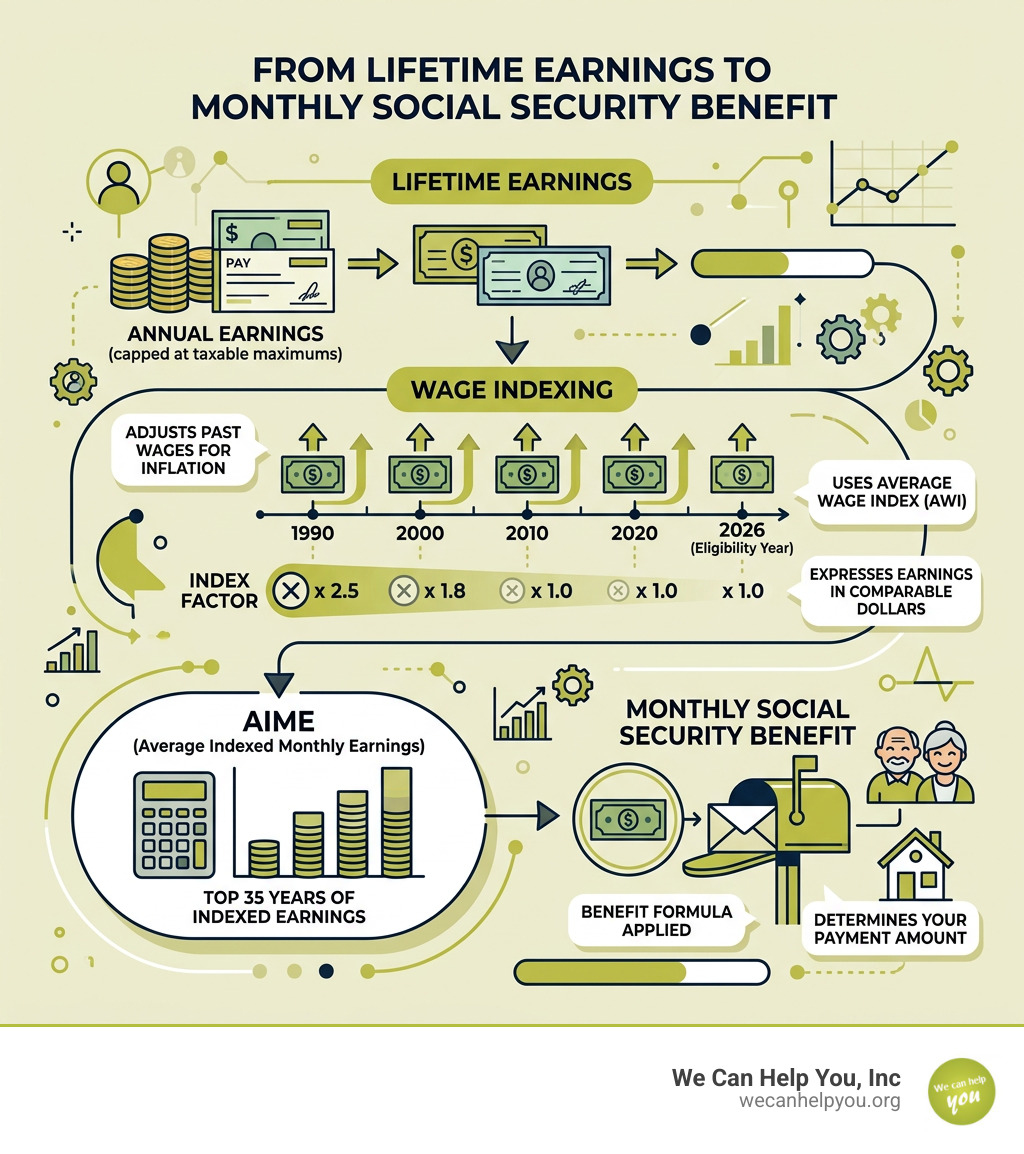
- The goal is to express your lifetime wages in comparable dollars — so a paycheck from 1985 is fairly compared to one from 2015
Think of it this way: $10,000 earned in 1990 simply isn’t worth the same as $10,000 earned today. The index factor table corrects for that. Without it, workers who spent decades in the workforce would get benefits based on outdated, shrunken dollar amounts — and that wouldn’t be fair.
This matters a lot if you’re approaching retirement and trying to understand why your Social Security statement shows higher “indexed earnings” than what you actually remember taking home. That gap isn’t an error — it’s the indexing system doing exactly what it’s designed to do.
Understanding the Social Security Index Factor Table
When we look at our old pay stubs from the 1980s or 90s, the numbers seem tiny compared to today’s salaries. If the Social Security Administration simply added up those raw numbers, your retirement benefit would be shockingly low. To fix this, the SSA uses a social security index factor table to bring those old earnings up to speed with modern wage levels.
This process is the foundation of your average-indexed-monthly-earnings-aime. By applying a specific multiplier to every year of work, the SSA ensures that your “purchasing power” from 30 years ago is accurately reflected in your check today.
Why SSA Uses Indexing Factors
The primary reason for indexing is to maintain a consistent standard of living. Wages tend to grow over time—not just because of individual promotions, but because the economy as a whole experiences wage inflation.
If we didn’t use indexing factors, a worker who earned the maximum taxable amount in 1965 ($4,800) would look like a “low earner” compared to someone earning the minimum wage today. Indexing ensures benefit fairness by treating that 1965 “max earner” with the same weight as a 2024 “max earner.” It effectively translates historical earnings into “today’s dollars.”
The Role of the Average Wage Index (AWI)
The “magic number” behind every indexing factor is the Average Wage Index (AWI). This is a national average of all wages subject to federal income taxes.
Because it takes time for the government to process tax returns and calculate these averages, there is always a two-year lag. For example, if you turn 62 in 2024, your earnings are indexed to the AWI from 2022. This 2022 AWI serves as the “benchmark” or “indexing year” for your entire calculation. The indexing series is essentially a ratio: the AWI of your benchmark year divided by the AWI of the year you actually earned the money.
How the Year of Eligibility Determines Your Factors
One of the most confusing parts of Social Security is that two people who earned the exact same wages might get different benefits if they were born in different years. This happens because your “year of eligibility”—the year you turn 62—dictates which social security index factor table you must use.
For retirement benefits, the SSA looks at the national wage levels in the year you turn 60. This creates a “frozen” set of factors that will follow you for the rest of your life.
Using the Social Security Index Factor Table for 2024 Eligibility
If you turn 62 in 2024, your indexing year is 2022. According to the official Indexing Factors for 2024 Eligibility, the multiplier for 1963 earnings is 14.5099735.
What does that mean in plain English? It means the SSA considers $1.00 earned in 1963 to be worth about $14.51 in today’s terms. If you’re trying to figure out your own numbers, you can follow your-aime-your-future-a-step-by-step-guide-to-calculating-your-average-indexed-monthly-earnings to see how these multipliers apply to your specific work history.
Why Factors Change Every Year
Every year, the SSA releases a new table. If you compare the Indexing Factors for 2020 Eligibility to the 2024 table, you’ll notice the numbers have shifted.
This happens because the “benchmark” AWI moves up as the economy grows. For a 2020 retiree, 1951 earnings were multiplied by 13.5239898. For a 2024 retiree, those same 1951 earnings would use an even higher factor because the 2022 AWI (the new benchmark) is higher than the 2018 AWI (the 2020 benchmark). This constant adjustment accounts for cumulative inflation and ensures that no matter when you retire, your past work is valued correctly relative to the current economy.
Step-by-Step: Manually Calculating Your Indexed Earnings
While the SSA does this automatically, many of our clients at We Can Help You, Inc. like to verify the math. To do this, you need your actual earnings record (found on your Social Security Statement) and the correct social security index factor table.
Here is how a “medium earner” eligible in 2024 might see their earnings adjusted:
| Year | Actual Earnings | Index Factor (for 2024) | Indexed Earnings |
|---|---|---|---|
| 1977 | $9,779 | 6.5233930 | $63,792.26 |
| 1990 | $21,028 | 3.0031802 | $63,150.87 |
| 2005 | $36,953 | 1.7088194 | $63,145.99 |
| 2022 | $63,795 | 1.0531582 | $67,186.23 |
To get your own estimate, dont-guess-calculate-a-guide-to-your-future-social-security-payments is a great resource to ensure you’re using the right starting points.
Applying the Social Security Index Factor Table to Your Earnings Record
When you look at the table, you must remember two critical rules:
- The Earnings Cap: You can only index earnings up to the “Maximum Creditable Earnings” for that year. In 1960, the max was $4,800. Even if you earned $10,000 that year, the SSA only multiplies $4,800 by the factor. For 2024, that cap is $168,600.
- The 35-Year Rule: Social Security takes your 35 highest indexed years. If you worked 40 years, the 5 lowest indexed years are dropped. If you worked fewer than 35 years, the remaining slots are filled with zeros.
Rounding and Precision in SSA Calculations
The SSA is very particular about rounding. When you multiply your actual earnings by the factor (which usually has 7 or 8 decimal places), you must round the result to the nearest cent.
The rule is: look at the third decimal place. If it is 5 or more, round up. If it is 4 or less, drop it. For example, if your calculation results in $3,457.765, it becomes $3,457.77. If it results in $3,457.764, it stays $3,457.76. Manual verification requires this level of precision to match the SSA’s official records.
Why Earnings After Age 60 Aren’t Indexed
A common question we hear is: “I’m still working at 64, why isn’t my 1.0 factor changing?”
The SSA “stops the clock” on indexing in the year you turn 60. This year is used to set the benchmark AWI. Therefore, any money you earn at age 60, 61, 62, and beyond is taken at its nominal value (face value). The multiplier for these years is always 1.0000000.
The “Today’s Dollars” vs. Future Estimates Debate
If you are under age 62, official SSA tools often use the most recent actual indexing factors rather than guessing future ones. This is because future factors are based on estimates from the Trustees Report, which can change.
By using current factors, the SSA shows your benefits in “today’s dollars.” This is actually helpful for planning! It allows you to compare your projected benefit to your current grocery bill or mortgage payment without having to guess what a gallon of milk will cost in 2035. According to Table VI.G6 – Estimated AWI, while future wages will be higher, the “real” value of the benefit aims to stay consistent.
How Post-62 Earnings Can Still Increase Your Benefit
Even though earnings after age 60 aren’t multiplied by a factor, they are still very important. If you earn a high salary at age 65, that “nominal” amount might be higher than one of your “indexed” amounts from your 20s.
If your earnings at age 65 are higher than the lowest of your “top 35” years, the SSA will automatically swap them out. This “replacement year” strategy is one of the best ways to boost your check, especially if you have zero-earning years in your record. You can learn more about building this strategy in your-retirement-roadmap-to-financial-freedom.
Frequently Asked Questions about Indexing Factors
What is the difference between indexing for 2024 vs. 2020?
The main difference is the “benchmark” year. For 2024 eligibility, earnings are indexed to the 2022 Average Wage Index. For 2020 eligibility, they were indexed to the 2018 AWI. Because wages generally go up over time, the 2024 factors are higher than the 2020 factors for the same work years.
Why does the SSA use the AWI from two years prior to my eligibility?
It takes the SSA and the IRS about two years to fully collect, report, and calculate the national average wage from every American’s tax returns. To ensure they are using “real” data rather than guesses, they use the most recent finalized data, which is always from two years prior.
Can I use current indexing factors to estimate my future benefits?
Yes, and most experts recommend it. Using current factors (like the 2024 table) gives you a “today’s dollars” estimate. This helps you understand your future purchasing power. If you used “estimated future factors,” your benefit might look huge (e.g., $5,000 a month), but because of inflation, that $5,000 might only buy what $3,000 buys today.
Conclusion
Understanding the social security index factor table is the first step toward taking control of your retirement planning. It turns a confusing list of old paychecks into a clear picture of your lifetime “AIME.”
At We Can Help You, Inc., we believe no one should have to guess about their financial future. As a non-profit dedicated to retirement education, we offer a free Social Security maximization report to help you identify the best time to claim and how your specific work history impacts your monthly check. Whether you are in Arizona, Florida, New Jersey, or any of our other service locations, we are here to help you navigate the complexities of average-indexed-monthly-earnings-aime and beyond.
Don’t leave your retirement to chance—reach out today for your free analysis and ensure you’re getting every penny you’ve earned!