
Prescription Drug Costs Don’t Have to Break Your Budget
Medicare Part D help is available right now for millions of Americans — and most people don’t know they qualify.
Here’s a quick look at your main options:
| Program | Who It’s For | What It Covers |
|---|---|---|
| Extra Help (LIS) | Limited income/resources | Premiums, deductibles, copays |
| Medicare Savings Programs | Low-to-moderate income | Part B premiums, sometimes more |
| LINET Program | Newly eligible, no plan yet | Temporary drug coverage (up to 2 months) |
| State Pharmaceutical Assistance Programs | Varies by state | Prescription costs |
| Manufacturer Assistance (PAPs) | Uninsured/underinsured | Specific brand-name drugs |
If you do nothing else after reading this, check whether you qualify for Extra Help — a Medicare program worth an estimated $6,200 per year in savings on prescription drug costs.
Prescription drugs are a lifeline for most people on Medicare. But the costs — premiums, deductibles, copays — can add up fast and feel overwhelming, especially on a fixed income.
The good news? Medicare has built-in programs specifically designed to reduce these costs. The challenge is that the system is complicated, and many people miss out on benefits they’re fully entitled to.
“It’s important that all older adults are aware of Extra Help as well as other benefits programs that can help them save money and stay healthy and independent for as long as possible.” — Jen Teague, Director for Health Coverage and Benefits at NCOA
This guide cuts through the complexity. Whether you’re new to Medicare, already enrolled in Part D, or helping a family member navigate their options, you’ll find clear, actionable answers here.
Understanding Medicare Part D Help and the Extra Help Program
When we talk about Medicare Part D help, the heavy hitter is a program officially known as the Low Income Subsidy (LIS), but most of us simply call it “Extra Help.” This program is a joint effort between the Social Security Administration (SSA) and the Centers for Medicare & Medicaid Services (CMS).

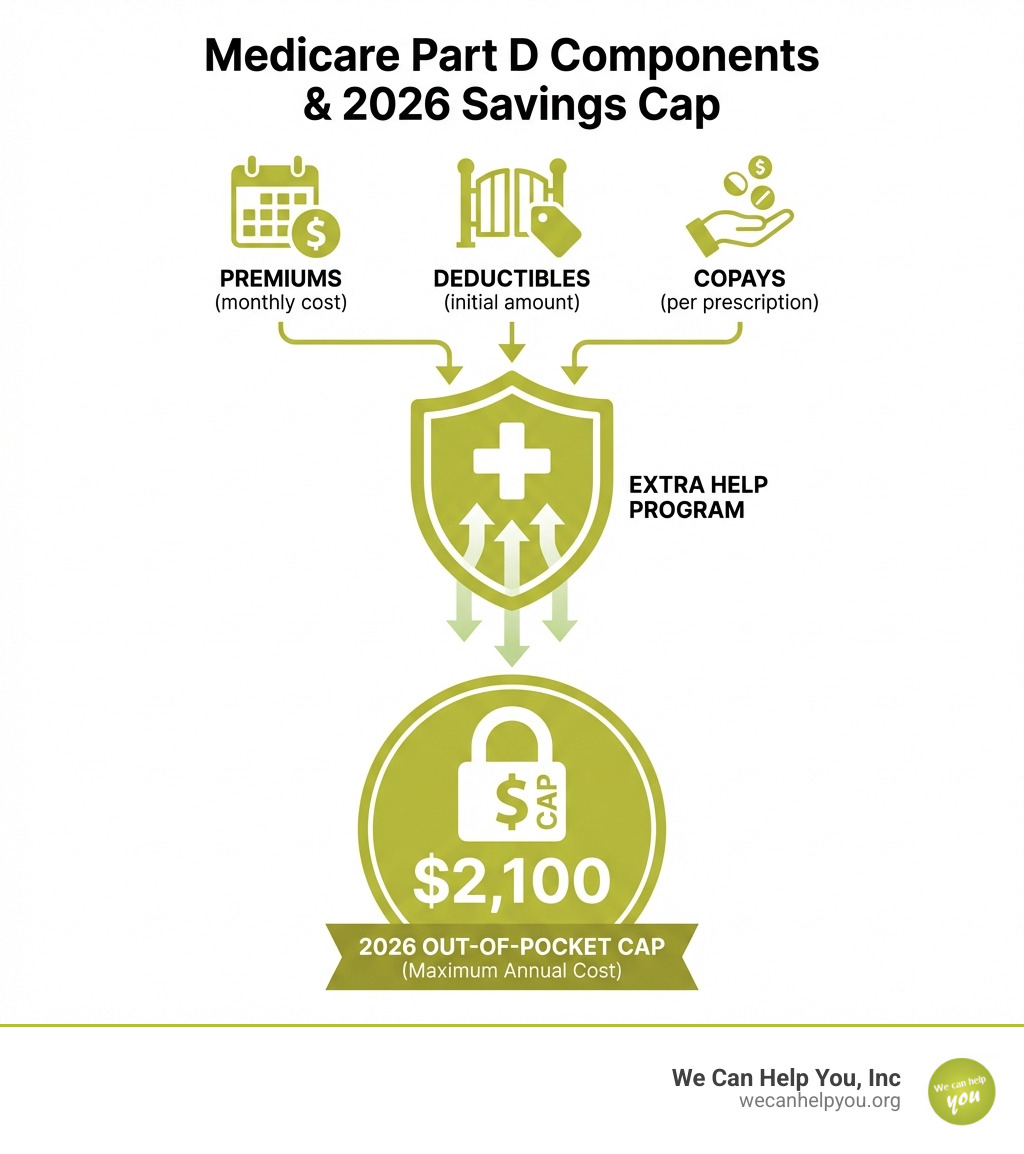
The benefits of Extra Help are substantial. It is designed to assist individuals with limited income and resources in paying for their Part D premiums, annual deductibles, and prescription copayments. For many, this program brings their monthly drug plan premium down to $0 and eliminates the annual deductible entirely.
If you aren’t automatically enrolled (which we’ll cover in a moment), you can Apply for Extra Help through the Social Security Administration at any time—even if you haven’t joined a drug plan yet. To learn more about the various ways to lower your medication expenses, you can explore our guide on help-to-pay-for-prescription-drugs.
Who Qualifies for Medicare Part D Help Automatically?
One of the best features of this program is that many people don’t have to lift a finger to get it. Medicare identifies certain groups who are “deemed” eligible, meaning they are automatically enrolled in Extra Help. You qualify automatically if:
- You have “Full Dual Eligible” status (you have both Medicare and full Medicaid benefits).
- You receive help from your state Medicaid program to pay your Medicare Part B premiums through a Medicare Savings Program (MSP).
- You receive Supplemental Security Income (SSI) benefits from Social Security.
If you fall into any of these categories, you should receive a purple or yellow notice in the mail letting you know you’ve been qualified. If you’re wondering how to trigger these benefits, we have a resource on how to unlock-savings-how-to-get-extra-help-with-your-medicare-prescriptions.
2025 Income and Resource Limits for Medicare Part D Help
If you don’t qualify automatically, you can still apply as long as your income and “resources” (assets like savings and stocks) fall below certain thresholds. For 2025, the limits for most of the continental United States (including states like Florida, Texas, Ohio, and Arizona) are:
- Individual: Annual income limit of $23,475 and resource limit of $17,600.
- Married Couple: Annual income limit of $31,725 and resource limit of $35,130.
“Income” includes things like Social Security benefits, pensions, and wages, while “resources” include money in checking or savings accounts, stocks, and bonds. However, your primary home, one car, and certain burial expenses usually don’t count toward these limits.
If your income is slightly above these limits, we still encourage you to Apply for Medicare Part D Extra Help program because certain expenses can be deducted from your gross income during the calculation.
Maximizing Your Benefits: 2026 Costs and Enrollment Rules
Looking ahead is vital for retirement planning. In 2026, the Extra Help program will continue to provide a massive safety net. For those receiving Medicare Part D help, the standard plan premium and deductible are waived.
The copayment structure for 2026 is designed to be very affordable:
- Generic Drugs: You will pay no more than $5.10 for each covered generic drug.
- Brand-Name Drugs: You will pay no more than $12.65 for brand-name drugs.
Perhaps the most significant change coming is the $2,100 out-of-pocket cap for 2026. Once your total drug costs (including the amounts the Extra Help program pays on your behalf) reach $2,100, you will pay $0 for all covered Part D drugs for the remainder of the year. This provides incredible peace of mind for those with chronic conditions requiring expensive medications.
Avoiding the Part D Late Enrollment Penalty
Medicare Part D is technically optional, but if you go 63 days or more without “creditable” drug coverage (coverage as good as Medicare’s) after your Initial Enrollment Period, you could face a lifetime late enrollment penalty. This penalty is 1% of the national base beneficiary premium for every month you waited.
However, here is a major perk of the Extra Help program: if you qualify for Extra Help, the late enrollment penalty is waived. This means even if you waited years to sign up, once you get Extra Help, you won’t have to pay that extra monthly fee. You can read more about the basics of medicare-part-d to ensure you’re fully covered.
Enrollment Periods and the Medicare Part D Help You Need
Timing is everything in Medicare. Usually, you can only join or switch plans during the Annual Enrollment Period (October 15 – December 7). But if you have Extra Help, you get a “Special Enrollment Period” (SEP).
Starting in 2025, individuals with Extra Help or Medicaid can switch their Part D plan once per month during the first three quarters of the year. This flexibility allows you to move to a plan that better covers your specific medications if your needs change. Staying informed about changes-to-part-d-for-2025 is key to making the most of these rules.
Troubleshooting and Temporary Coverage Solutions
Sometimes, the system glitches. You might walk into a pharmacy and be told you owe $50 for a drug that should cost $5.10. Don’t panic—this often happens when a plan hasn’t updated its records to show you have Extra Help.
If you believe you’re paying the wrong amount, you can provide “Best Available Evidence” (like a Medicaid card or an SSA award letter) to your pharmacy or plan. You can also contact your local State Health Insurance Assistance Program (SHIP) for free, unbiased help in resolving these billing disputes.
The LINET Program for Immediate Coverage
What if you just qualified for Medicare and Medicaid, but you haven’t picked a drug plan yet? This is where the Limited Income Newly Eligible Transition (LINET) Program comes in.
LINET provides immediate, temporary drug coverage (usually up to two months) for low-income seniors who aren’t yet enrolled in a Part D plan. It has no pharmacy network restrictions, meaning you can use it at almost any pharmacy. You can Learn more about LINET or check the official Limited Income Newly Eligible Transition (LINET) Program page for details on how to get reimbursed for drugs you paid for out-of-pocket while you were eligible but not yet enrolled.
How Medicare Savings Programs (MSPs) Interact with Extra Help
Medicare Savings Programs (MSPs) are state-run programs that help pay for Medicare Part B premiums and, in some cases, Part A and B deductibles and coinsurance. There are three main types:
- QMB (Qualified Medicare Beneficiary): Pays Part B premiums and most out-of-pocket costs.
- SLMB (Specified Low-Income Medicare Beneficiary): Pays Part B premiums.
- QI (Qualified Individual): Pays Part B premiums.
The beautiful thing is that if you qualify for any of these MSPs, you are automatically enrolled in the Extra Help program. This “dual enrollment” is a powerful form of prescription-drug-assistance that can save you thousands of dollars annually.
Additional Strategies to Lower Prescription Drug Costs
Even if you don’t qualify for Extra Help, there are several other ways we can help you find savings. Many states offer their own programs to fill the gaps.
| Strategy | Benefit | How it Works |
|---|---|---|
| SPAPs | State-funded aid | States like New York or New Jersey offer extra help for seniors with moderate incomes. |
| Generic Alternatives | Lower copays | Ask your doctor if a generic version or a “therapeutic alternative” exists. |
| Mail-Order | Convenience & Price | Many plans offer 90-day supplies for the price of 60 days via mail. |
| PAPs | Brand-name help | Drug manufacturers often have programs for people who don’t qualify for government aid. |
We also recommend understanding-the-medicare-prescription-payment-plan, a new option for 2025 that allows you to spread your out-of-pocket costs over the course of the year rather than paying a large amount all at once at the pharmacy.
Free Resources and Professional Medicare Part D Help
You don’t have to navigate this alone. There are several places to get free Medicare Part D help:
- 1-800-MEDICARE: Available 24/7 to answer questions about your specific plan.
- SHIP (State Health Insurance Assistance Program): Provides one-on-one counseling. You can find your local office at State Health Insurance Assistance Program (SHIP).
- BenefitsCheckUp: A tool by the NCOA that helps you find every program you might be eligible for.
- Medicare.gov: The official site to compare medicare-rx-plans and see which one covers your specific drugs at the lowest cost.
Frequently Asked Questions about Medicare Part D Help
What happens if I qualify for Extra Help—will I be automatically enrolled in a Part D plan?
Yes, if you qualify for Extra Help and don’t already have a Part D plan, Medicare may automatically enroll you in one. These are typically “benchmark” plans that have premiums covered entirely by the subsidy. However, you can always switch to a different plan if the one they chose doesn’t cover your specific medications well. You can verify your status with the Social Security Administration.
What should I do if I’m paying the wrong amount for prescriptions with Extra Help?
First, keep your receipts! Contact your drug plan immediately and provide proof of your Extra Help status. If the plan doesn’t fix it, call 1-800-MEDICARE or visit Medicare.gov to speak with a representative. They can help ensure your “Best Available Evidence” is processed so you pay the correct, lower amount.
Are there other ways to lower prescription drug costs if I don’t qualify for Extra Help?
Absolutely. We often suggest looking into Patient Assistance Programs (PAPs) offered by drug manufacturers. Additionally, your doctor may be able to prescribe a “therapeutic alternative”—a different drug that treats the same condition but is on a lower, cheaper tier of your plan’s formulary. To understand why these costs vary so much, check out our article on why-prescription-drug-costs-are-climbing-and-how-you-can-fight-back.
Conclusion
At We Can Help You, Inc., we believe that no one should have to choose between buying groceries and buying their life-saving medication. Navigating Medicare Part D help is a critical part of a successful retirement strategy.
As a non-profit dedicated to retirement education, we want to empower you with the right tools. We invite you to take advantage of our free Medicare Planning Guide and our Social Security maximization report, both designed to help you increase your retirement income and decrease your healthcare stress.
Whether you live in New Mexico, North Carolina, Illinois, or any of our other service areas, we are here to support your journey. Explore Medicare Part D Savings with us today and take the first step toward a more affordable retirement.